by in News

North Seas region signs landmark offshore wind deal

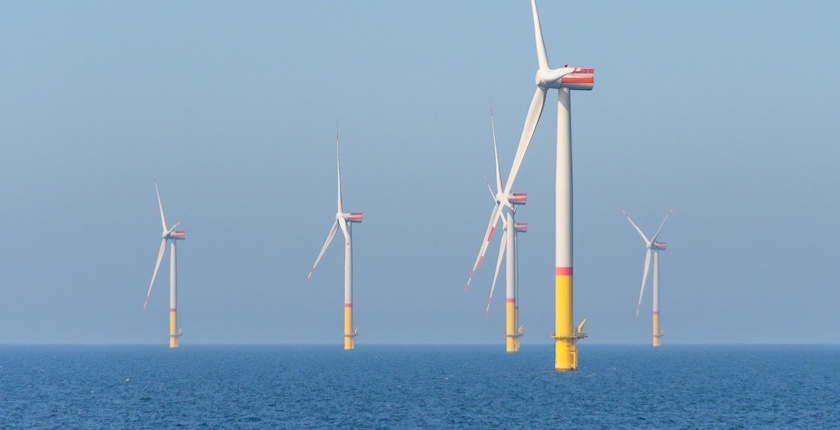
Seven heads of state and government and energy ministers of nine countries gathered in Hamburg today to boost the expansion of offshore wind. Together with industry and transmission system operators, the countries launched the Offshore Wind Investment Pact for the North Seas. They envisage cross-border projects totaling 100 GW.

Nine European countries committed to building 15 GW of offshore wind per year over 2031-2040 and derisking offshore wind investments. The industry, in return, pledged cost reductions, 91,000 additional jobs and EUR 1 trillion of economic activity.

Europe is charting the massive offshore wind buildout it needs to deliver on its energy security and competitiveness objectives, WindEurope said.

At the North Sea Summit in Hamburg today, Belgium, Denmark, France, Germany, Ireland, Luxembourg, the Netherlands, Norway and the United Kingdom confirmed their ambition to build 300 GW of offshore wind in the so-called North Seas by 2050.

Over one hundred companies participate in offshore wind pact

Governments, the wind industry and transmission system operators (TSOs) signed the Offshore Wind Investment Pact for the North Seas. The agreement is underpinned by separate declarations of the heads of state, energy ministers and the industry. The last of the three is an undertaking by more than 100 offshore wind companies across the value chain, the update adds.

Offshore wind has been a European success story with 37 GW installed across 13 countries, WindEurope stressed.

“That’s more than 6,000 turbines providing homegrown, clean and competitive electricity at scale. But deployment has been dragged by suboptimal auction design, increased costs of capital and lack of visibility for the supply chain due to an uncertain project pipeline,” the organization pointed out.

Two-sided CfDs to be auction standard

In the Investment Pact, governments pledge to provide planning and investment security and derisk offshore wind projects. It involves two-sided contracts for difference (CfDs) as the standard for offshore wind auction design, for visibility on revenue. The countries agreed to remove any regulatory obstacles to power purchase agreements (PPAs) – direct agreements between electricity producers and corporate end-consumers.

A steady pipeline of offshore wind projects will bring the needed confidence to invest in new capacity for manufacturing, ports infrastructure and vessels, according to WindEurope.

In return, Europe’s offshore wind industry pledges to drive down costs of offshore wind by 30% towards 2040 against the 2025 levels. The cost reduction would be driven by scale effects, lower costs of capital and further industrialization underpinned by clarity and visibility on the project pipeline.

The industry vowed to create lasting value for the economy, communities and consumers. It also said it would invest EUR 9.5 billion in the value chain including manufacturing, port infrastructure and vessels.

The TSOs intend to identify cost-effective cooperation opportunities and 20 GW of economically promising cross-border endeavors by 2027 for deployment in the 2030s. It includes offshore projects with interconnections to more than one country. The operators are about to develop cost-sharing principles.

The new partnership will secure 100 GW of joint offshore wind projects, Britain said.
by in News

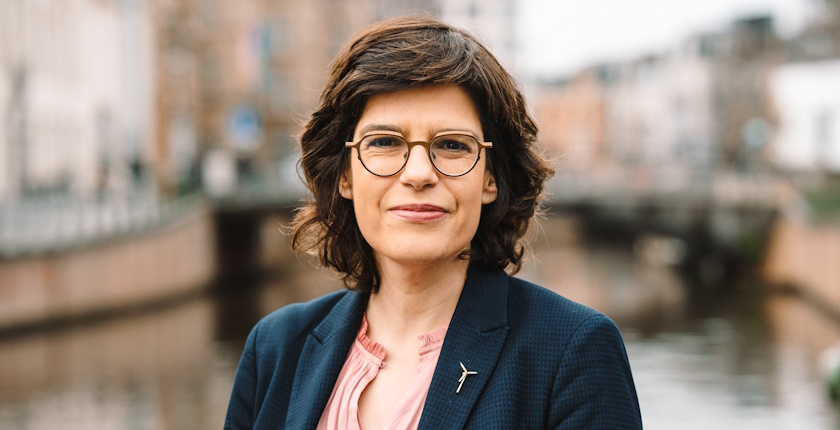
Belgium’s former Ministry of Energy Tinne Van der Straeten to become CEO of WindEurope next month

WindEurope’s new Chief Executive Officer Tinne Van der Straeten, member of the Chamber of Representatives of the Federal Parliament of Belgium and the country’s former minister of energy, will assume office on February 2. She is replacing Giles Dickson. The EU added 13 GW of wind capacity in 2025, less than half of what it requires.

WindEurope appointed Tinne Van der Straeten as its new CEO, effective on February 2. The organization pointed out that Belgium’s former minister of energy, from 2020 to 2025, is taking the helm at a critical time for Europe’s energy security, industrial competitiveness and climate commitments.

Tinne Van der Straeten oversaw Belgium’s wind energy expansion, including a broad consensus on Belgium’s response to the energy crisis in 2022, the announcement adds. She chaired the North Seas Energy Cooperation in 2020 and at the start of 2025 and the European Energy Council in 2024, and vice-chaired the ministerial meeting of the International Energy Agency (IEA) in 2022.

Most recently, the former minister served as a member of the Chamber of Representatives of the Federal Parliament of Belgium. She is a member of the Flemish Green Party – Groen.

Wind energy is central to Europe’s energy independence

Van der Straeten said she would take on her new responsibility with determination at a defining moment for Europe.

“Wind energy is central to Europe’s energy independence, industrial competitiveness and climate ambitions. Wind is a home-grown and scalable technology. It delivers affordable power, strengthens energy independence and sustains a competitive industrial base with high-quality jobs across Europe,” the incoming chief said.

Former CEO Giles Dickson served ten years

WindEurope’s Chairman Henrik Andersen praised Tinne Van der Straeten for passionately ensuring wind was kept high on the political agenda in her home country of Belgium and across the European Union.

“She has collaborated across industry and government to shape energy policy and build positive long-term investment frameworks that enable sustainable wind deployment. I look forward to working with Tinne as she leads WindEurope forward and supports Europe’s journey to a more competitive, homegrown energy system together with its members,” he stated.

The WindEurope Board thanked former CEO Giles Dickson for his 10 years of leadership and contribution to Europe’s wind industry.

Affordability, competitiveness, security

Van der Straeten will focus on ensuring Europe gets the most from wind to deliver affordability, industrial competitiveness and energy security, the organization said.

Faced with mounting geopolitical challenges, the continent must shake its dependence on imported fossil fuels, WindEurope stressed.

“Wind is uniquely placed to deliver that. A renewables-based energy system, with wind at its core, will save Europe up to EUR 1.6 trillion, even when counting the grid and backup costs. To reap these benefits, Europe must deliver on the Clean Industrial Deal, accelerate the buildout of homegrown and competitive renewables and ramp up the electrification of its economy,” the update reads.

Today wind energy generates 20% of all electricity consumed in Europe. With the right policies, the level will rise to 34% by 2030 and more than 50% by 2050, WindEurope estimated.

The EU installed 13 GW of new capacity in 2025. It is less than half of what Europe needs to deliver its 2030 energy security and climate targets.

“The wind sector is at a turning point. The industry is ready to accelerate and to provide more than 600,000 jobs by 2030. But it is held back by permitting issues and infrastructure delays,” said Tinne Van der Straeten.

by in News

Belgium’s former Ministry of Energy Tinne Van der Straeten to become CEO of WindEurope next month

WindEurope’s new Chief Executive Officer Tinne Van der Straeten, member of the Chamber of Representatives of the Federal Parliament of Belgium and the country’s former minister of energy, will assume office on February 2. She is replacing Giles Dickson. The EU added 13 GW of wind capacity in 2025, less than half of what it requires.

WindEurope appointed Tinne Van der Straeten as its new CEO, effective on February 2. The organization pointed out that Belgium’s former minister of energy, from 2020 to 2025, is taking the helm at a critical time for Europe’s energy security, industrial competitiveness and climate commitments.

Tinne Van der Straeten oversaw Belgium’s wind energy expansion, including a broad consensus on Belgium’s response to the energy crisis in 2022, the announcement adds. She chaired the North Seas Energy Cooperation in 2020 and at the start of 2025 and the European Energy Council in 2024, and vice-chaired the ministerial meeting of the International Energy Agency (IEA) in 2022.

Most recently, the former minister served as a member of the Chamber of Representatives of the Federal Parliament of Belgium. She is a member of the Flemish Green Party – Groen.

Wind energy is central to Europe’s energy independence

Van der Straeten said she would take on her new responsibility with determination at a defining moment for Europe.

“Wind energy is central to Europe’s energy independence, industrial competitiveness and climate ambitions. Wind is a home-grown and scalable technology. It delivers affordable power, strengthens energy independence and sustains a competitive industrial base with high-quality jobs across Europe,” the incoming chief said.

Former CEO Giles Dickson served ten years

WindEurope’s Chairman Henrik Andersen praised Tinne Van der Straeten for passionately ensuring wind was kept high on the political agenda in her home country of Belgium and across the European Union.

“She has collaborated across industry and government to shape energy policy and build positive long-term investment frameworks that enable sustainable wind deployment. I look forward to working with Tinne as she leads WindEurope forward and supports Europe’s journey to a more competitive, homegrown energy system together with its members,” he stated.

The WindEurope Board thanked former CEO Giles Dickson for his 10 years of leadership and contribution to Europe’s wind industry.

Affordability, competitiveness, security

Van der Straeten will focus on ensuring Europe gets the most from wind to deliver affordability, industrial competitiveness and energy security, the organization said.

Faced with mounting geopolitical challenges, the continent must shake its dependence on imported fossil fuels, WindEurope stressed.

“Wind is uniquely placed to deliver that. A renewables-based energy system, with wind at its core, will save Europe up to EUR 1.6 trillion, even when counting the grid and backup costs. To reap these benefits, Europe must deliver on the Clean Industrial Deal, accelerate the buildout of homegrown and competitive renewables and ramp up the electrification of its economy,” the update reads.

Today wind energy generates 20% of all electricity consumed in Europe. With the right policies, the level will rise to 34% by 2030 and more than 50% by 2050, WindEurope estimated.

The EU installed 13 GW of new capacity in 2025. It is less than half of what Europe needs to deliver its 2030 energy security and climate targets.

“The wind sector is at a turning point. The industry is ready to accelerate and to provide more than 600,000 jobs by 2030. But it is held back by permitting issues and infrastructure delays,” said Tinne Van der Straeten.

by in News

Energy system based on renewables is cheapest solution to achieve net zero by 2050 – study

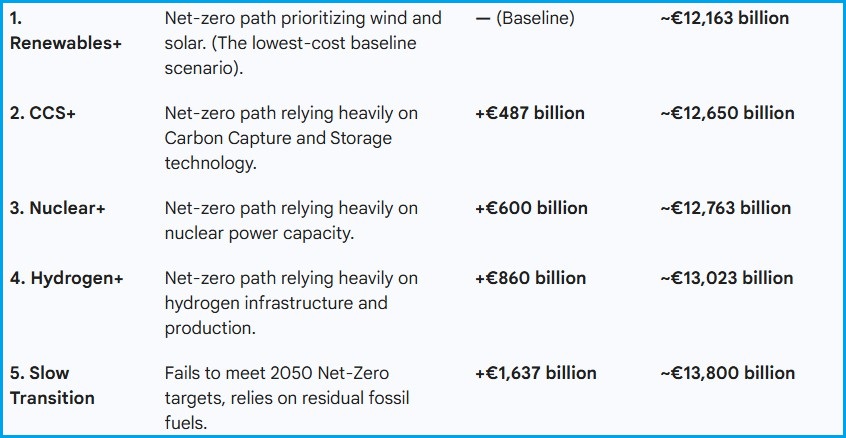
A European energy system based on a high share of renewable energy is the cheapest scenario until 2050 for achieving the net-zero goal, when compared to an increased use of nuclear capacity, or hydrogen, or carbon capture and storage, and against a delayed energy transition, according to a study produced by Hitachi Energy for WindEurope.

Costs for each scenario include not only generation facilities, but investments in grids, storage and back-up systems, according to WindEurope.

The study has mapped out the total system costs of five energy scenarios. Four scenarios deliver net zero and the remaining one is for a slow transition, where Europe doesn’t meet its climate targets, wind power advocacy group said.

The difference between the cheapest net zero path (Renewables+) and the most expensive path (Slow Transition) is EUR 1.64 trillion, the study reveals.

eu energy system 2050 scenarios costs hitachi study

The study’s authors calculated the total societal cost of building, operating, and adapting to the required energy system across electricity, transport, heat, and industry to meet or fall short of the 2050 climate targets.

The total system costs have three major groups of expenses.

The first group are new infrastructure investments in generation assets, as well as in grid, hydrogen, storage and carbon capture and storage (CCS) infrastructure.

Operational expenses are represented by fuel and CO2 costs, while the third group are electrification and demand shift costs.

The Renewables+ scenario drastically lowers import dependency

The Renewables+ scenario achieves net zero by 2050 through a massive deployment of variable renewable energy, primarily wind and solar power, leading to high electrification across the energy mix.

The renewables share reaches 85% of total electricity and nearly 70% of total gross available energy. Dependency on imported energy fuels falls drastically from 71% in 2030 to just 22% in 2050, the report reads.

“As Europe looks ahead to 2050, it is revealing to think what our energy system looked like 25 years ago. Back in 2000 the share of wind and solar in Europe’s electricity was a combined 0.8%. It’s 30% today. And Europe’s emissions are down by nearly 1/3 compared to 2000 while the economy has grown 45%. Let’s build on this success,” WindEurope stressed.

It is an inception report for the Energy System Costs Study, a project commissioned by WindEurope.

by in News

RE-Source Platform: Number of PPAs in Europe drops by 60%

The number of power purchase agreements in Europe decreased by 60% compared to the same period last year, while contracted capacity has dropped by 40%, according to RE-Source Platform.

Europe’s power purchase agreement (PPA) market is facing headwinds in grid development, permitting and electrification and from negative electricity prices, RE-Source Platform warned.

RE-Source Platform facilitates corporate renewable energy sourcing in Europe. It was founded by WindEurope, SolarPower Europe, Climate Group RE100, and World Business Council for Sustainable Development, and steered by a group of corporate buyers and developers.

There are four main problems

“This slowdown is very paradoxical. Europe has no path to energy security and competitiveness unless it electrifies its economy – shielding itself from energy shocks and leveraging large scale deployment of wind and solar energy. But the market is facing headwinds,” the update reads.

The platform identified four main problems.

Europe is not expanding its grid infrastructure quickly enough. The main bottleneck is grid permitting with hundreds of gigawatts of projects awaiting grid connection.

The permitting process for renewables remains too slow. The Renewable Energy Directive has set permitting rules for acceleration, but EU member states have not implemented them.

The Clean Industrial Deal rightly names PPAs as a key solution

Direct electrification is the cheapest and most efficient way to decarbonize. It could also improve competitiveness and energy security, however Europe’s electrification rates are stagnating.

The increase of the negative price hours is making PPA negotiations harder. The way out are energy storage solutions.

The platform stressed the importance of PPAs.

“The Clean Industrial Deal rightly names PPAs as a key solution. Without them, we risk losing industrial competitiveness – and missing our climate targets. PPAs are a cornerstone of Europe’s industrial decarbonization,” the platform added.

They also give companies price certainty, help new wind and solar projects get financed and cut buyers’ exposure to volatile energy markets, according to the update.

by in News

WindEurope to Greece: Accelerate licensing, reintroduce wind energy auctions

WindEurope has advice for Greece to accelerate wind power installations, given the country’s sluggish performance.

WindEurope expects Greece to add 300 MW of wind capacity in 2025, after 152 MW came online in the first six months. It is an improvement from the mere 108 MW of the entire 2024, but still far below previous years. For example, in 2023, the country added 544 MW of wind power. WindEurope’s Director of Advocacy and Messaging Viktoriya Kerelska has suggested solutions to increase the pace.

Greece needs to integrate the latest version of the European Union’s Renewable Energy Directive – RED3 – to facilitate faster and simpler licensing, she said at the Renewable and Storage Forum in Athens.

Other member states are behind schedule with the legislation as well. The European Commission opened infringement procedures in July by sending letters of formal notice to 26 of them – all except Denmark.

Kerelska: Do it like Germany

Furthermore, WindEurope believes that the concept of superior national interest must be applied in Greece, according to Kerelska.

Based on European law, it would allow easier wind farm deployment, while overriding unjustified public reactions that delay the process.

Kerelska added that Germany already applied the principle with great success.

Power purchase agreements (PPAs) are underutilized in Greece.

Therefore, the country should reintroduce wind power auctions, which it held until 2022, for support under contracts for difference (CfDs), according to the association.

One last issue is the delay in the national offshore wind program, which the government has not submitted yet to parliament for adoption, Kerelska noted.

HWEA: Time is running out

Easy times for renewable energy are over, Chairman of the Hellenic Wind Energy Association (HWEA or ELETAEN) Panagiotis Ladakakos said. The sector faces difficult decisions and potential hidden costs, while time is running out to make changes in the regulatory and legal framework, he claimed.

HWEA called on the government to introduce a curtailment allocation mechanism within which curtailed energy would be calculated. Namely, the cuts are not spread evenly, and wind farms connected to the transmission network suffer higher costs. The government has promised to introduce a mechanism by the end of 2025.

The organization said energy storage facilities should be able to have joint grid connection points with renewable energy plants. It referred to projects where the battery’s capability or operating power can be as high as the installed capacity for electricity production.

HWEA added that Greece requires to enact its national offshore wind plan and a special purpose vehicle (SPV) to carry out offshore studies. Moreover, it urged for the development of a new renewable energy spatial plan and more incentives for consumers in areas hosting renewable energy plants.

by in News

RES Croatia to Brussels: Renewables have no future in Croatia

RES Croatia, together with SolarPower Europe and WindEurope, has sent a letter to the European Commission to raise concerns about the crisis in Croatia’s renewable energy sector.

The three associations emphasized that for several years, 60 projects for investments in solar, wind, geothermal, and batteries have been blocked, and that if nothing is done, many of them would soon be abandoned.

Without urgent deblocking of renewable energy projects, Croatia will lose investments, increase fossil fuel imports, which already exceed 25%, and miss the European Union’s and national target of at least 42.5% of energy consumption coming from renewables by 2030, according to Renewable Energy Sources of Croatia (RES Croatia), SolarPower Europe and WindEurope.

The national organization warned that the government is gradually phasing out subsidies for electricity prices for citizens and entrepreneurs. At the same time, the development of renewable energy sources as the only sustainable solution for lower bills and lowering imports is at a complete standstill, it added.

Projects with a total capacity of 3.5 GW and investments of EUR 3 billion are blocked

Croatia is currently subject to infringement proceedings due to delays in implementing the European Union’s RED II and RED III directive. They aren’t just a piece of paper, but a mechanism to ensure energy security and independence, which is of strategic interest for Croatia and its citizens, RES Croatia underscored.

The organizations are urging the European Commission to use its tools to demand from the government to determine the grid connection fee, but at EUR 0 per kWh, open up the balancing market for renewable energy producers, and integrate battery energy storage systems (BESS) and electrification into national planning.

Currently, 60 projects for solar power plants, wind farms, geothermal power plants, and batteries with a total capacity of 3.5 GW and investments of EUR 3 billion are blocked, according to the letter, accompanied by an annex.

The domestic industry is unable to sign long-term PPAs

For these projects, the state has already charged EUR 25 million through energy approvals— the first in a series of documents that requires payment to the state, which, due to the blockage, are beginning to expire at the end of this year.

Organizations stressed that these projects are permanently losing the paid money, while local communities are losing significant revenues that would have been allocated to them from the implementation of renewable energy projects.

They also drew attention to the domestic industry’s inability to sign long-term power purchase agreements (PPAs) with renewable energy producers, securing more favorable market conditions and thereby increasing its competitiveness in European and global markets.

Of note, the European Commission advised Croatia in June to speed up the installation of renewable energy capacities.

If nothing is done, projects of as much as 2.5 GW overall will be abandoned as early as next week

The associations pointed out that the development of new projects larger than 10 MW has stalled since 2022 because the Croatian Energy Regulatory Agency (HERA) has not set a transmission network connection fee for renewable power plants.

Instead, they added, Croatia’s transmission system operator (TSO) HOPS is trying to shift the costs of network modernization – planned over ten years ago and not related to new projects – to new renewable energy projects.

The minister of economy said in March that the upcoming connection fee would be EUR 0 per kW

It is increasing the project cost by 30% to 40%, making them unprofitable, RES Croatia said.

Such a model for financing the network is not from European practice, because 80% of member states rely on EU funds and their national budgets, rather than on producers.

They also recalled that the minister of economy announced in March that a connection fee would be set at EUR 0 per kW and that developers would be offered flexible contracts to encourage investment in battery storage. But that promise has not yet been fulfilled.

The three organizations warn that if nothing is done, projects of up to 2.5 GW altogether would be abandoned as early as next week after HOPS’s decision,. It means companies would withdraw from the Croatian market and lose millions in investments that would have permanently lowered energy prices in the country, RES Croatia claimed.

The balancing market is not functional

An additional problem is the non-functional balancing market, according to the letter.

HEP Proizvodnja, a subsidiary of state-owned utility Hrvatska Elektroprivreda (HEP), is the dominant provider of balancing services, and often the only one. HOPS is legally obliged to ensure market-based procurement of these services, yet it is itself a wholly owned subsidiary of HEP.

It creates an obvious conflict of interest and undermines market competition, the signatories underlined.

“Despite the demonstrated technical ability of solar and wind power plants to provide balancing services, HOPS doesn’t allow these plants to participate in balancing markets. As a result, HOPS frequently activates extremely expensive balancing resources, often at maximum regulated prices even during hours of high renewable generation and positive market prices,” the letter reads.

Croatia has no serious electrification plan

The organizations pointed out that such pricing constitutes a clear violation of the EU principle that balancing services must reflect only the actual costs incurred by the TSO.

They also stressed that Croatia lacks a concrete electrification plan. In 2022, renewable energy accounted for only 2.4% of final energy consumption in transport, with electricity from renewables contributing just 0.2%.

The target for renewable electricity in transport by 2030 is only 5.8%, reflecting limited ambition compared to the EU ambitions, according to the letter.

Electrification of railways could significantly reduce emissions and accelerate the transition, however, it remains an untapped potential, the signatories organizations noted.

by in News

Europe’s wind installations in H1 2025 insufficient to meet EU’s 2030 targets – WindEurope

Europe installed 6.8 GW of new wind farms in the first six months of the year. According to WindEurope, it isn’t nearly enough to deliver the EU’s 2030 energy security and climate targets.

WindEurope has also reduced the 2025 outlook for wind investments. In its latest wind energy data for Europe, the organization highlighted the increase in turbine orders and investments as positive signals.

Out of 6.8 GW of new wind, 5.3 GW was in the European Union, and 89% was onshore wind. Europe now has a total of 291 GW of wind capacity – 254 GW on land and 37 GW at sea, according to the data.

In the first half of 2024, Europe installed 6.4 GW. To achieve the 2030 targets, the EU needs to install about 30 GW of wind power every year.

Germany is by far the most successful country in Europe. It is set to install 5 GW of onshore wind this year, nearly three times as much as it has been building over the last five years. WindEurope attributed the success to the fact that the country was the first to rigorously implement the EU’s excellent new permitting rules.

Germany permitted a record 15 GW of new onshore wind farms in 2024 and is on track to beat that in 2025, with 8 GW of onshore wind permits granted in the first half of 2025, the report revealed.

While on average German authorities grant permits within 18 months, none of the other 26 EU countries permits new wind farms within the REDIII deadline of 24 months. WindEurope highlighted slow expansion of electricity grids, stagnating efforts to electrify Europe’s economy, and suboptimal auction design as key obstacles for faster wind deployment.

Dickson: Governments must get their act together on wind energy

WindEurope CEO Giles Dickson said that governments must get their act together on wind energy.

“Wind is competitive – it brings down electricity costs for citizens and businesses. Wind is secure – home-grown wind turbines reduce costly and dangerous dependencies on fossil fuel imports. And wind is good for the economy – it creates jobs and tax income. Around 400,000 people in Europe work in wind already, and each new wind turbine contributes €16m to Europe’s GDP. But Governments are still failing to get wind permitted and built fast enough,” Dickson noted.

The organization stressed that Europe will build less new wind capacity in 2025 than it previously expected. At the start of the year, WindEurope estimated new wind installations at 22.5 GW, and now at 19 GW. The forecast for the EU is lowered from 17 GW to 14.5 GW.

It expects the EU to have 344 GW of wind energy capacity by 2030, compared to the 2030 target of 425 GW.

Two bright spots

Two bright spots are wind turbine orders and investments in new wind farms. Europe took EUR 34 billion worth of final investment decisions (FIDs) in new wind farms with a total capacity of 14 GW in the first half of 2025. It represented more than the total FIDs in 2024.

The majority of investments are for offshore wind, with six new projects, three of which in Poland, including the country’s largest-ever private investment, according to WindEurope.

Wind turbine orders have increased 19% and reached 11.3 GW.

According to Dickson, less new wind is bad news for Europe’s wider competitiveness. Industry in Europe is craving cheap electricity to compete with China and the US, he stressed.

“But too many governments remain half-hearted in their expansion of wind. This is not only threatening the wind sector. It’s also jeopardizing jobs and growth more widely – in steel, chemicals, and ICT. Doing business in Europe is so much harder for them if the EU can’t deliver on its energy targets”, Dickson underlined.

by in News

Wind installations in Greece remain low this year as new applications drop

WindEurope expects Greece to add 300 MW of wind capacity in 2025, after installing 152 MW during the first half of the year.

This is an improvement on the mere 108 MW added in 2024, but still far below previous years. For example, in 2023, the country added 544 MW of new wind farms.

According to the European wind industry association’s latest report, Greece is expected to install more wind farms from now on, with 490 MW in 2026 and 350-450 MW each year until 2030.

Cumulative installed capacity currently stands at 5,506 MW

Cumulative installed capacity currently stands at 5,506 MW and is projected to reach 7,480 MW by the end of this decade. This is not enough to meet the National Energy and Climate Plan’s (NECP) goal, which calls for 8,900 MW.

At the same time, WindEurope expects zero offshore installations, as efforts to develop this sector have been delayed despite a national goal of 1.9 GW by the beginning of the next decade.

The report also highlights that applications for new wind farms dropped 65% this year, from 618 MW to just 214 MW.

Support measures still absent

The Greek government has identified wind energy development as a priority from now on. Currently, the energy mix is dominated by photovoltaics, leading to high curtailments and an anomalous production curve.

The idea is to promote wind investments through regulatory changes, such as a higher priority in the connection queue. Furthermore, Greece must fully apply the European directive for a simpler licensing process. The European Commission recently announced that Greece would face referral to the European Court if it delays any further.

Recently, there have been cases of companies leaving the Greek market, which has raised concerns regarding investment profitability.

Therefore, there is much to be done for the sector in the coming months and years to reverse the course and increase installations.

by in News

WindEurope urges Germany to drop negative bidding in wind auctions, switch to CfDs

Germany’s second offshore wind auction in 2025 failed to attract bids from developers, sending a clear signal that the country’s wind auction design, which relies on negative bidding, is not fit for purpose, WindEurope has warned. Instead of swimming against the tide, Germany should follow in the footsteps of other European countries and switch to contracts for difference (CfDs), according to the European wind industry association.

The auction covered two offshore wind sites in the North Sea with a combined capacity of 2.5 GW, but no developer placed a bid. That should be a wake-up call for the German government, according to Viktoriya Kerelska, Director of Advocacy & Messaging at WindEurope.

In negative bidding, developers offer the amount of money they are willing to pay for the right to build a wind farm, with the highest bid most likely to win. In the CfD model, on the other hand, they bid the electricity price they need, and receive compensation from the government if the market price falls below that level.

Kerelska: Negative bidding reduces the number of companies willing to participate in auctions

Negative bidding does not offer any revenue stabilization and exposes bidders to risks that go beyond their control. The uncapped negative bidding further intensifies the financial pressure on offshore wind developers by asking them to pay high sums for the right to develop an offshore wind farm, according to WindEurope.

“Negative bidding adds costs that make offshore wind more expensive and reduces the number of companies willing and able to participate in auctions,” Kerelska stated, adding it is time to amend the auction model so Germany can deliver on its offshore wind targets and industrial competitiveness.

Wind energy provides 30% of all electricity consumed in Germany, making it crucial for ensuring competitive prices for households and industry as well as energy security, WindEurope noted.

CfDs ensure lower financing costs and more predictable revenues

Most countries in Europe have introduced two-sided CfDs as a revenue stabilization mechanism for offshore wind development. It ensures lower financing costs and more visibility on future revenues, WindEurope said, noting that Denmark was the latest country to switch to CfDs after its 3 GW negative bidding offshore wind tender failed to attract any bids last December.

  • 1
  • 2