by in News

EU opens energy, environment cluster in accession talks with Albania

Albania officially started negotiations with the European Union on the so-called cluster 4, encompassing the green agenda and sustainable connectivity. It is joining Montenegro and Serbia, which haven’t yet closed any of the four chapters in the group: transport policy, energy, trans-European networks, and environment and climate change.

The Council of the EU held an accession conference with Albania and declared the opening of formal talks on cluster 4.

“Enlargement is at the top of our priorities as a geopolitical necessity for the EU. I am happy that we took a next step today with Albania. This is another clear proof of the country’s path towards European integration. I look forward to holding more meetings in the coming months with Albania and with other candidate countries to move forward the EU’s enlargement,” said Minister for European affairs of Denmark Marie Bjerre, who led the European Union’s delegation. Her country is currently holding the six-month presidency of the Council of the EU.

Rama: Our challenge is to reinvent ourselves

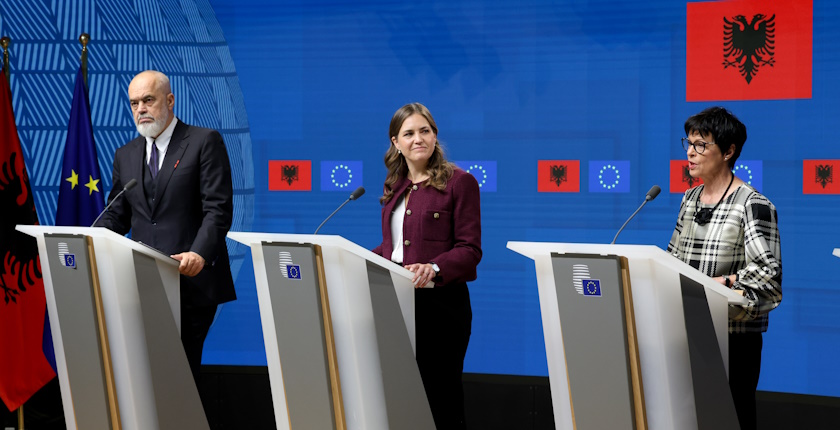
Prime Minister Edi Rama and his team represented Albania at the event, in which European Commissioner for Enlargement Marta Kos participated as well.

“Today we opened another cluster, it’s, as a matter of fact, five clusters in 11 months. In my understanding, it’s a record. And we are looking forward to opening the last cluster before this year ends… Environment is today a really pressing issue, and demands are challenging even for member states to keep the standards and to protect the standards. So, our challenge is to reinvent ourselves,” Rama said at a press conference with the two EU officials.

No chapters from cluster 4 closed yet in Western Balkans

The chapters in cluster 4, on the green agenda and sustainable connectivity, are transport policy (14), energy (15), trans-European networks (21) and environment and climate change (27). The trans-European networks comprise Trans-European Networks for Energy (TEN-E), Trans-European Networks for Transport (TEN-T) and Trans-European Networks for Telecommunications (eTEN).

As for the rest of the Western Balkans, Montenegro opened the first three in 2015 and the remaining one in 2018. It started its accession talks in 2012. The EU grouped 33 chapters into six clusters in 2020, while 34 and 35 are separate.

Albania is third in the region to open cluster 4

Serbia, which started negotiations in 2014, launched cluster 4 in late 2021. Notably, neither closed any chapters in the group. Montenegro closed seven in total, compared to just two on Serbia’s list.

Albania opened accession negotiations in 2022, as did North Macedonia. The former didn’t close any chapters yet and the latter didn’t even open a single one. Bosnia and Herzegovina is a candidate but it still didn’t start negotiations. Kosovo* is only a potential candidate.

EU urging tangible progress against environmental crimes

Among other points in its common position regarding the talks being launched, the EU urged Albania to accelerate renewable energy deployment by completing the necessary rules and regulations on permitting. The negotiators from the administration in Brussels said the Electricity Integration Package (EIP) needs to be fully implemented as well.

Albania has to align with EU acquis on environmental crimes and make tangible progress, especially against wildlife crimes, deterioration of habitats, illegal shipment or dumping of waste, pollution crimes and illegal trading in hazardous substances, the document reads.
* This designation is without prejudice to positions onstatus and is in line with UNSCR 1244/99 and the ICJ Opinion on the Kosovo declaration of independence.
by in News

Romania preparing to include biomethane in gas grid

Romania has drafted a directive that would regulate the production, transportation and distribution of biomethane and its inclusion into the gas network. The change is aimed at limiting the increase in the prices of gas for household heating, expected from the upcoming introduction of the ETS 2 carbon allowance scheme in the European Union. Delaying the shift would also affect the costs of industrial production and for other non-household consumers of gas.

Biomethane produced from sustainable sources is carbon neutral under the EU Emissions Trading System (EU ETS), making it appropriate for buildings and transportation, the Romanian Ministry of Energy said in a new draft emergency ordinance. With the executive order, it intends to pave the way for utilizing the renewable fuel in the natural gas network, Profit.ro reported.

The document is set to amend several acts and regulate the production, transportation and distribution of biomethane. It would counter, to an extent, the increase in gas prices for households, which is expected from the expansion of the EU’s carbon pricing scheme to buildings and transportation, the ministry explained. Namely, ETS 2 is scheduled to be introduced in 2027.

Biomethane is usually obtained by processing biogas to get methane of the same purity as in fossil gas

Any delay in allowing biomethane in the existing grid draws a risk of increasing the costs of natural gas consumption, both for non-household and household customers, the accompanying note reads.

Biomethane is usually obtained by processing biogas to get methane of the same purity as in fossil gas. The gaseous biofuel can also be produced from clean hydrogen and carbon dioxide. The EU allows incentives for biomethane facilities. Some countries in Southeastern Europe, like Greece, are developing the legal framework for embracing the technology within their energy transition.

Share in gas network planned to reach 10% by 2050

Romania is planning a 5% share of biomethane in its natural gas network in 2030 and to double it by mid-century. The sectors of waste management and agriculture can produce an estimated 501,000 tons of oil equivalent in 2050.

The EU is imposing strict requirements on the removal of biodegradable organic matter from wastewater and the reduction of food waste, the ministry noted. Together with agricultural and organic municipal waste, they are the main raw materials for the production of biogas.

According to the proposal, publicly announced business plans can secure a share of renewable gases in the grid up to 1.5%. However, without an urgent legislative intervention, the investments can’t materialize, the Ministry of Energy warned. The draft directive would update the definitions of guarantees of origin, biogas, biomethane, natural gas, renewable gases and biomethane producers.

BSOG Energy, Engie Romania at forefront of upcoming biomethane investment wave

As for other developments in the segment, BSOG Energy (BSOGE), a subsidiary of Black Sea Oil and Gas, recently hired industrial services provider Bilfinger for a biomethane facility in Alba county in Transylvania.

Earlier, BSOGE said it would invest EUR 30 million in the construction of a biomethane plant. It has signed deals with milk producer DN Agrar Group for up to 15 MW in capacity, with the possibility of exceeding 20 MW in later stages.

In April, the firm partnered with Unigrains Trading in a project for a biomethane and organic fertilizer facility. They estimated the investment at EUR 65 million, for 57 MW of biomethane capacity and over 250,000 tons of organic fertilizers per year. Parent company BSOG is controlled by controlled by investment firm Carlyle.

Engie Romania launched plans a year ago with Heineken to build a biodigester for brewery waste

Last November, French-owned Engie Romania obtained the first license in the country for biogas and biomethane supply. Earlier it established a partnership with Heineken for decarbonization projects in three breweries in Romania, including heat pumps and one biodigestion system.

The firm is the largest supplier and distributor of natural gas in the country, as well as an electricity producer and supplier.

by in News

EU donates EUR 240 million to Serbia for environment, energy efficiency

The European Union approved EUR 240 million in non-repayable assistance to Serbia from pre-accession funds for projects worth an overall EUR 325.2 million. The investments, intended for the period through 2032, are for waste and wastewater management, energy efficiency improvement and the transition to renewable energy sources.

Serbia and the European Union signed a financing agreement for the Multiannual Operational Programme on Environment and Energy, worth EUR 325.2 million. It includes EUR 240 million in non-repayable funds from the Instrument for Pre-accession Assistance, and Serbia is providing the rest.

State institutions will run the mechanism under an indirect management system, in accordance with the way that EU member states conduct programs within the cohesion and regional development funds. The agreement is another type of support in EU accession, the Ministry of European Integration said.

Grants also intended for green energy, waterworks

Serbia’s National IPA Coordinator and State Secretary at the Ministry of European Integration Mira Radenović Bojić said the agreement enables significant financial support for improving environmental protection and further developing the energy sector.

“This way we secured support for sustainable waste management, improvement of wastewater treatment infrastructure and the promotion of energy efficiency measures in public buildings and households,” she stressed. Radenović Bojić added that the assistance package also covers the development of capacities for the transition to renewable energy sources as well as the improvement of public waterworks and sewerage systems.

The program involves measures to protect air quality, aiming to lower harmful emissions and improve public health.

“In addition to renewing or building infrastructure, the program will support the development of strategic documents and plans for the harmonization with European Union standards. We will invest in capacity building of local and national institutions and in the development of technical documentation. Ultimately, the program will enable better cooperation with the relevant national and international stakeholders including civil society organizations and the private sector, in order to secure integrated implementation and improvement of the sustainable development policy,” Mira Radenović Bojić pointed out.

Von Beckerath: Our joint future depends on green, just transition

The agreement is another example of the EU’s strong and long-standing commitment to supporting Serbia on its path toward the EU, said the new Ambassador of the EU in Serbia Andreas von Beckerath.

“Environmental protection and sustainable energy are not only the core of the European Green Deal, but they are key to improving the quality of life of all citizens. With this significant investment, in synergy with the new Growth Plan for the Western Balkans, our goal is to accelerate Serbia’s alignment with EU standards and help the materialization of tangible benefits for citizens and the environment. Our joint future depends on this green and just transition, and we are delighted that we will go down that path together,” the chief of the Delegation of the EU stated.

The plan includes EUR 141.9 million for waste and wastewater and EUR 140 million for air quality and energy efficiency

The program, which covers the programming years 2024-2027, will be implemented from 2025 to 2032. It consists of EUR 141.9 million for waste and wastewater management and waterworks, EUR 140 million for air quality and energy efficiency and EUR 43.3 million for technical support.

There is EUR 44.9 million in the program earmarked for 2024, followed by EUR 108 million for the current year and EUR 76.8 million and EUR 95.5 million for the next two.

by in News

Council of Europe urges North Macedonia to improve environment, protect Romas from disproportionate risks

North Macedonia should bridge the gap between commitments and reality on human rights of Romas and environmental protection, the Council of Europe said. In his new memorandum, the organization’s Commissioner for Human Rights Michael O’Flaherty raised concerns about environmental risks disproportionately affecting Romas, including air and waste pollution, lack of sanitation and exclusion from public services.

As for broader environmental issues, the official noted that poor implementation of laws negatively impacts health and human rights, with cities like Skopje, Bitola, and Tetovo among the most polluted in Europe. O’Flaherty also warned of pressure on journalists and activists.

The Council of Europe Commissioner for Human Rights Michael O’Flaherty published a Memorandum on the Human Rights of Roma and on Issues Related to the Right to a Clean and Healthy Environment in North Macedonia, following his visit in April. He acknowledged the country’s significant efforts and political will to address human rights challenges faced by the Roma community.

Nevertheless, the official observed a gap between the policy framework and its implementation. O’Flaherty expressed concern that Romas continue to face discrimination, poverty and social exclusion. The government responded that relevant authorities would give careful attention to his recommendations.

The commissioner pointed to environmental risks disproportionately affecting Romas, including air and waste pollution, lack of sanitation and exclusion from public services.

Turning to broader environmental issues, he noted North Macedonia’s strong legal and policy framework and international commitments, including constitutional recognition of the right to a healthy environment, criminalizing ecocide and pledging to phase out coal. “Yet, poor implementation negatively impacts health and human rights, with cities like Skopje, Bitola, and Tetovo among the most polluted in Europe. Challenges remain in waste management, pollution control, and public access to environmental information,” the Council of Europe said.

Marginalized Roma communities disproportionately exposed to environmental hazards

O’Flaherty was informed that marginalized Roma communities experience disproportionate exposure to environmental hazards due to poverty and their living conditions. He visited a settlement in Skopje that has not been legalized in Skopje.

In such settlements, Romas often live in precarious conditions, with dwellings prone to mould and lacking access to services that are essential for living in a healthy environment, including sanitation facilities, sewage systems and clean running water, the memorandum reads.

Air quality meters have been installed in other parts of the city of Skopje, but not in the Roma-dominated Šuto Orizari

“The commissioner is concerned that vulnerable Roma communities are overexposed to air pollution because of poor quality housing and because they burn wood, plastic and waste for heating, due to poverty and a lack of access to safe energy sources. This increases the risk of respiratory illnesses, chronic diseases and reduces life expectancy. In this regard, the commissioner notes that air quality meters, designed to measure spikes in pollution levels and warn the inhabitants, have been installed in other parts of the city of Skopje, but not in the municipality of Šuto Orizari,” mostly inhabited by Roma, the report adds.

The official was informed that areas inhabited by Romas are sometimes excluded from public garbage collection, exposing them to waste pollution and further health risks.

Efforts underway to provide jobs, equipment to informal waste recyclers

O’Flaherty highlighted the recent efforts to equip a local kindergarten in Šuto Orizari with solar panels for heating and to increase the number of parks. In addition, he said he was impressed by a social enterprise that works for the recognition of the contribution of informal waste recyclers to environmental protection and supports them by providing formal employment and electric tricycles for the transport of waste.

The commissioner recommended that the authorities design and implement measures to uphold the community’s right to a healthy environment, as enshrined in the constitution. It includes access to adequate housing, notably as regards the requirements of adequate location and access to public services like clean water, sanitation and the removal of waste and toxic waste.

Persistent challenges in waste management including illegal landfills

The Council of Europe’s Commissioner for Human Rights acknowledged that North Macedonia has ratified multiple international and regional conventions and agreements related to the protection of nature, the atmosphere, tackling climate change, and dealing with chemicals, waste, soil and industrial accidents. It is one of the few member states of the Council of Europe to have introduced the crime of ecocide.

On the other hand, O’Flaherty raised the issue of the lack of implementation of laws and strategic objectives. He is concerned about negative impacts on people’s health of high levels of air pollution, with three cities in the country – Skopje, Bitola and Tetovo – regularly exceeding safe levels of polluting particles and ranking among the 10 most polluted cities in Europe, and sometimes the world, according to the memorandum.

O’Flaherty acknowledged that serious environmental issues cannot be resolved overnight and praised North Macedonia for numerous efforts

The official wrote about the negative impacts on human rights and the environment posed by persistent challenges in waste management and the proliferation of illegal landfills, disproportionately affecting vulnerable communities including Romas.

Serious environmental problems cannot be resolved overnight, he underscored. The commissioner praised the government for efforts that include increasing the number of electric buses, tax reduction on other electric vehicles, work toward an energy system based on gas and the phasing out of coal, as well as ongoing projects to address toxic sites and illegal landfills.

Access to justice largely absent

O’Flaherty learned that access to justice in cases of environmental human rights violations, including the right to a healthy environment, has been largely absent in North Macedonia.

Individuals supported by nongovernmental organizations working on human rights and the environment were unsuccessful in several environmental court cases. The Macedonian Young Lawyers Association (MYLA or MZMP) reported having brought six cases since 2019 concerning air pollution, waste management and water pollution. They were dismissed, with courts arguing they do not have the competence to deal with such matters.

NGOs also report that in some cases the Aarhus Convention and international law are incorrectly interpreted by domestic courts.

The commissioner observed that environmental activists are generally free to carry out their work in North Macedonia. However, he expressed concern about an increase in the use of vexatious lawsuits or so-called strategic lawsuits against public participation (SLAPPs) to silence investigative journalists and activists.

One example is Investigative Reporting Lab Macedonia (IRL), a journalistic NGO. It was ordered to pay thousands of euros of legal costs in the context of a defamation complaint about its documentary entitled Conspiracy Against the Air. Threats of the use of legal defamation and smear campaigns online are also used to silence activists, the Council of Europe added in the memorandum.

[wpcc-iframe title=”Редакција | Заговор против воздухот | Eпизода 1 | ИРЛ” width=”500″ height=”281″ src=”https://www.youtube.com/embed/asdHr27RgqI?feature=oembed” frameborder=”0″ allow=”accelerometer; autoplay; clipboard-write; encrypted-media; gyroscope; picture-in-picture; web-share” referrerpolicy=”strict-origin-when-cross-origin” allowfullscreen=””]

by in News

Germany supports Serbia in clean energy supply, environmental protection

The Republic of Serbia and Germany’s KfW Development Bank signed a loan agreement on July 18 for EUR 135 million for the second phase of the credit program Green Transition Development Policy Operation (DPO II).

The signatures underscore the joint activities by Germany and Serbia aimed at a climate-compliant and socially just energy transition, said Chargés d’Affaires ad interim Carsten Meyer-Wiefhausen from the Embassy of the Federal Republic of Germany in Serbia. “We will continue to be with Serbia on this path and support its reform efforts,” he stressed.

Within the financing for the reforms, the World Bank, French Development Agency (AFD) and the German KfW Development Bank are supporting the Republic of Serbia in conducting its ambitious reform agenda. The goal is to accelerate the transition to energy from clean sources and align with EU standards in environmental protection and climate.

Series of reforms through DPO II

Several successful reforms have been materialized within DPO II, among which:

  1. Promoting investments that are acceptable in environmental and climate terms: Public investments are graded under environmental criteria and with regard to the risk of natural disasters, and with models developed solely for the purpose. The citizens of Serbia benefit from the government’s more sustainable investment decisions.
  2. Enhanced transparency in the public budget: The Government of the Republic of Serbia has committed to publishing information on the execution of the public budget, not only at the end of the fiscal year, but also during the year. It improves the transparency of public expenditures, primarily concerning investments in environmental and climate protection.
  3. Affordable energy prices: The Government of the Republic of Serbia has rolled out temporary targeted subsidies for households with low income, like citizens with low pensions. The share of households receiving such aid has grown from 2.7%, registered in 2021, to last year’s 8%.
  4. Improvement in waste disposal: Aligning with EU standards brings a better approach to sanitary landfills, namely from 42% (2021) to last year’s 50%. The citizens of Serbia benefit from improved waste disposal and a cleaner environment.
  5. Prepared for CBAM: Since this year, large industrial facilities and power plants report their CO2 emissions in line with EU standards. That way Serbia is more prepared for the upcoming full implementation of the European Carbon Border Adjustment Mechanism (CBAM) for carbon prices. For instance, the country would be able to price CO2 emissions and charge them.

Financing reforms within climate partnership

Germany’s contribution to financing reforms is an integral part of Germany’s climate partnership with Serbia and the entire Western Balkans. The purpose of the partnership is to support Serbia’s work on achieving its national climate goals and adapting to climate change. The key goal of the partnerships is for the transformation that is necessary to meet climate goals, in the interest of Serbian citizens, to be socially just, a just transition.

This year, Serbia and Germany are celebrating the 25th anniversary of their development cooperation. In the meantime, KfW financed projects worth EUR 2.5 billion in Serbia.

by in News

BiH’s power utility EPBiH cancels waste co-incineration trial in Tuzla coal plant

Power utility Elektroprivreda Bosne i Hercegovine aborted a waste co-incineration test at its Tuzla coal power plant. It halted the pilot project upon a request from the city authorities.

Elektroprivreda BiH (EPBiH) announced it would comply with the resolutions that the City Council of Tuzla adopted, and halt the development project for trial co-incineration of alternative SRF and RDF fuel with coal at its Tuzla thermal power plant. RDF – refuse-derived fuel, and SRF – solid recovered fuel, are made from waste, and SRF is of higher quality.

The company claimed that, being socially responsible, it bases its operations on consistent compliance with laws, regulations, and local community views, continuous improvement of environmental standards, and a commitment to transparent dialogue and cooperation with all relevant stakeholders.

The plan was to incinerate 100 tons of waste

The trial waste co-incineration was scheduled for yesterday, but the day before, the Tuzla City Council demanded its cancellation at an emergency session.

The first reports about waste incineration at the Tuzla thermal power plant emerged in 2022. EPBiH said at the time that it planned to convert unit 3 of the Tuzla thermal power plant into a cogeneration unit, using wood biomass. However, Bankwatch and the Aarhus Center accused the company of intending to mix waste in, as well.

The idea to incinerate waste in coal power plants has been widely discussed in the region for several years. In 2021, Slovenian state-owned power utility Holding Slovenske Elektrarne (HSE) abandoned a project to burn waste in its Termoelektrarna Šoštanj (TEŠ) facility, citing opposition from local authorities and citizens.

Another BiH power utility, ERS, also plans waste incineration

In May 2023, Elektroprivreda Republike Srpske (ERS), another government-controlled power utility in BiH, revealed a plan for a trial incineration of waste.

Serbia’s Elektroprivreda Srbije (EPS) has such plans, too. The company has initiated several studies and pilot projects to analyze the use of alternative fuels in coal-fired power plants.

Its last move was to ask the Ministry of Environmental Protection to determine the scope and content of the environmental impact assessment study required for the project.

Tuzla City Council: We won’t allow experiments on Tuzla’s citizens

TPP Tuzla (photo: EPBiH)

The day before the planned waste incineration, the Tuzla city parliament adopted several conclusions. Among other things, it demanded urgent action from the Federal Ministry of Environment and Tourism and EPBiH regarding the lack of consultations with local authorities.

The assembly demanded that the management of TPP Tuzla immediately suspend all activities related to the incineration of RDF waste until an urgent public discussion is held with the participation of citizens, experts, and political representatives.

The local council stressed its opposition to all plans for co-incineration and incineration of waste, specifically RDF, until it is assured that the plan complies with legal, environmental, and health requirements.

The City of Tuzla and the City Council clearly and firmly declared that they won’t permit any experiments on Tuzla’s citizens, especially ones with potentially harmful or severe or even fatal consequences for human health, as well as environmental risks, the local parliament said.

Ministry: Everything was done to ensure testing was conducted under controlled and transparent conditions

The Federal Ministry of Environment and Tourism noted that EPBiH has requested permission for a trial co-incineration of a mix of coal and alternative SRF and RDF fuel at TPP Tuzla. However, according to the current Environmental Protection Law, there is no legal obligation to obtain either an environmental permit or an environmental impact assessment for trial co-incineration, it explained.

The ministry said that for the purpose of transparency it has issued an expert opinion to ensure the testing is implemented under controlled and transparent conditions, taking into account the interests of the local community.

EPBiH informed the entity ministry that, following the local assembly’s intervention, a federal environmental protection inspector conducted an inspection at TPP Tuzla on July 7 and confirmed that all the conditions were met for testing.

by in News

NALED urges action to protect jobs at energy-intensive industries threatened by CBAM

The National Alliance for Local Economic Development (NALED) has called on the authorities to establish a regulatory framework that would shield Serbia’s energy-intensive industries from the impact of the European Union’s (EU) Carbon Border Adjustment Mechanism (CBAM), which threatens jobs and businesses employing about 7% of the country’s workforce and accounting for 11% of its GDP.

Once the EU starts taxing the import of high-emission products on January 1, 2026, exporters from Serbia will face an increase in the prices of their products on the EU market. Simultaneously, they will face unfair competition on the domestic market from third countries that have not introduced a national carbon pricing system, according to the National Alliance for Local Economic Development (NALED).

The entry into force of the Carbon Border Adjustment Mechanism (CBAM) means that a levy will be charged on imports of cement, iron, steel, aluminum, fertilizers, hydrogen, and electricity into the EU from countries that do not tax CO2 emissions. Although there is more and more talk about delaying the implementation of the tax, it would not make the problem of CO2 taxation disappear – it would only give the affected countries more time to prepare for the change.

NALED has completed an analysis of CBAM’s potential impacts

NALED warns that the introduction of CBAM could have a severely adverse and destabilizing impact on the competitiveness of Serbia’s energy-intensive industries, which requires an urgent and appropriate response from state institutions. NALED’s recently completed analysis of potential impacts of CBAM suggests a high risk of financial pressures and loss of competitiveness of Serbia’s energy-intensive industries, which employ about 7% of the country’s workforce and account for 11% of its GDP.

“To maintain the competitiveness of domestic industry in the initial stage of its green transition, it is necessary to provide mechanisms for reducing CO2 emissions as soon as possible through a set of national regulatory measures. After that, a national mechanism should be established that would include levying a carbon tax on domestic industry, along with a national CBAM mechanism, modeled after the EU’s, to tax goods from third countries where climate policies are less ambitious than Serbia’s,” says Slobodan Krstović, director of NALED’s Sustainable Development Department.

Revenues from CO2 taxation would be used to decarbonize Serbia’s energy-intensive industries

This would ensure a level playing field, in terms of costs related to CO2 emissions, for the sale of energy-intensive products on the Serbian market, as is the case in the EU.

Additional budget revenues that would be secured in this way would primarily be used for supporting the decarbonization of energy-intensive industries, Krstović added.

The analysis further shows that introducing a national CO2 tax at the carbon price projected for 2034 in the National Energy and Climate Plan (NECP) –about EUR 40 per ton – would cost the economy up to EUR 539 million a year, not including the electricity sector.

A domestic CBAM would bring an additional EUR 13 million in state budget revenues in 2027 and as much as EUR 128.6 million in 2034.

Serbia needs mechanisms to decarbonize energy-intensive industries

NALED believes that such a measure, which would channel revenues into Serbia’s budget instead of the EU coffers, would be sustainably justified if the state first introduced regulatory mechanisms to help industry reduce its CO2 emissions.

Given that CBAM and the Green Agenda are new regulatory factors, which have not been taken into account before when defining state aid rules, it is necessary to thoroughly review the existing regulations for granting state aid to companies, according to NALED.

Adapting the national regulatory framework to ensure mechanisms for the decarbonization of energy-intensive industries primarily involves liberalizing the import of alternative fuels and raw materials, banning the export of waste that can be processed in Serbia, and incentivizing the construction of new renewable energy capacities.

If the state fails to react, the domestic industry will face a serious threat

In the absence of state action, NALED warns, the projected decline in the cost efficiency of domestic industry would irreversibly jeopardize Serbia’s exports to the EU market, as well as its competitiveness on the domestic market due to a sharp increase in imports of CBAM goods from non-EU countries.

This would inevitably lead to the loss of a large number of jobs and the financial sustainability of the entire energy-intensive industry operating in Serbia, NALED concludes.

The authorities in Bosnia and Herzegovina recently estimated the economy’s potential loss due to CBAM at between BAM 722 million and BAM 3.17 billion (EUR 369 million to EUR 1.62 billion).

by in News

Greece plans six waste-to-energy plants, set to meet EU landfilling limits

Large Greek companies, interested in the construction and operation of waste incinerators producing electricity and heat, are waiting for the government to complete the legal framework and launch tenders. Without the six planned facilities and accompanying infrastructure, the country would substantially lag behind the European Union’s targets for lowering the share of landfilled material.

Greece is transforming its waste management sector – dozens of units mechanically treating the material to feed six incinerators, covering all the regions. The Ministry of Environment and Energy is about to complete a strategic environmental assessment (SEA), after which its plan is to adopt a legal framework, before the end of the year.

Following a public consultation process, the general parameters would be determined including the details of a tender for the waste-to-energy plants. They are valued at EUR 1 billion in total. State-controlled Public Power Corp. (PPC or, in Greek, DEI) has expressed interest in entering the sector, alongside the conglomerates GEK Terna and Metlen, construction company Aktor, oil refinery operator Motor Oil and water, wastewater and waste processing operator Mesogeos.

The ministry intends to complete the competitive process in 2026, followed by a three-year construction period. The Greek media learned that public-private partnership is a favorable model for the investments.

At least two of six plants would provide district heating

In the central scenario, an incinerator in the Rhodope area would serve the wider region of East Macedonia and Thrace. One would be in Kozani, a coal region, for Central and Western Macedonia, Epirus, Thessaly and Corfu.

The government envisaged a unit in the Peloponnese to cover Western Greece, the Peloponnese peninsula itself and the Ionian Sea, excluding Corfu. One waste-to-energy plant is planned in Boeotia (Viotia), covering parts of Central Greece and the western part of Attica.

The waste incinerator in Kozani is likely to be built in the vicinity of Ptolemaida 5, Greece’s last coal power plant

In the same peninsula, where Athens is situated, a unit would also get shipments of waste from the north Aegean islands, one section of the Cyclades archipelago and the Dodecanese. An incineration plant in Heraklion (Iraklio) would be for Crete, Santorini, Karpathos and Rhodes.

The combined annual capacity of the six units is projected at 1.19 million tons. The largest ones are the Attica project (356,000 tons) and the Kozani plant (288,000 tons). The latter, which would probably be located near PPC’s Ptolemaida 5 coal power plant, is also seen providing up to 40% of the district heating needs in the area. The investment is valued at EUR 300 million.

Ptolemaida 5 is scheduled to be closed at the end of next year, marking the completion of Greece’s coal phaseout. The waste incinerator in Boeotia would provide district heating as well, the plan reads.

System for energy recovery clings on construction of mechanical treatment units, waste separation

On the logistics side, there are 13 waste treatment units in operation in Greece and 25 are under construction. The ministry expects all units to be complete by 2029, to feed the incinerators.

The capacity amounts to 1.45 million tons per year altogether, of which 651,000 tons of waste would be processed into solid recovered fuel (SRF), which is of higher quality. The energy-intensive industry would absorb 150,000 tons. The development of the treatment system requires substantial infrastructure including the selection of municipal waste selection at the source.

Up to 651,000 tons of SRF is expected to be produced per year in the waste treatment facilities

The estimated electricity production from 1.19 million tons of waste is 1.03 TWh, equivalent to 2% of the country’s total consumption. Notably, 57.5% of the projected output is considered renewable energy, in line with the portion of biodegradable waste.

In the study, the options to deploy pyrolysis or gasification technologies were rejected. The authors argued they are not viable in Europe. It left incineration as the only option to recover energy from waste.

If the incinerators aren’t built, but the energy-intensive industry receives the same amount of SRF, 22.7% of waste would be landfilled in 2030, projections showed. The European Union’s target is 10%. The share of landfilled waste rises to 29.2% in the same scenario.

by in News

Case of Struga illegal landfill in North Macedonia goes to Strasbourg court

The Macedonian Young Lawyers Association (MYLA or MZMP) from Skopje said the only hope for justice regarding the issue of the illegal landfill near Struga is now outside North Macedonia. Namely, judicial authorities have declared themselves incompetent for the nongovernmental organization’s 2021 lawsuit against local and state institutions. The landfill is jeopardizing a basic human right – to a healthy environment, the young lawyers pointed out.

North Macedonian environmental and civic activists have been trying to prove in court for years that the illegal landfill at the entrance of the town of Struga is poisoning people. It is the second-largest tourist center in the country, located on the shores of Lake Ohrid. Their struggle, which began in January 2021, has not yielded results.

The Macedonian Young Lawyers Association is suing the Municipality of Struga, the Public Utility Company of Struga, and the Ministry of Environment and Spatial Planning, claiming they have done nothing to solve the serious issue. They demanded that the court bans further waste dumping and that the area be cleaned and revitalized. But instead, thousands of tons of various waste are piling up at the landfill every year, polluting the environment, air, and agricultural land, thus negatively affecting the health of citizens.

Both the Basic Court in Struga and the Appellate Court in nearby Bitola declared that the courts in the country do not have the authority to rule on the issue. It is the first such lawsuit in the country.

Courts protect government even amid human rights violations

Now the landfill issue is moving to the Court of Human Rights in Strasbourg, after a failed attempt to prove that the landfill threatens a fundamental human right, to a healthy environment, but also the right to life, as the institutions did not take measures to prevent or reduce harmful consequences.

„I have an impression that Macedonian courts have a hard time getting out of this matrix, constantly protecting state and public authorities, even when we have a situation of violation of fundamental human rights and the constitutionally guaranteed right to a healthy environment,” Gligorie Kjatoski, from the civil initiative Enough is Enough, told Balkan Green Energy News. He is involved in the dispute as a lawyer.

The two courts in North Macedonia referred to the fact that there is not a single judgment yet against the government that they could apply

„If Strasbourg establishes a violation of one of the fundamental human rights, then that will be the basis for our request to repeat the procedure before the Macedonian courts,” Kjatoski said.

According to him, there are already examples when the European Court of Human Rights acknowledged its jurisdiction for similar cases.

„The practice in Strasbourg is very clear. That no one is responsible for an illegal landfill and enormous environmental pollution is not an option. During the procedure, we submitted several judgments to the European Court of Human Rights, where a violation was established in similar situations. The Appellate Court in Bitola and the court in Struga did not take into account the practice of the European Court, claiming there were no judgments against the Republic of Macedonia that could be directly applied. But I do not know how much that argument holds up,” Kjatoski added.

One 2022 judgment of Higher Court in Serbia is example of protection from illegal landfills

In neighboring Serbia, there are cases where the courts have ruled in favor of the citizens.

„The practice of the European Court of Human Rights is that resolving issues such as this one with the Struga landfill falls within the jurisdiction of regular courts. Unlike the domestic courts, which claim that civil courts do not have the jurisdiction to play a proactive role in protecting human rights in the context of protecting the environment from illegal landfills, courts in the region do rule in favor of citizens, Kjatoski stated. He pointed to a decision by the Higher Court in Belgrade in neighboring Serbia, from September 22, 2022.

Mayor of Struga Ramiz Merko from the Democratic Union for Integration, one of the parties representing the Albanian community in the country, has promised that the problem would be solved and the landfill moved to another location. The United States Department of State blacklisted him almost two years ago.

There are 54 illegal landfills in the Republic of North Macedonia

The Struga site is than 2,000 meters from Lake Ohrid, in a fertile agricultural plain. It covers an area the size of four football fields. According to estimates, more than 40,000 tons of waste are disposed of there annually.

The landfill was established in 2006, as a temporary solution. It is more than 18 meters high and about 10 meters deep.

It is located five hundred meters from the first houses in the city of Struga and the same distance from the Black Drim river. The United Nations Educational, Scientific and Cultural Organization (UNESCO) declared the area a world natural and cultural heritage.

According to data from the Ministry of Environment and Spatial Planning, there are 54 non-standard, illegal landfills in North Macedonia. The only one that meets such conditions is the Drisla near the capital Skopje.

The only solution to the problem is seen in the closure of local and construction of regional landfills, which public officials have been promising for years. But they cannot be built due to resistance from people residing around the proposed locations.

For the waste from Struga and several other settlements in the southwest and the Pelagonia area, there are plans to build a regional landfill in the small municipality of Novaci near Bitola.

by in News

Rörig (E.ON): Croatia charges up to six times higher e-waste fees on solar panels than other EU states

Croatia charges a waste fee on solar panels of EUR 300 per ton, up to six times more than other European Union countries. The levy slows down the expansion of solar energy, Andreas Rörig, president of the Management Board of E.ON Croatia, told Balkan Green Energy News.

In addition to the one-off e-waste management fee, hindering investments, another issue is that Croatia doesn’t have a system for collecting and recycling solar panels.

Andreas Rörig’s post on LinkedIn received a lot of public attention. He wrote that in Croatia high fees and regulatory barriers, including the ones related to waste, are holding back solar’s potential. With a waste fee of EUR 0.3 per kilogram (EUR 300 per ton), the profitability of solar investments is at risk, he added.

The fee in other EU countries ranges from EUR 50 to EUR 150

Rörig explained that a comparison with other EU member states demonstrates that fees in Croatia are significantly higher than in neighboring countries. For example, they range from EUR 50 to EUR 150 in the Netherlands, Belgium, Slovenia, and Hungary.

The fee is paid on total weight, which is more than 20 kilograms per panel, according to E.ON. Even more concerning is the disproportionate taxation: 80% to 90% of a solar panel’s mass consists of easily recyclable materials that aren’t classified as e-waste, yet the fee is charged on the total weight.

“This approach discourages investment, slows Croatia’s progress toward energy transition, and contradicts the country’s goals of reducing emissions and increasing energy efficiency. A practical example of why solar energy accounts for less than 2% of Croatia’s energy mix – far below its true potential,” Rörig stated.

There are signs that things are about to change

Therefore he recommended reducing the electronic waste management fee for solar panels and suspending the obligation until a functional disposal system is in place. He confirmed there is currently no functional system for the collection, processing, and recycling of e-waste from solar panels in Croatia.

“However, there are positive indications that the fee will be reduced and that the system will be established. We believe that the Environmental Protection and Energy Efficiency Fund or FZOEU has recognized the needs of the industry. E.ON supports such measures because we believe that they will fix the problem and enable easier waste management,” Rörig stressed.