by in News

Voltalia receives license for Spitalla PV plant in Albania

French renewable energy company Voltalia obtained a 30-year license for its Spitalla solar park at the Albanian port city of Durrës. It won the project at a renewable energy auction in 2021.

In its latest update, the Energy Regulatory Authority (ERE) of Albania authorized Spitalla Solar to generate electricity from a photovoltaic plant of 90 MW. France-based Voltalia has established the firm for a project for which it won state support in 2021.

The solar power auction for the Spitalla site, just north of Durrës, a port city on the Adriatic Sea, was for 100 MW in peak capacity. The renewable energy company started construction works late last year. At the time, it scheduled the commissioning of the facility for the second half of 2027.

Similarly, Voltalia developed and built its Karavasta PV plant of 140 MW in peak terms, won at a previous solar power auction. It is the largest in Albania.

The auctions are for contracts for difference (CfDs), but the winners are actually working with power purchase agreements (PPAs) with fixed prices. A procedure is underway to secure market liquidity, which would enable the switch. Notably, the Albanian Power Exchange (ALPEX) was launched already in April 2023.

Spitalla’s CfD is for 15 years and 70 MW in peak capacity. Voltalia, headquartered in Paris, earlier said it would sell the rest of the output under a long-term contract with buyers in the private sector.

Since last year, there is more electricity generation capacity in private ownership in Albania than in the system under state-controlled utility KESH. Growth in the solar power segment is the biggest factor behind the change.
by in News

Share of private power producers in Albania tops 50%

Since last year, there is more electricity generation capacity in private ownership in Albania than in the system under state-controlled utility KESH. Growth in the solar power segment is the biggest factor for the switch. Its share of capacity has reached 10%.

Government-owned KESH in Albania lost its monopoly in electricity production in 2007 with the introduction of hydropower concessions. According to the Energy Regulatory Authority (ERE), power plants in private ownership account for the majority of the capacity since last year, Monitor reported.

The total grew by 537 MW in 2024 to 3.21 GW, mainly due to a surge in the photovoltaic segment. KESH operated 1.56 GW or 48.6%, against 1.65 GW run by private companies. One year earlier, the state-owned utility held 56%, the article adds. Nevertheless, a hydropower plant usually generates three times more electricity than a PV plant of the same size.

Diversification into photovoltaics, wind, gas, storage

Albania is specific in the Western Balkans region for having no coal power plants and producing almost all its electricity in hydroelectric systems, which makes it vulnerable to droughts. KESH has dominated the sector mainly with its cascade on the Drin (Drim) river.

Private solar parks are leading the way in capacity additions in Albania, but a hydropower plant normally generates three times more electricity than a PV park of the same capacity

Norway-based Statkraft stands out among the largest private companies, with its projects on the Devoll, together with Turkish company Ayen Enerji’s endeavors in the Fan river basin and Austrian Verbund’s Ashta complex, also on the Drin.

Efforts are underway to diversify the country’s mix with solar and wind energy and introduce storage capacity. However, not a single wind turbine has been built yet. In addition, there is an opportunity for strengthening the electricity supply using gas from the Trans Adriatic Pipeline – TAP.

Two major solar power plants commissioned this year

ERE’s data show that in the first eight months of this year, Albania added two solar power plants of an overall 150 MW and a hydropower facility of 48.9 MW to its transmission grid.

The country hosts Karavasta, the biggest photovoltaic park in the region, at 140 MW in peak capacity. Its operator Voltalia, headquartered in France, is building Spitalla, a 100 MW facility. It won both projects at Albania’s renewable energy auctions.

Deputy Prime Minister and Minister of Infrastructure and Energy Belinda Balluku said today that solar power reached 10% of capacity.

In other recent news, CWP Europe recently signed a joint declaration with the European Commission and the Albanian Investment Development Agency in support of its Tropoja wind farm project.

by in News

Green Energy or Green Corruption? Inside Voltalia’s Controversial Solar Concessions in Albania.

The Ministry of Infrastructure and Energy of Albania signed the Project Development Agreement with Voltalia for the construction of the photovoltaic plant in Remas – Karavasta (near the Lushnja area) with an installed capacity of 140 MW, where the power generation from 70 MW will be offered as part of the support measures at a price of 24.89 euros/Mwh to state owned company ( OSHEE GROUP , public company) for 15 years and 70 MW will be traded on the free market, supported by EBRD with 29M Euro loan. The Karavasta Solar Park entered production in January 2024 (EBRD, 2023).

Karavasta Solar PV 140MW farm production for year 2024

Karavasta Solar PV 140MW farm production for year 2024

The concession agreement in question leaves numerous concerns unsettled. Beyond its significant social and environmental consequences—strongly opposed by local communities due to its proximity to the Divjaka-Karavasta National Park—the project represents Voltalia’s expanding and contentious presence in Albania. This development looks to follow the trend of so-called “green” efforts in the country, which have long been marred by suspicions of green corruption.

For 2024, the Karavasta solar power plant reported total electricity generation of 258.38 GWh. Yet the Energy Regulator Authority’s (ERE) report does not disclose the destination of roughly half of that output — 129.19 GWh — which should be sold under a contractual tariff of €24.89/MWh (towards OSHEE group). That unexplained 50% gap in the balancing is striking. The same report shows that FTL sh.a the Free Market Supplier, purchased only 67.7 GWh from domestic photovoltaic producers, while the other amount of the total of 2,596 GWh were supplied including hydropower generation and purchased on the free market. Taken together, these figures reveal inconsistencies in market reporting and raise serious questions about transparency, corruption, contractual compliance, and the adequacy of regulatory oversight (MIE, 2020)

FTL sha Free Market Supplier part of OSHEE Group, 2024, purchasing electricity.

FTL sha Free Market Supplier part of OSHEE Group, 2024, purchasing electricity. Data source : ERE

The Karavasta Solar PV plant site is adjacent to Divjaka-Karavasta National Park, a Candidate Emerald Site under the Bern Convention encompassing Karavasta Lagoon Ramsar Site. The project site also partially overlaps with the Karavasta Lagoon Key Biodiversity Area (KBA) and Important Bird Area (IBA) designated for globally threatened bird species, important congregations of wintering and breeding waterbirds, and the endemic Albanian Water Frog.

The Ministry of Infrastructure and Energy Albania held an international bid procedure to build also the 100 MW Spitalla photovoltaic park in Durrës, which Voltalia SA won. According to the tender, 70 MW of the capacity would get subsidized compensation of €29.89/MWh for 15 years, with the remaining 30 MW sold on the free market. The Project Agreement and Power Purchase Agreement (PPA) were signed in June 2021, and the project is currently being implemented again by Voltalia SA.
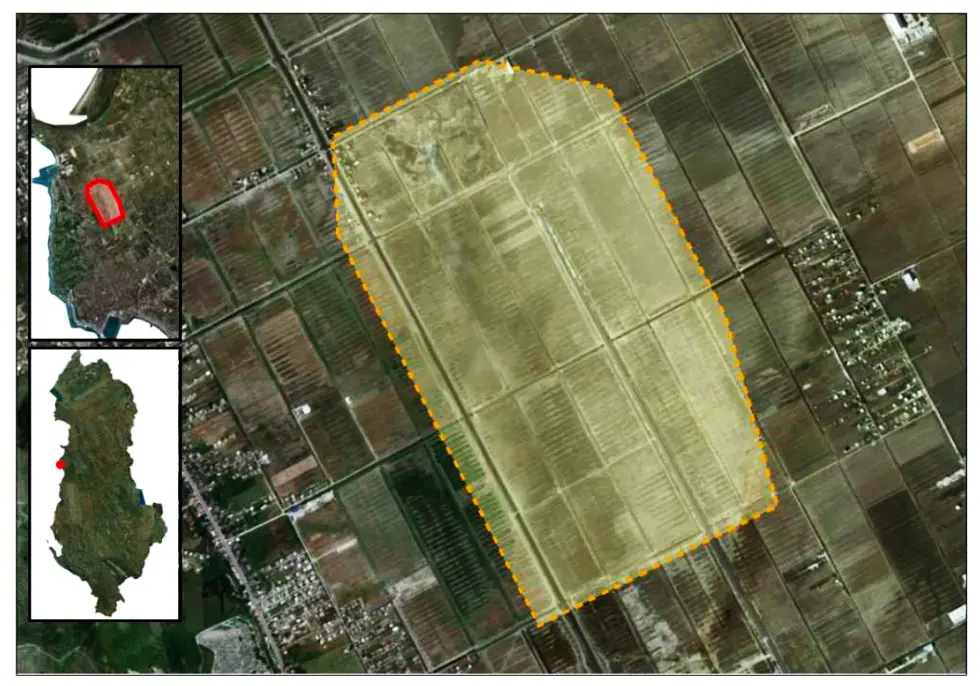
Karavasta Solar project location. Other PV farms in new located into the protected areas and river bank.

Karavasta Solar project location. Other PV farms in new located into the protected areas and river bank.

The Ministry of Infrastructure and Energy Albania held an international bid procedure to build also the 100 MW Spitalla photovoltaic park in Durrës, which Voltalia SA won. According to the tender, 70 MW of the capacity would get subsidized compensation of €29.89/MWh for 15 years, with the remaining 30 MW sold on the free market. The Project Agreement and Power Purchase Agreement (PPA) were signed in June 2021, and the project is currently being implemented again by Voltalia SA (MIE, 2021).

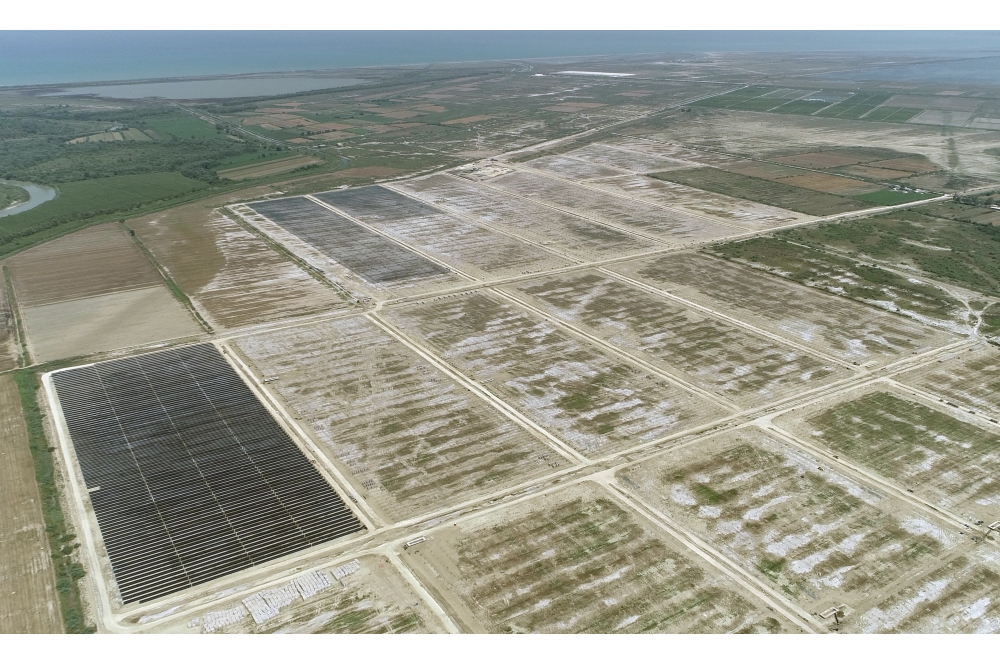
In the case of the Spitalla Solar project, Voltalia SA has proceeded with internal tenders and begun constructing high-voltage lines, a substation bay, and the plant itself, despite failing to provide formal communication to stakeholders or local residents. No environmental and social impact assessment (ESIA), restoration plan, or archaeological survey has been presented, nor has any meaningful public hearing been conducted to date. The company is reportedly working with a well-connected local firm linked to government and political circles to produce the required reports and assessments—documents that, critics allege, exist largely on paper. Local communities, facing limited possibilities  for recourse, describe the project as shielded by a network of political protection and systemic corruption.

Spitalla Solar Project 100MW in Durres, Albania

Spitalla Solar Project 100MW in Durres, Albania . Data source: AKM

Voltalia SA established two local businesses  “Spitalla Solar” and “Karavasta Solar”  through its Dutch vehicle, Voltalia Management International B.V., which is registered in a country that may hinder transparency. Spitalla Solar has two foreign administrators, Bertrand Pierre Francis Tournier and Gustavo Manuel Ferreira Fernandes; the same people also run Karavasta Solar, the concessionaire for the Karavasta solar park, which has a 30-year concession. The fact that both Albanian companies are subsidiaries of a Dutch holding company raises valid concerns regarding ultimate beneficial ownership, corporate transparency, and regulatory control (Vox News, 2024).

It appears that Prime Minister Rama may have steered these projects toward associates tied to President Macron  a move critics describe as a political favour rather than a transparent procurement outcome. The 2020 Albanian Law on the Beneficial Ownership Registry was intended to reveal company shareholders, but its 25% disclosure threshold leaves room for concealing minority owners; consequently, a convicted individual or someone embedded in politics could remain undeclared if they hold under 25% of a company’s shares, even when that company wins public contracts. The planned 100 MW photovoltaic park is covered to be developed alongside the new Durrës Port and the Reconstruction zone  developments likely to reshape the local real-estate market. In this sensitive corridor, a French firm and a Dutch entity with opaque ownership structures were granted 121 hectares by the government for 30 years, a deal that raises serious questions about transparency, accountability and the protection of the public interest (MIE, 2020).

The financial advantages and drawbacks of concession agreements, compared to new production capacity outside such arrangements, are closely tied to contractual provisions defining the allocation of financial risk. According to a statement by Voltalia SA, concession contracts can shift this burden onto the Albanian state budget, effectively exposing public finances to potential liabilities—often without the public’s awareness.

By Ranier della Vecchia