by in News

Serbia plans to stop using coal, fuel oil in district heating by 2040

By 2040, Serbia intends to replace fuel oil and coal in district heating plants with solar, wood biomass, heat pumps, municipal waste and geothermal energy.

Maja Vukadinović, acting Assistant Minister of Mining and Energy for Energy Efficiency and Climate Change, has said that the goal for the district heating sector is to phase out fuel oil and coal by 2040.

She explained that the idea is to replace fossil fuels with solar energy, wood biomass, heat pumps, municipal waste and geothermal energy.

“The list of programs and projects until 2028 is defined in the draft Program for the Implementation of the Energy Development Strategy of the Republic of Serbia until 2040 with projections to 2050, for the period from 2026 to 2028,” Vukadinović told Balkan Green Energy News.

The share of renewables should increase from 2.4% to 5.5%

According to the draft, implementation of decarbonization projects in district heating systems by 2028 should lift the share of renewable energy sources in heat production from 2.4% to 5.5%.

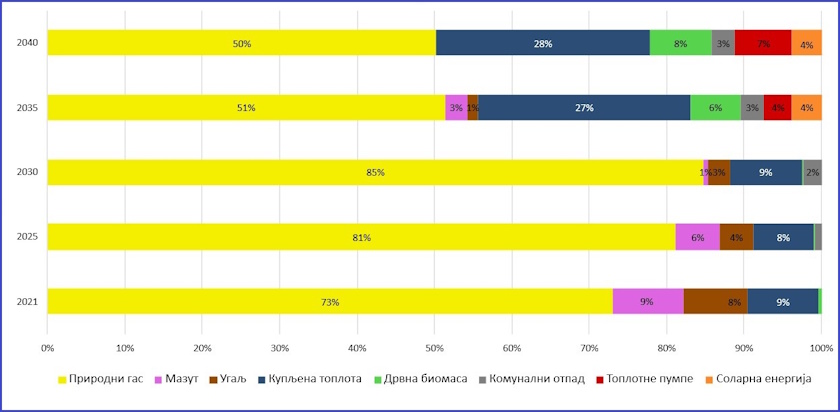
The fuel mix in 2023 was 75% natural gas, 8% petroleum products, 2% coal, 2% wood biomass, and 13% purchased heat. The structure of purchased heat production is 46.8% natural gas, 48.8% coal, 3.3% wood biomass, and 1.1% fuel oil.
serbia decarbonization district heating mix 2040

Natural gas will remain the dominant source of thermal energy, as it is today, although its share is expected to decrease from 73% to 50% by 2040, according to Vukadinović.

The decarbonization of the district heating system would reduce air pollution in cities, especially where coal or fuel oil is currently used, the ministry added.

A strategic plan for the district heating decarbonization policy is being prepared

“It’s very important that the fuels conversion is carried out in parallel with energy renovation of buildings and a reduction of the energy consumption for heating. It would significantly improve living conditions,” Vukadinović underlined.

Decarbonization would also have to lead to the improvement of the overall operation of the heating plants, as well as a reduction in network losses, the modernization of substations, and the introduction of daily and seasonal thermal energy storage, in her opinion. The operation of the district heating systems should depend less on the price volatility of imported fuels, Vukadinović stressed.

Serbia is preparing a strategic plan for the district heating decarbonization policy. The document is under development in cooperation with the European Bank for Reconstruction and Development (EBRD) and the business association of Serbian heating plants, Toplane Srbije.

The document, she explained, will outline steps to improve the district heating system, including the rollout of thermal energy storage, heat pumps, and heat production from waste, as well as the development of the country’s first district cooling systems.
by in News

One megawatt per day: North Macedonia enjoys strong renewable energy growth

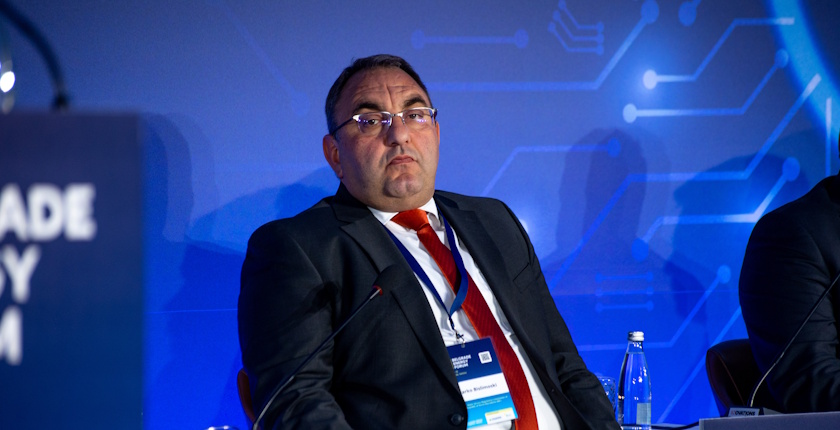
Over the past four years, North Macedonia has achieved strong growth in renewable energy sources. A total of 1,200 MW of capacity has been connected to the grid, marking a new phase of the country’s energy transition, according to Marko Bislimoski, President of the Energy, Water Services, and Municipal Waste Management Services Regulatory Commission of the Republic of North Macedonia (ERC or RKE).

According to ERC data, almost 1 MW of renewable capacity has been added to the grid every day over the past four years.

Between 2022 and October 2025, North Macedonia built 1,200 MW of renewable power generation capacity, Bislimoski said at the Regional Conference on Green Transformation of the Western Balkans, held in Tirana, Albania.

“Electricity generation from solar power has become a reality – the El Dorado of photovoltaic plants has heralded the country’s energy transition, initiating a transformation of the power sector. The figures are encouraging, but the period ahead will be full of challenges, among which is balancing the system, when it comes to renewable electricity generation,” Bislimoski said.

Solar power capacity has overtaken hydropower

At the recently held 14th International Forum on Energy for Sustainable Development (IFESD-14), Sanja Božinovska, Minister of Energy, Mining and Mineral Resources, said that renewable energy sources account for more than half of North Macedonia’s total installed electricity generation capacity – 56% as of 2024.

Solar power plants account for 28%, while large hydropower plants have a 24% share.

“For the first time in our history, solar has overtaken hydro – a symbolic and practical milestone in our path toward decarbonization,” Božinovska stated.

Need for investments in baseload generation

Bislimoski emphasized that in the current phase of the energy transition, it is necessary to encourage investments in energy facilities that produce baseload energy.

The use of battery storage has its role, but it is essential to implement projects that will replace coal-fired power generation with gas or biomass, he added

The digitalization of administrative procedures for obtaining the necessary permits and documentation was highlighted as a key prerequisite for increasing the number of green investments, according to the panel How to Create Zones for Faster Implementation of Green Projects.

Speakers, including energy experts, economists, and representatives of national and local authorities, agreed that the energy transition will only be successful if households also feel its benefits, not just industry. Policies and reforms aimed at building a smart and green energy future must be a priority for regional governments to facilitate integration into the European energy market.

by in News

Romanian city of Timișoara nearing construction of its own solar park

Romania is experiencing strong growth in photovoltaic capacity, with 1.7 GW installed in 2024 alone. Local authorities are actively contributing to the energy transition. They include Timișoara, which will soon get its own solar power plant, of 5.6 MW.

According to data from the Romanian Photovoltaic Industry Association (RPIA), solar power plants with a total capacity of 1.7 GW were installed in Romania last year. The expansion is driven by accessible financing, legal reforms, simplified permitting procedures, and auctions for contracts for difference (CfD).

Local authorities, including counties, are one of the pillars of the country’s energy transition. For example, in the small town of Turceni in southwestern Romania, home to only about 7,000 residents, a EUR 380 million project was recently launched. The municipal authority signed an agreement with the European Investment Bank (EIB) for the construction of agrosolar parks, energy storage systems, and facilities for green hydrogen production and storage.

Timișoara is part of a growing group of local authorities developing solar power projects for their own needs

In northern Romania, the municipality of Târgu Lăpuș has established a public-private partnership with a company founded by Turkish and Romanian investors. The goal is to build a 200 MW solar power plant with an energy storage system. The investment is estimated at EUR 100 million.

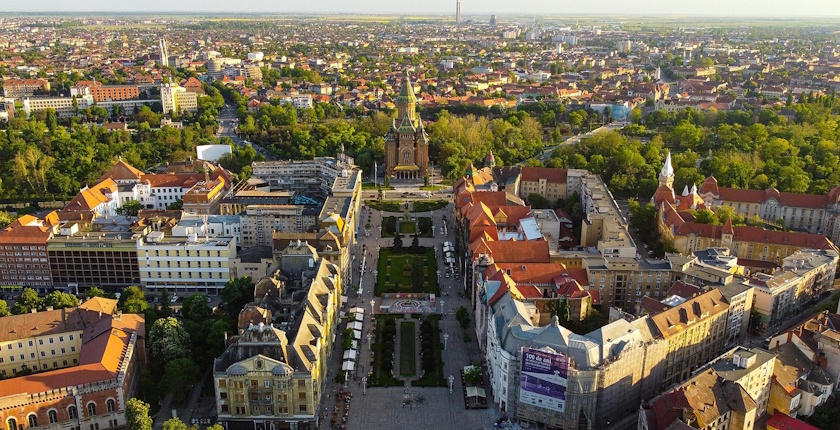
Timișoara, the capital of Timiș county and the largest city in western Romania, has long been a part of the growing group of municipalities developing solar power projects for their own needs. Mayor Dominic Fritz and Minister of Environment Diana Buzoianu have signed a grant agreement for the construction of the city’s first solar park, of 5.6 MW, marking the start of the investment’s next phase.

The municipality will now launch the tender procedure for design and construction services. The solar power plant is expected to generate an average of 7.8 GWh of green energy annually.

Solar park to deliver direct benefits for the city

The total investment value is RON 32.2 million lei (EUR 6.3 million) including value-added tax. The project is conducted under the European Union’s Modernisation Fund, managed by the Ministry of Energy. The fund supports investments in renewable energy, energy efficiency, storage, grids, and just transition in 13 European Union member states with lower incomes. It uses the proceeds from the sale of greenhouse gas emission allowances under the EU Emissions Trading System (EU ETS).

“The solar park will bring direct benefits to the city – lower costs, reduced emissions, and more sustainable infrastructure. It is just one of the projects through which we are transforming Timișoara into a green and smart city, capable of producing a significant share of the energy it consumes from renewable sources,” said Fritz.

The solar power plant will cover two thirds of public lighting needs

PV panels will be installed near the wastewater treatment plant in the Freidorf district, on 20 hectares. The generated electricity will cover around two thirds of the city’s public lighting consumption. The facility would contribute to lowering greenhouse gas emissions with 4,800 tonnes of CO₂ equivalent annually.

The solar power plant is part of the local administration’s broader plan to switch to renewable energy sources and reduce pollution. Timișoara has also expressed interest in a state aid mechanism for the production and transport of geothermal energy for district heating and cooling systems, worth EUR 300 million, covered from the Modernisation Fund. Last year, the city signed a strategic partnership with OMV Petrom to utilize geothermal energy for district heating.

by in News

World’s first floating solar power plant with vertical panels comes online

A floating solar power plant with vertically installed panels was commissioned in Germany. Sinn Power, the company that deployed the technology, claims it is the world’s first utility-scale facility of its kind.

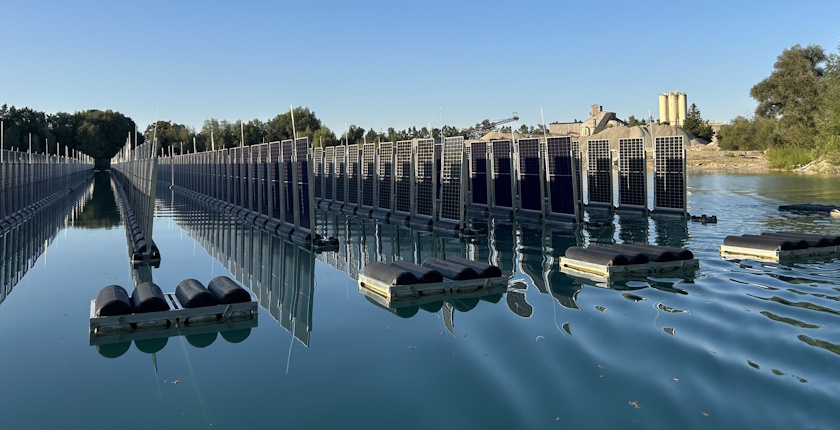
The floating solar power plant featuring vertically mounted panels is situated on artificial lake Jais, created by gravel extraction, in the Starnberg district of Bavaria in southern Germany. With a peak capacity of 1.87 MW, the plant is expected to generate around 2 GWh of electricity annually.

The technology, called SKipp by Sinn Power, is designed for artificial water bodies deeper than 1.6 meters, such as quarry lakes and gravel pits. Floating solar installations on artificial water surfaces are particularly valuable because they provide additional opportunities for solar energy generation without occupying land.

On Jais, arrays of vertical east-west oriented solar panels are separated by at least four meters. The company claims it ensures stable electricity generation throughout the day and increases output during morning and evening hours when conventional solar systems produce less energy.

Each SKipp-Float segment requires only a narrow submerged base, serving as the stabilizing part of the structure. At up to 1.6 meters below the water surface, it ensures a minimal spatial footprint, according to the company’s engineers. The substructure secures the modules and allows controlled movement under wind loads and fluctuating water levels.

Additionally, the plant is connected to the grid via a floating cable and a shore-based feed-in point, enabling smooth energy transfer without disrupting the lake’s ecosystem.

The installation of the floating solar plant has a positive impact on the lake’s ecosystem

The SKipp-Float system was commissioned on August 21 and officially inaugurated last week. Among the speakers at the ceremony was Bavarian Minister-President Markus Söder, who emphasized that the project demonstrates what an innovative energy transition looks like.

“The huge floating solar power plant on the lake generates electricity following the sun’s position. This is an example of Sinn Power’s engineering expertise, perfectly suited to Bavaria – a land of engineers and start-ups, as well as a leader in renewable energy,” said the regional leader, noting that Bavaria contributes 25% to Germany’s overall expansion of new capacity.

During the initial phase of operation, the company managing the gravel pit, Kies- und Quetschwerk Jais, reduced its grid electricity consumption by around 60%, with savings expected to reach up to 70% once production stabilizes, Sinn Power added.

The company said its floating PV plant occupies only 4.65% of the lake’s surface, well below the 15% maximum allowed under the German Federal Water Resources Act. An expansion of 1.7 MW of installed capacity is planned, keeping total lake coverage below 10%.

The company emphasized that the solar power plant has shown no negative ecological impact. On the contrary, the structure itself improves oxygen exchange and allows sunlight to reach deeper water layers, with reports indicating that water quality has improved since commissioning. New waterfowl nests have been observed on the floating sections, while schools of fish gather around the submerged stabilizing part of the platform.

Sinn Power plans to extend its vertical floating solar concept to open sea applications, further advancing renewable energy production at sea.

by in News

EU solar jobs headed to first decrease in decade

Jobs in the European Union’s solar industry reached a record level last year, however they are dropping in 2025.

Nevertheless, the decrease in solar jobs this year could be only temporary, according to SolarPower Europe’s latest report.

Europe’s green job expansion continued in 20254, with EU solar jobs rising to a record high of 865,000. The sector’s 5% increase outperformed the wider EU labour market’s 0.8% growth, the EU Solar Jobs Report 2025 showed.

Most jobs, 86%, are provided by the solar deployment sector.

EU solar employment will face a temporary drop in 2025, of 5% decline to 825,000 jobs, due to slower solar deployment and manufacturing challenges, the update reads.

Nevertheless, the association expects solar workforce to grow over the coming years and reach 916,000 by 2029.

Solar delivers 825,000 quality jobs for Europe in 2025, said Walburga Hemetsberger, CEO of SolarPower Europe. It is incredible, she added.

“However, this falls short of the one million solar job mark we were hoping to reach by now, and for the first time in a decade, solar jobs growth has halted. We can’t ignore this warning. EU leaders have the opportunity to reverse course, stabilise the market, support EU solar manufacturers, and strengthen its skills strategy,” Hemetsberger stated.

The main reason for the decrease this year is a slowdown in residential solar. The share of EU rooftop solar workforce has been shrinking for the last three years, from 73% in 2022, to 59% in 2024, and it is projected to land at 56% in 2029, according to the report.

In July, the association estimated that the EU’s annual solar installations would come in weaker year-on-year in 2025 for the first time in a decade. The warning coincided with the month when solar power became the EU’s biggest electricity source for the first time.

Germany remained the leading EU country for employment

The largest national solar markets also represented the largest sources of solar employment in the EU.

Germany remained in the lead in employment last year, with around 128,000 direct and indirect full-time equivalent (FTE) jobs. However, the level tumbled from 154,000, registered in 2023, despite a jump in new installations to 17.2 GW from 15.1 GW.

Spain ranked second, with 122,000 FTEs. Italy saw significant growth, with the solar job market surpassing 100,000 workers, placing it third in the EU. Other top markets included Poland (90,000), France (66,000), Romania (62,000), and Hungary (47,000), the report adds.

SolarPower Europe issued ten policy recommendations for maintaining job growth:

  1. Establish a European solar skills intelligence hub.
  2. Scale and stabilize funding for renewable skills, with simplified access for small and medium-sized enterprises (SMEs).
  3. Map existing skills initiatives.
  4. Conclude sectoral agreements to enable large-scale retraining.
  5. Run coordinated campaigns to improve the attractiveness of technical green careers as well as apprenticeships and vocational training.
  6. Promote gender balance and diversity in solar careers.
  7. Develop cross-renewable career pathways and portable competence frameworks.
  8. Introduce a European solar skills passport.
  9. Adopt an electrification skills strategy that links photovoltaics with heat, mobility and storage.
  10. Invest in advanced digital and artificial intelligence (AI) training.
by in News

Record solar panel imports in Africa: a lifeline for a continent where 600 million people lack electricity

Half of Africa’s population still lacks access to electricity, but a record surge in solar panel imports could signal a turning point. A report by the Ember research center shows a 60% increase in solar panel imports from China to Africa. Although it is too early to make forecasts, the report suggests that the solar boom could positively impact the power systems of many African countries.

As many as 570 million people in Africa still lack reliable access to electricity, which is almost half of the continent’s population. According to data from the Energy Progress Report, in 2022, 685 million people worldwide did not have access to electricity, meaning that Africa accounts for 80% of the global population without access.

While North African nations and countries like Ghana, Gabon, and South Africa have made progress, major challenges remain in Central Africa and the Sahel region (Burkina Faso, Mali, Niger, Cameroon, Guinea, Gambia, Senegal, Nigeria, Chad, and Mauritania), where entire communities remain off the grid.

Solar energy could be an opportunity for Africa to skip the phase of relying on fossil fuels and make a significant step toward an energy transition. It is still too early to say if this process is already underway, but the latest report by Ember shows that solar power is gaining serious momentum.

The total imported capacity reached 15,032 MW

According to their analysis, from June 2024 to June 2025, solar panel imports from China to Africa increased by 60%. The total imported capacity during these 12 months amounted to 15,032 MW. Ember used Chinese customs data in the report because China is the world’s largest producer and exporter of solar panels, accounting for around 80% of the global output in 2024.

The last significant increase in solar imports was recorded in 2023, when South Africa experienced a solar boom due to its energy crisis. However, new data shows that interest in solar energy is spreading to other countries as well. Solar panel imports outside South Africa nearly tripled in the last two years, rising from 3,734 MW to 11,248 MW.

The report shows that a record solar panel import was set in as many as 20 African countries, while 25 countries imported at least 100 MW of solar capacity from June 2024 to June 2025.

Increasing solar panel imports could reduce fuel imports

Ember’s analysis suggests that solar could significantly contribute to electricity production in many African countries. If Sierra Leone installed all the panels imported in the last 12 months, it could produce the equivalent of 61% of its total electricity output from 2023. Similar results are seen in Chad — 49%.

In five countries, newly imported solar panels could contribute more than 10% of total electricity production from 2023: Liberia (25%), Somalia (15%), Eritrea (15%), Togo (11%), and Benin (10%). Overall, 16 countries have the potential to increase electricity production by at least 5%, according to the report.

In addition, solar panel imports can significantly reduce fossil fuel imports, especially diesel, on which many African countries still rely. According to 2022 research by Wood Mackenzie, 17 African countries had more diesel generator capacity than grid-connected power plants.

In some countries, such as Nigeria, if diesel imports for electricity production were stopped, savings could cover the cost of solar panels in approximately six months or even less.

Although solar expansion in Africa is accelerating, experts emphasize that the process is still in its early stages and that more data and research are needed to fully understand its potential.

by in News

Deanovec PV project near Zagreb conditionally passes environmental assessment

Croatia’s Ministry of Environmental Protection and Green Transition has decided that no environmental impact assessment study is required for the 65.7 MW Deanovec solar power plant project. The investment was initiated by Statkraft, which recently sold its entire business in the country to Resalta.

The project is planned on the territory of Ivanić-Grad in Zagreb county, with a peak capacity of 65.7 MW. The Deanovec site covers 73.2 hectares, of which photovoltaic modules would occupy around 28 hectares.

In May, Statkraft OIE, the project firm, submitted a request to the ministry to determine whether a full environmental impact assessment is necessary. It submitted the environmental study, produced by Zagreb-based Eko Invest, revealing that the plant would have a 59 MW grid connection.

The ministry concluded that a full environmental impact assessment is not necessary, but the investor must prevent potential harm.

The prescribed measures include coordination with the local hunting rights holder. Protection of watercourses involves preventing precipitation runoff from access roads into nearby streams. Wherever possible, cable lines must be placed within existing infrastructure corridors. The solar park needs to be divided into four fenced sections, with fencing designed to allow the passage of small animals.

Deanovec solar power project deemed environmentally acceptable

According to the decision, the investor must use anti-reflective PV modules, ensure sufficient spacing between them, and install eco-friendly lighting. Vegetation within the solar park must be mechanically maintained, without herbicides or chemicals, while the removal of invasive plant species is mandatory.

The ministry stated that the project is not expected to have significant negative impacts on biodiversity, soil, watercourses, agricultural land, landscape, or air quality, and that the defined mitigation measures are sufficient to avoid potential harm. All relevant authorities provided positive opinions, and the public consultation process did not result in major objections.

Furthermore, the ministry ruled that a comprehensive assessment under the procedure for the network of nature protection areas is not required. Its purpose is to determine whether a planned project could have a significant negative impact on protected areas, including those within the Natura 2000 network. It was concluded that the Deanovec solar power project does not affect or directly threaten these areas.

Norwegian energy giant Statkraft recently announced it was selling all its operations in Croatia to Resalta. However, it is still listed as the owner of the Deanovec project.

by in News

Clean energy, grid upgrade projects in Western Balkans to be backed under EU’s Growth Plan

The European Commission has proposed the first support package, of EUR 87.7 million, under the European Union’s Growth Plan for the Western Balkans, to help implement EUR 487.3 million worth of hydropower, solar district heating, and grid modernization projects in Albania, Montenegro, and Serbia. The package was announced following a high-level meeting between European Commissioner for Enlargement Marta Kos and Western Balkan partners in North Macedonia’s capital, Skopje.

The package, funded from the EUR 6 billion Reform and Growth Facility (RGF), set up under the Growth Plan, will be rolled out through the Western Balkans Investment Framework (WBIF). The proposal was made to the WBIF Operational Board, according to a press release from the commission.

The eight proposed projects include building a new generation unit and upgrading existing ones at Serbia’s Potpeć hydropower plant, which would increase its annual production to 236 GWh while reducing CO2 emissions. The investment is valued at EUR 72.1 million, with the RGF support amounting to EUR 15.8 million. The project is targeted for completion in 2030, according to the commission’s fact sheet.

Serbia could get support for introducing solar energy in district heating

The other project in Serbia is the construction of a 31 MW solar-thermal plant and 17 MW heat pump in Novi Sad, which will introduce renewable energy sources to the district heating system. The project would cost a total of EUR 114.3 million, with the RGF support at EUR 25 million. The targeted completion date is 2028.

In Montenegro, the package would support three projects. The first is an EUR 18.3 million investment in building a 38-kilometer 110kV overhead transmission line between Vilusi and Herceg Novi, aimed at increasing transmission capacity and reducing energy losses. It would receive EUR 3.1 million from the RGF.

The EU plans to back Montenegro’s SCADA roll-out

The second project in Montenegro is the introduction of SCADA in the power distribution system, estimated at EUR 26.5 million, with the proposed RGF support of EUR 5 million. The third one is a planned upgrade of the Brezna substation on the Trans-Balkan Electricity Corridor. The EUR 35.6 million investment would be backed with EUR 6.3 million from the RGF.

Albania plans to digitalize its transmission network in EUR 64.2 million project

The support package also includes Albania’s EUR 95.3 million investment in upgrading the Fierza hydropower plant, aimed at increasing its capacity by 10% and extending its lifespan by at least 30 years. The support from the RGF would amount to EUR 10.5 million. The other project to be supported in Albania is the EUR 64.2 million digitalization of the transmission network, which would receive 13.6 million from the RGF.

by in News

Construction of largest solar power plant in Bosnia and Herzegovina begins

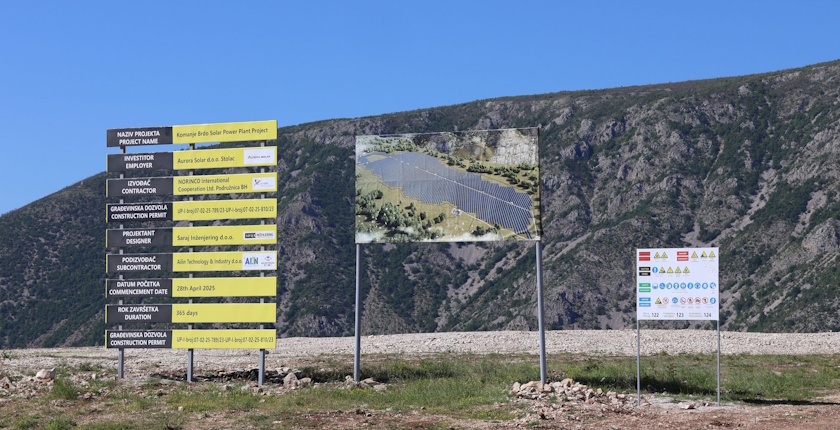
The construction of Bosnia and Herzegovina’s largest solar power plant has officially commenced. The location for the facility with a peak capacity of 125 MW is in the municipality of Stolac, near the village of Komanje Brdo. The project has caused discontent among some residents.

The investment is valued at EUR 100 million. According to the investor’s estimates, the power plant is expected to generate around 200 GWh of electricity annually over the next three decades.

The cornerstone was laid by Mayor of Stolac Stjepan Bošković, along with the representatives Aurora Solar, which developed the project, and Chinese company Norinco International, the contractor.

In recent years, the City of Stolac has actively promoted solar initiatives, with a particular focus on Komanje Brdo, according to the local authority’s website. It expects to collect between EUR 1.53 and EUR 2.05 million per year through the concession and utility fees.

 The project has faced public criticism

Despite its scale and potential, the project has faced criticism from a part of the public. Citizens gathered in an informal initiative called Za Komanje Brdo (For Komanje Brdo) have repeatedly raised concerns about a lack of transparency, the absence of public consultation, and alleged non-compliance with environmental protection laws. They claim the permitting process wasn’t transparent and that the local community was not adequately involved in decisions that directly affect its environment and quality of life.

“We are not against renewable energy sources, but we are against arbitrariness, the disregard for the law, and the neglect of residents’ interests. This project was launched against the will of the people,” residents said at a protest held on the same day that construction began, local media outlet Glas Stoca reported.

On the other hand, the investors claim the project is of strategic importance, promising new jobs and long-term benefits for the local community. They also maintain that all necessary permits were obtained in accordance with the law.

Despite public opposition and official complaints submitted to relevant institutions, construction works began on April 28. The plant is expected to be completed within a year and is set to become the largest photovoltaic park in Bosnia and Herzegovina. Currently, the largest solar power plant in the country is Hodovo, operated by Eco-Wat.

by in News

CISOLAR 2019 submit new opportunities for developing solar energy in Central and Eastern Europe

The 8th International Solar Energy Conference and Trade Show of Central and Eastern Europe, CISOLAR-2019 KYIV, the largest regional business event, devoted to solar energy industry, will take place at the in Kyiv (Ukraine) on April 16-18, 2019.

Today solar energy development is one of priority areas for investors in the world and Eastern Europe in particular.

As of October, 2018 in Ukraine more than 1,06 GW capacity of megawatt-type solar power station were built and by end of the year this indicator will increase to 1,2 GW.

In addition to large scale projects, the segment of small solar stations, including solar roof stations, is also rapidly developing.

Since 2015 in Ukraine more than 72 million euro has been invested in the installation of small households stations. As of June 15, 2018, the number of households equipped with solar power plants exceeded 6 031.

One of the CISOLAR 2019 key issue will be a possible change of the solar energy market model is transition from green tariff system to the auction model. It is precisely this legislative initiative is a focus of market players and investors today.

The rich business program of event will allow participants to answer industry questions of various complexity levels and information of the highest professional level.

On April, 16 a key B2B event the CISOLAR 2019 Solar Energy Conference and Trade Show will be held at the Hilton Kyiv Hotel (30 Tarasa Shevchenko Blvd.). It will be attended more than 70 speakers and 500 delegates – owners, executives, directors of influential companies, and as well as investors and entrepreneurs in the field of solar energy from more than 30 countries.

In particular, at the conference participants will discuss industry prospects, main trends and investments in solar energy projects. Presenters will share their international experience and tell about new technologies and innovative solutions for the PV sector.

An important part of the conference – CISOLAR AWARDS 2019 Ceremony, which traditionally will be chosen the best solar energy projects in Central and Eastern Europe and will be held at the first day of business event.

On April 17-18, the CISOLAR 2019, 2-days Trade Show will be held at the ACCO International Exhibition Center (40-B, Peremohy Avenue, Kyiv). A large-scale Trade Show will feature more than 100 exhibitors who will demonstrate new projects, the best technological solutions for business and home. The number of visitors is expected to be 5 000+.

The practical trainings and workshops for PV-installers have already become an integral part of event and will take place on April, 17-18. Events will be useful for property owners – private and multi-apartment buildings that have already installed solar panels, operate or plan to install. Participants will learn how to economize on green tariff and start developing own businesses.

CISOLAR is the first major business platform in Central and Eastern Europe, where participants share their experience of the most successful PV projects, discuss current issues in the solar energy field and learn about the latest trends, legal aspects, present ideas and solutions, conclude contracts, find and strengthen partnerships.

Become a member of CISOLAR 2019 and join world-renowned experts, participants in the international solar energy market, suppliers of state-of-the-art energy efficiency solutions – individuals with activities and achievements who write a new page on the development energy industry.

The future begins here! 

Organizer – Innovative Businss Centre (IB Centre Europe)


Register on the site:

https://2019.cis-solar.com/

phone number: +38 044 383 03 56

or write a letter to organizing committee on e-mail: [email protected]