by in News

Slovenia Bolsters Energy Transition with €174 Million Grid Investments

Slovenia has taken a decisive step toward a decarbonized future, announcing a €174 million investment package dedicated to the comprehensive modernization of its national power transmission and distribution networks. This strategic initiative aims to bolster grid capacity, enhance supply reliability, and—most critically—facilitate the rapid integration of renewable energy sources into the national mix.

The project is supported by €59 million in co-funding from the European Union’s Modernisation Fund, a financial instrument fueled by the EU Emissions Trading System (ETS) designed to assist member states in meeting climate targets.

A Foundation for the Green Transition

Minister of the Environment, Climate and Energy, Bojan Kumer, formalized the initiative by signing four contracts and two strategic decisions with the CEOs of Slovenia’s six state-owned energy entities. The group includes the transmission system operator (TSO) ELES and five distribution system operators (DSOs).

“The energy transition actually begins with the grid,” Minister Kumer noted during the signing ceremony. “A strong, resilient network is the bedrock upon which our future energy autonomy and sustainability are built.”

Key Projects and Financial Breakdown

The modernization efforts are distributed across the country’s regional operators, focusing on infrastructure upgrades, digitalization, and increased transformer capacity.

Operator Project Focus Total Investment EU Support
Elektro Ljubljana Urban network upgrades, cabling, and digitalization €53.2 Million €19.6 Million
Elektro Gorenjska Upgrading Trata and Brnik substations €32.9 Million €14.9 Million
Elektro Maribor New 110 kV line (Murska Sobota – Lendava) €32.3 Million €11.1 Million
ELES (TSO) Upgrading 110 kV line (Dravograd–Velenje) €12.9 Million €5.7 Million
Elektro Celje Switchgear refurbishment & transformer replacement €11.0 Million €5.5 Million
Elektro Primorska Reconstruction of Vrtojba substation switchgear €3.5 Million €1.7 Million

The 2030 Vision: Scaling Smart Infrastructure

This current wave of investment is only the beginning of a broader strategic roadmap. Slovenia has secured over €300 million from the Modernisation Fund to be utilized through 2030, specifically earmarked for grid refurbishment, energy efficiency, and renewable deployments.

The Ministry is already preparing a subsequent public call, expected in April, which will allocate €69 million for smart electricity grid investments between 2026 and 2030. These funds will prioritize three pillars:

  1. Renewables Development: Strengthening the grid to handle intermittent wind and solar inputs.

  2. Electrification of Heating: Supporting the transition away from fossil-fuel boilers to heat pumps.

  3. E-Mobility: Building the infrastructure necessary for the widespread adoption of electric vehicles.

By reinforcing its electrical backbone today, Slovenia is ensuring that its infrastructure can meet the demands of a more electrified and sustainable tomorrow.
by in News

Slovenian Energy Market 2025: Household and Industrial Electricity Prices Record Annual Declines

The Slovenian Ministry of the Environment, Climate and Energy has released its final statistical report for 2025, revealing a general cooling of retail electricity prices across the country. According to the data, which covers the fourth quarter and the full calendar year, households and non-household consumers both benefited from lower year-on-year costs, driven largely by significant adjustments in grid fees and government exemptions.

Household Sector: Grid Fee Relief Offsets Rising Energy Costs

For the average Slovenian household, the retail electricity price in 2025 settled at €95 per MWh, representing a 4% decrease compared to 2024. This downward trend continued into the final months of the year, with Q4 prices dipping an additional 2%.

While the overall retail price fell, the underlying “electricity component”—the cost of the energy itself—actually rose by 7% to an average of €111 per MWh (excluding VAT). The net reduction for consumers was primarily achieved through aggressive cuts to regulated charges:

  • Grid Fees: Averaged €42.1 per MWh (excluding VAT), a substantial 30% reduction from the previous year.

  • Policy Support: Households enjoyed a total exemption from renewable energy (RES) and high-efficiency cogeneration (CHP) fees during the first half of 2025, with partial exemptions remaining in place for the second half. These surcharges averaged just €5.2 per MWh.

  • Excise Duty: Stood at €1.53 per MWh.

By the end of 2025, the cost structure for a typical household invoice consisted of the energy component (56.9%), grid fees (21.6%), VAT (18%), energy taxes (2.7%), and excise duties (0.8%).

Non-Household Sector: Significant Annual Savings Despite Q4 Spike

The broader consumer category, dominated by the business and industrial sectors, saw an even sharper annual decline. The average price for non-household consumers in 2025 was €181 per MWh, a 13% drop over 2024.

However, the sector faced a volatile end to the year; while annual figures were down, prices in the fourth quarter alone actually climbed by 6%.

The ministry highlighted a across-the-board reduction in core cost drivers for businesses:

  • Energy Component: Decreased by 13% to €116.7 per MWh.

  • Regulated Grid Fees: Also fell by 13%, averaging €20.7 per MWh.

  • Fiscal Charges: Energy taxes dropped 14% to €9.5 per MWh, though excise duties saw a marginal increase of 2% to €1.3 per MWh.

For these consumers, the energy component represents the vast majority of the total cost at 78.7%, followed by grid fees at 14%, energy taxes at 6.4%, and excise duties at 0.9% (all figures excluding VAT).

by in News

Slovenia’s GEN-I Group Goes Global with Launch of North American Trading Hub

Slovenia’s GEN-I Group Goes Global with Launch of North American Trading Hub

Slovenian energy leader GEN-I has officially expanded its footprint across the Atlantic, announcing the establishment of its first U.S.-based subsidiary: GEN-I Trading North America LLC.

Headquartered in Houston, Texas—a premier global energy hub—the move marks a transformative milestone for the group, elevating it from a regional European player to a global energy trader. With this expansion, GEN-I now maintains active operations in 27 countries across multiple continents.

Strategic Foundation and Market Entry

The launch follows a rigorous preparation period in 2025, during which the firm finalized its trading, regulatory, and human resources infrastructure. According to Igor Koprivnikar, Member of the Management Board, the Houston office is staffed by a specialized team that blends international trading experience with local market expertise.

GEN-I aims to leverage its proprietary digital solutions and advanced trading models to capture growth in the high-liquidity U.S. market. The company views the American energy landscape as a prime environment for value creation, particularly through its focus on innovation and data-driven trading strategies.

A Vision for “Small Country” Global Leadership

For Maks Helbl, President of the Management Board, the expansion is a validation of the company’s technical maturity. He characterized the move as a strategic effort to prove that firms originating from smaller nations can significantly influence the global energy future.

“The expansion into the USA is a milestone in GEN-I’s evolution into a global energy trader operating across multiple continents. It is a significant recognition of our expertise, reliability, and innovation.” — Maks Helbl

Momentum in Energy Storage

While expanding its geographic reach, GEN-I continues to deepen its technical capabilities in Europe. Over the last quarter, the firm has secured two landmark agreements in Bulgaria and Romania, both focused on the deployment of Battery Energy Storage Systems (BESS). These projects underscore the company’s dual strategy: expanding its trading reach while investing in the physical infrastructure necessary for a flexible, renewable-led grid.

by in News

Enery secures EUR 250 million for hybrid power plants in four EU states

Austrian green energy producer Enery has secured financing for hybrid power plants in Czechia, Slovakia, Bulgaria, and Slovenia.

Enery said it has successfully raised more than EUR 250 million in long-term portfolio project financing.

Československá obchodní banka, a. s. (ČSOB) is acting as the sole lender, while United Bulgarian Bank AD and Československá obchodná banka, a.s. Slovakia are subparticipants. The financing has a tenor of 22 years.

The transaction is structured as portfolio project finance, featuring a single borrower and a single lender, and supported by several operating companies as guarantors, Enery explained.

Enery currently operates a portfolio with 566 MW of installed capacity

The financing will be used to support the development and operation of a cross-border renewable energy portfolio in Czechia, Slovakia, Bulgaria, and Slovenia, according to the announcement.

It includes 300 MW of solar capacity and 100 MW / 220 MWh of co-located battery energy storage systems (BESS) assets spanning four countries.

“Securing more than EUR 250 million through this long-term portfolio financing is another strong endorsement of our strategy and execution capabilities,” Enery CEO Richard König underscored.

König: Another strong endorsement of Enery’s strategy and execution capabilities

Teodor Filip, VP Financing at Enery, pointed to this long-term financing as a major milestone for the company. It strengthens its ability to scale renewable generation and storage solutions in the region and supports its contribution to long-term decarbonization goals, he added.

In early January, the company started the construction of one of the largest photovoltaic plants and hybrid power plants in Europe. The Ogrezeni facility will feature an installed peak capacity of 761 MW, coupled with a 1 GWh battery energy storage system.

Enery also intends to commission a four-hour battery storage system of 150 MW in central Bulgaria by the end of the first quarter.

The company currently operates a portfolio of 566 MW in installed capacity, 90% which is solar.

by in News

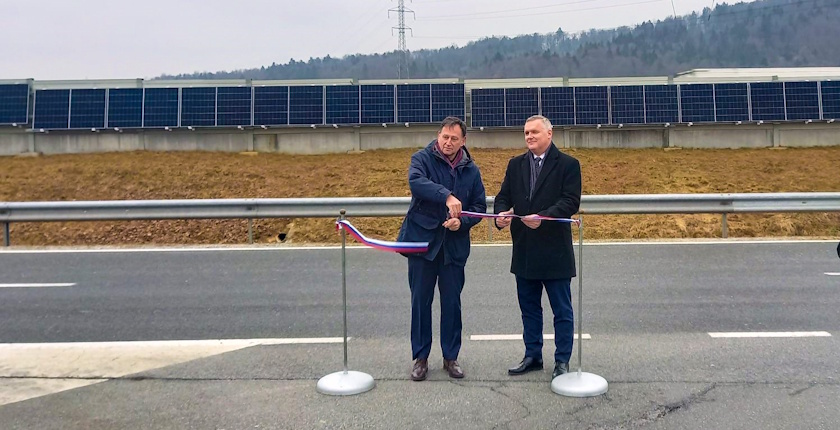
Slovenia opens its first highway solar power plant

Slovenia’s road management firm Družba za Avtoceste v Republiki Sloveniji has installed a solar power plant on a noise barrier alongside a highway. It is the first such photovoltaic system in the country.

Družba za avtoceste v Republiki Sloveniji (DARS) has officially opened its first photovoltaic plant on a noise barrier at the Šmarje Sap West rest area. It is about ten kilometers from Ljubljana on the motorway connecting the Slovenian capital and Zagreb.

According to DARS, the project is part of a series of activities to achieve the company’s strategic goals in sustainable development, decarbonization, and efficient energy use.

The firm announced the development of such projects in July 2023. A pioneering idea in the region, it was later followed by Bosnia and Herzegovina, Montenegro, and Croatia.

Ribič: An example of thoughtful siting of renewable power plants

The opening ceremony was attended by the Chairman of the Management Board of DARS Andrej Ribič, Minister of the Environment, Climate and Energy Bojan Kumer, representatives of the contractor – Solvera Lynx, and representatives of distribution system operator Elektro Ljubljana.

Andrej Ribič stressed that the project is significant for electricity production but also as an example of thoughtful siting of renewable energy power plants without impacting traffic safety or routine highway maintenance.

The electricity generated by the PV system will be used for DARS’s own consumption, including public lighting and tunnel systems, he explained. This will ensure greater energy independence and more rational management of the energy system, Ribič added.

DARS plans to continue building PV plants

In line with its strategy, DARS aims to gradually reduce energy consumption from the grid and lower CO2 emissions in scopes 1 and 2. By 2030, the goal is to reduce energy consumption and carbon emissions by 30% from the 2024 levels, according to the firm.

Based on its revised strategy, DARS adopted several energy measures in 2024. They included the establishment of an energy department and the implementation of the first phase of solar installations across its five facilities, with a total capacity of 420 kW.

These plants can cover approximately 2% of the company’s annual electricity consumption.

DARS intends to further expand its solar energy projects. The plan includes building bigger plants in degraded areas and more PV systems on buildings and along highway tunnels.

The electricity produced would primarily power lighting and other road systems to ensure the safe and smooth operation of the motorway network, the company added.

Careful site selection for solar plants is crucial

In July 2023, DARS and state-owned hydropower operator Soške Elektrarne Nova Gorica (SENG) announced plans to build solar power plants along highways.

The first one was planned in the Slovenian Littoral and Coastal-Karst area. However, the new solar power plant is not located there.

The two firms later established similar cooperation with the Ministry of Defense and the Municipality of Vipava.

Solar energy use is expanding all over the planet. Experts warn that the optimal siting of PV panels is crucial to avoid occupying large areas of arable land or harming the environment. Therefore, the best solution is to install solar panels in locations that cannot be used for other purposes, such as alongside railways and roads, or on rooftops.

by in News

Slovenia to aid energy-intensive companies with EUR 30 million per year

The Government of Slovenia has adopted a bill on state aid for energy-intensive companies.

Minister of the Environment, Climate and Energy Bojan Kumer said following a government session that the bill on state aid for energy-intensive companies addresses the serious challenges facing this segment of the Slovenian economy.

He added that these companies generate high added value, account for a significant share of Slovenia’s exports, and provide thousands of quality jobs, often in regions which offer no alternative employment opportunities.

According to an analysis from last May, electricity tariffs for Slovenian businesses were among the highest in the European Union.

The law aims to ensure competitiveness for companies exposed to international competition, for which electricity costs are a key factor in business operations.

Around 40 companies should benefit from the state aid

In difficult global economic conditions, support for energy-intensive companies is essential to help them remain competitive in international markets, the minister emphasized.

The subsidies will be limited to electricity consumption over the next three years, including 2026. The ministry expects them to be available to approximately 40 companies in the chemical, steel, and paper industries.

The law defines clear criteria for receiving aid, limits on the amount of support, control mechanisms, and sanctions in case of violations, with the beneficiaries required to allocate at least half of the received aid to sustainable investments, according to the ministry.

The annual electricity consumption threshold is 15 GWh

Funding for the subsidies will come from sources outside the state budget, through companies wholly owned by the government that operate the country’s key electricity generation capacities. The estimated amount of aid is approximately EUR 30 million a year.

The government will send the bill to parliament for consideration under a fast-track procedure, as its implementation will require timely approval from the European Commission.

To qualify for the subsidies, companies will have to meet criteria including annual electricity consumption of more than 15 GWh and a share of electricity costs in the company’s added value of at least 5%, Naš stik reported.

They will also be required to have an established energy management system and to invest at least half of the savings from lower electricity prices in decarbonizing production or improving energy efficiency.

by in News

Slovenia again uses shortcut to meet national renewables target

Slovenia will purchase renewable energy from Croatia through a statistical transfer to meet its 2024 renewable energy target.

A statistical transfer is allowed at the European Union to help member states meet their national renewable energy targets. This will be the fourth time Slovenia has used this option in the 2020-2024 period.

Since 2020, the 25% goal for renewable energy’s share in gross final consumption has only been reached in 2023. The shortfall for 2024, when the share was 24.6%, will be covered by purchasing 207 GWh from Croatia for EUR 1.78 million, or EUR 8.60 per MWh, Žurnal24 reported.

The Czechs and Croats have benefited from Slovenia’s failure to reach the set goal

In 2020, Slovenia paid the Czech Republic EUR 5 million for a missing 465 MWh. The same country assisted it in 2021 as well, and the price for the service was EUR 2 million, for 208 MWh. According to the Ministry of Infrastructure, which was in charge of energy at the time, it did it to retain access to the EU’s Cohesion Fund for 2021-2027.

Slovenia paid the most in 2022, EUR 10.8 million for 1,193 MWh, to Croatia. In total, since 2020, nearly EUR 20 million has been spent on statistical transfers from the Czech Republic and Croatia.

EUR 20 million in total went to Czechia and Croatia

The government in Ljubljana covered the cost from renewable energy support funds, managed by electricity market operator Borzen.

The problem could become even bigger as the national target will increase to 33%

The Ministry of Environment, Climate and Energy attributed the failure to reach the 2024 goal to an increase in the consumption of fossil fuels.

It was 1 TWh higher than in 2023. However, the issue could get even worse. Slovenia faces new targets from 2030 on.

The minimum share set in the National Energy and Climate Plan (NECP) is 33%. It means that the share should increase by at least 1.6 percentage points per year on average over the next five years to avoid new payments.

by in News

Slovenia again uses shortcut to meet national renewables target

Slovenia will purchase renewable energy from Croatia through a statistical transfer to meet its 2024 renewable energy target.

A statistical transfer is allowed at the European Union to help member states meet their national renewable energy targets. This will be the fourth time Slovenia has used this option in the 2020-2024 period.

Since 2020, the 25% goal for renewable energy’s share in gross final consumption has only been reached in 2023. The shortfall for 2024, when the share was 24.6%, will be covered by purchasing 207 GWh from Croatia for EUR 1.78 million, or EUR 8.60 per MWh, Žurnal24 reported.

The Czechs and Croats have benefited from Slovenia’s failure to reach the set goal

In 2020, Slovenia paid the Czech Republic EUR 5 million for a missing 465 MWh. The same country assisted it in 2021 as well, and the price for the service was EUR 2 million, for 208 MWh. According to the Ministry of Infrastructure, which was in charge of energy at the time, it did it to retain access to the EU’s Cohesion Fund for 2021-2027.

Slovenia paid the most in 2022, EUR 10.8 million for 1,193 MWh, to Croatia. In total, since 2020, nearly EUR 20 million has been spent on statistical transfers from the Czech Republic and Croatia.

EUR 20 million in total went to Czechia and Croatia

The government in Ljubljana covered the cost from renewable energy support funds, managed by electricity market operator Borzen.

The problem could become even bigger as the national target will increase to 33%

The Ministry of Environment, Climate and Energy attributed the failure to reach the 2024 goal to an increase in the consumption of fossil fuels.

It was 1 TWh higher than in 2023. However, the issue could get even worse. Slovenia faces new targets from 2030 on.

The minimum share set in the National Energy and Climate Plan (NECP) is 33%. It means that the share should increase by at least 1.6 percentage points per year on average over the next five years to avoid new payments.

by in News

Slovenia to aid energy-intensive companies with EUR 30 million per year

The Government of Slovenia has adopted a bill on state aid for energy-intensive companies.

Minister of the Environment, Climate and Energy Bojan Kumer said following a government session that the bill on state aid for energy-intensive companies addresses the serious challenges facing this segment of the Slovenian economy.

He added that these companies generate high added value, account for a significant share of Slovenia’s exports, and provide thousands of quality jobs, often in regions which offer no alternative employment opportunities.

According to an analysis from last May, electricity tariffs for Slovenian businesses were among the highest in the European Union.

The law aims to ensure competitiveness for companies exposed to international competition, for which electricity costs are a key factor in business operations.

Around 40 companies should benefit from the state aid

In difficult global economic conditions, support for energy-intensive companies is essential to help them remain competitive in international markets, the minister emphasized.

The subsidies will be limited to electricity consumption over the next three years, including 2026. The ministry expects them to be available to approximately 40 companies in the chemical, steel, and paper industries.

The law defines clear criteria for receiving aid, limits on the amount of support, control mechanisms, and sanctions in case of violations, with the beneficiaries required to allocate at least half of the received aid to sustainable investments, according to the ministry.

The annual electricity consumption threshold is 15 GWh

Funding for the subsidies will come from sources outside the state budget, through companies wholly owned by the government that operate the country’s key electricity generation capacities. The estimated amount of aid is approximately EUR 30 million a year.

The government will send the bill to parliament for consideration under a fast-track procedure, as its implementation will require timely approval from the European Commission.

To qualify for the subsidies, companies will have to meet criteria including annual electricity consumption of more than 15 GWh and a share of electricity costs in the company’s added value of at least 5%, Naš stik reported.

They will also be required to have an established energy management system and to invest at least half of the savings from lower electricity prices in decarbonizing production or improving energy efficiency.

by in News

Slovenian DSO registers enormous interest in connecting BESS to distribution grid

Applications for 400 MW have been submitted for the connection of battery energy storage systems to the distribution grid, according to Elektro Ljubljana, one of the distribution system operators in Slovenia.

Slovenia’s distribution system operators (DSOs) are getting an increasing number of requests to connect battery storage systems directly to distribution substations. Notably, in early May, the five Slovenian DSOs fed more electricity into the transmission network than they drew from it for the first time, and for two consecutive days.

Matjaž Osvald, Executive Director of Operation and Development of the Distribution Network in DSO Elektro Ljubljana, pointed out that last summer the company observed increased investor interest in directly connecting batteries to distribution substations.

It issued installation terms for 90 MW, and requests for at least as much are waiting to be processed, he added.

Installation terms were issued for batteries with 90 MW in overall capability

However, the company estimated there could be at least 300 MW more in applications. Due to the technical limitations of existing substations, much less could be connected. Substations in the Elektro Ljubljana area are already overloaded and don’t allow additional connections of larger devices, Osvald explained.

Furthermore, upgrading or constructing new facilities is a lengthy process, he pointed out. Current delivery times for transformers alone are longer than two years, with financing also being an issue.

According to Osvald, batteries would be used to store energy from solar power plants, and three types of investors have emerged. One group wants to install batteries to provide system services for system operators on the European market or for electricity trading.

Three types of investors are submitting applications

The second and third batch aim to bring their projects to a certain stage of development and then sell them – either they would purchase land, obtain permits, and install a battery, or only buy land and obtain permits for energy storage.

Osvald expressed concern about the idea of using batteries solely to provide system services in the European market. In that case, there would be no benefits for the Slovenian distribution network, but it could create problems, he stressed.

Such use would occupy all available connection capacity in substations, which, with increasing electrification, could lead to no spare capacity for other grid users, according to Osvald.

He also pointed to the value of BESS for the distribution network in reducing peak loads and consumption.

  • 1
  • 2