by in News

Serbia’s EPS starts trial operation of its Petka PV plant on coal tailings dump

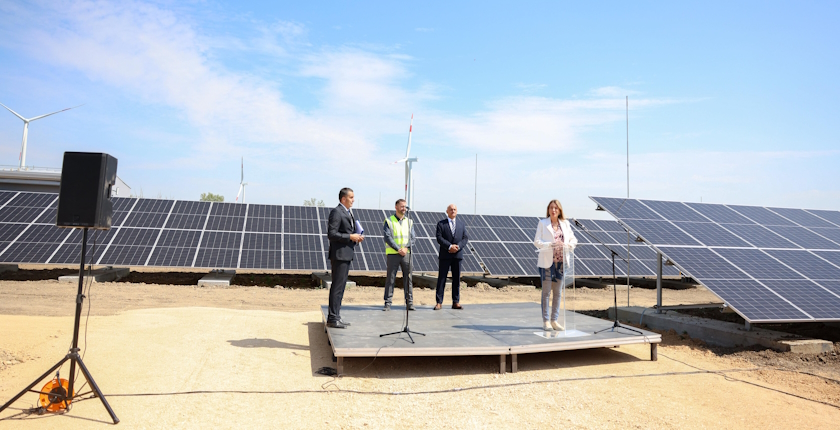
Serbian state-owned power utility Elektroprivreda Srbije, EPS, connected its first larger photovoltaic unit to the grid. The new solar power plant is called Petka and it has a 10 MW grid connection. It is located in the Kostolac coal mining complex east of Belgrade, next to a wind park that is nearing completion. Each new megawatt is important, according to Minister of Mining and Energy Dubravka Đedović Handanović and the company’s Chief Executive Officer Dušan Živković.

After many years of planning and launching numerous solar power projects, EPS launched the trial operation of its first larger facility of the kind. The Petka PV system has 10 MW in connection capacity. It is located on a former tailings dump of the Ćirikovac open pit coal mine in the Kostolac complex.

“It is another important pioneering milestone in our energy sector. We are now producing clean, green energy on the site of an old mining dump, which is a turning point and the beginning of the energy transition of Elektroprivreda Srbije and an example how we can use old energy for new energy,” Minister of Mining and Energy Dubravka Đedović Handanović stated.

Of note, EPS recently installed solar panels of 948 kW total on the buildings within the Termoelektrana Nikola Tesla A (TENT A) coal power plant and of TENT’s rail transportation arm. Another photovoltaic system is on the Lazići dam in Zaovine, belonging to the state-owned utility’s Bajina Bašta hydropower plant.

EPS to connect adjacent wind park Kostolac to grid next month

There are no big or small projects, as every megawatt is important for Serbia’s energy security and it means greater security, Đedović Handanović pointed out.

“In addition to the Petka solar power plant, wind generators of EPS’s first wind park stand tall today in the mining area. They are also built mainly on recultivated tailings dumps. We expect the connection to the grid in August and a testing phase, when the blades will start spinning. That way we will strengthen our electricity system here in Kostolac by 76 MW of green energy,” the minister said.

The ministry’s priorities are the projects for the Bistrica pumped storage hydropower plant and battery-backed solar power plants of 1 GW in total connection capacity

She recalled that the strategic goal of the Government of Serbia is defined by the Energy Development Strategy, to reach a 45% share of renewable energy sources by 2030.

“We have much more to do and put in maximum efforts, because ahead of us are strategic projects which will change Serbia’s electricity bloodflow to a significant extent. They primarily entail the construction of the Bistrica pumped storage hydropower plant and the project for solar power plants of 1 GW with battery storage units. Energy investments necessary in the next ten years are estimated at about EUR 14 billion. Therefore, we must make up for all the delays and be up to the task, to secure energy tranquility for the future generations”, Đedović Handanović added.

EPS continuing with other green projects in its coal mining areas

EPS’s Chief Executive Officer Dušan Živković said each new megawatt is important for the company and the electricity system, especially in tropical days, when electricity demand is getting higher and higher.

“Not only are we strengthening our green portfolio that way, but also the reliability of the entire energy system, while citizens and companies have a secure supply, the same as until now. Projects like this one are concrete steps toward decarbonization and a sustainable energy development, which are also our goals for the decades to come. We will continue with the similar projects both here in Kostolac and also at dumping and landfilling sites in other parts of EPS,” he asserted.

Petka is one of the first PV facilities in the Western Balkans on former coal exploitation locations.

In addition, the construction of the Kostolac B3 coal plant in the same complex was finished last year. It was EPS’s first big energy production system in more than three decades.
by in News

Impact Report 2024: GGF grows direct lending, committed to energy transition, energy security

In its Impact Report 2024, the Green for Growth Fund outlined how it powers the green transition across Southeast Europe, the Caucasus and beyond – from repurposing coal sites and decarbonizing industries to strengthening energy security and building climate resilience. It ended last year with EUR 1.09 billion in assets under management and an outstanding investment portfolio of EUR 1.03 billion.

Luxembourg-based GGF has become one of the largest green blended-finance funds. It marked its 15th anniversary in 2024 by passing the EUR 1 billion mark in its portfolio.

“To date, we have delivered over EUR 2 billion in green finance through 70+ active financial institutions, companies, and infrastructure projects. This is impact on a systematic level and reflects the dedication of our partners, teams, and investors. We delivered many landmark projects as we continue to grow our direct lending,” the fund said in its 2024 Impact Report: Breaking the billion for lasting green impact.

GGF highlighted its role in transforming legacy energy systems into clean energy sites in North Macedonia. “We are also investing in corporate decarbonization across resource-intensive sectors in Turkey, including the country’s second-largest retail chain. Working with our financial institution partners, Ukraine’s energy security – and the security of the wider region – remains our focus,” the update reads.

Driving the energy transition and strengthening energy security is an urgent task, the fund said and stressed that its commitment remains strong. It ended 2024 with EUR 1.09 billion in assets under management and an outstanding investment portfolio of EUR 1.03 billion.

Energy-intensive sectors in region can decarbonize

The cumulative volume invested in partner lending institutions has reached EUR 2 billion. GGF is active in 18 countries.

“Passing the EUR 1 billion mark brings greater responsibility. We must continue to show the world that energy-intensive sectors in the region can decarbonize and renewables can lead to energy stability and security,” Chairperson of the Board of Directors Simon Gupta stated.

Headline figures include 1.4 million tons of carbon dioxide emission savings per year, which is the equivalent of taking 949,000 cars off the road. GGF supported 1.76 GW of renewable energy capacity through 2024, which is a whopping 36.4% more than one year before. Its activity resulted in 2.16 million cubic meters of water saved or treated per annum, which translates to 865 swimming pools.

GGF strategically manages impact through supporting measures that mitigate climate change and promote sustainable economic growth in Southeast Europe including Turkey, the European Eastern Neighborhood Region, and the Middle East and North Africa.

From coal pit to solar plant

Recognizing the need for energy independence, the Western Balkans are prioritizing projects that support the green energy transition, GGF pointed out.

“But financing is essential to help countries shift to domestic and clean renewable power. We arranged EUR 25.7 million in project financing for a 50 MW solar power generation project on the site of the former Oslomej coal mine in Kičevo, North Macedonia,” it added.

GGF arranged a EUR 25.7 million package for a PV plant on former coal mining land in the REK Oslomej complex in North Macedonia

The region’s reliance on legacy coal-fired power plants has resulted in outages, shortfalls, closures and volatile energy costs, GGF warned. “Governments recognize this and are increasingly prioritizing sustainable power projects aimed at reducing fossil fuel imports, lowering costs and stabilizing energy supply. To fulfill this ambitious agenda, they need support,” the fund stressed.

Oslomej is GGF’s second project finance transaction in North Macedonia, following its investment as a minority shareholder in the 36 MW Bogoslovec wind farm in 2021.

“Our investment in the Oslomej solar project underscores our commitment to North Macedonia’s green energy transition. By reducing reliance on fossil fuels and enhancing energy security, this project aligns with our mission to mitigate climate change and promote sustainable energy solutions,” said Fund Director for GGF at Finance in Motion Borislav Kostadinov.

Of note, he was one of the keynote speakers at this year’s edition of Belgrade Energy Forum (BEF 2025), organized by Balkan Green Energy News. Finance in Motion is GGF’s advisor.

Future-proofing Turkish businesses

The fund provided USD 26 million to Sanko Tekstil, one of the largest yarn producers in Turkey. It financed the full cost of a 20 MW rooftop photovoltaic system and partially covered the construction of a fiber recycling facility in Gaziantep.

Meanwhile, a USD 18 million investment into A101, the country’s second-largest retail chain, is decarbonizing store operations across 81 cities via a large-scale solar installation. It supported a 30 MW solar power project, expected to meet 10% of the company’s electricity needs.

Embedding sustainability

GGF complements its financing with advisory and capacity-building services, and risk-management support. It includes environmental and social due diligence, as well as monitoring, to keep projects aligned with international best practices.

The advisory and capacity-building activities in 2024 focused on embedding sustainability and advancing green finance across partner institutions.

A key highlight was the completion of four Deep Greening Mainstreaming projects, which supported financial institutions in developing strategies in the environmental, social, and governance (ESG) sector, green products, and internal sustainability structures.

by in News

GGF grows direct lending, committed to energy transition, energy security

In its Impact Report 2024, Green for Growth Fund outlined how it powers the green transition across Southeast Europe, the Caucasus and beyond – from repurposing coal sites and decarbonizing industries to strengthening energy security and building climate resilience. It ended last year with EUR 1.09 billion in assets under management and an outstanding investment portfolio of EUR 1.03 billion.

Luxembourg-based GGF has become one of the largest green blended-finance funds. It marked its 15th anniversary in 2024 by passing the EUR 1 billion mark in its portfolio.

“To date, we have delivered over EUR 2 billion in green finance through 70+ active financial institutions, companies, and infrastructure projects. This is impact on a systematic level and reflects the dedication of our partners, teams, and investors. We delivered many landmark projects as we continue to grow our direct lending,” the fund said in its 2024 Impact Report: Breaking the billion for lasting green impact.

GGF highlighted its role in transforming legacy energy systems into clean energy sites in North Macedonia. “We are also investing in corporate decarbonization across resource-intensive sectors in Turkey, including the country’s second-largest retail chain. Working with our financial institution partners, Ukraine’s energy security – and the security of the wider region – remains our focus,” the update reads.

Driving the energy transition and strengthening energy security is an urgent task, the fund said and stressed that its commitment remains strong. It ended 2024 with EUR 1.09 billion in assets under management and an outstanding investment portfolio of EUR 1.03 billion.

Energy-intensive sectors in region can decarbonize

The cumulative volume invested in partner lending institutions has reached EUR 2 billion. GGF is active in 18 countries.

“Passing the EUR 1 billion mark brings greater responsibility. We must continue to show the world that energy-intensive sectors in the region can decarbonize and renewables can lead to energy stability and security,” Chairperson of the Board of Directors Simon Gupta stated.

Headline figures include 1.4 million tons of carbon dioxide emission savings per year, which is the equivalent of taking 949,000 cars off the road. GGF supported 1.76 GW of renewable energy capacity through 2024, which is a whopping 36.4% more than one year before. Its activity resulted in 2.16 million cubic meters of water saved or treated per annum, which translates to 865 swimming pools.

GGF strategically manages impact through supporting measures that mitigate climate change and promote sustainable economic growth in Southeast Europe including Turkey, the European Eastern Neighborhood Region, and the Middle East and North Africa.

From coal pit to solar plant

Recognizing the need for energy independence, the Western Balkans are prioritizing projects that support the green energy transition, GGF pointed out.

“But financing is essential to help countries shift to domestic and clean renewable power. We arranged EUR 25.7 million in project financing for a 50 MW solar power generation project on the site of the former Oslomej coal mine in Kičevo, North Macedonia,” it added.

GGF arranged a EUR 25.7 million package for a PV plant on former coal mining land in the REK Oslomej complex in North Macedonia

The region’s reliance on legacy coal-fired power plants has resulted in outages, shortfalls, closures and volatile energy costs, GGF warned. “Governments recognize this and are increasingly prioritizing sustainable power projects aimed at reducing fossil fuel imports, lowering costs and stabilizing energy supply. To fulfill this ambitious agenda, they need support,” the fund stressed.

Oslomej is GGF’s second project finance transaction in North Macedonia, following its investment as a minority shareholder in the 36 MW Bogoslovec wind farm in 2021.

“Our investment in the Oslomej solar project underscores our commitment to North Macedonia’s green energy transition. By reducing reliance on fossil fuels and enhancing energy security, this project aligns with our mission to mitigate climate change and promote sustainable energy solutions,” said Fund Director for GGF at Finance in Motion Borislav Kostadinov.

Of note, he was one of the keynote speakers at this year’s edition of Belgrade Energy Forum (BEF 2025), organized by Balkan Green Energy News. Finance in Motion is GGF’s advisor.

Future-proofing Turkish businesses

The fund provided USD 26 million to Sanko Tekstil, one of the largest yarn producers in Turkey. It financed the full cost of a 20 MW rooftop photovoltaic system and partially covered the construction of a fiber recycling facility in Gaziantep.

Meanwhile, a USD 18 million investment into A101, the country’s second-largest retail chain, is decarbonizing store operations across 81 cities via a large-scale solar installation. It supported a 30 MW solar power project, expected to meet 10% of the company’s electricity needs.

Embedding sustainability

GGF complements its financing with advisory and capacity-building services, and risk-management support. It includes environmental and social due diligence, as well as monitoring, to keep projects aligned with international best practices.

The advisory and capacity-building activities in 2024 focused on embedding sustainability and advancing green finance across partner institutions.

A key highlight was the completion of four Deep Greening Mainstreaming projects, which supported financial institutions in developing strategies in the environmental, social, and governance (ESG) sector, green products, and internal sustainability structures.

by in News

Public call for funding for energy communities in Western Balkans

The Emilia-Romagna Region in northern Italy is supporting the creation and strengthening of renewable energy communities (RECs) in five countries in the Western Balkans. Ten projects can receive up to EUR 200,000 each, alongside technical and other support.

For-profit and non-profit entities in Albania, Bosnia and Herzegovina, Montenegro, North Macedonia and Serbia are eligible for an open call for the setup, empowerment and potential investment in renewable energy communities (RECs). Within a project funded by the European Commission’s Directorate-General for Regional and Urban Policy (DG Regio), the Emilia-Romagna Region invited expressions of interest.

The initiative is called Better Cohesion through Development of Energy Communities in the Western Balkans. The administration of the northern Italian region is conducting the activity with the support of its consortium ART-ER Attractiveness Research Territory. It includes universities, research institutions, the regional chamber of commerce, local authorities and other stakeholders.

Up to 10 projects, or two per country, would receive a maximum of EUR 200,000, together with support in financial planning and community governance, technical assistance and mentoring and access to a digital energy management tool.

Phase 2 is for existing renewable energy communities

Eligible applicants in phase 1 include municipalities, nongovernmental organizations, associations, cooperatives, small and medium-sized enterprises and informal citizen groups with the capacity to formalize. All project activities must be carried out on a not-for-profit basis, meaning any surplus must be reinvested in the community.

Cross-border projects with partners in Croatia, Greece, Slovenia and Italy are eligible

Phase 1 is for candidates looking to activate a new energy community from the ground up — from stakeholder mobilisation to legal establishment. Existing renewable energy communities can enter in phase 2, to assess feasibility and conduct small-scale energy infrastructure investment.

The Emilia-Romagna Region pointed out that the call is also open for cross-border projects with partners in Croatia, Greece, Slovenia, and Italy – the European Union member states within the EU Strategy for the Adriatic and Ionian Region (EUSAIR).

Second deadline to submit drafts is October 20

Applicants are encouraged to engage with the process even at an early or conceptual stage of their initiative, as technical support and guidance will be provided to strengthen and finalize proposals, according to the documentation. The call will consist of two rounds.

The first draft proposal submission deadline is July 16, followed by the negotiation phase until August 22 and a deadline for final proposals on September 8. The respective dates for the second round are October 20, November 21 and December 5.

Applicants that are not yet ready can participate in the second round. It is also the opportunity to fulfill the quota of two projects per country.

Members of RECs must be located near their projects

The Western Balkans are introducing the legal framework for citizen energy communities (CECs) and renewable energy communities (RECs).

Shareholders or members of a renewable energy community are located in the proximity of the renewable energy project that it owns and develops. They are natural persons, small and medium-sized enterprises and local authorities.

A private enterprise can participate in RECs if it isn’t its primary commercial or professional activity

RECs utilize technology for energy production only from renewable sources, encompassing electricity, gas and heat. Private enterprises can participate in such a community only if it isn’t their primary commercial or professional activity.

CECs are limited to electricity but they can use fossil fuels

Citizen energy communities gather individuals, local authorities including municipalities and small enterprises. They engage in generation, distribution, supply, consumption, aggregation, energy storage, energy efficiency services and charging services for electric vehicles. CECs can also provide other energy services to its members or shareholders.

They can operate on a national scale and have the flexibility to employ both fossil fuel– and renewables-based technologies, but solely for electricity production. The range of activities of CECs is broader than for RECs.

by in News

Satellite dishes get new life, hosting solar panels for data center

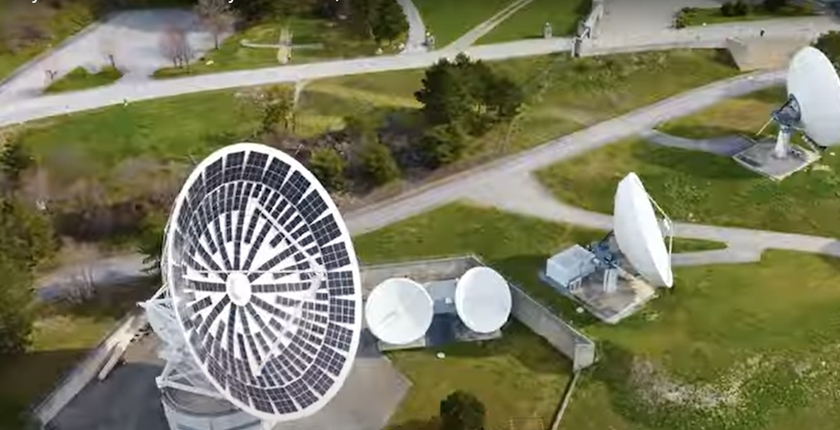
A Swiss telecom service provider converted unused satellite dishes into solar dishes, powering its data center’s rising energy needs. Smart energy tech firm SolarEdge provided its DC-optimized inverter solution, overcoming the challenge of shading.

CKW, a Swiss provider of integrated energy and building technology solutions, has transformed disused satellite dishes located on the premises of telecom service provider Leuk TDC. The project was developed in collaboration with smart energy technology company SolarEdge, highlighting the potential of repurposing infrastructure for solar.

Instead of disposing of the parabolic antennas, they now host photovoltaic systems. Axpo’s subsidiary CKW fitted two satellite dishes in Leuk, Switzerland, with 307 solar panels each.

The new design for the complex, constructed in 1972, enables meeting the energy requirements of Leuk TDC’s power-hungry data centre. Each dish generates an estimated 110 MWh of clean energy per year. The telecommunications firm has also installed a rooftop solar system on the main building of the computing and data centre, for a further 555 MWh.

The data centre is powered by hydroelectric plants as well, so its electricity demand is covered with 100% renewable energy.

[wpcc-iframe title=”Case study: Satellite Dish to PV System – Leuk, Switzerland” width=”500″ height=”281″ src=”https://www.youtube.com/embed/dR2ETrx3aJ0?feature=oembed” frameborder=”0″ allow=”accelerometer; autoplay; clipboard-write; encrypted-media; gyroscope; picture-in-picture; web-share” referrerpolicy=”strict-origin-when-cross-origin” allowfullscreen=””]

SolarEdge systems maximizing output of each pair of PV panels in satellite dishes

Given the complex orientation and inclination of the solar panels on the satellite dishes, shadows threatened to reduce the efficiency of the solar system. With traditional string solar inverters, they reduce the overall performance of the solar array to match the weakest-performing panel on the string, meaning one shaded panel could reduce energy yield considerably.

In a string structure, a photovoltaic unit in a satellite dish wouldn’t be cost-effective

SolarEdge’s DC-optimized inverter solution was used with Power Optimizers, attached to the underside of every pair of solar panels. It enables the solar system to mitigate the impact of module mismatch on the satellite dishes. Inverters turn the direct current (DC) from PV panels into alternating current (AC).

“Having design flexibility with a solar installation is a huge benefit for installers. In complex cases such as these, with uneven surfaces, without the use of power optimizers we simply would not have been able to achieve anywhere close to the level of energy being produced today. I recommend that others planning similar solar installations allocate sufficient time for planning and collaborate with trusted personnel to overcome any technical challenges,” said CKW’s Deputy Head of Solar Technology for Central Switzerland Manuel Jossi.

Making use of existing ability to track sun’s movement

The combination of PV and hydropower provides Leuk TDC with more financial stability by reducing its dependency on variable grid electricity costs. “The satellite dishes were becoming obsolete, so we always knew we wanted to make use of them in some way or another,” the company’s Chief Executive Officer John Harris explained.

One other advantage is that the parabolic antennas follow the sun’s path throughout the day, maximizing the solar power output.

by in News

Grants for public institutions’ solar projects in Romania top EUR 500 million

The Romanian Ministry of Energy has signed 29 more grants to public entities for investments in solar power plants for self-consumption, bringing the total number of projects under the program to 1,046. The latest round of grants is worth EUR 11.3 million, putting the total sum approved so far at EUR 502 million.

The 29 grants, financed from the European Union’s Modernisation Fund, will help build solar power plants with a total installed capacity of 9.13 MW at schools, hospitals, city halls, and other institutions across Romania. It brings the total installed capacity supported under the program to over 403 MW, according to a press release from the Ministry of Energy.

The latest batch of projects puts the total planned capacity at over 403 MW

In many cases, installed renewable capacities cover up to 70% of the energy needs of public institutions, the ministry noted.

Romania’s outgoing Minister of Energy Sebastian Burduja hailed the program as a “paradigm shift,” noting that Romania was already in a new energy era, with local communities no longer just consumers, but active participants.

“Over the past two years, the Ministry of Energy has consistently provided support to local public authorities that understood the importance of investing in energy production for their own consumption. We have made funds available, simplified procedures, and worked side by side with beneficiaries so that the projects move forward quickly,” Burduja stated in a Facebook post.

The latest round of contracts covers public entities in 18 counties across the country: Arad, Argeș, Bacău, Brăila, Călărași, Constanța, Dâmbovița, Galați, Brașov, Gorj, Hunedoara, Maramureș, Mehedinți, Olt, Sibiu, Suceava, Teleorman, and Timiș.

The number of contracts has increased from 633 in March

In March, the ministry said it had signed 633 contracts, worth a combined EUR 339 million, of which EUR 294 million was from the Modernisation Fund. Total planned capacity at the time was 237.4 MW.

by in News

Federation of BiH launches grants program for prosumers

The Federation of BiH, one of the two entities constituting Bosnia and Herzegovina, has launched a grants program to co-finance the installation of rooftop solar power plants, expected to cover around 500 households a year and lead to an increase of 4.2 GWh in renewable electricity production.

Operator for Renewable Energy Sources and Efficient Cogeneration – Operator za OIEiEK estimates that the average installed capacity of the solar power plants will be 6 kW, and that the grants will help reduce greenhouse gas emissions by 3,800 tons a year.

The program will be funded from renewable energy surcharges

The program will be funded from renewable energy surcharges paid through electricity bills by all consumers in FBiH. Grants will be approved for two categories of applicants. The first one is vulnerable households whose annual consumption exceeds 3,500 kWh. The second covers those who consume more than 5,500 kWh a year and whose connection power is equal to or less than the requested installed capacity of the solar installation, according to the decision of the Operator za OIEiEK.

The maximum grant amount per applicant is BAM 7,000 (EUR 3,580), or up to 60% of the investment cost for users in the second category.

Damir Miljević: People in extreme energy poverty will get solar power plants for free

Although the budget and the anticipated scope of the program are modest, one positive aspect is that part of it is intended to fully cover the cost of PV installations for people in extreme energy poverty. They will receive a rooftop system free of charge, eliminating, partially but permanently, some of the concerns about financing their energy needs, according to Damir Miljević, a member of the Board of the Center for Sustainable Energy Transition (RESET), a BiH think tank.

Prosumers were introduced in the FBiH legislation two years ago, with the passage of a set of reform energy bills, including the Law on the Use of Renewable Energy Sources and Efficient Cogeneration.

At the national level in Bosnia and Herzegovina, prosumer regulations have not been adopted yet. According to some estimates, the country could cover half of its electricity consumption by installing solar panels on about a million roofs.

by in News

BESS factory of 1.5 GWh per year opening near Sofia in Bulgaria

International Power Supply (IPS), a Bulgarian manufacturer of battery energy storage systems, is about to launch operations at its new facility near Sofia. Its latest model has 8.2 MWh and fits into a standard container. The company plans to double the factory’s annual capacity to 3 GWh already by the end of the year.

IPS, headquartered in Sofia, is automating and scaling its production of battery energy storage systems (BESS). It is counting on growing demand in Europe, including the domestic market. The company already has orders for 7 GWh for the next three years, Chief Executive Officer Alexander Rangelov told the Kapital news website.

The systems in the new X-BESS line have 8.2 MWh in capacity, fitting into a standard TEU container of 20 feet (6.1 meters). Each consists of seven liquid-cooled modules of 1.17 MWh. The model has inverters of 4 MW, translating to a two-hour duration.

Serial production is about to begin in the Hemus high-tech industrial park near Bulgaria’s capital city. Initially, the annual capacity would be 1.5 GWh, but IPS aims to double it already by the end of the year.

IPS plans another, fully robotic factory

X-BESS started three years ago with a 6.5 MWh version. IPS is currently fulfilling contracts for 670 MWh for projects funded through the country’s National Recovery and Resilience Plan (NRRP or, in Bulgarian, PVU). The company also applied for EUR 150 million from the European Union’s Innovation Fund, for a fully robotic 5 GWh factory.

The majority owner of IPS, with 65.5%, is Power Technology Investment Group. It is controlled by the family of the founder Stoil Rangelov Trifonov. SIL Energy Invest has 31.5%. The Capital Investments Fund (CIFund) of the Bulgarian Development Bank holds the remaining 3%.

X-BESS includes a battery management system developed by IPS

The company mainly uses European parts and the lithium-iron-phosphate (LFP) battery cells are from China. The battery management system (BMS) is proprietary. The project pipeline includes a 5 MW rooftop solar power plant for the new factory, combined with own batteries.

IPS is looking for a strategic partner for further expansion.

Just ten days ago, a BESS facility of 124.1 MW – 496.4 MWh was inaugurated in Lovech in Bulgaria. The Ministry of Energy said it is the biggest in the European Union.

Deal with NEK for BESS at Vacha 1 hydroelectric plant

In consortium with GBS Energy Solutions, IPS recently won a tender for equipping the Vacha 1 hydropower plant with BESS. It is a pilot project of state-owned National Electricity Co. (NEK), which has several such investments underway.

The deal is for a system of at least 5 MW in capability and 10 MWh in capacity. The minimum round-trip efficiency is 85%. At 365 cycles per year, the contractors guarantee at least 60 GWh within the duration the 15-year arrangement. They won the job, which includes maintenance, with a bid of EUR 3.4 million.

NEK is also planning another pumped storage hydropower plant at the Vacha dam

Notably, Minister of Energy Zhecho Stankov said last week that NEK sent applications to the European Commission for four pumped storage hydropower projects. Initially, two facilities were planned, at the Batak and Dospat sites. Stankov revealed there would be two systems at Dospat.

The fourth new pumped storage hydroelectric plant is planned near Ravnogor, he said. The village is right next to Vacha 1 and the existing Orphey pumped storage system. The proposed facility would have some 800 MW in capacity, similar to Chaira, according to Stankov. The three existing pumped storage hydropower plants and the sites for the four projects are all in the Rhodope mountains in the south.

by in News

Global solar power capacity hits 2.2 TW in 2024, with Turkey among top growers

The world added 597 GW of photovoltaic capacity last year, achieving an astounding 36% rate of growth, SolarPower Europe found. China accounted for 55.1% of all new installations. Turkey is in the global top ten with its 1.42% annual share, while Greece is sixth in the world in the category of solar capacity per person.

SolarPower Europe calculated a much higher global total, 2.2 TW, for photovoltaic facilities at the end of 2024, than the International Renewable Energy Agency (IRENA) – 1.87 TW. The Global Market Outlook for Solar Power 2025-2029 showed annual growth of 36%, by a record 597 GW. The increase itself was 33% higher than in 2023, the update reads.

Photovoltaics accounted for 81% of all new renewable electricity capacity added worldwide. While remaining a modest contributor to overall electricity generation for now, its share reached 6.9%, nearly doubling in just three years. It took nearly 70 years to reach the first terawatt, but only two to more than double it.

Total global capacity is projected at 7.1 TW by 2030

Other renewables accounted for 25% of electricity output in 2024.

In its “most realistic,” moderate scenario, the report’s authors anticipate a 10% increase in new installations to 655 GW this year. Annual growth rates remain in the low double digits through 2029, reaching 930 GW. Total capacity is projected at 7.1 TW by 2030, compared to the 11 TW renewable energy target from the United Nations Climate Change Conference COP28.

China hosted 44% of global solar fleet at end-2024

A key issue is the uneven distribution of solar market growth, SolarPower Europe pointed out. China grew by 329 GW, which is 30% more than in 2023 and more than the combined total of the other top 10 markets! Of note, IRENA measured just 278 GW.

China’s increase was 55.1% of the global total last year. It hit 985 GW overall, the report reads. It is 44% of the global photovoltaics fleet, after 40% in 2023 and 34% in 2022. In IRENA’s statistics, China topped 50% of all solar power installations in the world.

Turkey spikes 76% to 19.7 GW

Turkey, the largest country in the region that Balkan Green Energy News covers, delivered 8.5 GW, catapulting its capacity by 76% to complete 2024 at 19.7 GW.

Its addition made up 1.42% of the world’s annual increase, earning it the seventh position. Turkey’s absolute increase was five times higher than in 2023. Rooftop photovoltaics attributed a stunning 90%.

There are nearly 70 companies in the country actively engaged in PV module manufacturing, with a total capacity exceeding 40 GW. Several investments in solar cell production increased the segment to 2 GW altogether in annual terms.

The number of countries with expansion greater than 1 GW per year is 35, after 31 in 2023. The group, which includes Greece, Romania and Bulgaria, is seen getting ten more members in 2025.

EU within reach of 2030 target

At the end of last year, Europe had a total installed capacity of 407 GW, which is 25.2% more than in 2023. The European Union accounted for 338 GW, growing 23.9%.

The medium scenario suggests the EU would climb to 797 GW altogether by 2030, exceeding the REPowerEU target of 750 GW. But it is 11% lower than in last year’s outlook.

In 2024, solar power generation in the European Union surpassed coal for the first time. Its share in the electricity mix exceeded 10% and reached 20% or more in markets such as Cyprus, Greece, Hungary and Spain. The last two even touched 25%.

Germany is Europe’s largest solar market for 13 years in a row. Overall capacity surged 21% to 101 GW.

Romania is advancing in 2025 by an estimated 67% to 2.9 GW. The government provided strong backing for the rally, advancing large-scale solar projects.

Greece is sixth in world in watts per capita

The report reveals that Germany became the third country hosting more than 1 kW of solar power per capita. It spiked 20.5% to 1,187 W.

The first is Australia, which leaped 10.9% to 1,521 W per person. The Netherlands advanced 13.4% to 1,491 W.

All other countries in the top 10 chart are in Europe. Greece is in the global vanguard, in the sixth place, after spiking 40.3% to 964 W for every inhabitant.

by in News

Self-consumption capacity set to break 1 GW in Greece

Renewable energy projects for self-consumption are expected to reach 1 GW this year in Greece.

According to the Green Tank, at the end of March 2025, self-consumption capacity amounted to 937.6 MW, of which the overwhelming majority (871.9 MW) was in photovoltaics.

It should be noted that last year the government introduced a big change in the segment. The net metering regime was abandoned in favor of net billing, following European guidelines.

Insufficient capacity limit

There were 32,955 self-consumption units in the country at the end of the first quarter. Projects in operation plus remaining applications are estimated at 1,865 MW, which is near the 2 GW ceiling, set by law.

Energy communities, small companies, farmers and individuals have asked for the available capacity to be increased.

They also complain that the Hellenic Distribution Network Operator (HEDNO or DEDDIE) is too slow with connecting them to the grid. The operator has mostly been integrating units in the category of up to 10.8 kW, while ignoring larger projects.

The Renewable Energy Sources Operator and Guarantees of Origin (DAPEEP) began accepting net billing applications for projects of over 10.8 kW only last month. It means it needs to accelerate connections to keep pace.

Renewable energy aggregators have warned that the regulatory framework is unclear when it comes to such projects and their representation in the market.