by in News

North Seas region signs landmark offshore wind deal

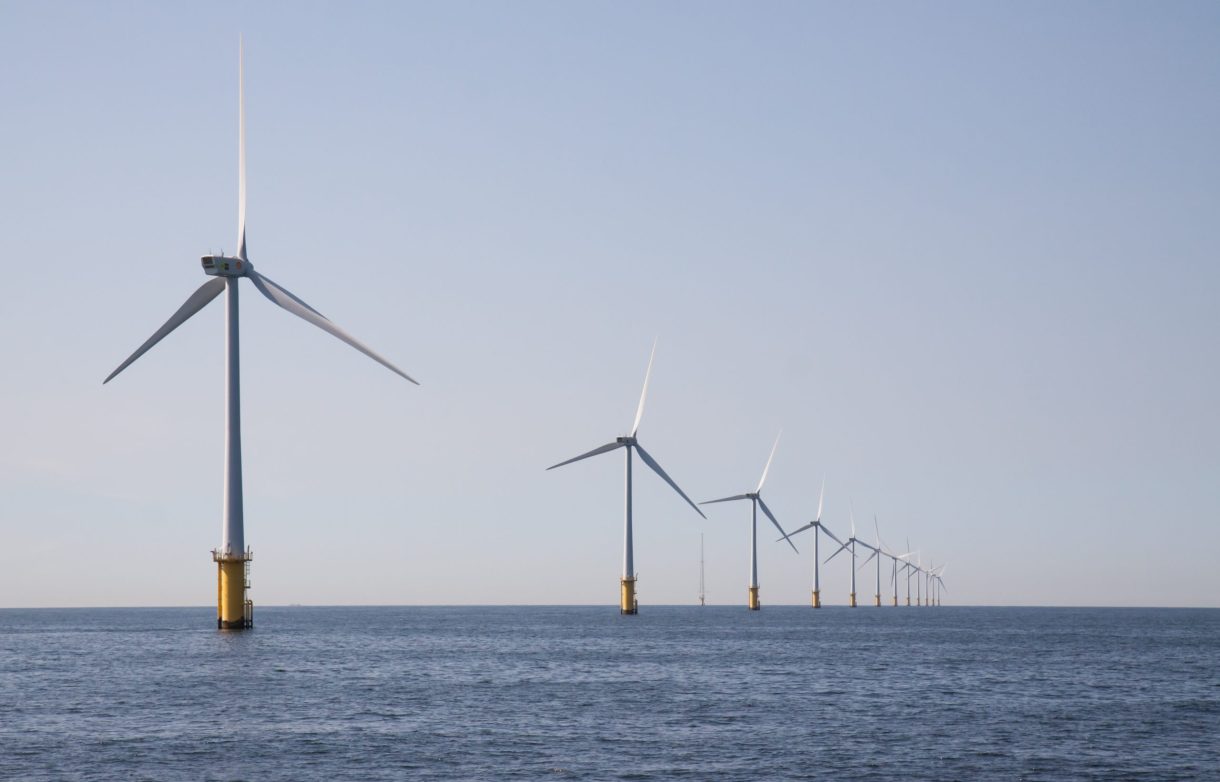
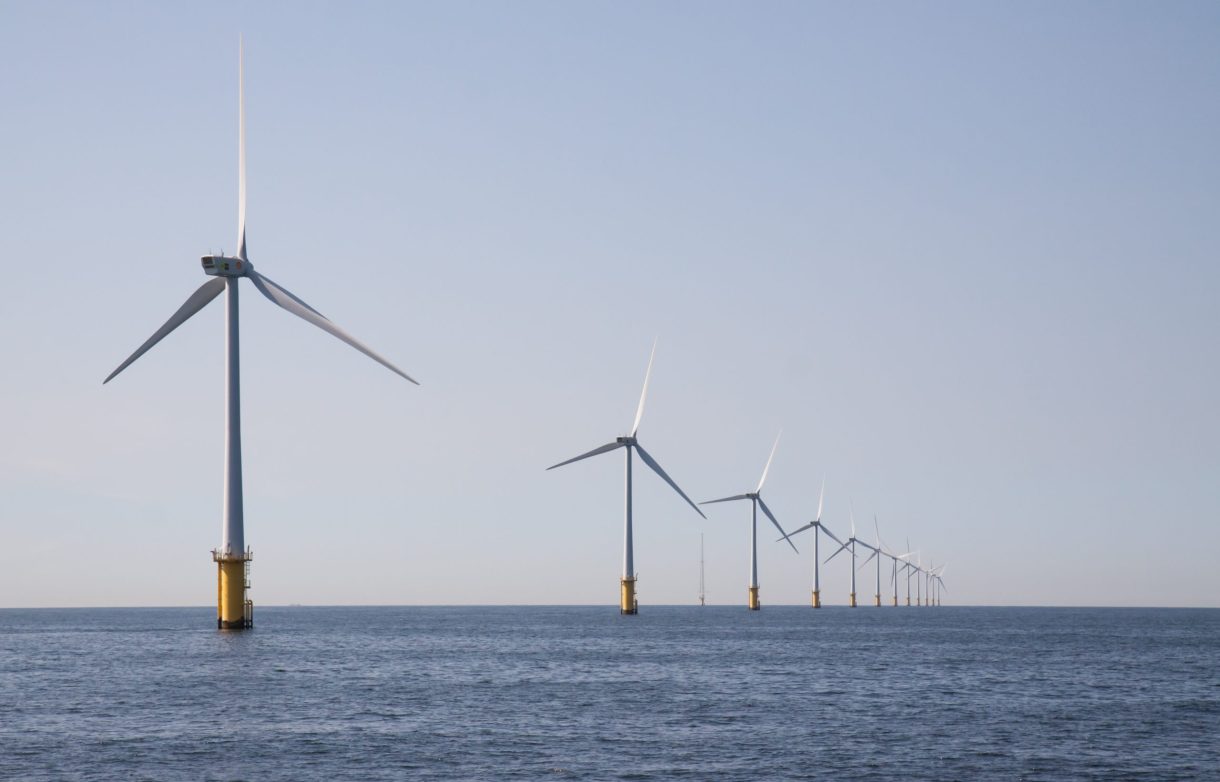
Seven heads of state and government and energy ministers of nine countries gathered in Hamburg today to boost the expansion of offshore wind. Together with industry and transmission system operators, the countries launched the Offshore Wind Investment Pact for the North Seas. They envisage cross-border projects totaling 100 GW.

Nine European countries committed to building 15 GW of offshore wind per year over 2031-2040 and derisking offshore wind investments. The industry, in return, pledged cost reductions, 91,000 additional jobs and EUR 1 trillion of economic activity.

Europe is charting the massive offshore wind buildout it needs to deliver on its energy security and competitiveness objectives, WindEurope said.

At the North Sea Summit in Hamburg today, Belgium, Denmark, France, Germany, Ireland, Luxembourg, the Netherlands, Norway and the United Kingdom confirmed their ambition to build 300 GW of offshore wind in the so-called North Seas by 2050.

Over one hundred companies participate in offshore wind pact

Governments, the wind industry and transmission system operators (TSOs) signed the Offshore Wind Investment Pact for the North Seas. The agreement is underpinned by separate declarations of the heads of state, energy ministers and the industry. The last of the three is an undertaking by more than 100 offshore wind companies across the value chain, the update adds.

Offshore wind has been a European success story with 37 GW installed across 13 countries, WindEurope stressed.

“That’s more than 6,000 turbines providing homegrown, clean and competitive electricity at scale. But deployment has been dragged by suboptimal auction design, increased costs of capital and lack of visibility for the supply chain due to an uncertain project pipeline,” the organization pointed out.

Two-sided CfDs to be auction standard

In the Investment Pact, governments pledge to provide planning and investment security and derisk offshore wind projects. It involves two-sided contracts for difference (CfDs) as the standard for offshore wind auction design, for visibility on revenue. The countries agreed to remove any regulatory obstacles to power purchase agreements (PPAs) – direct agreements between electricity producers and corporate end-consumers.

A steady pipeline of offshore wind projects will bring the needed confidence to invest in new capacity for manufacturing, ports infrastructure and vessels, according to WindEurope.

In return, Europe’s offshore wind industry pledges to drive down costs of offshore wind by 30% towards 2040 against the 2025 levels. The cost reduction would be driven by scale effects, lower costs of capital and further industrialization underpinned by clarity and visibility on the project pipeline.

The industry vowed to create lasting value for the economy, communities and consumers. It also said it would invest EUR 9.5 billion in the value chain including manufacturing, port infrastructure and vessels.

The TSOs intend to identify cost-effective cooperation opportunities and 20 GW of economically promising cross-border endeavors by 2027 for deployment in the 2030s. It includes offshore projects with interconnections to more than one country. The operators are about to develop cost-sharing principles.

The new partnership will secure 100 GW of joint offshore wind projects, Britain said.
by in News

Offshore wind turbines create conditions for richer marine ecosystems

In addition to contributing to the energy transition, offshore wind power plants have a positive impact on marine life. A new study, conducted by researchers from Murdoch University in Australia and Dalian Ocean University in China, shows that offshore wind farms enhance marine ecosystems and contribute to greater diversity in aquatic food chains.

The massive steel towers of offshore wind turbines are new solid and rough surfaces on an otherwise sandy seabed and they function as artificial reefs. Together with submarine cables, they enable the formation of habitats for sessile organisms.

Sessile organisms, such as sponges, corals, sea anemones and shellfish, are permanently attached to a surface and cannot move independently. They feed by filtering particles from the water or by waiting for prey to pass by.

“These organisms act as critical food sources and habitat for other species, and this has flow-on effects for overall ecosystem diversity and health,” explained James Tweedley, one of the researchers.

Scientists from Murdoch University and Dalian Ocean University compared data collected in 2023 and 2024 at the Zhuanghe offshore wind farm in the northern Yellow Sea in China with data from a control area without wind turbines, located about six kilometers to the east.

Built between 2019 and 2021, it is the largest wind farm off the coast of northeastern China, at 1.35 GW. The researchers used the Ecopath with Ecosim software, into which they input biological and environmental data.

The results showed a greater number of functional groups and increased complexity of the marine food web in the wind farm area, particularly among macroinvertebrates and fish.

Fish in wind farm area are up to three times larger

According to the study, published in the journal Global Ecology and Conservation, more than 50% of the total biomass around wind turbine foundations consists of sessile organisms, such as blue mussels (Mytilus edulis) and other filter-feeding invertebrates.

“These benthic-dominated ecosystems are critical for nutrient cycling, diversifying food webs and even storing carbon,” said Neil Loneragan, one of Western Australia’s leading experts on fish and marine biology. According to him, these findings provide a foundation for understanding how offshore wind farms interact with ecosystem energy dynamics and fisheries resources in coastal waters.

Most fish groups exhibited significantly higher biomass in the wind farm area, particularly species that live and feed closer to the seabed. This finding is consistent with the results of other studies suggesting that offshore wind farms act as fish aggregation devices, the paper notes.

Estimates showed that the fish Hexagrammos otakii was up to twice as large in the wind farm area than outside it, while Sebastes schlegelii was more than three times larger, as was the predatory Asian rapa whelk.

While acknowledging the risks associated with exploration and construction, including habitat destruction and disturbance to birds, marine mammals, and fish, the authors pointed out that seabed disturbance can increase food availability as well.

by in News

Offshore wind turbines create conditions for richer marine ecosystems

In addition to contributing to the energy transition, offshore wind power plants have a positive impact on marine life. A new study, conducted by researchers from Murdoch University in Australia and Dalian Ocean University in China, shows that offshore wind farms enhance marine ecosystems and contribute to greater diversity in aquatic food chains.

The massive steel towers of offshore wind turbines are new solid and rough surfaces on an otherwise sandy seabed and they function as artificial reefs. Together with submarine cables, they enable the formation of habitats for sessile organisms.

Sessile organisms, such as sponges, corals, sea anemones and shellfish, are permanently attached to a surface and cannot move independently. They feed by filtering particles from the water or by waiting for prey to pass by.

“These organisms act as critical food sources and habitat for other species, and this has flow-on effects for overall ecosystem diversity and health,” explained James Tweedley, one of the researchers.

Scientists from Murdoch University and Dalian Ocean University compared data collected in 2023 and 2024 at the Zhuanghe offshore wind farm in the northern Yellow Sea in China with data from a control area without wind turbines, located about six kilometers to the east.

Built between 2019 and 2021, it is the largest wind farm off the coast of northeastern China, at 1.35 GW. The researchers used the Ecopath with Ecosim software, into which they input biological and environmental data.

The results showed a greater number of functional groups and increased complexity of the marine food web in the wind farm area, particularly among macroinvertebrates and fish.

Fish in wind farm area are up to three times larger

According to the study, published in the journal Global Ecology and Conservation, more than 50% of the total biomass around wind turbine foundations consists of sessile organisms, such as blue mussels (Mytilus edulis) and other filter-feeding invertebrates.

“These benthic-dominated ecosystems are critical for nutrient cycling, diversifying food webs and even storing carbon,” said Neil Loneragan, one of Western Australia’s leading experts on fish and marine biology. According to him, these findings provide a foundation for understanding how offshore wind farms interact with ecosystem energy dynamics and fisheries resources in coastal waters.

Most fish groups exhibited significantly higher biomass in the wind farm area, particularly species that live and feed closer to the seabed. This finding is consistent with the results of other studies suggesting that offshore wind farms act as fish aggregation devices, the paper notes.

Estimates showed that the fish Hexagrammos otakii was up to twice as large in the wind farm area than outside it, while Sebastes schlegelii was more than three times larger, as was the predatory Asian rapa whelk.

While acknowledging the risks associated with exploration and construction, including habitat destruction and disturbance to birds, marine mammals, and fish, the authors pointed out that seabed disturbance can increase food availability as well.

by in News

Energy Community calls for nominations of PECI energy infrastructure projects

Developers of cross-border energy infrastructure investments within the Energy Community or internal ones with significant cross-border dimensions can nominate them by January 19 within the selection process for projects of Energy Community Interest (PECI). In line with the Trans-European Networks for Energy (TEN-E) regulation, the mechanism is for electricity transmission and energy storage including protection, monitoring and control systems, together with smart power and gas grids, hydrogen and carbon dioxide.

The Energy Community Secretariat opened a call for promotors to submit their projects for evaluation within the 2026 PECI selection. EU regulation 2022/869 – revised TEN-E, which the Energy Community Ministerial Council adopted as 2023/02/MC-EnC, stipulates the approval of the second list of projects of Energy Community Interest (PECI) by December 31, 2026.

Nominations are received until January 19. The proposals concern the electricity and gas sectors.

In the first group are high- and extra-high-voltage overhead transmission lines and underground and submarine transmission cables. It includes equipment and installations for offshore renewable electricity.

Eligible electricity segment investments are also for energy storage, as well as protection, monitoring and control systems for all of the above and at all voltage levels.

Projects for smart power and gas grids are both in the scope of the PECI selection process. Hydrogen-based technologies, electrolyzers and CO2 projects are within the gas infrastructure list as well, the call reads.

PECIs are for cross-border energy infrastructure within the Energy Community or internal endeavors with significant cross-border dimensions.

Proposal forms are available at the call’s webpage.

Ministries, regulatory authorities and transmission system operators will be among the institutions evaluating nominated projects. The group also consists of the European Commission, Energy Community Secretariat, Energy Community Regulatory Board, the ECDSO-E entity of Energy Community distribution system operators, the European Network of Transmission System Operators for Electricity (ENTSO-E) and European Network of Transmission System Operators for Gas (ENTSOG).

The Energy Community comprises the Western Balkans, Moldova, Georgia and Ukraine.

by in News

WindEurope to Greece: Accelerate licensing, reintroduce wind energy auctions

WindEurope has advice for Greece to accelerate wind power installations, given the country’s sluggish performance.

WindEurope expects Greece to add 300 MW of wind capacity in 2025, after 152 MW came online in the first six months. It is an improvement from the mere 108 MW of the entire 2024, but still far below previous years. For example, in 2023, the country added 544 MW of wind power. WindEurope’s Director of Advocacy and Messaging Viktoriya Kerelska has suggested solutions to increase the pace.

Greece needs to integrate the latest version of the European Union’s Renewable Energy Directive – RED3 – to facilitate faster and simpler licensing, she said at the Renewable and Storage Forum in Athens.

Other member states are behind schedule with the legislation as well. The European Commission opened infringement procedures in July by sending letters of formal notice to 26 of them – all except Denmark.

Kerelska: Do it like Germany

Furthermore, WindEurope believes that the concept of superior national interest must be applied in Greece, according to Kerelska.

Based on European law, it would allow easier wind farm deployment, while overriding unjustified public reactions that delay the process.

Kerelska added that Germany already applied the principle with great success.

Power purchase agreements (PPAs) are underutilized in Greece.

Therefore, the country should reintroduce wind power auctions, which it held until 2022, for support under contracts for difference (CfDs), according to the association.

One last issue is the delay in the national offshore wind program, which the government has not submitted yet to parliament for adoption, Kerelska noted.

HWEA: Time is running out

Easy times for renewable energy are over, Chairman of the Hellenic Wind Energy Association (HWEA or ELETAEN) Panagiotis Ladakakos said. The sector faces difficult decisions and potential hidden costs, while time is running out to make changes in the regulatory and legal framework, he claimed.

HWEA called on the government to introduce a curtailment allocation mechanism within which curtailed energy would be calculated. Namely, the cuts are not spread evenly, and wind farms connected to the transmission network suffer higher costs. The government has promised to introduce a mechanism by the end of 2025.

The organization said energy storage facilities should be able to have joint grid connection points with renewable energy plants. It referred to projects where the battery’s capability or operating power can be as high as the installed capacity for electricity production.

HWEA added that Greece requires to enact its national offshore wind plan and a special purpose vehicle (SPV) to carry out offshore studies. Moreover, it urged for the development of a new renewable energy spatial plan and more incentives for consumers in areas hosting renewable energy plants.

by in News

Greece’s energy transition at risk amid gridlock with batteries, new tech

An overreliance on photovoltaics, combined with slow growth in the deployment of new technologies and storage, threatens Greece’s renewable energy future.

The country achieved rapid growth in renewable energy in the past five years, and penetration has surpassed 50% of the electricity mix.

However, the very success of the energy policies also led to significant issues that the government must address to achieve its 2030 goals.

Curtailments slashing profits as storage lags

This year, curtailments doubled from 2024, alongside a rising number of hours of zero or negative prices in the day-ahead market (DAM). It means that producers are subject to a loss of profits. Some investors have exited the Greek market as a result of worsening conditions.

At the same time, there is a huge licensing queue, as more than 15 GW of projects have acquired connection terms from the network operators. This is more than enough to cover the country’s 2030 goal and even beyond.

Energy storage is expected to provide a solution to curtailments and zero pricing. However, the first standalone battery projects have been pushed back nine months, as the original deadline was deemed too strict. Developers are competing against time to secure European funding through the Recovery and Resilience Facility (RRF), via the National Recovery and Resilience Plan Greece 2.0.

Energy mix diversification needed

Photovoltaics dominate the energy mix and this year they are expected to surge by 2 GW. There is growth in every segment of the solar market, although small investors complain of a preferential policy towards larger players. This is especially evident in the case of energy communities and farmers‘ photovoltaics, where such issues are abundant.

Wind installations have stalled in recent years and the offshore wind program has not made any progress towards the 2030 goal. The European Commission warned that investments in carbon capture and storage (CCS) are in danger of losing RRF funding at the current pace. Pilot projects in hydrogen are advancing, but it remains uncertain when they will become operational and at what scale.

The special renewables account turned red this summer, with an ever-growing deficit. There is also uncertainty surrounding projections about the country’s future electricity demand. Sales of electric cars and heat pumps are lagging behind the European average, while large data centers are seen as a way to increase consumption and support more power production.

All these issues mean that Greece may not achieve all its 2030 goals from the final National Energy and Climate Plan (NECP). The country initially presented a highly ambitious first version, but later reduced it to keep costs low for consumers.

by in News

Greek offshore wind farm program at standstill for more than one year

More than three years after the first offshore wind law, Greece made little progress toward achieving the national goal.

According to the National Energy and Climate Plan (NECP), the country should have its first 1.9 GW of offshore wind farms by 2030.

However, the entire program seems to be on hold. No government official has mentioned it within the past year.

The next steps in the process should be the approval of the National Offshore Wind Program through a joint ministerial decree. According to Insider.gr, the decree has been ready for more than a year now, waiting for the signature. It sent a message to investors that the pace is slow.

Companies selected in the initial auctions would conduct exploration in each allocated offshore zone. The main auctions would follow, for the winners to install the wind power plants.

Exploration permits have so far been provided only to Public Power Corporation (PPC), Terna Energy and Motor Oil Hellas, for a zone in the northeast, offshore Alexandroupolis. It is for pilot projects totaling 600 MW. The wind parks are supposed to become operational by 2029, but the Ministry of Environment and Energy has not yet requested approval from the European Commission for a support mechanism through contracts for difference (CfDs).

More wind needed for the energy mix

It should be noted that the government has acknowledged the need for more wind energy in the country’s renewables mix. Currently, it is dominated by photovoltaics, leading to an imbalance and ever-higher curtailments.

Offshore wind farms are seen more as a source of baseload electricity than solar and onshore wind power, given their high capacity factor, at around 50%.

Advisory firm Ricardo said recently that the Greek NECP is likely going to fail, partly as a result of missing its offshore wind goal.

by in News

Wind installations in Greece remain low this year as new applications drop

WindEurope expects Greece to add 300 MW of wind capacity in 2025, after installing 152 MW during the first half of the year.

This is an improvement on the mere 108 MW added in 2024, but still far below previous years. For example, in 2023, the country added 544 MW of new wind farms.

According to the European wind industry association’s latest report, Greece is expected to install more wind farms from now on, with 490 MW in 2026 and 350-450 MW each year until 2030.

Cumulative installed capacity currently stands at 5,506 MW

Cumulative installed capacity currently stands at 5,506 MW and is projected to reach 7,480 MW by the end of this decade. This is not enough to meet the National Energy and Climate Plan’s (NECP) goal, which calls for 8,900 MW.

At the same time, WindEurope expects zero offshore installations, as efforts to develop this sector have been delayed despite a national goal of 1.9 GW by the beginning of the next decade.

The report also highlights that applications for new wind farms dropped 65% this year, from 618 MW to just 214 MW.

Support measures still absent

The Greek government has identified wind energy development as a priority from now on. Currently, the energy mix is dominated by photovoltaics, leading to high curtailments and an anomalous production curve.

The idea is to promote wind investments through regulatory changes, such as a higher priority in the connection queue. Furthermore, Greece must fully apply the European directive for a simpler licensing process. The European Commission recently announced that Greece would face referral to the European Court if it delays any further.

Recently, there have been cases of companies leaving the Greek market, which has raised concerns regarding investment profitability.

Therefore, there is much to be done for the sector in the coming months and years to reverse the course and increase installations.

by in News

Floating solar farm ready to be merged with North Sea offshore wind park

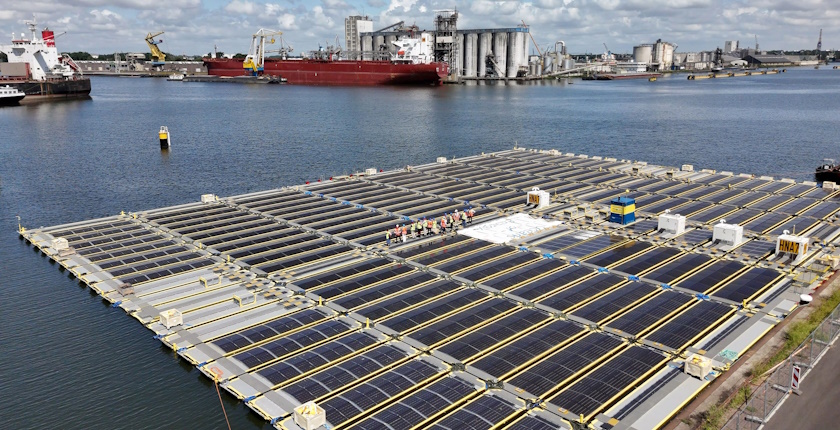
Dutch company Oceans of Energy has assembled its new floating photovoltaic plant in the Port of Amsterdam in just three days. The modular facility is about to be towed and integrated with the Hollandse Kust Noord offshore wind farm on the North Sea, creating a hybrid power plant.

The Nymphaea Aurora floating solar power platform comprises 1,400 photovoltaic panels on 196 floaters. It features reused metals at 70%, while the share of reused polymers is 80%. The name is inspired by a water lily and how it gently floats, while aurora is the Latin word for dawn.

SolarPower Europe promoted the project after the modular platform was assembled in the Port of Amsterdam in just three days. It is about to be towed to a spot 22 kilometers offshore IJmuiden on the North Sea. There it would be installed within the Hollandse Kust Noord offshore wind farm.

Using just 3% to 5% of the space between turbines for solar panels can boost energy output by over 20%, all while using the existing energy system infrastructure, the update adds.

Next step after Nymphaea Aurora is scaling up so units reach 10 MW, 100 MW, 1 GW

Founder and Chief Executive Officer of Oceans of Energy Allard van Hoeken claimed Nymphaea Aurora is the world’s first offshore solar farm to be installed within an operational offshore wind park.

However, China’s State Power Investment Corp. (SPIC) commissioned one such facility in 2022. It used Ocean Sun’s technology for the two solar power units offshore Haiyang, a city in Shandong province in eastern China. It connected them with an offshore wind turbine. Several other hybrid offshore wind and floating PV projects have been initiated over the last few years.

Van Hoeken: Everything you do at sea is very scalable

Combining the two renewable energy technologies brings variation into the generation profile, Van Hoeken noted.

“There is more solar energy in the summer and more wind energy in the winter. The next step is scaling up the farms from 1 MW to 10 MW, to 100 MW and to 1,000 MW. This is the size that offshore solar offers to the world, because everything you do at sea is very scalable,” the CEO stressed.

Hollandse Kust Noord is operated by CrossWind, a joint venture between Shell and Eneco. The 759 MW facility consists of 69 wind turbines, while Nymphaea Aurora brings only 0.5 MW. It takes up one hectare and it will be moored at a location with water depth of 25 meters.

Oceans of Energy deployed three standalone offshore PV units so far

In 2019, Oceans of Energy installed the world’s first floating solar power plant at sea, North Sea 1. Initially located one kilometer from the shore, it had 8.5 kW in capacity. It was expanded to 50 kW the following year and moved to a spot 15 kilometers away, near The Hague. It is an area with high waves, of up to 13 meters.

The firm earlier said it would expand its other pilot facility, North Sea 2, to 1 MW. It is 12 kilometers from the shore. North Sea 3 was deployed last year for testing off the Belgian coast.

by in News

WindEurope urges Germany to drop negative bidding in wind auctions, switch to CfDs

Germany’s second offshore wind auction in 2025 failed to attract bids from developers, sending a clear signal that the country’s wind auction design, which relies on negative bidding, is not fit for purpose, WindEurope has warned. Instead of swimming against the tide, Germany should follow in the footsteps of other European countries and switch to contracts for difference (CfDs), according to the European wind industry association.

The auction covered two offshore wind sites in the North Sea with a combined capacity of 2.5 GW, but no developer placed a bid. That should be a wake-up call for the German government, according to Viktoriya Kerelska, Director of Advocacy & Messaging at WindEurope.

In negative bidding, developers offer the amount of money they are willing to pay for the right to build a wind farm, with the highest bid most likely to win. In the CfD model, on the other hand, they bid the electricity price they need, and receive compensation from the government if the market price falls below that level.

Kerelska: Negative bidding reduces the number of companies willing to participate in auctions

Negative bidding does not offer any revenue stabilization and exposes bidders to risks that go beyond their control. The uncapped negative bidding further intensifies the financial pressure on offshore wind developers by asking them to pay high sums for the right to develop an offshore wind farm, according to WindEurope.

“Negative bidding adds costs that make offshore wind more expensive and reduces the number of companies willing and able to participate in auctions,” Kerelska stated, adding it is time to amend the auction model so Germany can deliver on its offshore wind targets and industrial competitiveness.

Wind energy provides 30% of all electricity consumed in Germany, making it crucial for ensuring competitive prices for households and industry as well as energy security, WindEurope noted.

CfDs ensure lower financing costs and more predictable revenues

Most countries in Europe have introduced two-sided CfDs as a revenue stabilization mechanism for offshore wind development. It ensures lower financing costs and more visibility on future revenues, WindEurope said, noting that Denmark was the latest country to switch to CfDs after its 3 GW negative bidding offshore wind tender failed to attract any bids last December.

  • 1
  • 2