by in News

Workshop on power grid development in Western Balkans held by GIZ, Energy Community Secretariat

The development of grid infrastructure in the Western Balkans is a crucial step in the region’s energy transition. In support of the Green Agenda for the Western Balkans, GIZ, in cooperation with the Energy Community Secretariat, organized a Strategic Workshop on Power Grids, with a focus on a concrete action plan for the entire region.

Without the development of grid infrastructure, large-scale electrification based on clean energy sources is not possible. The process requires significant investments and new solutions for operating the grid. Existing power lines will need to be reinforced, while new infrastructure, especially on low and medium voltage levels, as well as interconnectors, must be built over the next ten years.

The recent large-scale power outage in Southern Europe, and the one in the Western Balkans in 2024, are a stark reminder of the importance of ensuring system stability amid the growing use of renewables and the need for preventive safety measures. A functional and reliable electricity supply is key to gaining broad public support for alternative energy sources and green policies.

The Strategic Workshop on Power Grids, organized by GIZ in Vienna as part of the project Green Agenda: Decarbonization of the Electricity Sector in the Western Balkans, in cooperation with the Energy Community Secretariat, brought together representatives from transmission and distribution system operators, along with experts from the Hrvoje Požar Energy Institute (EIHP), intending to develop the Action Plan for Power Grids in the Western Balkans.

The action plan provides a clear roadmap for grid development in the Western Balkans

Electricity networks in Western Balkan countries were not designed to meet the challenges of the 21st century. Although the countries in the region have adopted very ambitious decarbonization and renewable energy integration targets, around two thirds of electricity generation comes from coal-fired power plants, according to Goran Majstrović, Deputy Director and Head of the Energy Transmission and Distribution Department at EIHP.

“Regional power networks remain constrained by outdated assets, insufficiently utilized interconnection capacities, administrative bottlenecks, and inadequate digitalization. Without urgent and coordinated action, the power network in the Western Balkans will become a serious bottleneck to secure operation and progress rather than a platform for transformation and development,” Majstrović explains.

Without urgent and coordinated action, the electricity network in the Western Balkans could become a serious obstacle to secure operation and progress, instead of being a platform for transformation and development, he warned.

The Western Balkan Action Plan for Power Grids directly addresses the root causes of recent blackouts, including extreme weather events, aging infrastructure, and the growing share of variable renewable energy sources, particularly wind and solar, as their output is sensitive to any changes in weather conditions.

By focusing on grid modernization, regional coordination, and system resilience, the plan offers a concrete roadmap for preventing future outages. It also promotes investment in smart grid technologies, cross-border interconnectors, and digital system monitoring, all of which are essential for adapting to growing demand and fluctuations in electricity production.

The action plan is a strong expression of regional cooperation in the power sector

Crucially, the plan strengthens operational cooperation among system operators across the Western Balkans region, enabling a more flexible and integrated regional grid. In doing so, it lays the foundation for a stable and secure energy transition based on renewables, helping the region become a reliable supplier of clean electricity to Europe.

According to Goran Majstrović, the Action Plan for Western Balkans Grids provides a forward-looking and regionally harmonized strategy to address the challenges. It is built on the vision of the European Union’s Action Plan for Grids and aligns closely with the Sofia Declaration on the Green Agenda for the Western Balkans, the Energy Community framework, and each country’s national energy and climate plan (NECP).

The document is a strong expression of collaboration of the Western Balkans power sector in a matter of high mutual interest – mobilizing attention, human and financial resources for a rapid energy transition, enabled by sustainable, interconnected, and resilient power infrastructure.
by in News

BEF 2025: Regional cooperation can facilitate energy transition, energy security

Montenegro, Serbia, and the Republic of Srpska don’t have a problem attracting investments in electricity production, but they do have issues when it comes to investments in transmission networks. If the introduction of CBAM is not postponed, it will greatly burden their economies. Hungary is interested in strengthening energy ties with them as well as the rest of the Western Balkans, which would bolster energy security for the whole region. Croatia could also assist it in strengthening employment in the green technologies sector, to counter the loss of jobs due to decarbonization. These are the main messages from the High-ministerial panel on SEE regional cooperation and energy transition strategies.

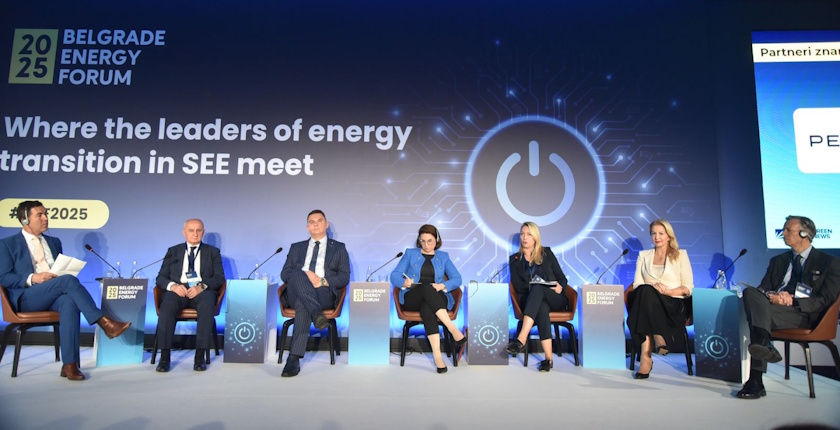
The ministerial panel was the first of eight at this year’s Belgrade Energy Forum 2025 (BEF 2025). The conference, organized by Balkan Green Energy News, welcomed four hundred participants from more than 30 countries from the region, Europe, and beyond.

The panel featured representatives of the governments of Montenegro, Croatia, Hungary, the Republic of Srpska – one of the two political entities in Bosnia and Herzegovina – Serbia, and the United Nations Economic Commission for Europe (UNECE). The moderator of the panel was Dirk Buschle, who until recently was a key figure in the Energy Community Secretariat, and now is a partner at law firm Becker Büttner Held.

He noted it is a mistake to say that the contracting parties of the Energy Community are lagging behind EU countries in the energy transition. They all face the same issues, which are energy accessibility, supply security, and sustainability, Buschle added.

Additional proof, in his words, are the similar issues faced by investors – in grid connections and permitting.

Investments in production are coming, the issues are grids, CBAM

Dirk Buschle, Petar Đokić and Admir Šahmanović

According to Minister of Energy and Mining of the Republic of Srpska Petar Đokić, the entity has made significant progress in defining a regulatory framework that aligns with the rules of the Energy Community and the European Union.

He noted that with the help of the Energy Community Secretariat, the two entities of BiH recently reached an agreement on adopting a law on the electricity regulator, transmission, and market. It is one of the cornerstones for establishing an organized electricity market.

The Republic of Srpska was successful in attracting investments in green energy in recent years, Đokić added. It established concessions and partnerships for the construction of 2,200 MW of renewable energy power plants – wind, solar, and hydropower.

However, large investments in transmission networks are also necessary, he pointed out and said he expects assistance from the European Union’s financial institutions such as the European Bank for Reconstruction and Development (EBRD) and the European Investment Bank (EIB), as well as the World Bank.

Đokić: CBAM to hit hard BiH’s economy

The minister called on them to set up such partnerships.

Regarding the EU’s Carbon Border Adjustment Mechanism (CBAM), he said that measures have been taken to change the domestic energy mix. Until recently, the share of fossil fuels was 62%, but it has now dropped to 54%, he recalled.

By 2028, the Republic of Srpska will have two new hydropower plants, of 159 MW and 36 MW, and new solar power plants with a total capacity of 250 MW, the minister asserted. It would additionally green the energy mix, Đokić said.

CBAM, in his words, could harm the economy of the Republic of Srpska and BiH.

If it is applied the way it is apparently envisaged, it would result in a significant increase in costs, with a severe negative impact, he underlined. Đoković expressed hope that the rollout would be separately discussed in the case of BiH.

Šahmanović: Montenegro is finishing its NECP

Montenegro also enjoys great interest from investors. It has received applications for building solar power plants and wind farms with a total capacity of 5.5 GW, said Admir Šahmanović, Minister of Energy and Mining.

The country’s current capacity is slightly over 1 GW.

It is, in his words, the result of improving the regulatory framework including the adoption of laws on renewable energy sources and energy. However, investment in the transmission grid is also necessary. The government plans to discuss with Italy the possibility of installing another subsea cable for electricity transmission, while the national energy and climate plan (NECP) will be completed by the end of next month, the minister revealed.

Montenegro is requesting a postponement of CBAM until 2030

In addition, renewable energy auctions are being prepared with the EBRD, and a memorandum on market coupling with Italy will be signed, he added.

As for CBAM, the minister stressed that Montenegro doesn’t believe the EU wants to harm its economy, but argued that the country isn’t ready for the mechanism’s implementation.

“Perhaps we are now in a situation similar to where our EU partners were 20 years ago. So, we need to invest a lot in our production capacities, grid, storage. It will take years, so if we don’t receive an exemption by 2030, I believe we won’t be able to handle this challenge,” Šahmanović stressed.

Secure supply of the national market is the highest priority

Boglárka Illés, Admir Šahmanović and Jovana Joksimović

Jovana Joksimović, Serbian assistant minister of mining and energy for international cooperation, European integration, and project management, expressed the opinion that the energy transition is a long and intensive process, technically, operationally, and financially.

Since October 2022, renewable energy in the energy mix has increased by 83%, which demonstrates the progress of the energy transition in Serbia, Joksimović asserted.

“We need to be realistic, as well as socially aware, because a fair and sustainable transition is something that should be carefully considered when changing the energy mix, where coal accounts for 60%,” she noted.

Joksimović: The priority is to ensure a sufficient supply of electricity at the most affordable prices for citizens and the economy

It is necessary, in her words, to be ambitious and dedicated to the energy transition goals, but she is convinced that there is a higher objective.

At the country level, it is to ensure enough electricity at the most affordable prices for both citizens and the economy, she underlined. “That’s what our top priority is,” Joksimović underscored.

Guided by the said goal, Serbia is also considering the use of nuclear energy and a study on possible options is currently being prepared.

Boglárka Illés, State Secretary for Bilateral Relations at Hungary’s Ministry of Foreign Affairs and Trade, also stressed that the government’s primary duty is to ensure not only climate neutrality and sustainable energy but also affordable energy with a stable supply for households and businesses.

She pointed out that diversifying energy imports and the energy mix plays a key role in securing energy sovereignty. It is the reason why cooperation with the Western Balkans, and especially Serbia, is important to Hungary, Illés asserted.

Illés: Europe’s energy security has been demolished

A few days before, Hungary’s Prime Minister Viktor Orbán said the EU has abandoned a successful economic strategy, based on cheap Russian gas and advanced German technology.

“And now we don’t see any other strategy within the EU,” she stated.

Due to ideologically driven sanctions against Russia, and the European Green Deal, the energy security of Europe is demolished, in Illés’s opinion. The region is located at the intersection of essential energy routes, connecting the East and the West, and also South and North, she underlined.

“We, as an EU member country, can act as a bridge between non-EU member countries and also the EU,” the state secretary stressed.

As an example of good cooperation with Serbia, she highlighted the supply of gas through the TurkStream pipeline and the Pannonian Corridor project for doubling the capacity for power exchange between the two countries.

The energy transition is an opportunity

Jovana Joksimović, Marija Pujo Tadić and Dario Liguti

In one respect, Marija Pujo Tadić, Special Envoy for Climate Action from the Government of Croatia, doesn’t share the opinion of the Hungarian official. She argued it isn’t true that Europe lacks a plan.

The EU has a clear plan and a well-defined strategy – it is the Clean Industrial Deal, she stressed.

She highlighted two important strategies relevant to the region: the Paris Agreement and the Green Agenda for the Western Balkans.

As a member of the scientific advisory board for the COP 29 presidency, she recalled that this year a review of nationally determined contributions (NDCs) would be conducted. It is an assessment of how countries are meeting their plans for lowering CO2 emissions.

Pujo Tadić: Education and workforce specialization are essential

She underlined the Green Agenda for the Western Balkans also envisages reducing net greenhouse gas emissions to zero by 2050, which is essentially the shared goal of the EU.

However, Pujo Tadić expressed the belief that policies and laws alone are not enough. Public education and workforce specialization are also necessary because the transition will create many new jobs, she added.

Croatia could be of great support to the Western Balkans, having launched such educational programs five years ago, according to Pujo Tadić.

The link between the energy transition and the creation of new jobs was also stressed by Dario Liguti, Director of Sustainable Energy at UNECE. In his view, the region has a huge opportunity to become part of the supply chains for green technologies by greening the domestic power generation and by leaning on the EU’s energy transition.

He sees the main factors for it in the region’s geographic proximity to the large European market, and the large, skilled workforce that can be educated for other tasks. Liguti drew a connection with the expected job loss from decarbonization measures and the related need for a just transition.

Liguti: There is great potential for energy efficiency in the region

Liguti praised the forthcoming investments in renewable energy production, but warned it is only one side of the story, arguing that the other one is energy efficiency. He reminded the audience that the region’s energy intensity is high, saying there is room for savings.

The installation of big solar plants and wind farms, in his words, is great because it’s very visible.

“It’s a great investment and makes a lot of sense. The harder part is making energy efficiency investments, whether in buildings or the industrial processes in large, small, or medium enterprises,” Liguti stated.

As an example, he recalled that UNECE is running a project with the EBRD in North Macedonia to support households and small and medium enterprises to lower the costs of liquid fuels and electricity.

by in News

Federation of BiH secures EUR 83 million for just transition of coal regions

Bosnia and Herzegovina has secured EUR 83 million for a just transition project, which includes installing renewable power plants, social protection measures, and skills development in coal regions.

The funds are for the Federation of BiH, one of the two entities constituting Bosnia and Herzegovina.

The Board of Executive Directors of the World Bank has approved a EUR 79.90 million loan and a EUR 2.89 million grant to support Bosnia and Herzegovina’s National Energy and Climate Plan, enhance energy independence, foster job opportunities, and strengthen local economies in former coal regions.

It explained that the Just Transition in Select Coal Regions of Bosnia and Herzegovina Project would help repurpose post-mining lands in Banovići, Zenica, and Kreka, and facilitate the closure of underground works in Zenica. The project entails support for the installation of renewable energy systems at Banovići and Kreka mines.

The project has four components

The measures also involve social protection and skills development for workers and communities seeking opportunities outside the coal sector, the international financing institution noted.

The project will be implemented by the Federal Ministry of Energy, Mining and Industry and the state-owned RMU Banovići coal mine operator and power utility Elektroprivreda Bosne i Hercegovine (EPBiH). It has four components.

The first focuses on enhancing the capacity of coal regions, their entities, and the state-level government to manage a just transition. It will support the Committee on Just Transition at the State Level, a state-level knowledge platform, and capacity building of the Interministerial Committee on Just Transition in the Federation of BiH.

The project includes the land repurposing master plans in Banovići, Zenica, and Kreka

Technical assistance to relevant FBiH ministries to enhance the existing regulatory laws on labor transitions will be provided.

Component 2 supports the repurposing of select post-mining lands in Banovići, Zenica, and Kreka, and closure of specific underground works in the Zenica mine. The segment includes implementing the land repurposing master plans in all three areas

The third part envisages the construction of new power plants. A photovoltaic system of 27 MW in peak capacity will be installed at two identified sites at the Banovići and Kreka mines. Annual power production is projected at over 30 GWh.

Sheldon: To make sure no one is left behind

Component 4 aims to mitigate the social and labor impacts of coal transition on workers and communities by covering the financial obligations toward the miners in Zenica, reskilling and retraining eligible workers in Banovići and Zenica, and supporting affected communities through community investment, the project reads.

According to the World Bank, BiH is developing a National Energy and Climate Plan (NECP). The lender intends to ensure that mine closure is environmentally and socially responsible, supporting new job opportunities and strengthening local economies in former coal regions.

“This new project is an opportunity to boost BiH’s energy security while supporting communities, making sure no one is left behind,” said Christopher Sheldon, World Bank Country Manager for BiH and Montenegro.

by in News

Romania’s plan to install 2.15 GW of gas power plants isn’t viable

Romania’s plans for new combined cycle gas turbines with a total capacity of 2.15 GW isn’t economically viable and, if constructed, the facilities should be decommissioned by 2035, according to ENTSO-E’s annual assessment of Europe’s security of electricity supply for the ten years ahead.

ENTSO-E’s European Resource Adequacy Assessment 2024 (ERAA 2024) provides an integrated pan-European perspective for the years 2026, 2028, 2030 and 2035.

The document includes comments on individual countries, specific insights provided by transmission system operators (TSOs).

According to the entry about Romania, low adequacy concerns have been identified in ERAA 2024. The findings rely on assumptions from the National Energy and Climate Plan (NECP), in place on the date of the data collection, as well as from investment plans, permits, connection requests, and available inputs from market participants.

NECP’s central reference scenario reflects the coal phase-out process and further plans for the replacement of the decommissioned capacity with, mainly, combined cycle gas turbine (CCGT) power plants, the document reads.

The results of the economic viability assessment show 2.15 GW of CCGT capacity would not be economically viable by the 2035 horizon

The commissioning of envisioned gas CCGTs is, however, highly uncertain, and national analyses reveal that the validity of the adequacy indicators depends on the implementation of generation goals, the update showed.

Uncertainties related to the commissioning date of the new capacities may have an adverse impact on Romania and, potentially, on the region, the document underlines.

Moreover, results of the economic viability assessment (EVA), part of ERAA 2024, demonstrate that the 2.15 GW of envisaged CCGT capacity would not be economically viable by the 2035 horizon and should be decommissioned in target year 2035.

Considering it is not existing capacity, but rather assumed commissioned in the 2026-2030 period, it is most likely the investments will not materialize at all and thus, the correspondent capacity should be excluded from the analysis for the earlier target years, too, not only 2035, with a negative effect on loss-of-load-expectation (LOLE) results, the authors warned.

Goal in NECP is 2.6 GW of CCGT power plants

According to Romania’s NECP, the goal is 2030 to construct at least 2.6 GW of natural gas–powered CCGTs and around 900 MW of natural-gas-fired combined heat and power (CHP) plants.

The CCGT facilities are Iernut (430 MW), Mintia (at least 860 MW, with a possibility of reaching 1.700 MW), and Ișalnița and Turceni, of 1,325 MW in total.

Investments aren’t going as planned. In January, Minister of Energy Sebastian Burduja acknowledged that the addition of gas-fired units expected in line with the restructuring plan for Complexul Energetic Oltenia – CE Oltenia has been delayed.

Burduja: Mintia to be operational next year

Tenders were launched, such as the one for Ișalnița, but not a single offer was submitted, he added. In Burduja’s words, it is one of the reasons why the operation of coal power plants should be extended.

State-owned CE Oltenia is the largest producer of coal power and the third-largest producer of electricity in the country. Its restructuring plan envisages lignite-based electricity production to be replaced with natural gas, in Işalniţa and Turceni, and renewables.

The Mintia project got the construction permit in January. In March, Burduja said it would be commissioned next year, according to Romania Insider.

  • 1
  • 2