by in News

Slovenia again uses shortcut to meet national renewables target

Slovenia will purchase renewable energy from Croatia through a statistical transfer to meet its 2024 renewable energy target.

A statistical transfer is allowed at the European Union to help member states meet their national renewable energy targets. This will be the fourth time Slovenia has used this option in the 2020-2024 period.

Since 2020, the 25% goal for renewable energy’s share in gross final consumption has only been reached in 2023. The shortfall for 2024, when the share was 24.6%, will be covered by purchasing 207 GWh from Croatia for EUR 1.78 million, or EUR 8.60 per MWh, Žurnal24 reported.

The Czechs and Croats have benefited from Slovenia’s failure to reach the set goal

In 2020, Slovenia paid the Czech Republic EUR 5 million for a missing 465 MWh. The same country assisted it in 2021 as well, and the price for the service was EUR 2 million, for 208 MWh. According to the Ministry of Infrastructure, which was in charge of energy at the time, it did it to retain access to the EU’s Cohesion Fund for 2021-2027.

Slovenia paid the most in 2022, EUR 10.8 million for 1,193 MWh, to Croatia. In total, since 2020, nearly EUR 20 million has been spent on statistical transfers from the Czech Republic and Croatia.

EUR 20 million in total went to Czechia and Croatia

The government in Ljubljana covered the cost from renewable energy support funds, managed by electricity market operator Borzen.

The problem could become even bigger as the national target will increase to 33%

The Ministry of Environment, Climate and Energy attributed the failure to reach the 2024 goal to an increase in the consumption of fossil fuels.

It was 1 TWh higher than in 2023. However, the issue could get even worse. Slovenia faces new targets from 2030 on.

The minimum share set in the National Energy and Climate Plan (NECP) is 33%. It means that the share should increase by at least 1.6 percentage points per year on average over the next five years to avoid new payments.

by in News

Slovenia again uses shortcut to meet national renewables target

Slovenia will purchase renewable energy from Croatia through a statistical transfer to meet its 2024 renewable energy target.

A statistical transfer is allowed at the European Union to help member states meet their national renewable energy targets. This will be the fourth time Slovenia has used this option in the 2020-2024 period.

Since 2020, the 25% goal for renewable energy’s share in gross final consumption has only been reached in 2023. The shortfall for 2024, when the share was 24.6%, will be covered by purchasing 207 GWh from Croatia for EUR 1.78 million, or EUR 8.60 per MWh, Žurnal24 reported.

The Czechs and Croats have benefited from Slovenia’s failure to reach the set goal

In 2020, Slovenia paid the Czech Republic EUR 5 million for a missing 465 MWh. The same country assisted it in 2021 as well, and the price for the service was EUR 2 million, for 208 MWh. According to the Ministry of Infrastructure, which was in charge of energy at the time, it did it to retain access to the EU’s Cohesion Fund for 2021-2027.

Slovenia paid the most in 2022, EUR 10.8 million for 1,193 MWh, to Croatia. In total, since 2020, nearly EUR 20 million has been spent on statistical transfers from the Czech Republic and Croatia.

EUR 20 million in total went to Czechia and Croatia

The government in Ljubljana covered the cost from renewable energy support funds, managed by electricity market operator Borzen.

The problem could become even bigger as the national target will increase to 33%

The Ministry of Environment, Climate and Energy attributed the failure to reach the 2024 goal to an increase in the consumption of fossil fuels.

It was 1 TWh higher than in 2023. However, the issue could get even worse. Slovenia faces new targets from 2030 on.

The minimum share set in the National Energy and Climate Plan (NECP) is 33%. It means that the share should increase by at least 1.6 percentage points per year on average over the next five years to avoid new payments.

by in News

Montenegro adopts National Energy and Climate Plan

The Government of Montenegro has adopted the National Energy and Climate Plan, along with a bill on cross-border electricity and natural gas exchange.

The National Energy and Climate Plan (NECP) of Montenegro is the overarching strategy that clearly defines what the country should achieve by 2030: a 55% reduction in emissions, a renewable energy share of at least 50%, and substantial progress in energy efficiency, according to the Ministry of Energy and Mining.

“Over the past eight months, we have made a tremendous effort to finalize two key documents that have been awaited for years and are crucial for our European commitments,” Minister Admir Šahmanović stressed.

This is a plan that enables new investments, new renewable energy power plants, modern grid infrastructure, and a secure transition for the Pljevlja coal region, he explained.

Šahmanović: The latest European Commission report confirms Montenegro’s progress

The ministry noted that the bill on cross-border electricity and natural gas exchange is among the most important energy laws proposed by this government. Šahmanović recalled that this is not merely a technical issue.

The bill, in his words, opens the door to the single European market, directly impacts the closure of Chapter 15 of the accession negotiations with the EU, and gives full meaning to the electricity interconnection with Italy and the EU market.

It would provide greater energy security, better competition, more stable prices, and a stronger position for the country’s economy, he added.

“The latest report from the European Commission confirms that we have made progress. Today’s decisions by the government are the best confirmation of this. These are the foundations for a more energy-secure, modern, and European Montenegro, and we have reason to be satisfied with the progress we have achieved,” Šahmanović underscored.

The bill represents the most extensive reform of energy legislation in the past decade

According to the ministry, by adopting these two strategic documents, Montenegro has taken a significant step forward in aligning with EU energy rules.

The NECP integrates energy, climate, and development policies into a single framework for the first time, sets clear and measurable goals, and lays the foundation for Montenegro’s long-term energy transition.

The law on cross-border electricity and natural gas exchange represents the most extensive reform of energy legislation in the past decade, transitioning from a basic regulatory framework to a full European system of market, technical, and security rules.

Together, these two documents represent the most important reform package in the energy sector in recent years, fully aligned with European legislation and the EU’s strategic priorities, the ministry concluded.

by in News

Croatia drafts EUR 1.68 billion Social Climate Plan

Croatia has prepared a Social Climate Plan for the period 2026-2032, worth EUR 1.68 billion. It would introduce measures for the buildings and road transport sectors aimed at supporting households and small businesses.

The draft of Croatia’s Social Climate Plan is under public discussion, which will last until December 22.

The process of adopting the most important national instrument for protecting citizens from the adverse effects of climate transition and the introduction of the European Union’s Emissions Trading System 2 (EU ETS 2) has begun, the Ministry of Environmental Protection and Green Transition stressed.

The plan will be financed with EUR 1.26 billion from the EU’s Social Climate Fund, and the remainder from Croatia’s national budget. Essentially, all the funds are coming from the auctions of emission allowances in the EU and Croatia under the EU ETS 2. It is an expansion of the EU ETS to the buildings sector (heating and cooling) and road transport.

The EU established the Social Climate Fund in May 2023 to protect households and small businesses

The expansion could increase the costs of heating, cooling, and transport. In May 2023, the EU established the Social Climate Fund to protect low-income households, micro enterprises, and transport users that could be affected by the cost increase.

The measures and investments also contribute to the implementation of the goals of the National Energy and Climate Plan (NECP).

The Social Climate Plan allocates EUR 658.1 million (39%) for the buildings sector, and EUR 958.4 million (57%) for road transport. Technical assistance is the third component, with EUR 42 million (2.5%).

The measures planned for the buildings sector include support for the establishment of energy communities and subsidies for the energy renovation of family homes. In the road transport sector, the plan envisages investments in cycling, on-demand mobility services, zero-emission vehicles, and railway infrastructure.

Vučković: Restoration planned for 180 kilometers of bike trails

croatia social climate policy plan EU ets 2 marija vuckovic plenkovic
Photo: Government of Croatia

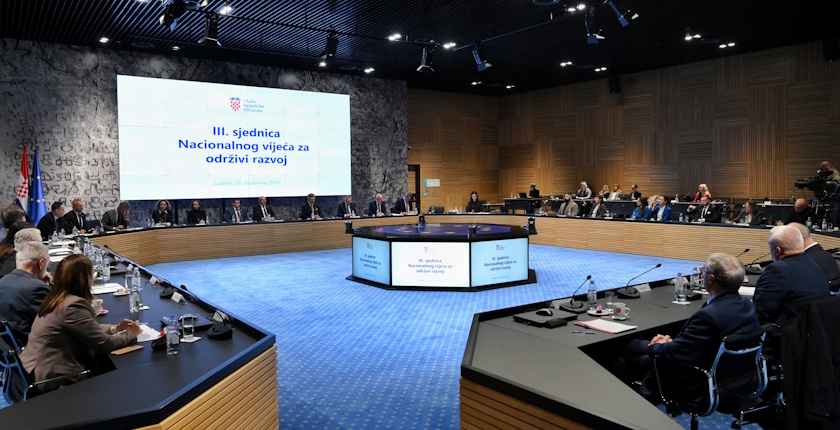
​While presenting the draft plan at a session of the National Council for Sustainable Development, Minister of Environmental Protection and Green Transition Marija Vučković said it identifies two groups: the energy poor or vulnerable, and transport poor or vulnerable.

“The plan provides for 10 measures, four of which relate to so-called stationary or energy poverty, and the remaining six to achieving affordable and favorable mobility and reducing the risk of transport poverty,” she explained.

According to the ministry, the plan provides for the renovation of 180 kilometers of bicycle paths, 80 kilometers of railway lines, as well as the procurement of 30 electric trains, 80 electric buses, and 3,000 electric cars.

Prime Minister Andrej Plenković stressed that the plan isn’t just a technical and administrative document, arguing that it determines what Croatia would become in ten, twenty, and fifty years.

“And we want a Croatia that is economically strong, socially just, and sovereign,” Plenković underlined.

by in News

Montenegro drafts green hydrogen development program with 2026-2028 action plan

Montenegro has drafted a program for the development of green hydrogen with an action plan for the period 2026-2028 and a strategic environmental impact assessment report.

The public discussion is underway about the draft green hydrogen development program with an action plan for the period 2026-2028 and strategic environmental assessment report. It lasts 20 days from the publication of the public call – November 25.

Green hydrogen is a strategic priority for Montenegro by 2030 as a key energy fuel for transition, decarbonization, and security, the document reads.

The program defines four operational goals

Its use is planned in the energy, transportation, and industry sectors, with production based on excess electricity from wind and solar power plants and the development of grid balancing activity and charging infrastructure in line with the EU regulations, the draft underlines.

The document defines four operational goals.

The first is the establishment of an institutional, regulatory, and standardisation framework for the development of the hydrogen economy. It would include a national hydrogen council.

The plan is to produce a feasibility study with a financial assessment for a green hydrogen pilot project

Strengthening administrative capacity is the second goal. The activities include staff training and the adoption of guidelines and regulatory adjustments by the local authorities in line with the national green hydrogen policy.

The third objective is to plan and develop infrastructure for the integration of green hydrogen. The program envisages the creation and adoption of a national hydrogen infrastructure map, as well as a feasibility study with a financial assessment for a pilot project for the production of green hydrogen.

The final goal is to develop science, innovation, education, and promotion in the field of green hydrogen, for which educational programs at the high school and university levels would be developed.

NECP examined two scenarios for hydrogen

The program aims to increase the competitiveness of the Montenegrin economy and achieve carbon neutrality in line with the Paris Agreement, as well as other EU strategic documents, including the European Green Deal and the New Industrial Strategy for Europe.

The country’s National Energy and Climate Plan (NECP) has outlined two hydrogen scenarios – a moderate one (MH2E) and an ambitious one (AH2E).

Pilot projects are planned by 2030, while investments are estimated at EUR 127 million to EUR 212 million by 2050, according to the NECP.

by in News

Greece’s energy transition at risk amid gridlock with batteries, new tech

An overreliance on photovoltaics, combined with slow growth in the deployment of new technologies and storage, threatens Greece’s renewable energy future.

The country achieved rapid growth in renewable energy in the past five years, and penetration has surpassed 50% of the electricity mix.

However, the very success of the energy policies also led to significant issues that the government must address to achieve its 2030 goals.

Curtailments slashing profits as storage lags

This year, curtailments doubled from 2024, alongside a rising number of hours of zero or negative prices in the day-ahead market (DAM). It means that producers are subject to a loss of profits. Some investors have exited the Greek market as a result of worsening conditions.

At the same time, there is a huge licensing queue, as more than 15 GW of projects have acquired connection terms from the network operators. This is more than enough to cover the country’s 2030 goal and even beyond.

Energy storage is expected to provide a solution to curtailments and zero pricing. However, the first standalone battery projects have been pushed back nine months, as the original deadline was deemed too strict. Developers are competing against time to secure European funding through the Recovery and Resilience Facility (RRF), via the National Recovery and Resilience Plan Greece 2.0.

Energy mix diversification needed

Photovoltaics dominate the energy mix and this year they are expected to surge by 2 GW. There is growth in every segment of the solar market, although small investors complain of a preferential policy towards larger players. This is especially evident in the case of energy communities and farmers‘ photovoltaics, where such issues are abundant.

Wind installations have stalled in recent years and the offshore wind program has not made any progress towards the 2030 goal. The European Commission warned that investments in carbon capture and storage (CCS) are in danger of losing RRF funding at the current pace. Pilot projects in hydrogen are advancing, but it remains uncertain when they will become operational and at what scale.

The special renewables account turned red this summer, with an ever-growing deficit. There is also uncertainty surrounding projections about the country’s future electricity demand. Sales of electric cars and heat pumps are lagging behind the European average, while large data centers are seen as a way to increase consumption and support more power production.

All these issues mean that Greece may not achieve all its 2030 goals from the final National Energy and Climate Plan (NECP). The country initially presented a highly ambitious first version, but later reduced it to keep costs low for consumers.

by in News

Montenegro to produce coal until 2050

The Pljevlja coal mine has been granted a concession for coal production for 24.5 years, extending the extraction of the solid fossil fuel until 2050.

Admir Šahmanović, Minister of Energy and Mining, and Nemanja Laković, CEO of coal mine operator Rudnik uglja Pljevlja (RUP), exchanged concession agreements for the period up to 2050.

They spoke at a ceremony in Pljevlja marking Miner’s Day, September 24, and the 73rd anniversary of the mine’s operation.

The signing of the concession agreement enables the long-term use of significant coal reserves in the Pljevlja municipality, which is one of the key steps in further valorizing the mining potential of northern Montenegro, according to the Ministry of Mining and Energy.

The coal extraction concession is granted for 24.5 years

“Our joint mission is for mining in Montenegro to continue developing responsibly, and in line with the highest standards. Our special focus will be on the development and future of this sector, having in mind the changes introduced by a just transition,” Šahmanović stated.

In late June, the Government of Montenegro decided to grant the concession to the mine for the excavation of lignite deposits at the sites Potrlica, Kalušići, Grevo, and Rabitlje in the Pljevlja coal basin.

The duration of the contract is 24.5 years, the government said. The mine is obliged to produce at least 1.65 million tons of lignite annually.

The Pljevlja coal power plant is planned for closing in 2041

The concession fee amounts to 4% of the market value of the excavation reserves.

Of note, almost the entire production of the mine is for the Pljevlja thermal power plant – the country’s only coal plant and the largest electricity producer.

The draft National Energy and Climate Plan (NECP) of Montenegro proposes 2041 as the provisional date for closing the Pljevlja coal plant.

The timeline primarily depends on the success of the just transition process and maintaining the security of the electricity supply, the document reads.

by in News

Montenegro publishes NECP for public consultation – sole coal plant planned for shutdown in 2041

State institutions, companies, organizations, and individuals have until August 6 to deliver their suggestions and comments about the draft National Energy and Climate Plan of Montenegro. It sets the provisional date for taking the Pljevlja coal power plant, the only one in the country, at 2041, but the authors pointed out that it primarily depends on a just transition and the security of electricity supply.

Montenegro’s long-awaited draft National Energy and Climate Plan (NECP) sets out the key 2030 targets for greenhouse gas emission cuts, share of renewable energy sources in gross final energy consumption, and energy efficiency.

The document, also known for its acronym INECP, in which the first letter stands for integrated, was published for the public consultation phase. It lasts until August 6. The Ministry of Energy and Mining called on the interested public – local authorities and other state institutions, the expert and scientific communities, associations, organizations, companies and individuals, to send their comments and suggestions.

“The energy and climate policy isn’t just a task for the government – it is a joint responsibility. That is why I am inviting all stakeholders, and especially nongovernmental organizations, to use this opportunity and contribute to the creation of a realistic, ambitious and just plan,” Minister Admir Šahmanović stated.

Renewables target can be surpassed

National goals match the ones adopted within the Energy Community. The targeted primary energy consumption in 2030 amounts to 0.92 million tons of oil equivalent. Under the business-as-usual scenario (with existing measures – WEM), the benchmark is expected to land at 1.04 million. With additional measures (WEM), the trajectory moves closer to the objective, projected at 0.97 million tons of oil equivalent.

The goal for final energy consumption is 0.73 million tons of oil equivalent. Existing measures result in 0.82 million, and added ones in 0.77 million tons of oil equivalent.

The share of renewable sources in transportation could reach 24.4% instead of only 7.2%

Montenegro fares better with its expected share of renewables in gross final energy consumption, against the 50% target. In the WEM scenario, it reaches 42.5%, and the WAM projection is 53.3%.

Without additional measures, renewable sources have a 66.3% share in electricity production. The document’s authors calculated that it could grow to 79.4%. As for transportation, the range is from 7.2% to 24.4%. In heating and cooling, the possible progress from the results of current measures is only 0.4 percentage points, reaching 49.2%.

The targeted reduction in emissions is 55%, the same as in the European Union. It translates to 2.42 million tons of carbon dioxide equivalent in the final year of the current decade. With existing measures, the curve touches 3.06 million in 2030, and with added ones the result is 2.4 million tons of CO2 equivalent.

Retirement of Pljevlja coal plant depends on socio-economic situation in northern region

Oil derivatives, which are all imported, participated in the 2022 final energy consumption with 47.3%, followed by electricity, 33.3%. Wood fuel is the next item, with 18.7%. The share of coal is only 0.7%, because almost the entire output goes to thermal power plant Pljevlja, the only such facility in Montenegro.

The overall electricity production capacity at the end of 2023 was 1.07 GW. The Pljevlja coal plant, which is currently under reconstruction, has 225 MW.

According to the projection, the Pljevlja coal plant is in cold reserve after 2040

The provisional date for its shutdown is 2041, but it primarily depends on the success of the just transition process and maintaining the security of electricity supply, the NECP reads. It also shows the Pljevlja coal plant in cold reserve after 2040.

In addition, taking it offline requires supplying end consumers under favorable conditions, while minding the overall socio-economic situation in the country’s northern region, where the coal mines and the power plant are, the authors explained. They noted as well that an energy storage pilot project is under consideration for the site of the Pljevlja facility.

Electricity sector’s self-sufficiency varying due to dependence on hydrological conditions

The country’s two large hydropower plants Piva and Perućica have 342 MW and 307 MW in capacity, respectively.

There are 38 other hydroelectric units in Montenegro, of which the smallest one is 200 kW. The biggest facility, Vrbnica (6.75 MW), is owned by a firm with the same name, registered in the capital Podgorica.

The high share of hydropower plants in electricity production, implying dependence on hydrology, is the main reason of the variability of the level of self-sufficiency of the national energy balance year after year, the NECP says.

There are two wind power plants on the grid: Krnovo (72 MW) and Možura (46 MW), while the third one, called Gvozd, is under construction. The project envisages 54.6 MW in the first phase.

There are only five independent solar power plants. The biggest one, Čevo, has 4.4 MW in nominal capacity and a 3.25 MW connection. Nevertheless, units operated by prosumers reached 75 MW altogether, according to one entry, though the numbers are lower in other parts of the NECP.

by in News

Slovenia preparing hydrogen action plan until 2030

The Slovenian Ministry of the Environment, Climate and Energy has invited bids for preparing a draft action plan to achieve the hydrogen targets from the National Energy and Climate Plan (NECP). The document is intended to guide the development of hydrogen technologies in Slovenia until 2030, with an outlook to 2040.

Hydrogen is expected to help decarbonize sectors such as industrial production, transportation, and energy. The action plan must clearly define strategic goals, measures, and projects for introducing hydrogen, including cross-sectoral integration (power-to-X solutions), according to the public call.

Hydrogen is expected to help Slovenia decarbonize industrial production, transportation, and energy

The drafting of the action plan is partly financed by the European Union as part of the North Adriatic Hydrogen Valley (NAHV) project, a joint effort by partners from Slovenia, Croatia, and Italy, the ministry said. The NAHV is expected to start producing hydrogen by the end of 2026.

The document is co-financed by the EU under the North Adriatic Hydrogen Valley project

The document is intended to provide guidelines for the development of infrastructure, support policies, and incentive measures that would enable the gradual development of the hydrogen ecosystem in Slovenia. It must also define a timeline and provide cost estimates. Its purpose is to define a comprehensive, coordinated, and feasible set of measures, the ministry said.

The action plan must provide a timeline, cost estimates, and a feasible set of measures

The plan should also include an analysis of existing hydrogen strategies in the EU; an overview of existing hydrogen initiatives and projects in Slovenia; recommendations for technical, political, financial, legal, and regulatory feasibility; and an analysis of environmental and socio-economic impacts.

Bids are accepted until July 17, while the deadline for completing the job is 10 months from signing the contract, according to the public call.

by in News

Serbia shelves plan for strategic partnership for 1 GW in wind farms

Serbia has revised its Baselines of the Energy Infrastructure Development Plan and Energy Efficiency Measures for the period up to 2028, with projections up to 2030. It defines priority projects in the energy sector.

The Baselines of the Energy Infrastructure Development Plan and Energy Efficiency Measures were adopted in mid-2023 at the proposal of the Ministry of Mining and Energy. In the new document, the construction of 1 GW wind farms is no longer among the priority projects. The plan was to involve with a strategic partner, similar to the project for 1 GW of solar power plants, which is currently being developed by state-owned power utility Elektroprivreda Srbije (EPS) with a strategic partner.

The development plan serves as a basis for the implementation of Serbia’s Energy Development Strategy and the National Energy and Climate Plan (NECP).

The ministry outlined projects across six sectors

The investment cycle planned for the upcoming strategic period represents the backbone of the Energy Development Strategy. It provides the foundation for further assessments and projections of the targeted energy mix through 2030 and 2050. It aligns with the international commitments undertaken in the process of European Union accession as well as with the obligations within the Energy Community, the document reads.

The plan includes projects in six sectors: electricity generation, transmission network, distribution network, natural gas, oil and petroleum products, and energy efficiency. It ranks the projects within each sector.

The most significant change in renewable energy is that the construction of wind farms with a combined capacity of 1 GW is no longer on the list of priority projects.

Solar power plants Kolubara and Morava on the priority list

The 1 GW of solar power and the Kostolac wind farm remained among the four most important endeavors, while the new items are the Morava and Kolubara photovoltaic projects. The Klenovnik solar power plant has been removed from the list. According to the document, the projects on the list are the most advanced.

In total, EPS has 41 projects for power generation or 20 less than in the original document.

Fewer projects, but more realistic

The authors explained that the number of renewable energy projects is lower, but more realistic and better optimized. The entire EPS investment portfolio across all areas requires significant funds and loans, so it would not be realistic to pursue a larger number of high-value projects that cannot be financially or physically implemented within a reasonable timeframe, the document underlined.

It was also taken into account that many private projects, mainly wind farms, are being developed through the auction system, so the focus of EPS’s projects is primarily on solar power plants, to create a balanced ratio between wind and solar power plants in the system. The company’s project for the wind farms with a strategic partner remained a backup option, in case an additional capacity is needed, according to the document.

There are new items on the list for the electricity distribution network

There were no changes in the transmission network segment. The priority projects are the third and fourth sections of the Trans-Balkan Corridor, the Pannonian Corridor, and Beogrid 2025. The list contains 66 investments, five fewer than in the original plan.

Changes have been made regarding investments in the power distribution network. The most important projects now are the 110/10 kV substations National Stadium and Surčin. Automation of the medium-voltage network was kept, together with the ongoing replacement of wooden poles with concrete ones and the replacement of electricity meters with smart ones.

The integrated system for remote monitoring, diagnostics, and control of the low-voltage distribution network has been removed from the list. Instead of replacing transformers at 10 kV, 20 kV, 35 kV, and 110 kV voltage levels, the new focus is on the reconstruction of 25 substations of 110/35 kV.

Planning the first district cooling systems

The energy efficiency part of the baselines was changed the most.

The previous document was primarily focused on reviewing and securing financial support for ongoing projects, while the current one is envisaging expanding the scope and considering new financial mechanisms and sectors that require additional support.

Among other initiatives, the Strategic Plan for the Decarbonization Policy of the District Heating and Cooling Sector in the Republic of Serbia is being prepared. It is a joint endeavour of the European Bank for Reconstruction and Development (EBRD), the Association of Serbian Heating Plants, and the Ministry of Mining and Energy.

The project aims to define steps to improve the district heating system, including heat storage, the use of heat pumps, utilization of heat generated from waste treatment, and the development of the first district cooling systems, according to the document.

Special attention will be devoted to developing guidelines for expanding the district heating system by connecting new users while simultaneously shutting down fossil fuel boilers. It will directly contribute to reducing CO2 emissions and pollution, the authors noted.

  • 1
  • 2