by in News

Serbia plans to stop using coal, fuel oil in district heating by 2040

By 2040, Serbia intends to replace fuel oil and coal in district heating plants with solar, wood biomass, heat pumps, municipal waste and geothermal energy.

Maja Vukadinović, acting Assistant Minister of Mining and Energy for Energy Efficiency and Climate Change, has said that the goal for the district heating sector is to phase out fuel oil and coal by 2040.

She explained that the idea is to replace fossil fuels with solar energy, wood biomass, heat pumps, municipal waste and geothermal energy.

“The list of programs and projects until 2028 is defined in the draft Program for the Implementation of the Energy Development Strategy of the Republic of Serbia until 2040 with projections to 2050, for the period from 2026 to 2028,” Vukadinović told Balkan Green Energy News.

The share of renewables should increase from 2.4% to 5.5%

According to the draft, implementation of decarbonization projects in district heating systems by 2028 should lift the share of renewable energy sources in heat production from 2.4% to 5.5%.

The fuel mix in 2023 was 75% natural gas, 8% petroleum products, 2% coal, 2% wood biomass, and 13% purchased heat. The structure of purchased heat production is 46.8% natural gas, 48.8% coal, 3.3% wood biomass, and 1.1% fuel oil.
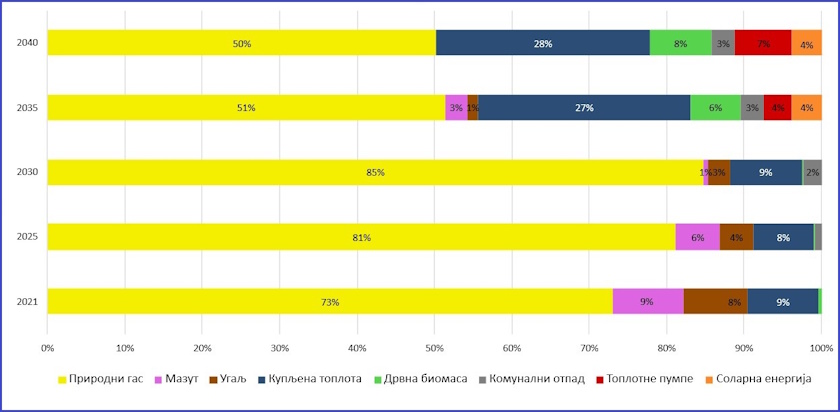
serbia decarbonization district heating mix 2040

Natural gas will remain the dominant source of thermal energy, as it is today, although its share is expected to decrease from 73% to 50% by 2040, according to Vukadinović.

The decarbonization of the district heating system would reduce air pollution in cities, especially where coal or fuel oil is currently used, the ministry added.

A strategic plan for the district heating decarbonization policy is being prepared

“It’s very important that the fuels conversion is carried out in parallel with energy renovation of buildings and a reduction of the energy consumption for heating. It would significantly improve living conditions,” Vukadinović underlined.

Decarbonization would also have to lead to the improvement of the overall operation of the heating plants, as well as a reduction in network losses, the modernization of substations, and the introduction of daily and seasonal thermal energy storage, in her opinion. The operation of the district heating systems should depend less on the price volatility of imported fuels, Vukadinović stressed.

Serbia is preparing a strategic plan for the district heating decarbonization policy. The document is under development in cooperation with the European Bank for Reconstruction and Development (EBRD) and the business association of Serbian heating plants, Toplane Srbije.

The document, she explained, will outline steps to improve the district heating system, including the rollout of thermal energy storage, heat pumps, and heat production from waste, as well as the development of the country’s first district cooling systems.
by in News

Slovenia allocates EUR 375 million for sustainable mobility

Slovenia has allocated EUR 835 million from the Climate Fund for climate change mitigation and adaptation. The funds should be used over the period 2025-2028.

The Government of Slovenia has adopted a decree on the allocation plan for the Climate Fund for 2025-2028. The plan follows the key measures from the previous plan for the period 2023-2026 and adds funds for 2027 and 2028. The amount is determined based on expected revenues from emission allowance auctions.

Emission allowances are part of the European Union Emissions Trading System (EU ETS).

The funds will be directed to sectors addressing the main climate challenges, both in mitigation and adaptation to climate change. Measures supporting the green transition and increasing the country’s resilience to climate change will also be supported, according to the Government of Slovenia.

EUR 121 million was allocated for decarbonizing the economy

The largest chunk will go to sustainable mobility – EUR 375 million. The funds will be used for investments in public transport – purchase of new trains and buses, renovation of ticketing and information systems, co-financing of zero-emission vehicles and charging infrastructure, promotion of cycling and walking, and shifting freight transport from roads to rail.

EUR 121 million is designated for decarbonizing the economy. The government will co-finance successful European Union projects, support the introduction of a circular economy and sustainable reporting for small and medium-sized enterprises, as well as investments in industrial decarbonization.

Energy renovation of public and residential buildings, measures to reduce energy poverty, and the construction of nearly zero-energy buildings are also part of the allocation plan. There is EUR 111 million for such activities.

EUR 26 million is set for awareness raising and education

EUR 95 million is designated for renewable energy sources. The funds will be used to replace outdated household heating devices with modern ones and heat pumps, as well as for energy storage, geothermal energy, and measures to increase the energy self-sufficiency of buildings.

The Climate Fund will support additional climate change adaptation measures. The activities include reducing flood risks, preserving biodiversity, adaptation in forestry and agriculture, and strengthening the resilience of local communities. The allocated funds amount to EUR 49 million.

Slovenia has envisaged EUR 12 million for international climate change financing and EUR 26 million for awareness raising and education.

by in News

Green solutions in practice: Roundtable in Knjaževac points the way to a sustainable, energy-efficient future

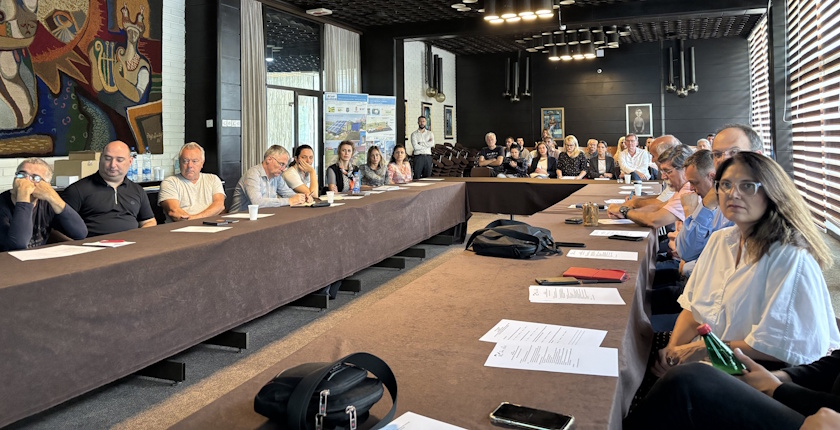
A roundtable titled Green Solutions in Practice, held in the eastern Serbian town of Knjaževac, brought together local government officials, experts, rural tourism providers, entrepreneurs, and citizens to exchange experiences on renewable energy sources and energy efficiency.

The event was organized by the Regional Development Agency of Eastern Serbia (RARIS) as part of the Promotion of Renewable Energy Sources and Energy Efficiency in Eastern Serbia project, implemented by German Cooperation in Serbia GIZ. The gathering demonstrated that eastern Serbia is becoming an increasingly active player in implementing green solutions and strengthening energy sustainability.

The roundtable Green Solutions in Practice was opened by Saša Petrović, Deputy Mayor of Knjaževac, who highlighted the importance of the green transition for promoting rural development and improving the quality of life.

Daniela Kostadinova, a representative of GIZ, presented the organization’s contribution to achieving energy sustainability in Serbia. She said that the project’s results so far have been highly significant, but added that she believes further development and awareness-raising are still necessary.

Photo: RARIS

Kostadinova also stressed the importance of financial support for citizens to implement energy efficiency measures, and she pointed out that energy poverty should be the next priority to address. She expressed hope that some ideas would be realized by the end of the Promotion of Renewable Energy Sources and Energy Efficiency in Serbia project, which runs until December.

Expressing her satisfaction at the opportunity to visit partner municipalities, Kostadinova noted that GIZ strives to provide both advice and support to its partners in the implementation of projects. She added that long-term success is extremely important to GIZ, which seeks to maintain its reputation as a high-quality and reliable partner.

Empowering eastern Serbia through renewable energy

Vladan Jeremić, Director of RARIS, presented the results of the Promotion of Renewable Energy Sources and Energy Efficiency in Eastern Serbia project. Four key results have been achieved: establishing a regional platform for renewable energy and energy efficiency in Eastern Serbia as a mechanism for aligning the positions, interests, and policies of key local and regional stakeholders; strengthening regional capacities; opening the Energy Advisory Center; and raising public awareness about the importance of renewable energy sources and energy efficiency.

Jeremić: People are eager to learn about renewable energy sources and energy efficiency

As a result of the regional platform’s work, the first renewable energy and energy efficiency fair was held in Zaječar. Numerous workshops and training sessions have been organized, and a guide on applying renewable energy and energy efficiency in rural tourism has been produced.

According to Jeremić, the project has shown that people are eager to acquire the knowledge they need to improve their lives in practice, making them more cost-effective, affordable, and sustainable, while also contributing to the energy transition.

“At the initiative of citizens, although it wasn’t planned within the project, we organized the fair. Even though we didn’t have an appropriate exhibition space, and despite the demanding nature of such events, we worked with great enthusiasm. The fair brought together technicians, engineers, and representatives of local governments and the private sector, many of whom are here today, which we see as a strong indicator of our success,” he said.

Managing energy efficiently in rural tourism

As part of the project, an interesting guide has been prepared for owners of rural tourism households, offering practical tips for improving energy efficiency, reducing costs, and introducing sustainable solutions into their business.

Ivan Svetozarević, the author of the guide and owner of a rural tourism household called Gorski konak in the village of Zubetinac, presented the guide through an engaging presentation filled with personal examples. The presentation addressed the question of how to manage energy efficiently in rural tourism. Situated on the slopes of Stara Planina, Gorski konak stands out as a model of sustainability.

Photo: Ivan Svetozarević / RARIS

The Svetozarević family equipped the household with solar panels, solar collectors for water heating, and a heat pump. Guests can use electric bicycles to reduce car use and emissions. Cooperation with neighbors and local producers further enhances the sustainability of the entire complex.

“My wife and I have been in this for over 20 years, but only a few years ago did we have the opportunity to install solar panels and a heat pump. Sustainability is actually our way of life,” said Svetozarević.

Multidisciplinary approach as a key to communication

Maja Lalić, Creative Director of the Mikser Festival, emphasized the importance of communication in promoting sustainable practices and raising public awareness about renewable energy sources and energy efficiency.

“The Mikser Festival is a partner of GIZ in popularizing these topics, seeking to involve the culture and creative industries sector, which has so far been rarely represented in discussions on renewable energy and energy efficiency. As a multidisciplinary platform, Mikser brings together numerous actors from different fields and engages in citizen education to bring these important topics closer to a wider audience,” she said.

For years, the organization has been staging events in revitalized abandoned industrial facilities as part of circular economy measures, applying various sustainable practices, such as issuing e-tickets, using reusable cups, and avoiding PVC branding.

Photo: RARIS

In cooperation with GIZ, this year’s edition of the festival developed an interactive educational program to increase energy literacy among three target groups: architecture and design professionals, young people, and the general population. The program included a panel discussion titled New Citizen Energy, where experts and prosumers dispelled myths about energy, shared experiences, and presented local challenges and solutions.

A special focus was placed on youth and children through workshops, empowering them to become agents of community change and develop creative ways to raise energy awareness and sustainable habits.

Mikser as a communicator and a dissemination platform

Maja Lalić highlighted the importance of decentralization, noting that successful initiatives from different parts of Serbia are encouraging, though they often remain less known to the wider public.

“Mikser positions itself as a communicator and a platform for disseminating success stories, giving people and communities space to share their experiences and inspire others. It is precisely this openness that makes the festival a dynamic place of meeting and exchange, supporting the further development of sustainability,” she said.

Examples of good practice

The application of renewable energy sources and energy efficiency measures goes far beyond installing solar panels or replacing windows, as demonstrated by various innovative examples of good practice.

Ilija Stevanović from the Mihajlo Pupin Institute presented innovative solutions developed in cooperation with farmers, schools, and festivals. As a special example, he cited the “digitalized field” implemented in collaboration with farmer Nikola Lončar from Belegiš and the smart device Mobisan – a mobile solar power generator.

Mobisan combines soil sensors, a weather station, and wireless communication to collect data on microclimate and soil conditions, enabling automated irrigation and fertilization. The device is controlled remotely and powered by solar panels, saving resources and reducing the use of chemicals.

Ognjen Tomašević from the Exit Foundation presented the “Green Exit” initiative and plans to improve the energy efficiency of one of the region’s largest events.

Innovative solutions are contributing to the festival’s energy efficiency

In addition to recycling, which has been a focus of the Exit Festival’s activities for five years, a “solar guitar” and gramophone-shaped solar collectors have been developed in cooperation with the Mihajlo Pupin Institute. These two devices provide electricity and hot water to Exit camp users, aiming to improve its energy efficiency.

Photo: Solar guitar / Mihajlo Pupin Institute

Aleksandar Branković, the owner of one of the first home solar power plants in eastern Serbia, presented his 6.7-kilowatt system installed back in 2013, making it one of the first in Serbia.

Vladan Dragićević, energy manager at the Municipality of Knjaževac, presented the achievements of the Energy Advisory Center. “The Energy Advisory Center is not just a place – it is a network of trust, a space where knowledge turns into savings and the energy transition into an opportunity for all,” he emphasized.

More than 70 citizens have received support at the Energy Advisory Center

The center provides relevant information and advice enabling citizens and businesses to use energy more efficiently, reduce costs, and even generate additional income. To date, more than 70 citizens have received advisory support.

The center is open for both individual consultations and group discussions on various topics, and it offers all necessary advice related to energy efficiency.

by in News

Heat pump sales in Europe plunge in 2024

The European Union has an ambitious goal to lift the number of heat pumps to 60 million by 2030. Still, total sales of the devices in 19 European countries fell by a combined 22% last year, according to the European Heat Pump Association (EHPA).

As part of its energy transition strategy, the EU aims to have 60 million heat pumps in operation by 2030 at the latest. It would allow at least half of European buildings to be heated, and partly cooled, using renewable energy sources. Gas consumption in buildings would be 40% lower than in 2022, saving EUR 60 billion in energy imports and significantly cutting CO₂ emissions.

More than 25 million heat pumps have already been installed in Europe

The intermediate target of 20 million by 2026 was surpassed before the end of 2024, EHPA data shows. Last year, Europe had more than 25 million heat pumps installed. However, reaching 60 million units in less than six years now appears increasingly challenging.

The report notes that after steady sales growth through 2022, the market declined in both 2023 and 2024. Last year, sales in the observed group of 19 countries fell by 22%. The steepest drops were recorded in the Czech Republic (64%) and Germany (48%).

Photo (EHPA): Number of heat pumps sold every year from 2012 to 2024

The report’s authors warned that if current trends continue, the EU could fall short by about 15 million units in 2030, or 25% below the target.

Leading markets and new data from Southeastern Europe

France and Italy had the strongest sales in 2024, with 546,000 and 348,000 units, respectively. However, looking at the share of households using heat pumps, Scandinavian countries are in the lead.

Scandinavian countries are in the lead in the household heat pump segment

Norway has 632 heat pumps per 1,000 households, followed by Finland, with 524. Sales remained strong in 2024, with 48 and 33 heat pumps per 1,000 households, the highest levels in Europe.

Photo (EHPA): Number of heat pumps sold per 1,000 households in 2024

EHPA published sales estimates for nine additional European countries for the first time, including some that Balkan Green Energy News tracks. Sales in Bulgaria and Croatia amounted to 8,000 units each last year. In Cyprus, 3,000 were bought, compared to 18,000 in Greece, 4,000 in Latvia, 1,000 in Luxembourg, 6,000 in Malta, 10,000 in Romania and 13,000 in Slovenia. There are no historical data for the countries in the group for comparison.

The estimates are based on 2023 sales figures from the EurObserv’ER Heat Pump Barometer 2024, supplemented with 2024 sales estimates provided by heat pump manufacturers.

UK records the largest growth in heat pump sales

The United Kingdom, Ireland, and Portugal were the only countries achieving growth last year. Although the total number of heat pumps in the UK remains relatively small, sales increased by 56% in 2024.

Photo (EHPA): The table shows the number of units sold in 2024, followed by the decrease or increase in sales from 2023 and the total number of heat pumps at the end of 2024 by country

According to EHPA, the progress was driven by a combination of clear and stable policy, the government’s Boiler Upgrade Scheme – offering up to GBP 7,500 per household to replace fossil fuel systems – as well as removing hybrid systems from subsidy schemes, raising public awareness, and increasing the number of trained installers.

Ireland also saw strong sales growth, 19%, underpinned by long-term policy stability and a clear commitment to renewable energy. It ranks fifth in Europe in the share of heat pumps among households. The market initially grew in the new-build sector, where heat pumps have become standard, while the renovation segment is expanding thanks to subsidies and a rising carbon tax.

Additional measures needed

EHPA pointed out that stronger strategic support at the EU level, along with stable legislation and regulations, is crucial for achieving the targets.

“More heat pumps is a win-win for Europe – and it must also be the smart choice for consumers. To get there, electricity prices must be made more competitive, good long-term support schemes put in place and installers trained up, so buying a heat pump is affordable and easy,” said EHPA Executive Director Paul Kenny.

by in News

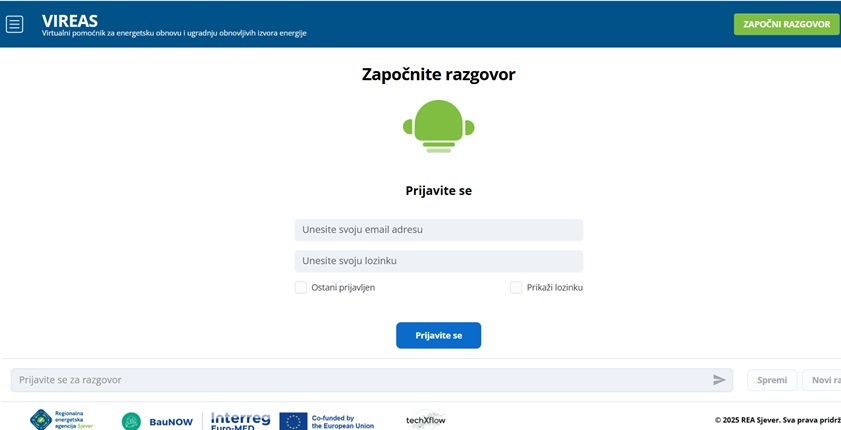
Meet VIREAS: new AI-powered virtual assistant for energy

Croatia’s Regional Energy Agency North has launched VIREAS – a virtual energy assistant powered by artificial intelligence.

VIREAS answers users’ questions about energy renovation and renewable energy sources in real time, provides recommendations tailored to users’ homes and needs, helps identify opportunities to save energy and reduce costs, and explains technical concepts in simple terms, the Regional Energy Agency North (REA North) said.

The VIREAS app is an interactive platform that enables users to engage with an AI assistant on various topics related to energy efficiency and renewable energy.

VIREAS is designed for those who want to save energy and use renewables

The idea behind the chatbot is to help owners of houses and buildings improve energy efficiency or install facilities for the use of renewable energy sources. For example, it assists in renovating the facade, replacing the heating system, or installing a heat pump or solar power plant.

It enables faster, easier, and more secure decision-making processes related to energy renovation, without the need for expert knowledge, the agency claimed.

VIREAS can be used both by people with very little knowledge and by experts

Using VIREAS is simple and user-friendly for everyone, whether you have very little knowledge or you are an expert, according to REA North.

In addition to technical recommendations, VIREAS informs users about available subsidies and public calls from the Environmental Protection and Energy Efficiency Fund or FZOEU, making it easier to access public funds and further reduce investment costs.

The agency warned that VIREAS doesn’t replace a project designer or a certified energy consultant

REA North underlined that VIREAS uses official sources of information. It includes public calls launched by FZOEU, technical rules on thermal protection and heating and cooling systems, and energy certification rulebooks.

The agency stressed that although its chatbot provides useful information and tips, it doesn’t replace a project designer or authorized energy consultant. REA North advised citizens to consult experts to make a final decision and for the preparation of project documentation.

The design of the chatbot was co-financed by the BauNOW project under the Interreg Euro-MED program.

by in News

Slovenia kicks off grants program for renewables-based district heating, cooling

The Ministry of the Environment, Climate and Energy of Slovenia launched a public call for cofunding the construction or restructuring of district heating and cooling systems using renewable energy sources. The grants, for companies and cooperatives, are from the European Union’s cohesion support mechanisms.

The introduction of renewables-based district heating and cooling systems reduces pollution, greenhouse gas emissions and the dependence on fossil fuels. Much of the European household and business sectors still rely on gas boilers for heating. In addition, the ever-increasing severity and length of heat waves are prompting the need for a systemic cooling solution.

As part of its decarbonization and energy efficiency efforts, Slovenia launched a EUR 51.2 million cofunding package for companies and cooperatives.

The program covers the construction or restructuring of district heating and cooling systems using renewable energy sources. The first deadline for applications is September 11, followed by one on January 8, the Ministry of the Environment, Climate and Energy said.

The public call will be open until the entire sum is allocated, or at the latest until September 11, 2026, the third deadline. The EU’s cohesion funding accounts for 85% and Slovenia is providing the rest.

District heating projects that include cooling get additional points

While primarily aimed at increasing the production of electricity and heat from renewable energy sources and from waste heat, the scheme includes additional points for projects that involve cooling. The systems are required to cover at least 350 kW of consumption.

Eligible equipment includes heat pumps, solar collectors, wood biomass boilers and combined heat and power (CHP or cogeneration) solutions.

Large companies can receive up to 45% of their investment, while mid-sized ones can get 55%. The cap for small and micro enterprises is 65%. The maximum individual grant is EUR 30 million.

Slovenia’s current calls for subsidizing sustainable mobility, energy efficiency and renewables projects are worth more than EUR 300 million altogether. The government is preparing four more, for EUR 62 million overall.

by in News

Clean energy, grid upgrade projects in Western Balkans to be backed under EU’s Growth Plan

The European Commission has proposed the first support package, of EUR 87.7 million, under the European Union’s Growth Plan for the Western Balkans, to help implement EUR 487.3 million worth of hydropower, solar district heating, and grid modernization projects in Albania, Montenegro, and Serbia. The package was announced following a high-level meeting between European Commissioner for Enlargement Marta Kos and Western Balkan partners in North Macedonia’s capital, Skopje.

The package, funded from the EUR 6 billion Reform and Growth Facility (RGF), set up under the Growth Plan, will be rolled out through the Western Balkans Investment Framework (WBIF). The proposal was made to the WBIF Operational Board, according to a press release from the commission.

The eight proposed projects include building a new generation unit and upgrading existing ones at Serbia’s Potpeć hydropower plant, which would increase its annual production to 236 GWh while reducing CO2 emissions. The investment is valued at EUR 72.1 million, with the RGF support amounting to EUR 15.8 million. The project is targeted for completion in 2030, according to the commission’s fact sheet.

Serbia could get support for introducing solar energy in district heating

The other project in Serbia is the construction of a 31 MW solar-thermal plant and 17 MW heat pump in Novi Sad, which will introduce renewable energy sources to the district heating system. The project would cost a total of EUR 114.3 million, with the RGF support at EUR 25 million. The targeted completion date is 2028.

In Montenegro, the package would support three projects. The first is an EUR 18.3 million investment in building a 38-kilometer 110kV overhead transmission line between Vilusi and Herceg Novi, aimed at increasing transmission capacity and reducing energy losses. It would receive EUR 3.1 million from the RGF.

The EU plans to back Montenegro’s SCADA roll-out

The second project in Montenegro is the introduction of SCADA in the power distribution system, estimated at EUR 26.5 million, with the proposed RGF support of EUR 5 million. The third one is a planned upgrade of the Brezna substation on the Trans-Balkan Electricity Corridor. The EUR 35.6 million investment would be backed with EUR 6.3 million from the RGF.

Albania plans to digitalize its transmission network in EUR 64.2 million project

The support package also includes Albania’s EUR 95.3 million investment in upgrading the Fierza hydropower plant, aimed at increasing its capacity by 10% and extending its lifespan by at least 30 years. The support from the RGF would amount to EUR 10.5 million. The other project to be supported in Albania is the EUR 64.2 million digitalization of the transmission network, which would receive 13.6 million from the RGF.

by in News

Virtual power plants: How they work and who can benefit from extra income

Virtual power plants, aggregators, and flexibility are gaining increasing attention, and not just within the energy sector. The growth and volatility of electricity prices have forced many businesses and institutions to install solar panels to cut costs. Virtual power plants – set up by aggregators to provide flexibility services – can generate additional income for new electricity producers and consumers capable of reducing or increasing consumption or storing energy.

The deployment of solar panels across Europe, including the Western Balkans, is experiencing remarkable growth, bringing numerous benefits to all who choose to produce electricity for self-consumption and become prosumers. Two of the four D’s of the energy transition are already underway – democratization and decentralization – resulting in increasing numbers of small energy producers and growing amounts of distributed (decentralized) production from renewable energy sources.

This has led to the emergence of aggregators – firms that connect multiple small producers, or even large-scale solar power plants or wind farms, with energy consumers capable of reducing or increasing consumption on demand, and with energy storage systems. The result is the virtual power plant, which functions like a real power plant thanks to software that connects and harmonizes all these actors.

Such a system can “iron out” the variability of renewable energy sources – solar or wind, and offer a more predictable energy delivery to the market as well as auxiliary services and on-demand flexibility to the system.

Naturally, this brings revenue, which is distributed among the members. For all this to work in practice, a lot of regulation is needed, and it is slowly being adopted in this region. Although they have not yet reached their full potential, there are already virtual power plants and aggregators in Bosnia and Herzegovina, Croatia, Hungary… But how does it all look in practice?

Energy Institute Hrvoje Požar joins virtual power plant KOER

By concluding an aggregation agreement, Energy Institute Hrvoje Požar (EIHP) has joined the KOER virtual power plant. Specifically, EIHP made available its 50 kW solar power plant, installed on the roof of its office building, to KOER, an aggregator on the Croatian electricity market.

Minea Skok, head of the Scientific Council and senior researcher at EHIP, explains to Balkan Green Energy News that KOER has conducted preparations for including the EIHP solar power plant in the virtual power plant.

The aggregator has installed control and metering equipment that enables the reading of electricity production from the existing electricity meter, along with software that enables data aggregation and forwarding to the transmission system operator, real-time 24/7 monitoring and alerting, reporting to the operator and the owner, and cost calculation.

It also conducted internal tests of the EIHP solar power plant’s balancing energy.

KOER provides services to Croatia’s transmission system operator HOPS

KOER’s virtual power plant, along with eight other providers on the Croatian market (aggregators and network users), provides services to the Croatian Transmission System Operator (HOPS), which is responsible for organizing the balancing market throughout Croatia, Skok explains.

Currently, the service involves balancing through the activation of balancing energy from a contracted mFRR (manual frequency restoration reserve), and soon also from aFRR (automatic frequency restoration reserve), according to her.

These system services are essential for any country’s transmission system operator to maintain power system balance, ensuring that all consumers have enough electricity at all times. These services also provide flexibility, which is increasingly in demand due to the growing share of solar power plants and wind farms – energy sources that are not flexible, since they only generate electricity when the sun is shining or the wind is blowing.

KOER and EIHP split the earnings 50-50

As for EHIP’s compensation for providing these services, Skok revealed that the contract defines the compensation received by KOER, as the aggregator, is split 50-50 with EHIP.

For the provision of these services, HOPS organizes tenders in which KOER competes with other service providers.

Skok emphasizes that EHIP’s solar power plant is profitable on its own, as it brings savings through lower electricity bills, which means the service fee is additional income.

On top of all that, gaining practical experience is an added value for EIHP, says Skok.

EIHP will also install a heat pump and a battery

The 50 kW photovoltaic power plant, matching the maximum available roof space of the EIHP building, was put into operation nearly a year ago.

Its average annual output is about 50,000 kWh. The EIHP building’s electricity consumption used to be 186,539 kWh, but thanks to energy renovation and the option of working from home, it was reduced. As a result, in the first ten months of operation, the power plant covered 53% of EIHP’s electricity consumption.

Following the energy renovation and the installation of solar panels, EHIP now plans to install a heat pump and a battery.

With its solar power plant, EIHP makes an additional contribution to power system balancing. By adding flexibility on the consumption side through the planned installation of a battery system and a heat pump, and in cooperation with KOER, the aggregator, EIHP contributes to system stability and the integration of new renewable energy sources, according to Skok.

by in News

Serbia secures EUR 50 million loan for air quality projects

The Government of Serbia has secured a EUR 50 million loan to fund a series of air quality projects across several cities. The funds will primarily go towards replacing coal- and fuel oil-fired boiler rooms in six cities.

For years, air pollution has been one of the biggest environmental issues in Serbia.

Minister of Environmental Protection Sara Pavkov and First Deputy Prime Minister and Minister of Finance Siniša Mali have signed two agreements with the European Bank for Reconstruction and Development (EBRD), which will soon lead to significant investments in air protection projects in multiple Serbian cities, the Ministry of Environmental Protection said.

Mali signed a EUR 50 million loan agreement, while Pavkov inked the project agreement. On behalf of the bank, both documents were signed by Matteo Colangeli, EBRD Regional Head of the Western Balkans.

EUR 50 million will be invested in cities with the highest levels of harmful emissions

Pavkov noted that based on these agreements, EUR 50 million would be invested in cities mapped as those with the largest excesses of harmful emissions. This is good news for residents of Belgrade, Niš, Valjevo, Zaječar, Novi Pazar, and Smederevo, where the projects will be implemented, she added.

In these cities, old, outdated boilers running on fuel oil, coal, and other fuels with an adverse impact on air quality will be replaced. Modern and sustainable heat energy sources, such as heat pumps, biomass, and industrial waste heat, will be installed, she stressed.

The projects will also include, where possible, connection to district heating systems or natural gas networks.

An air protection law is in the process of adoption

“These projects are the culmination of years of work. We have entered a phase where we can expect the launch of construction and intensification of the efforts for cleaner air, which remains one of our top priorities,” Pavkov stressed.

She recalled that an EBRD loan had helped replace 50-year-old coal boilers with state-of-the-art gas boilers at the Kragujevac district heating plant. The second phase, the remediation of the ash landfill, has also begun, she added.

From 2021 to 2024, the ministry has implemented projects to replace 169 boiler rooms in public institutions across 76 local authorities, according to Pavkov.

Under a public call, funds have been allocated for projects in 18 municipalities in 2025, with another call currently underway. An air protection bill is now before the National Assembly, intended to provide a new overarching framework and fresh momentum in the fight for better air quality, Pavkov noted.

by in News

Serbia to invest EUR 60 million in renewables in district heating

Serbia plans to sign an agreement by the end of the year on introducing renewable sources in district heating plants, according to the Ministry of Mining and Energy.

Minister of Mining and Energy Dubravka Đedović Handanović met with Ambassador of Germany Anke Konrad and Director of Germany’s KfW Development Bank for Southeast Europe and Turkey Klaus Müller.

They discussed cooperation on ongoing projects in the energy sector and a plan for further investments in renewables and energy efficiency.

The minister highlighted the successful cooperation with KfW in the construction of biomass heating plants and the introduction of renewable energy in district heating systems. She recalled that four biomass heating plants have been installed.

In the coming years, new boilers will be installed in several heating plants

She noted that in the second phase of the project, in the coming years, heating plants in Prijepolje, Novi Pazar, Niš, Rača, Vranje and Majdanpek are envisaged to get new boilers.

By the end of the year, Serbia plans to sign an agreement on the introduction of renewables in district heating plants, namely solar technology and heat pumps, Đedović Hanadanović announced.

The investment is estimated at EUR 60 million, of which EUR 20 million would be a donation, thanks to the support of KfW, she added.

Serbia and Germany plan to strengthen cooperation

Đedović Handanović stressed the importance of the climate partnership with Germany and thanked for the support that the other country provides to Serbia in the modernization of the energy sector.

“We are grateful to the German government and the KfW Development Bank for their continuous support in different subsectors in energy, from district heating and energy efficiency to the development of new capacities from renewable energy sources,” she stated.

In line with its ambitions and reform goals in energy, Serbia intends to deepen cooperation with Germany through new projects.

Of note, the four heating plants were installed in Priboj, Mali Zvornik, Novi Pazar and Majdanpek. The agreement for the second phase of the project was signed in May last year.