by in News

Bruegel: Without refining or delaying CBAM for electricity, EU risks market integration, security of supply

Unless the rules are refined for the electricity sector, the Carbon Border Adjustment Mechanism (CBAM) risks undermining the European electricity market integration and security of supply, Brussels-based think tank Bruegel warned.

Bruegel has analyzed the impacts of the application of CBAM, set for January 1, 2026. The tax will apply to steel, cement, iron, aluminium, fertilizers, hydrogen, electricity, and also to the cross-border trade in electricity.

The think tank proposes the application of CBAM in the electricity sector to be reconsidered, or at least for it to be postponed until 2028.

“Including electricity from January 2026 risks undermining European electricity market integration and security of energy supply, while the climate benefits are unclear. A delay could form part of a constructive compromise in an ongoing CBAM revision,” Ben McWilliams, Rouven Stubbe and Georg Zachmann wrote.

Ukraine and the Western Balkans will face implied export penalties of EUR 70-80 per MWh

The trading partners affected by CBAM on electricity are the United Kingdom, Morocco, the Western Balkans – Albania, BiH, Kosovo*, Montenegro, North Macedonia, and Serbia – Ukraine, Moldova and Turkey.

According to the analysis, Ukraine and the Western Balkans will face implied export penalties of EUR 70 per MWh to EUR 80 per MWh. It will significantly reduce trade with the EU, the authors stressed.

Ukraine’s electricity exports to the EU are expected to drop more than 60% from the level in a scenario without CBAM – from 6 TWh to 2.5 TWh, they added.

Additional trade barriers on the EU’s eastern borders would slow electricity market integration.

The export of solar power from Greece to other EU countries could also be affected by CBAM

“Falling average electricity prices, lower market values for renewables and increased price volatility would also reduce incentives to invest in renewable assets in these countries. Moreover, the Western Balkans is an important transit region for intra-European electricity trading. The export of solar power from Greece to other EU countries, for example, could also be affected by CBAM,” the analysis reads.

The authors said the policy goal of integrating Energy Community countries into the EU’s internal energy market is strategically more important than addressing carbon leakage and argued that, in the long run, it is more important from a climate perspective, too.

Not clear whether the application of CBAM to the electricity trade will deliver

They recalled that the purpose of CBAM is to reduce the risk of so-called carbon leakage, as well as to encourage third countries to implement domestic carbon pricing.

“However, it is not clear that the application of CBAM, as currently designed, to the electricity trade will deliver on either front,” the authors said. They named two reasons why carbon leakage in the electricity sector is problematic. The free allowances issued to electricity producers under the ETS were already phased out in 2013 – implying that electricity is not considered by the European Commission to be a sector at serious risk of carbon leakage.

The current CBAM legislation is not clear enough

Secondly, the current CBAM legislation is not clear enough. Unless hard-to-fulfil conditions apply, the Regulation (EU) 2023/956, which established CBAM, proposes that default carbon emission values be applied.

The outcome is that the values in question are calculated according to the last five-year average CO2 intensity of electricity produced from fossil fuels. It is problematic because electricity is exported when prices in one grid are lower than in another, which typically happens when renewables output is high, the think tank underlined in its analysis.

It is also unfair because power systems are evolving – production from fossil fuels is decreasing and renewables generation is increasing.

The coupling of the electricity markets of Energy Community countries is unlikely before 2028

Regarding CBAM’s intention to push third countries to introduce carbon pricing, the authors said that the first developments indicate some results.

However, they explained that an exemption for the electricity sectors of third countries is available under certain conditions, including electricity market coupling and the introduction of an ETS with an equivalent price to the EU ETS by 2030.

The CBAM charge sets off in January 2026, and the coupling of the electricity markets of Energy Community countries is unlikely before 2028, which means that an exemption for electricity cannot be secured before that date under current rules, the analysis underlined.

The solution

The authors pointed out that the potential gains from including electricity in CBAM are limited, compared to the frictions it will create. They suggested to the EU to follow the lead of the UK, which doesn’t plan to include electricity in its own CBAM, and thus to drop electricity from its sectoral coverage.

Otherwise, the authors proposed a revision of the calculation of default carbon emissions, and application delay until 2028 with additional analysis on the risk of carbon leakage in the electricity sector.

Regarding the default carbon emissions, five-year average CO2 intensity should be substituted for average grid emission factors calculated on an hourly or 15-minute basis, administered by the European Network of Transmission System Operators for Electricity (ENTSO-E) and national transmission system operators.

The application of CBAM to electricity should be delayed until 2028 to avoid disruption to the electricity trade and to give more time for the introduction of domestic carbon pricing and the coupling of electricity markets, the authors of the analysis concluded.

* This designation is without prejudice to positions onstatus and is in line with UNSCR 1244/99 and the ICJ Opinion on the Kosovo declaration of independence.
by in News

Serbia plans new mining law to align legislation with EU rules on critical raw materials

Serbia’s Ministry of Mining and Energy has launched a public consultation on a preliminary framework for a new law on mining and geological exploration. One of the goals of the new law is to align national legislation with European Union regulations on critical raw materials, sustainable development, and the circular economy.

The law will be harmonized with the EU’s Critical Raw Materials Act and the European Green Deal, to gradually align Serbia’s regulatory framework with the EU’s goals for sustainable mining, climate neutrality, and secure minerals supply, according to a document outlining the basis for the draft law.

Earlier this year, the European Commission included a lithium mining project in Serbia among the EU’s strategic projects for critical raw materials. Rio Tinto’s Jadar project is the only one on the list that involves the extraction of lithium and boron.

Lithium mining in Serbia is among the EU’s strategic projects for critical raw materials

Regarding harmonization with EU regulations, Serbia intends to introduce standardized reporting systems in line with the Pan-European Reserves and Resources Reporting Committee (PERC) standards, the UN Framework Classification for Resources (UNFC), and the Petroleum Resources Management System (PRMS), as well as implement ESG principles, which integrate environmental, social, and governance requirements into all phases of geological exploration and mining.

The main objective of the new law is to establish a modern, transparent, and efficient system for managing mineral and other geological resources in line with sustainable development standards, while strengthening the role of the state as the owner and steward of the country’s natural resources, according to the document.

It further highlights the need for more clearly defined mechanisms to ensure the application of sustainable mining principles and compliance with environmental standards, in line with advanced global practices. Investors’ obligations regarding environmental protection, land reclamation, and site remediation should be more precisely regulated during exploration and mining.

Investors’ obligations concerning environmental protection need to be more clearly defined

Improving the legal framework for granting exploration and mining rights is of particular importance, the document states. This would be done through models that ensure greater legal certainty, more efficient oversight, and consistent application of environmental and social standards, in line with sustainable mining principles.

The new law will also set clear criteria for identifying and protecting strategic mineral deposits, and ensure they are included in spatial and development plans. This would enable long-term protection of national interests in the field of mineral resources.

The law will digitalize permitting procedures for exploration and mining

The law will envisage digitalization and electronic processing in all administrative phases through a unified information system that enables electronic application and permitting, while allowing public access to data on exploration and mining fields.

The new law is also intended to ensure gradual alignment with European policies in the fields of green and digital transition.

The public consultation will be open until November 11, during which time citizens and organizations can submit proposals, comments, and suggestions.

by in News

European Commission: Russian gas ban doesn’t include transit to Serbia, BiH

The proposed ban on importing Russian natural gas to the European Union doesn’t apply to the transit of Russian gas, so it doesn’t affect the supply of Serbia and Bosnia and Herzegovina, the European Commission’s spokesperson Anna-Kaisa Itkonen told Balkan Green Energy News.

After the Council of the European Union on Monday adopted its negotiating position on the European Commission’s draft regulation to phase out imports of Russian natural gas by January 1, 2028, reports emerged that Bulgaria would halt the transit of Russian gas to Serbia from January 1, 2026. The council agreed with the initiative to prohibit imports of Russian gas, starting on January 1, 2026, while maintaining a transition period for existing contracts.

Notably, Bulgaria’s Prime Minister Rosen Zhelyazkov announced in late September that his country would suspend Russian gas transit for short-term contracts in 2026 as part of EU plans to cut off Russian gas imports completely, Reuters reported.

Serbia receives natural gas from Russia via the Balkan Stream. The pipeline is an extension of TurkStream that passes through Bulgaria and Serbia. TurkStream delivers gas from Russia across the Black Sea to Turkey.

Bosnia and Herzegovina and Hungary, Serbia’s neighbors, are also supplied via Balkan Stream.

With regards to transit via EU territory, the EU proposal only requires more transparency on transited volumes to third countries

Balkan Green Energy News asked the European Commission to clarify if the supply of Russian gas to Serbia and BiH via Bulgaria would be halted as of January 1, 2026, but also how the EU could assist Serbia and BiH in that case.

The European Commission’s spokesperson Anna-Kaisa Itkonen noted that its REPowerEU proposal foresees a prohibition of the import of Russian gas into the EU.

“The EU import prohibition doesn’t concern the transit of Russian gas through the EU territory to third countries – including to Serbia and BiH. It doesn’t therefore affect Serbia’s or BiH gas supply,” she stressed.

With regards to transit via EU territory, in her words, the EU proposal only requires more transparency on transited volumes to third countries.

EU candidate countries are expected to progressively align their legislation with the EU acquis and rules

However, EU candidate countries are expected to progressively align their legislation with the EU acquis and rules as part of the accession process, Itkonen pointed out and added that it includes REPowerEU regulation once it becomes EU law.

Of note, the draft regulation to phase out imports of Russian natural gas constitutes a central element of the EU’s REPowerEU roadmap to end the EU’s dependency on Russian energy.

According to Itkonen, as a way to ensure security of supply, candidate countries including Serbia should diversify away from unreliable energy suppliers such as Russia. Following Russia’s war of aggression on Ukraine, it became evident how important this is and what problems it can create for any European country, she asserted.

“The EU is supporting the WB countries for diversifying their energy supplies”

Anna-Kaisa Itkonen (photo: European Commission)

“The EU is supporting the Western Balkan countries for diversifying their energy supplies and for closer integration into the EU’s energy networks, both for electricity and gas, as well as through investments in renewable energy and decarbonization efforts,” Itkonen underlined.

After energy ministers in the Council of the EU have agreed on the institution’s negotiating position on the European Commission’s draft regulation, the next step is the adoption of the European Parliament’s position.

The council and the parliament would then start negotiations on the regulation. When the two institutions approve a regulation, it directly applies to all member states.

The meeting of the so-called Energy Council highlighted several issues and concerns among EU member states about the proposed ban on Russian natural gas.

by in News

Serbia warns of gas crisis as EU transit ban threatens Balkan Stream supply

Serbia is in a very difficult situation because, as of January 1, 2026, it won’t be able to receive Russian natural gas via Bulgaria, according to the Ministry of Mining and Energy.

Serbia receives natural gas from Russia via the Balkan Stream. The pipeline is an extension of TurkStream that passes through Bulgaria and Serbia. Bosnia and Herzegovina and Hungary, Serbia’s neighbors, are also supplied via Balkan Stream. TurkStream delivers gas from Russia across the Black Sea to Turkey.

Serbia is facing a very difficult and almost dead end situation due to the European Union’s ban on the transit of Russian gas through the EU to third countries, which will come into effect on January 1, 2026, according to Serbia’s Minister of Mining and Energy Dubravka Đedović Handanović.

Đedović Handanović: Bulgaria won’t allow the flow of Russian gas through the Balkan Stream

Bulgaria won’t allow the flow of Russian gas through Balkan Stream, which will negatively impact Serbia, she stressed.

The European Commission set out a plan in May to phase out the purchases of Russian natural gas, including in liquefied natural gas (LNG), and oil, by the end of 2027. The council now confirmed that imports of Russian gas will be prohibited from January 1, 2026, while maintaining a transition period for existing contracts.

Đedović Handanović: We are doing everything in our power, but the situation is almost hopeless, considering the current situation regarding NIS

Yesterday, the Council of the European Union agreed on its negotiating position on the European Commission’s draft regulation to phase out imports of Russian natural gas. When the European Parliament adopts its own position, it can start negotiating with the council.

When the two institutions approve a regulation, it directly applies to all member states.

Đedović Handanović expressed hope that a solution would be found due to, as she put it, President Aleksandar Vučić’s excellent relations with world leaders.

“We are doing everything in our power, but it is an almost dead end situation, considering the current situation regarding Naftna industrija Srbije [NIS]. Our country, which is not involved in any conflict, has found itself affected through no fault of its own. Despite everything, we will do our best, as we have so far, so that citizens don’t feel the problems we are facing,” Đedović Handanović underlined.

Namely, the United States imposed sanctions on October 9 against NIS, Serbia’s national oil importer, refiner, and operator of a chain of service stations.

by in News

RES Croatia to Brussels: Renewables have no future in Croatia

RES Croatia, together with SolarPower Europe and WindEurope, has sent a letter to the European Commission to raise concerns about the crisis in Croatia’s renewable energy sector.

The three associations emphasized that for several years, 60 projects for investments in solar, wind, geothermal, and batteries have been blocked, and that if nothing is done, many of them would soon be abandoned.

Without urgent deblocking of renewable energy projects, Croatia will lose investments, increase fossil fuel imports, which already exceed 25%, and miss the European Union’s and national target of at least 42.5% of energy consumption coming from renewables by 2030, according to Renewable Energy Sources of Croatia (RES Croatia), SolarPower Europe and WindEurope.

The national organization warned that the government is gradually phasing out subsidies for electricity prices for citizens and entrepreneurs. At the same time, the development of renewable energy sources as the only sustainable solution for lower bills and lowering imports is at a complete standstill, it added.

Projects with a total capacity of 3.5 GW and investments of EUR 3 billion are blocked

Croatia is currently subject to infringement proceedings due to delays in implementing the European Union’s RED II and RED III directive. They aren’t just a piece of paper, but a mechanism to ensure energy security and independence, which is of strategic interest for Croatia and its citizens, RES Croatia underscored.

The organizations are urging the European Commission to use its tools to demand from the government to determine the grid connection fee, but at EUR 0 per kWh, open up the balancing market for renewable energy producers, and integrate battery energy storage systems (BESS) and electrification into national planning.

Currently, 60 projects for solar power plants, wind farms, geothermal power plants, and batteries with a total capacity of 3.5 GW and investments of EUR 3 billion are blocked, according to the letter, accompanied by an annex.

The domestic industry is unable to sign long-term PPAs

For these projects, the state has already charged EUR 25 million through energy approvals— the first in a series of documents that requires payment to the state, which, due to the blockage, are beginning to expire at the end of this year.

Organizations stressed that these projects are permanently losing the paid money, while local communities are losing significant revenues that would have been allocated to them from the implementation of renewable energy projects.

They also drew attention to the domestic industry’s inability to sign long-term power purchase agreements (PPAs) with renewable energy producers, securing more favorable market conditions and thereby increasing its competitiveness in European and global markets.

Of note, the European Commission advised Croatia in June to speed up the installation of renewable energy capacities.

If nothing is done, projects of as much as 2.5 GW overall will be abandoned as early as next week

The associations pointed out that the development of new projects larger than 10 MW has stalled since 2022 because the Croatian Energy Regulatory Agency (HERA) has not set a transmission network connection fee for renewable power plants.

Instead, they added, Croatia’s transmission system operator (TSO) HOPS is trying to shift the costs of network modernization – planned over ten years ago and not related to new projects – to new renewable energy projects.

The minister of economy said in March that the upcoming connection fee would be EUR 0 per kW

It is increasing the project cost by 30% to 40%, making them unprofitable, RES Croatia said.

Such a model for financing the network is not from European practice, because 80% of member states rely on EU funds and their national budgets, rather than on producers.

They also recalled that the minister of economy announced in March that a connection fee would be set at EUR 0 per kW and that developers would be offered flexible contracts to encourage investment in battery storage. But that promise has not yet been fulfilled.

The three organizations warn that if nothing is done, projects of up to 2.5 GW altogether would be abandoned as early as next week after HOPS’s decision,. It means companies would withdraw from the Croatian market and lose millions in investments that would have permanently lowered energy prices in the country, RES Croatia claimed.

The balancing market is not functional

An additional problem is the non-functional balancing market, according to the letter.

HEP Proizvodnja, a subsidiary of state-owned utility Hrvatska Elektroprivreda (HEP), is the dominant provider of balancing services, and often the only one. HOPS is legally obliged to ensure market-based procurement of these services, yet it is itself a wholly owned subsidiary of HEP.

It creates an obvious conflict of interest and undermines market competition, the signatories underlined.

“Despite the demonstrated technical ability of solar and wind power plants to provide balancing services, HOPS doesn’t allow these plants to participate in balancing markets. As a result, HOPS frequently activates extremely expensive balancing resources, often at maximum regulated prices even during hours of high renewable generation and positive market prices,” the letter reads.

Croatia has no serious electrification plan

The organizations pointed out that such pricing constitutes a clear violation of the EU principle that balancing services must reflect only the actual costs incurred by the TSO.

They also stressed that Croatia lacks a concrete electrification plan. In 2022, renewable energy accounted for only 2.4% of final energy consumption in transport, with electricity from renewables contributing just 0.2%.

The target for renewable electricity in transport by 2030 is only 5.8%, reflecting limited ambition compared to the EU ambitions, according to the letter.

Electrification of railways could significantly reduce emissions and accelerate the transition, however, it remains an untapped potential, the signatories organizations noted.

by in News

Greece loses EU grant intended for renewable electricity for vulnerable consumers

The ambitious Apollo program, which the Greek government outlined in late 2023, is losing EUR 100 million. The European Union earlier approved the grant for investments in renewable energy and storage, intended to lower energy costs for vulnerable consumers through self-consumption.

The first phase of the Apollo program was envisaged to help vulnerable households. It aimed to support renewable energy projects, through auctions, of 400 MW to 500 MW overall, combined with battery systems.

Each of Greece’s 13 regions, also known as peripheries, would get a green power plant, and eligible consumers who join a local energy community get discounted electricity bills. Therefore, the program is in the form of virtual self-consumption. It is the first of its kind in the region that Balkan Green Energy News tracks.

Apollo fails to take off on time

The scheme was supposed to benefit from an EUR 100 million grant from the European Union’s Recovery and Resilience Facility (RRF). It is implemented via the National Recovery and Resilience Plan Greece 2.0.

However, Apollo was significantly delayed and now the deadlines are considered impossible to achieve, even if they are extended. It means RRF funds are going to be lost. Energypress reported that they have already been removed from the budget.

Namely, the issue is with the batteries. Now their costs would have to be covered entirely by the producers. In turn, they are expected to lock higher prices in Apollo’s auctions, possibly passing them on to end consumers and making the whole initiative less effective at combating energy poverty.

It should be noted that the rest of Apollo remains intact for the time being, despite the setback. The loss of funds concerns household consumers with special tariff A. Funding is still available, in theory, for the other category of vulnerable households, defined by different income criteria.

The entire initiative also aims to lower energy costs for municipal authorities, water utilities and irrigation associations. They haven’t been affected so far.

Standalone battery plants also at risk

Another Greek initiative, for subsidized standalone battery plants, faces very short deadlines. It is eligible for EUR 341 million in RRF funding. In total, projects for 900 MW overall have been selected through three auctions.

The first wave of investors should declare connection readiness this month, so their facilities can become operational by the end of 2025.

HAESS: Selected projects may not receive support

They have complained of a lengthy licensing process and logistical difficulties. The investors asked the Ministry of Environment and Energy for an extension.

In July, the Ministry of Finance submitted a request for the sixth RRF tranche, EUR 2.1 billion in grants, after completing 39 more targets. If it is approved by the administration in Brussels, Greece will have secured EUR 23.4 billion overall, or 65% of allotted funds.

by in News

Von der Leyen: EU needs more homegrown renewables with nuclear as baseload

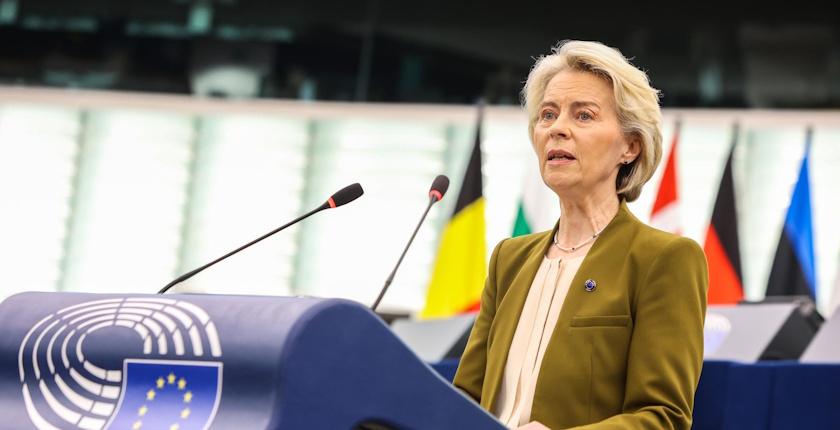
European Commission President Ursula von der Leyen delivered her 2025 State of the Union address at the European Parliament in Strasbourg. She said the single energy market would be completed and pointed out that clean homegrown energy is a tool to lower energy prices.

Ursula von der Leyen said the European Union’s greatest asset is the single market, but that it remains incomplete. The IMF, she noted, has estimated that the internal barriers within the single market are equivalent to a 45% tariff on goods, and 110% on services.

Most gaps are in three domains: finance, energy, and telecommunications.

“We need clear political deadlines. This is why we will present a single market roadmap to 2028. On capital, services, energy, telecoms,” she stated.

Energy bills are still a real source of anxiety for millions of Europeans

The EU’s top official said the commission would put forward a series of packages on affordability and the cost of living. One would be for energy.

Von der Leyen recalled that the EU managed to stabilize prices and secure supply during the energy crisis, and insisted that the 27-member bloc is now on the path to energy independence.

But, she told EU lawmakers, energy bills are still a real source of anxiety for millions of Europeans.

Von der Leyen unveiled an initiative called Energy Highways

“We know what drove prices up: dependency on Russian fossil fuels. So it is time to get rid of dirty Russian fossil fuels. And we know what brings prices down: clean homegrown energy. We need to generate more homegrown renewables – with nuclear as a baseload,” Von der Leyen stressed.

She reiterated that the commission would propose a grids package to strengthen infrastructure and speed up permitting.

Von der Leyen unveiled an initiative called Energy Highways. “We have identified eight critical bottlenecks in our energy infrastructure. From the Øresund Strait to the Sicilian Canal. We will now work to remove these bottlenecks one by one,” the European Commission president asserted.

  • 1
  • 2