
by in News

Electricity prices for Slovenian firms among highest in EU in 2024

Last year, Slovenian households had cheaper electricity than the European Union average while the tariffs for other categories of consumers, including businesses, were among the highest in the EU, according to an analysis by Slovenia’s transmission system operator ELES.

The analysis, conducted by ELES CEO Aleksander Mervar, also showed network fees are significantly lower than the EU’s average.

Slovenia is in the bottom third of the list of the 27 member countries. As for its neighbors, domestic prices were higher than in Hungary and Croatia, and lower than in Austria and Italy, Naš Stik reported.

Last year, Bulgaria had the lowest prices in the EU, followed by Malta, Luxembourg, Hungary, and Croatia. When measured against purchasing power, prices in Slovenia are in the lower half of the list.

The Government of Slovenia has capped electricity prices for households

The analysis attributes the lower tariffs for households mainly to measures that the Government of Slovenia introduced. The two main interventions were setting a maximum price for 90% of consumption, and freezing the payment of a fee for subsidizing electricity production from renewables and high-efficiency cogeneration.

From January 1 to October 31, the maximum price was 8.2 eurocents per kWh in the lower tariff and 11.8 eurocents per kWh in the higher one. They were the maximum prices for 90% of consumption, while the remainder was set by suppliers in line with the market conditions.

Without government measures, the annual bill of the average Slovenian household, with an annual consumption of 4,000 kWh, would be higher by EUR 345.89 or 45.77%, according to the calculation.

ELES denies network fees impacted competitiveness of firms

The conditions for businesses were different. Prices for commercial and industrial consumers were among the highest in the EU. However, the domestic average was lower than in neighboring countries.

Businesses in Serbia experienced a similar issue last year.

ELES denied the claim by the Chamber of Commerce and Industry of Slovenia that high network fees lowered corporate competitiveness. The company argued they were significantly lower for commercial consumers, by 36.5% to 49%, than the EU average.

In addition, network fees are as much as 53% below the level in the countries surrounding Slovenia, according to the ELES analysis.

Network fees for households in Slovenia are among the lowest in the EU.
by in News

Delta Green launches platform in CEE for households to provide grid balancing

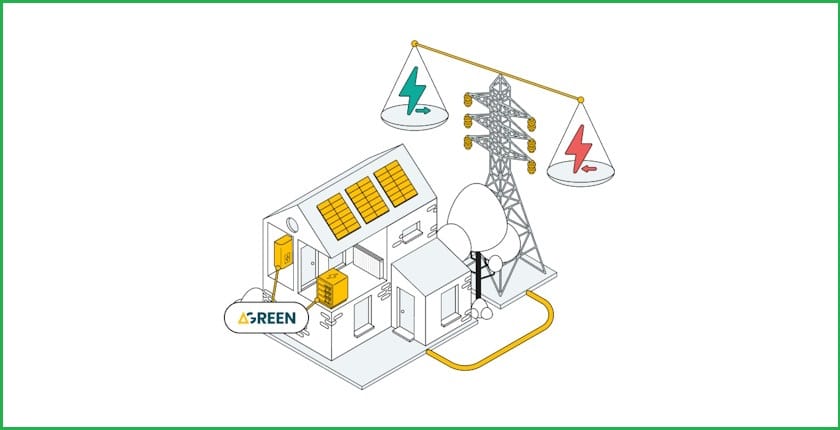
Czech energy startup Delta Green has launched a platform enabling households to provide grid balancing for transmission system operators. The company claims it is the first in Central and Eastern Europe and among the first in Europe to implement such a solution.

Delta Green said it just became the first in the CEE region to launch a platform that lets ordinary households help stabilize the energy grid, arguing it’s never been done before at this scale in the region.

The startup stressed the innovation comes at a critical time when European flexibility needs are projected to more than double, from 220 TWh in 2025 to 530 TWh by 2033, according to the latest projections by ENTSO-E.

Flexibility could bring benefits to consumers, and savings to grid operators, but also reduce electricity prices and grid investments.

The platform transforms ordinary households into active participants in the energy market

The platform transforms ordinary households into active participants in the energy market, allowing them to adjust electricity consumption or supply power in response to grid demands – a capability that directly addresses Europe’s growing flexibility challenges, the company underlined.

“A standard home solar system with battery storage can save up to EUR 40 per month. In Germany and France, where millions of homes have solar setups, 10% participation could offset the output of several power plants, reducing fossil fuel reliance and boosting grid resilience,” co-owner and Chief Product Officer of Delta Green Jan Hicl said.

Delta Green says its platform is the Airbnb of grid balancing

The company added its tech is already saving consumers money and reducing fossil fuel reliance. One can think of it as the Airbnb of grid balancing, Delta Green said.

The company is now working on expanding its services beyond the Czech Republic to both Western and Eastern Europe, for example the DACH region (Germany, Austria, and Switzerland), Italy, and Romania.

Delta Green was established in 2008 as Nano Green under the Nano Energies group. It rebranded itself last year. The company is jointly owned by David Brožík, Prokop Čech, Lukáš Beneš, and Jan Hicl.

Demand-side flexibility could deliver over EUR 300 billion in benefits for European consumers

A recent study from the Smart Energy Europe Association (smartEn) demonstrates that demand-side flexibility could deliver over EUR 300 billion in benefits for European consumers by 2030. Grid flexibility from available assets, including household systems, could contribute a projected EUR 4 billion in annual savings for European grid operators.

According to the European Agency for the Cooperation of Energy Regulators (ACER), grid expansion and flexibility measures potentially could reduce electricity prices by 11% by 2035 and by 30% in 2040 in a net zero scenario.

The European Union needs EUR 584 billion in grid upgrades by 2030. Flexibility solutions, combined with grid optimization, could lower the much needed grid investments from an anticipated EUR 67 billion to EUR 55 billion annually between 2025 and 2050.