by in News

Albania as a Regional Outlier: Diesel Dominance Persists Amid Europe’s Green Transition

New data from Eurostat reveals a significant divergence in automotive trends between Albania and the European Union. While the EU moves aggressively toward decarbonization, Albania has emerged as the country with the highest share of diesel-powered vehicles among first-time passenger car registrations in 2024.

This trend stands in sharp contrast to the broader European trajectory, where environmental regulations and technological shifts are rapidly phasing out internal combustion engines in favour of electric and hybrid alternatives.

The Data: A Stark Statistical Divide

According to Eurostat’s latest report on transportation, 66.2% of all passenger vehicles registered for the first time in Albania during 2024 were diesel-powered. To put this in perspective, the EU average for diesel registrations has plummeted to just 14.9%.

The regional comparison further highlights Albania’s unique position:

  • Albania: 66.2% diesel share

  • Moldova: 47.0%

  • Bosnia and Herzegovina: 34.5%

  • Other Balkan neighbors: Generally below 30% (excluding Kosovo and North Macedonia, for which data was unavailable).

In absolute numbers, out of the 85,700 passenger vehicles registered for the first time in Albania in 2024, approximately 56,700 were diesel. Conversely, gasoline vehicles accounted for only 17.6% of registrations—one of the lowest shares in Europe—while electric vehicles (EVs) represented a mere 3.3% of the total.

The European Shift Toward Electrification

The European landscape tells a completely different story. The transition to Battery Electric Vehicles (BEVs) is accelerating, driven by the EU’s ambitious climate goals to reduce the 27% of greenhouse gas emissions currently attributed to transport.

  • Denmark: Over half (51.3%) of new registrations are fully electric.

  • Sweden, Malta, and the Netherlands: EVs account for more than one-third of the market.

  • EU Average: Electric vehicle registrations reached 13.5% in 2024.

Looking back at the decade between 2014 and 2024, the shift is even more dramatic. In 20 representative EU countries, the registration of diesel vehicles fell by 67%, while registrations for fully electric cars grew by 45 times, moving from a negligible 0.3% share in 2014 to nearly 14% today.

Why is Albania Lagging Behind?

The dominance of diesel in Albania is not a matter of consumer preference alone but is rooted in several structural and economic factors:

  1. Second-Hand Market Dominance: The Albanian market is heavily reliant on imported used cars from Western Europe. As EU consumers sell off their older diesel models to switch to EVs, these vehicles often find a second life in the Albanian market.

  2. Initial Cost Barriers: The upfront cost of electric or hybrid vehicles remains high compared to older diesel models, making them less accessible to the average Albanian consumer.

  3. Infrastructure Gaps: The national charging network for electric vehicles is still in its infancy, leading to “range anxiety” and deterring potential EV buyers.

  4. Policy Incentives: There is a lack of robust fiscal incentives or subsidies to encourage the adoption of “green” vehicles compared to the aggressive tax breaks seen in EU member states.

Looking Ahead

While Albania remains a diesel stronghold for now, the European trend is inevitable. As EU emission standards tighten and the production of internal combustion engines scales down, the supply of diesel vehicles will eventually dwindle.

For Albania to bridge this gap, experts suggest a dual approach: investing in charging infrastructure and implementing fiscal policies that make cleaner alternatives more competitive. Without these interventions, Albania risks becoming a “parking lot” for Europe’s aging, high-emission fleet.
by in News

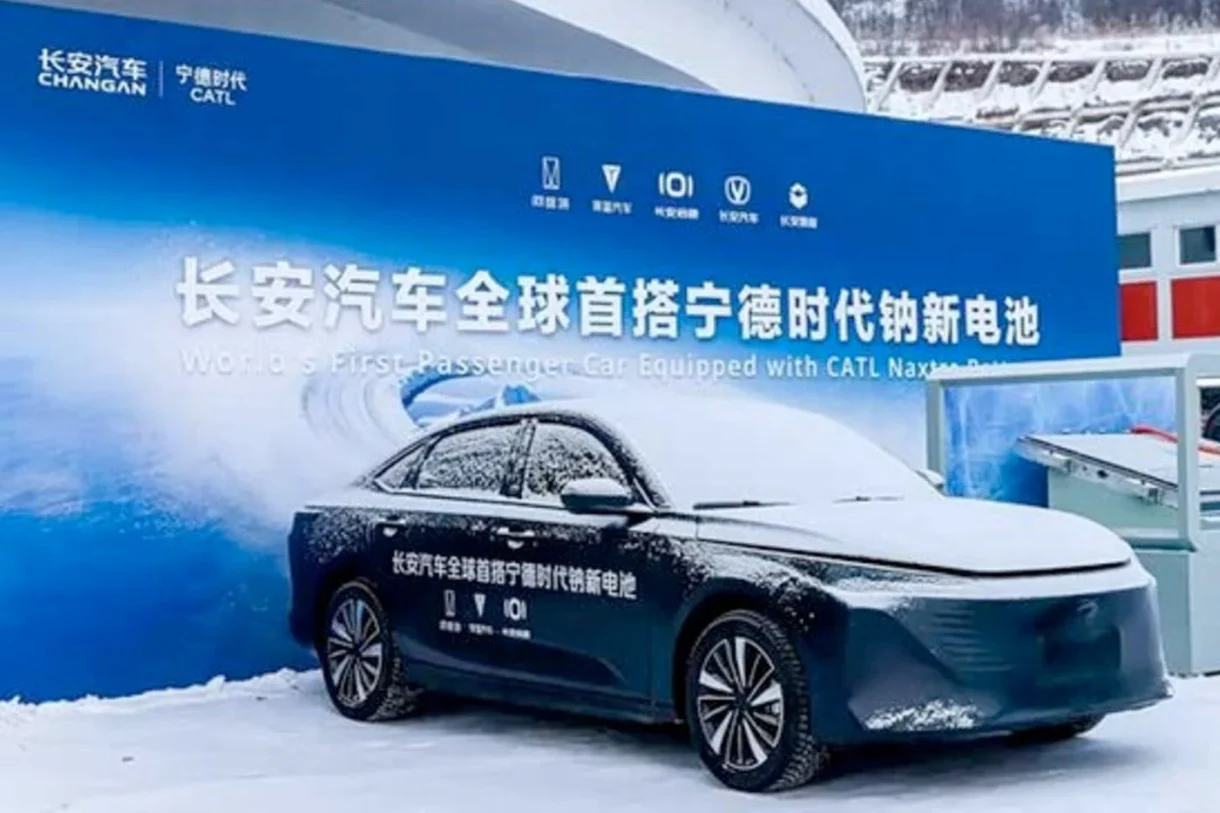
Changan and CATL Debut First Mass-Produced Sodium-Ion Passenger EV

Chinese automotive manufacturer Changan has introduced the world’s first mass-produced passenger vehicle equipped with sodium-ion batteries, developed in partnership with CATL. The companies are positioning the technology around strong performance in extremely low temperatures and enhanced fire safety.

After a decade of research and development, Contemporary Amperex Technology Co. Ltd. (CATL), the world’s largest battery producer, has reached a key milestone in commercializing sodium-ion technology. State-owned China Changan Automobile Group has now unveiled the first passenger vehicle to deploy the solution at mass scale.

According to the companies, the Changan Nevo A06 (Changan Qiyuan A06) sedan is expected to reach the market by mid-year. They report a driving range of more than 400 kilometers under the China Light-Duty Vehicle Test Cycle (CLTC), powered by CATL’s 45 kWh Naxtra battery—while noting that Western testing standards are generally more stringent.

Naxtra is built as a cell-to-pack (CTP) system, integrating cells directly rather than using an intermediate module structure.

Safety as a differentiator in the EV market

While the Nevo A06 is not the first vehicle to use sodium-ion batteries, Changan and CATL are aiming to achieve true mass production. Changan plans to expand Naxtra adoption across its wider brand portfolio, including AVATR, Deepal, and UNI.

CATL emphasized that sodium-ion batteries are intended to complement—not replace—lithium-ion solutions. The company described the launch as a significant step toward a dual-chemistry ecosystem in which sodium-ion and lithium-ion batteries work together to meet diverse customer requirements. CATL also underscored its view that the technology is safe, reliable, and high-performing.

Cold-weather performance and fire safety claims

CATL stated that its Naxtra sodium-ion battery reaches an energy density of up to 175 Wh/kg, which it described as the current benchmark for mass production and approaching the average levels of lithium-iron-phosphate (LFP) batteries.

The manufacturer added that as the sodium-ion supply chain matures, driving ranges are projected to rise to 500–600 kilometers.

On low-temperature performance, CATL said the battery remains reliable in extreme cold, delivering nearly three times the discharge power of comparable LFP batteries at minus 30°C. It also reported more than 90% capacity retention at minus 40°C and stable power delivery down to minus 50°C.

CATL further said the battery has been tested under harsh conditions—including crushing, drilling, and sawing—while remaining free of smoke and fire and continuing to provide power.

In addition, the companies argue that sodium costs a fraction of LFP material, potentially strengthening the cost case for broader adoption.

Given sodium-ion’s claimed resistance to cold, the partners are eyeing colder-climate markets as an avenue to support electric-vehicle sales, noting that lithium-ion solutions are more sensitive to low temperatures.

Ouyang Xiaolong, CATL’s head engineer for passenger cars, told the South China Morning Post that more than 10,000 new battery units would be deployed this year, with the goal of reaching “hundreds of thousands” by 2027.

by in News

Croatia launches subsidy call for electric taxi, delivery, car-sharing vehicles

The Government of Croatia has launched a public call to grant subsidies for the purchase of electric vehicles intended for use in taxi, delivery, and car-sharing services.

This is the first public call in Croatia for co-funding for the purchase of electric vehicles for taxi, delivery, and car-sharing services.

The program for the allocation of non-refundable aid was published by the Croatian Ministry of Environment and Green Transition. The call is part of a mechanism for investments in road transport with zero emissions.

The grants were secured via the European Union’s Modernisation Fund.

There is EUR 22 million earmarked for taxi drivers,

From the entire EUR 45 million package, taxi drivers are entitled to EUR 22 million, versus EUR 20 million for delivery vehicles, while EUR 3 million is set for car sharing providers, according to the public call.

The ministry aims to support the purchase of zero-emission vehicles – EVs of categories M1 or N1, to achieve a reduction in greenhouse gas emissions in the transport sector by 20.99% by 2030 from the 2005 level.

In category M1 are passenger vehicles with a maximum of nine seats, and N1 are light commercial vehicles with a maximum permissible weight of 3.5 tons. The maximum subsidy per vehicle is EUR 9,000, meaning the call should co-finance the purchase of at least 5,000 EVs.

North Macedonia is supporting the purchase of EVs for taxi drivers

The submission of applications kicks off on January 15, 2026. It lasts until the funds are exhausted, or at the latest until September 30, 2026.

Three months ago a subsidiy program for taxi services was launched in North Macedonia.

The Ministry of Environment and Spatial Planning and an association of cab drivers are implementing a project to subsidize 200 EVs.

It is a part of efforts for cleaner, quieter, and more efficient urban transportation for the citizens of Skopje and the entire country. It is one of the cities with the most polluted air in the world.

by in News

Croatia launches subsidy call for electric taxi, delivery, car-sharing vehicles

The Government of Croatia has launched a public call to grant subsidies for the purchase of electric vehicles intended for use in taxi, delivery, and car-sharing services.

This is the first public call in Croatia for co-funding for the purchase of electric vehicles for taxi, delivery, and car-sharing services.

The program for the allocation of non-refundable aid was published by the Croatian Ministry of Environment and Green Transition. The call is part of a mechanism for investments in road transport with zero emissions.

The grants were secured via the European Union’s Modernisation Fund.

There is EUR 22 million earmarked for taxi drivers,

From the entire EUR 45 million package, taxi drivers are entitled to EUR 22 million, versus EUR 20 million for delivery vehicles, while EUR 3 million is set for car sharing providers, according to the public call.

The ministry aims to support the purchase of zero-emission vehicles – EVs of categories M1 or N1, to achieve a reduction in greenhouse gas emissions in the transport sector by 20.99% by 2030 from the 2005 level.

In category M1 are passenger vehicles with a maximum of nine seats, and N1 are light commercial vehicles with a maximum permissible weight of 3.5 tons. The maximum subsidy per vehicle is EUR 9,000, meaning the call should co-finance the purchase of at least 5,000 EVs.

North Macedonia is supporting the purchase of EVs for taxi drivers

The submission of applications kicks off on January 15, 2026. It lasts until the funds are exhausted, or at the latest until September 30, 2026.

Three months ago a subsidiy program for taxi services was launched in North Macedonia.

The Ministry of Environment and Spatial Planning and an association of cab drivers are implementing a project to subsidize 200 EVs.

It is a part of efforts for cleaner, quieter, and more efficient urban transportation for the citizens of Skopje and the entire country. It is one of the cities with the most polluted air in the world.

by in News

Athens International Airport builds biggest photovoltaic-BESS plant

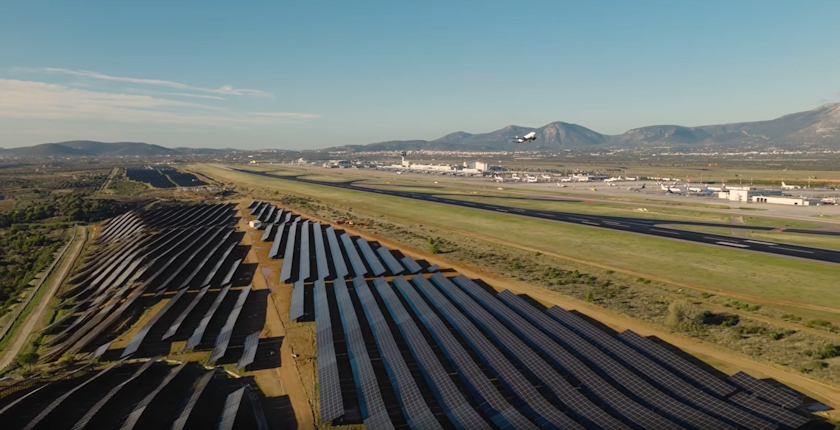
Athens International Airport (AIA) Eleftherios Venizelos completed its comprehensive energy makeover program. It is now operating a photovoltaic facility of 51.5 MW and a battery energy storage system of 82 MWh. It is the largest hybrid power plant of its kind within the premises of any airport in Europe and, reportedly, even the entire world.

At the same time, the Bucharest Henri Coandă International Airport is about to build 12.6 MW in peak PV capacity and a BESS of 17.9 MWh, in the first phase of a larger project.

Following European and global trends, airports in Southeastern Europe are introducing resource, waste and wastewater management systems. Energy is the largest segment of the decarbonization push. With the completion of its Route 2025 program, Athens International Airport Eleftherios Venizelos covered all its electricity needs with photovoltaics, becoming the only such airport in Europe.

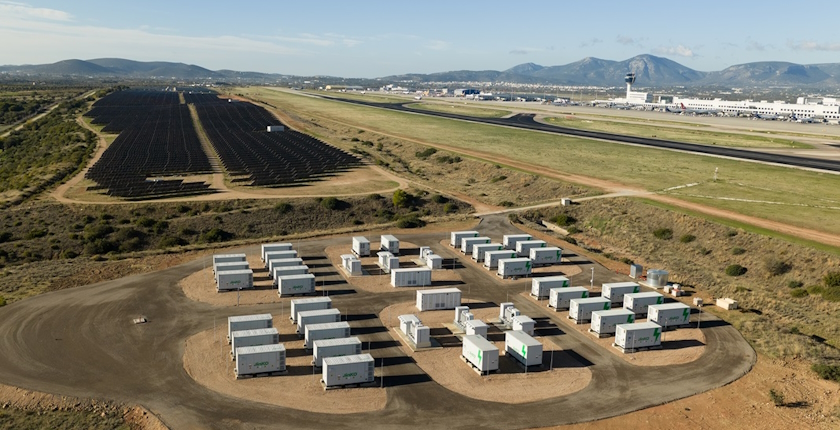
In the groundbreaking project, the operator extended the existing solar power plant by 35.5 MW in peak capacity, reaching 51.5 MW, and added a battery energy storage system. The facility has 124 MWh in nominal capacity, of which 82 MWh is usable.

The hybrid system is the largest of its kind inside the fence of any airport in Europe, while the Greek press has even called it the largest in the world. Some of the world’s largest airports are set to follow soon. For instance, IGA Istanbul Airport is investing EUR 212 million in an external solar power plant of 199.3 MW, in Eskişehir.

Athens International Airport builds biggest photovoltaic BESS plant
Photo: Athens International Airport

Hybrid power plant to keep Athens International Airport at net zero through 2046

AIA’s PV-BESS plant will generate an estimated 88 GWh per year, which is equivalent to the consumption of 22,000 households. The storage system is only for self-consumption. Importantly, the hybrid system can cover the entire planned expansion up to 2046, when the concession period ends.

AviAlliance, which controls 50.2% of the public-private partnership, is a wholly-owned subsidiary of Public Sector Pension Investment Board (PSP Investments) from Canada. The government holds 25.6% through Superfund, officially Growthfund – The National Fund of Greece.

AIA launched Route 2025 six years ago, with the aim to cut net greenhouse gas emissions to zero by the end of this year. It compares to the 2050 net zero goal of the European airports sector.

The Route 2025 program was worth EUR 70 million

The investments totaled EUR 70 million. A significant portion was financed through loans from the European Union’s Recovery and Resilience Facility (RRF), the update adds.

Heat pumps have eliminated the need for natural gas in buildings at AIA in normal winter conditions. The electric vehicle fleet consists of 19 buses, 13 follow-me vehicles and 29 vans. A network of chargers also serves passenger cars.

“In the airport company, we operate on the basis of the principle that sustainability, and environmental responsibility in particular, are and will increasingly be prerequisites for what we call the social license to operate and grow,” said outgoing Managing Director of AIA Yiannis Paraschis.

Two airports in Romania receive EU funds for solar-BESS projects

As for other recent developments in the Balkans, operators of two airports in Romania received grants via the European Union’s Modernisation Fund for solar power plants with battery storage.

National Company Bucharest Airports (CNAB) signed a contract for RON 132.04 million (EUR 25.9 million) excluding value-added tax. It is for 12.6 MW in peak PV capacity and a BESS of 17.9 MWh at the Bucharest Henri Coandă International Airport in Otopeni.

The entire investment amounts to RON 176.9 million (EUR 34.7 million) excluding VAT. The Romanian state-owned company said it is the first phase of a project for 31.5 MW and 30 MWh overall, valued at EUR 55.7 million.

Bacău International Airport George Enescu will build a solar power plant of 1.25 MW and a BESS of 2.06 MWh. Bacău County Council will also provide support for the on-site project on 2.2 hectares, worth more than EUR 4.9 million.

by in News

Athens International Airport builds biggest photovoltaic-BESS plant

Athens International Airport (AIA) Eleftherios Venizelos completed its comprehensive energy makeover program. It is now operating a photovoltaic facility of 51.5 MW and a battery energy storage system of 82 MWh. It is the largest hybrid power plant of its kind within the premises of any airport in Europe and, reportedly, even the entire world.

At the same time, the Bucharest Henri Coandă International Airport is about to build 12.6 MW in peak PV capacity and a BESS of 17.9 MWh, in the first phase of a larger project.

Following European and global trends, airports in Southeastern Europe are introducing resource, waste and wastewater management systems. Energy is the largest segment of the decarbonization push. With the completion of its Route 2025 program, Athens International Airport Eleftherios Venizelos covered all its electricity needs with photovoltaics, becoming the only such airport in Europe.

In the groundbreaking project, the operator extended the existing solar power plant by 35.5 MW in peak capacity, reaching 51.5 MW, and added a battery energy storage system. The facility has 124 MWh in nominal capacity, of which 82 MWh is usable.

The hybrid system is the largest of its kind inside the fence of any airport in Europe, while the Greek press has even called it the largest in the world. Some of the world’s largest airports are set to follow soon. For instance, IGA Istanbul Airport is investing EUR 212 million in an external solar power plant of 199.3 MW, in Eskişehir.

Athens International Airport builds biggest photovoltaic BESS plant
Photo: Athens International Airport

Hybrid power plant to keep Athens International Airport at net zero through 2046

AIA’s PV-BESS plant will generate an estimated 88 GWh per year, which is equivalent to the consumption of 22,000 households. The storage system is only for self-consumption. Importantly, the hybrid system can cover the entire planned expansion up to 2046, when the concession period ends.

AviAlliance, which controls 50.2% of the public-private partnership, is a wholly-owned subsidiary of Public Sector Pension Investment Board (PSP Investments) from Canada. The government holds 25.6% through Superfund, officially Growthfund – The National Fund of Greece.

AIA launched Route 2025 six years ago, with the aim to cut net greenhouse gas emissions to zero by the end of this year. It compares to the 2050 net zero goal of the European airports sector.

The Route 2025 program was worth EUR 70 million

The investments totaled EUR 70 million. A significant portion was financed through loans from the European Union’s Recovery and Resilience Facility (RRF), the update adds.

Heat pumps have eliminated the need for natural gas in buildings at AIA in normal winter conditions. The electric vehicle fleet consists of 19 buses, 13 follow-me vehicles and 29 vans. A network of chargers also serves passenger cars.

“In the airport company, we operate on the basis of the principle that sustainability, and environmental responsibility in particular, are and will increasingly be prerequisites for what we call the social license to operate and grow,” said outgoing Managing Director of AIA Yiannis Paraschis.

Two airports in Romania receive EU funds for solar-BESS projects

As for other recent developments in the Balkans, operators of two airports in Romania received grants via the European Union’s Modernisation Fund for solar power plants with battery storage.

National Company Bucharest Airports (CNAB) signed a contract for RON 132.04 million (EUR 25.9 million) excluding value-added tax. It is for 12.6 MW in peak PV capacity and a BESS of 17.9 MWh at the Bucharest Henri Coandă International Airport in Otopeni.

The entire investment amounts to RON 176.9 million (EUR 34.7 million) excluding VAT. The Romanian state-owned company said it is the first phase of a project for 31.5 MW and 30 MWh overall, valued at EUR 55.7 million.

Bacău International Airport George Enescu will build a solar power plant of 1.25 MW and a BESS of 2.06 MWh. Bacău County Council will also provide support for the on-site project on 2.2 hectares, worth more than EUR 4.9 million.

by in News

European Commission proposes easing 2035 car emissions rules

The European Commission has proposed a new Automotive Package that aims to give carmakers greater flexibility in meeting emissions reduction requirements. The new rules would lower the emissions cut target from 100% to 90%, allowing the sale of hybrid and internal combustion vehicles after 2035.

From 2035 onwards, carmakers will need to comply with a 90% emissions reduction target, while the remaining 10% emissions will need to be compensated through the use of low-carbon steel produced in the European Union, or from e-fuels and biofuels, according to a press release from the commission.

“This will allow for plug-in hybrids (PHEV), range extenders, mild hybrids, and internal combustion engine vehicles to still play a role beyond 2035, in addition to full electric (EVs) and hydrogen vehicles,” reads the announcement.

Carmakers will be incentivized to produce affordable EVs

The commission is also proposing “super credits” to incentivize carmakers to produce small, affordable electric cars made in the European Union. This measure would be in place until 2035.

Hoekstra: The EU is staying the course towards zero-emissions mobility

European Climate Action Commissioner Wopke Hoekstra has said the EU is staying the course towards zero-emissions mobility, but introducing some flexibilities for manufacturers to meet their CO2 targets in the most cost-efficient way.

The move comes amid pressure from car manufacturers, who claim their business is threatened by competition from China and the United States, according to reports.

The move comes amid pressure from European carmakers

Several EU member states – Germany, Italy, Bulgaria, the Czech Republic, Hungary, Poland, and Slovakia – say their automakers are struggling with high energy prices, a shortage of components, including batteries, and weak demand for electric vehicles.

The proposal includes a EUR 1.8 billion package to help develop a fully EU-made battery value chain and tackle competition from outside the bloc. As part of the accompanying Battery Booster package, EUR 1.5 billion will be disbursed in interest-free loans to European battery manufacturers, according to the press release.

by in News

Croatia drafts EUR 1.68 billion Social Climate Plan

Croatia has prepared a Social Climate Plan for the period 2026-2032, worth EUR 1.68 billion. It would introduce measures for the buildings and road transport sectors aimed at supporting households and small businesses.

The draft of Croatia’s Social Climate Plan is under public discussion, which will last until December 22.

The process of adopting the most important national instrument for protecting citizens from the adverse effects of climate transition and the introduction of the European Union’s Emissions Trading System 2 (EU ETS 2) has begun, the Ministry of Environmental Protection and Green Transition stressed.

The plan will be financed with EUR 1.26 billion from the EU’s Social Climate Fund, and the remainder from Croatia’s national budget. Essentially, all the funds are coming from the auctions of emission allowances in the EU and Croatia under the EU ETS 2. It is an expansion of the EU ETS to the buildings sector (heating and cooling) and road transport.

The EU established the Social Climate Fund in May 2023 to protect households and small businesses

The expansion could increase the costs of heating, cooling, and transport. In May 2023, the EU established the Social Climate Fund to protect low-income households, micro enterprises, and transport users that could be affected by the cost increase.

The measures and investments also contribute to the implementation of the goals of the National Energy and Climate Plan (NECP).

The Social Climate Plan allocates EUR 658.1 million (39%) for the buildings sector, and EUR 958.4 million (57%) for road transport. Technical assistance is the third component, with EUR 42 million (2.5%).

The measures planned for the buildings sector include support for the establishment of energy communities and subsidies for the energy renovation of family homes. In the road transport sector, the plan envisages investments in cycling, on-demand mobility services, zero-emission vehicles, and railway infrastructure.

Vučković: Restoration planned for 180 kilometers of bike trails

croatia social climate policy plan EU ets 2 marija vuckovic plenkovic
Photo: Government of Croatia

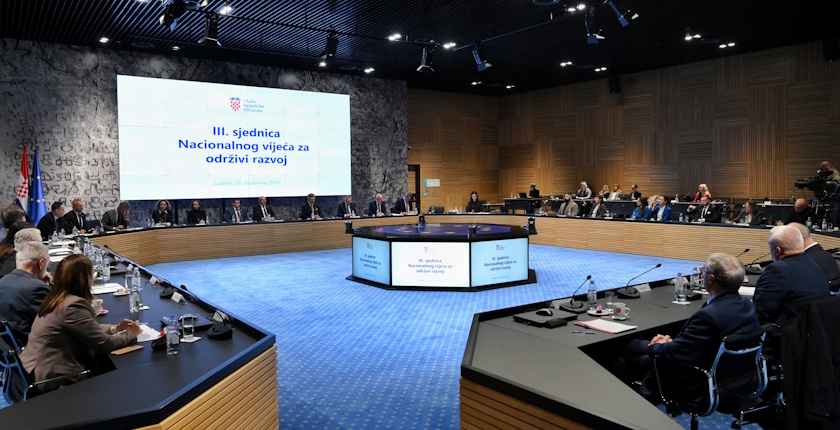
​While presenting the draft plan at a session of the National Council for Sustainable Development, Minister of Environmental Protection and Green Transition Marija Vučković said it identifies two groups: the energy poor or vulnerable, and transport poor or vulnerable.

“The plan provides for 10 measures, four of which relate to so-called stationary or energy poverty, and the remaining six to achieving affordable and favorable mobility and reducing the risk of transport poverty,” she explained.

According to the ministry, the plan provides for the renovation of 180 kilometers of bicycle paths, 80 kilometers of railway lines, as well as the procurement of 30 electric trains, 80 electric buses, and 3,000 electric cars.

Prime Minister Andrej Plenković stressed that the plan isn’t just a technical and administrative document, arguing that it determines what Croatia would become in ten, twenty, and fifty years.

“And we want a Croatia that is economically strong, socially just, and sovereign,” Plenković underlined.

by in News

IEA on deep shifts in auto industry: Electric car sales soar, ICE models drop 30%

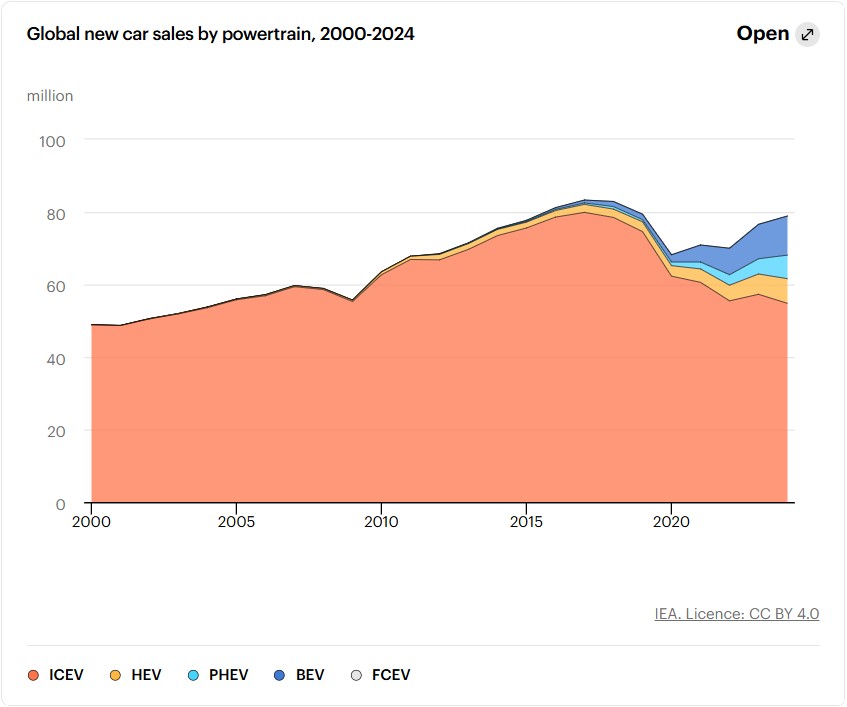
Global car sales growth is predominantly driven by sales of electric and hybrid cars. Sales of pure internal combustion engine cars peaked in 2017 and have since fallen by 30% while the sales of electric cars achieved a 14-fold increase, according to the latest report, called What Next for the Global Car Industry?

The International Energy Agency, which published the data, stressed that the car industry is experiencing deep changes as electric car sales continue to rise and the geography of global car sales shifts.

How the incumbent car industry responds to these shifts will be critical for its future and that of industries across the supply chain – and for the energy sector as a whole, IEA warned.

Global car sales reached 80 million in 2024, driven by electric and hybrid cars. They made up around 30% of the total.

world iea report auto industry car sales by fuel

Sales of pure internal combustion engine (ICE) cars peaked in 2017 and have since fallen by 30%. Electric car sales grew more than 14-fold over the same period, reaching over one fifth of cars sold globally in 2024, according to IEA’s data.

The second major shift is the geography of car markets. China and other emerging economies now account for over half of global car sales, up from just 20% in 2000, the report What Next for the Global Car Industry? reads.

world iea report auto industry car sales by fuel regions

China’s car production more than doubled between 2010 and 2024, while India’s output grew 25% from the 2017 level. China overtook the European Union to become the world’s largest exporter. China now accounts for 40% of total manufacturing capacity, and Europe and North America have a 15% share each.

What will he incumbent car industry do?

The response of the incumbent car industry is crucial, IEA underlined.

The agency added that passenger cars represent the single largest source of global oil demand today, with 25% of total consumption. The use of alternative fuels, notably biofuels, represents 5% of energy use from cars today.

The extent and pace by which cars electrify, however, is what will affect future car manufacturing as well as the energy sector the most, and it explains the focus of the report, IEA stressed.

world iea report auto industry car sales market

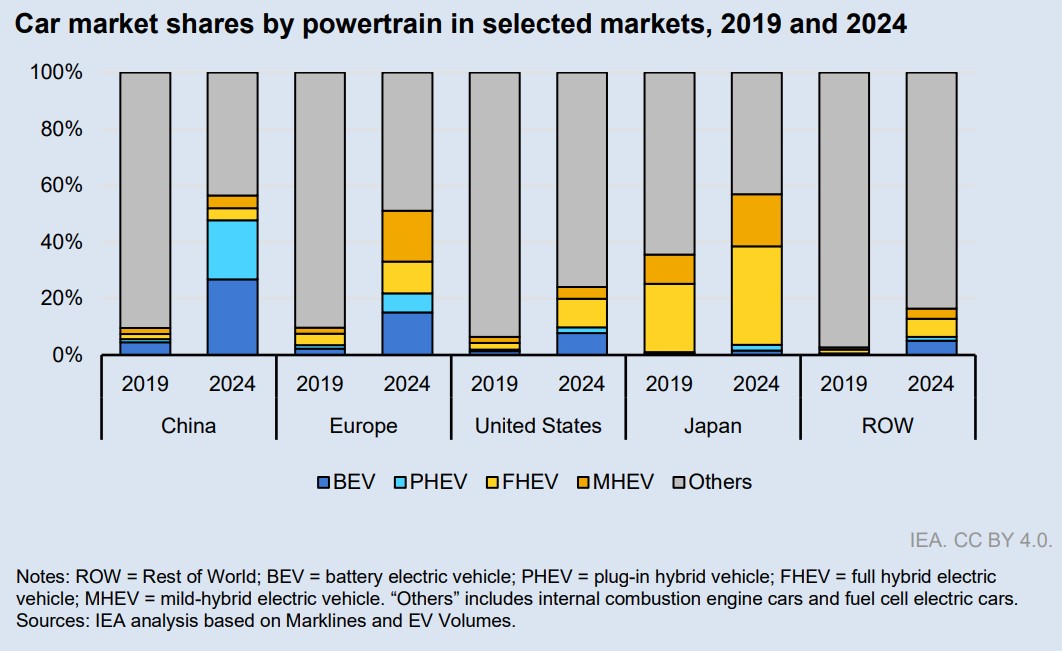
Even as ICE car sales are on a downward trend in China and advanced economies in aggregate, they are likely to rise in some regions, meaning carmakers must navigate multiple trends at once, the report reads.

For example, imports from China make up 90% of electric car sales in emerging markets today. New market entrants are capturing an increasingly large share of the electric car market.

Carmakers from China and US-based Tesla sold 45% of all electric cars in 2024, IEA underlined.

Batteries drive manufacturing costs

The report adds that battery costs remain the main factor for higher direct manufacturing costs of battery electric cars than ICE cars.

Producing cars in China is cheaper than in advanced economies, especially electric ones. Advanced economies include the EU, USA, Japan and South Korea.

Producing a small SUV in China is over 30% cheaper than in advanced economies for both ICE and battery electric powertrains.

Large-scale manufacturing operations and vertical integration are the key reasons behind China’s cost competitiveness; lower energy prices and labour costs also contribute, but to a lesser degree, the IEA concluded.

by in News

Croatia initiates project to harness solar energy along highways

Croatia’s highway management enterprise, Hrvatske Autoceste, is implementing a project for solar power plants along its highways. The company plans to use the electricity for self-consumption and for electric vehicle chargers. It would reduce costs and increase its energy independence.

After a tender procedure, Hrvatske Autoceste (HAC) selected ETS Farago to produce project designs for photovoltaic plants at four locations on the A3 highway. It heads east from the capital Zagreb to the border with Serbia.

The job, covering 36 hectares, should be finished by March 2026. Along with the documentation, the selected company is required to submit an assessment of its advantages and disadvantages.

It would be followed by a techno-economic analysis and, if it is favorable, a tender for the installation of solar panels. It is the final step, expected not before 2027.

Slovenia and BiH have initiated similar projects

Of note, Slovenia and Bosnia and Herzegovina have initiated similar projects. Roadside locations could be a good solution for solar panels, given that such land is unused and alternatives are limited.

ETS Farago is tasked with preparing three versions for each of the four locations: Zagreb Plitvice (2.5 hectares), Rastovica (3.1 hectares), Sredanci (11 hectares), and Ivanja Reka (18 hectares). The first two are next to rest areas, while the other two are at interchanges.

HAC intends to install 259 electric vehicle chargers

The first model is for the production of electricity for self-consumption, with the surplus fed into the grid. Another option is self-consumption including battery energy storage systems (BESS). The third model is the complete sale of all electricity produced in the PV facilities.

The contract is estimated at EUR 11,400 excluding VAT.

HAC previously said that in addition to supplying its own facilities, such as toll booths, traffic maintenance and control centers, and street lighting, its project called solar highways is key to plans for expanding electric vehicle infrastructure.

The company intends to install 259 chargers on roads within five years.