by in News

PPC starts building two battery storage systems in northern Greece

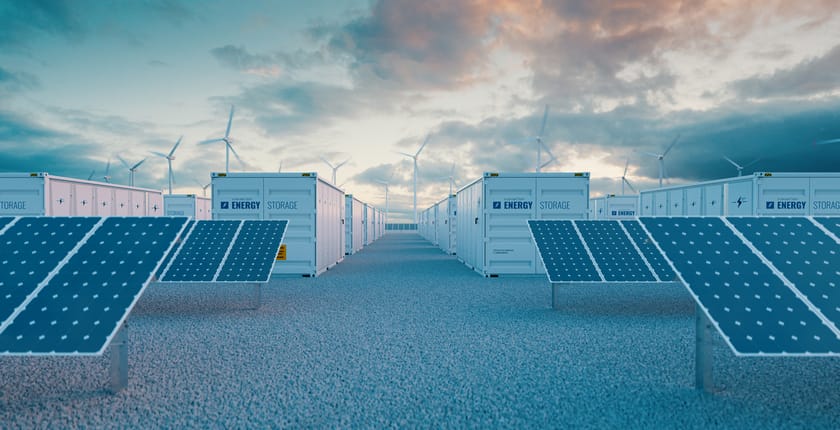
Public Power Corp. (PPC Group) is launching construction on two battery energy storage systems (BESS) in northern Greece, of 48 MW / 96 MWh and 50 MW / 100 MWh. There is currently no larger BESS in Southeastern Europe, but the Oslomej solar park in North Macedonia is expected to get a battery system of 62 MW in operating power by the end of the year.

PPC’s Melitis 1 battery system will be located in the vicinity of its future photovoltaic plants in the Western Macedonia region, and Ptolemaida 4 will be built in the area of the former Ptolemaida coal mines. The energy storage units are intended to support the operation of adjacent photovoltaic plants.

The battery systems are targeted for completion within the year

The systems will use liquid-cooled batteries with the lithium iron phosphate (LFP) technology, maximizing both energy utilization and safety during operation, according to a statement from the Greek company, controlled by the government through a minority stake. It expects to complete the construction within the year.

PPC Group’s investment plan for the 2025-2027 period envisages BESS projects totaling 600 MW, which are currently at various stages of implementation in Greece and elsewhere in Southeastern Europe.

Konstantinos Mavros, the group’s deputy CEO responsible for renewable energy sources, said PPC is a leader in investing in energy storage systems. “In the coming years it will significantly increase investments in all flexible generation systems through energy storage,” he stated.

PPC plans 600 MW of battery projects in Southeastern Europe

PPC Group recently started building a battery system in neighboring Bulgaria with 25 MW in operating power and a capacity of 55 MWh. The facility would support the operation of a new solar power plant with a total capacity of 165 MW.

The company runs renewable energy systems with a total capacity of 6.2 GW in Greece, Romania, Italy, and Bulgaria. Its investment plan envisages increasing the capacity from renewables to 11.8 GW by 2027. PPC’s strategic goal is to expand into new renewable energy technologies, such as offshore wind farms and floating solar parks.
by in News

CATL: World’s first mass-produced sodium ion battery is here

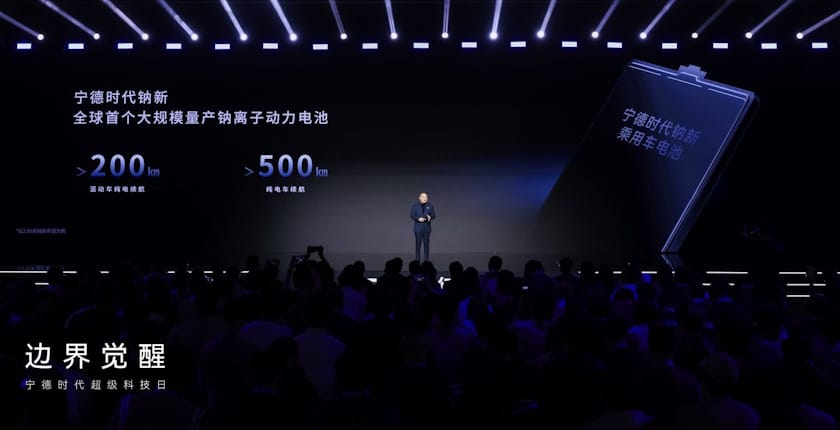
Chinese battery producer CATL has unveiled Naxtra, claiming it is the world’s first mass-produced sodium ion battery. At its inaugural Super Tech Day, the company also showcased a battery that sets a new global record for superfast charging technology.

Naxtra breaks resource constraints and strengthens the foundation of the new energy industry, according to Contemporary Amperex Technology Co. Ltd. (CATL), one of the world’s biggest battery producers. Back in 2021 the company presented first generation of sodium ion batteries.

Batteries for electric vehicles and energy storage systems are predominantly made using lithium ion technology. However, the technical solution comes with environmental risks because of lithium production in mines and salt flats. The race is on to find a better one and sodium ion could be the winner.

CATL underlined that Naxtra Battery breaks through the performance boundaries of the material itself, allowing mass production of sodium ion batteries for the first time.

Naxtra Battery product line has two units

“With sodium’s inherent safety and abundant reserves, it efficiently reduces dependence on lithium resources and strengthens the foundation of new energy technologies, while promoting energy utilization from single resource dependence to energy freedom,” the press release reads.

Naxtra passenger EV Battery (photo: CATL)

The Naxtra Battery product line has two units: the Naxtra passenger EV Battery and the Naxtra 24V Heavy-Duty Truck Integrated Start-Stop Battery. Both are capable of performing across the full temperature range from minus 40 to as high as 70 degrees Celsius, redefining the extreme temperature limitations of batteries, CATL said.

The Naxtra passenger EV Battery retains 90% usable power at minus 40 degrees and achieves an energy density of 175 Wh per kilogram, the highest among sodium ion batteries worldwide, and comparable to LFP batteries, the update reads.

In terms of safety, it is a transformative breakthrough

CATL said the system provides a 500-kilometer range and that it can achieve over 10,000 cycles, significantly reducing maintenance costs. In terms of safety, it is a transformative breakthrough from “passive defense” to “intrinsic safety,” the manufacturer claimed.

According to the company, Naxtra 24V Heavy-Duty Truck Integrated Start-Stop Battery boasts over eight years of service life and reduces total lifecycle costs by 61% from the level in traditional lead-acid batteries.

Compared to lead-acid batteries, it is more efficient, eco-friendly, and economical, driving commercial vehicles into a lead-free era where vehicles and batteries age as one, the company claims.

Shenxing Superfast Charging Battery offers robust power across all temperature ranges

On the same occasion, the company presented two more “groundbreaking EV battery products,” as it called them.

The Freevoy Dual-Power Battery introduces a pioneering cross-chemistry system design that transcends the limitations of single technology paths to meet customized user needs. The second-generation Shenxing Superfast Charging Battery, with its peak 12C charging rate, sets a new global record for superfast charging technology, according to CATL.

The company stressed that Shenxing Superfast Charging Battery is the world’s first LFP system featuring both an 800-kilometer range and a 12C peak charging rate. With a peak charging power of 1.3 MW, it achieves 2.5 kilometers of range per second of charging, virtually eliminating the frustration of waiting, according to the press release.

Additionally, the device provides robust power across all temperature ranges and states of charge.

by in News

Serbia receives first two grid applications for battery energy storage systems

Serbia’s transmission system operator Elektromreža Srbije received two grid connection applications for battery energy storage systems. They are the first energy storage projects in the country.

Investments in battery energy storage systems (BESS) is ramping up around the world and Serbia is now making its first steps. Annual installations have increased more than 12 times in just four years, projects for an overall 11.5 GWh were announced in only three European countries, and last year China and Germany increased their battery capacity by 130% and 50%, respectively.

The grid connection applications in Serbia were submitted by Green BESS KV, for a 100 MW project of the same name, and MKBDP Energy, for its 50 MW project Skladište električne energije Jagodina.

Applications were submitted by Green BESS KV and MKBDP Energy

Green BESS is a special purpose vehicle (SPV) of Radiant Partners, while MKBDP Energy is part of the MK Group. Of note, there are other energy storage projects in the pipeline, but none of them are as far ahead as them. Both parent companies are registered in Serbia.

MK Group is very active in the renewable energy sector in the country. It put its Krivača wind farm into operation last year.

Serbia’s TSO Elektromreža Srbije (EMS) confirmed to Balkan Green Energy News that it has received the first applications for signing the agreement on the preparation of the connection study for standalone storage.

MKBDP Energy applied for a 50 MW facility located close to Jagodina. The site for Green BESS KV of 100 MW facility is near Kraljevo, according to EMS. Both cities are in the central part of the country.

After signing such an agreement, the TSO starts work on the study, which lasts 120 days.

The start of construction is scheduled for the first half of 2026

According to Green BESS KV, it is an SPV established by consulting firm Radiant Partners, a developer of large-scale renewable energy projects. Radiant Partners is developing one of the largest solar power projects in Serbia – Noćaj, near Sremska Mitrovica, with a capacity of 180 MW, while new solar and wind projects are in the initial phase.

“Our vision is focused on sustainability, innovation, and energy independence. The 100 MW / 200 MWh battery storage facility represents a significant step in the modernization of Serbia’s energy system, contributing to environmental protection and bringing numerous economic benefits,” CEO of Radiant Partners Nikola Ćeha told Balkan Green Energy News.

Batteries are a good market opportunity

In the next phase, the construction of a storage facility after obtaining all the permits, Radina Partners plans to cooperate with Chinese partners. The project is located in Kraljevo, in the vicinity of the TS Kraljevo 3 transformer station. The start of works is scheduled for the first half of 2026.

Asked about motives for the pioneering step, Ćeha explains there are currently no battery storage facilities in Serbia and that interest in renewable energy projects is growing.

“We see a project for supporting existing and future renewable power plants as a market opportunity, given their variability in daily production,” he stated.

Battery storage increases flexibility in the market

He stressed the importance of large-scale BESS units in Serbia, saying they are crucial for balancing production with consumption, in a situation where renewable energy production is increasing. Batteries stabilize the power grid and enable the storage of excess energy and its use in times of higher consumption or lower production.

In his words, batteries increase flexibility in the market because of their quick response to changes in energy consumption and prices, which opens up opportunities for trade and cost optimization.

Such a project attracts investments and encourages the development of energy infrastructure, which contributes to market competitiveness and technological progress, Ćeha said.

by in News

Greece plans 4.7 GW of commercial battery storage projects

The much-awaited ministerial decree for zero-subsidy standalone battery systems has been published in Greece.

So far, Greece has provided support to 900 MW of standalone storage projects under three previous auctions. The new plan, prepared by the Ministry of the Environment and Energy, calls for installing 4,700 MW of standalone battery projects across the country, equal to the entire projected capacity until 2030 under the country’s National Climate and Energy Plan (NECP).

More specifically, 3,800 MW will be installed in the transmission network and 900 MW in the distribution network.

Investors will have up to 18 months to apply to the operator

There are also specific rules to avoid concentration and ensure a level playing field. For example, individual companies may apply for up to 250 MW of storage projects. In the distribution segment, this limit is set lower, at 50 MW. Including previous storage auctions and batteries that operate as part of renewable plants, each player may install up to 500 MW of total battery capacity by 2029.

The guarantee is set at EUR 200,000 per MW for the transmission grid and EUR 50,000 per MW for the distribution grid.

The ministry has also set a specific timeframe for the completion of projects. Investors will have up to 18 months to submit a declaration of intent to the operator. If this deadline is not observed or the anti-monopoly clause is violated, the letter of guarantee will be forfeited.

After the announcement, the market players expressed their satisfaction for getting a time frame extension, compared to the originally planned 14 months.

Curtailments rise further this year, storage needed urgently

Last year, Greece experienced 3.5% curtailments as a result of a rapid renewable energy rollout. Since the beginning of March, they have increased even further, according to the chairman of Hellenic Association of Photovoltaic Companies (HELAPCO), Sotiris Kapelos.

Kapelos: Curtailments reached 20% at the beginning of March

As he mentioned during a conference on Friday, 13 March, “last year we had 12% curtailments during the first days of March and now we are witnessing 20%.”

Batteries are expected to keep curtailments under 5% by 2030, as long as the projects are implemented.

by in News

Montenegro’s EPCG to launch public call for 300 MWh of batteries

Montenegro’s state-owned power utility, Elektroprivreda Crne Gore (EPCG), intends to invite bids by the end of the year for the installation of battery energy storage systems.

President of EPCG’s Board of Directors Milutin Đukanović has said that the company’s business philosophy is based on three principles – production at the point of consumption, use of hydropower for the integration of solar energy, and energy storage.

Speaking at a conference on regional power companies and their plans for the future, organized by Energija Balkana, Đukanović highlighted batteries as one of the key enablers of the green transition.

“By the end of year, EPCG will announce a public call for the procurement of battery energy storage systems (BESS) with a capacity of 300 MWh,” he said, according to EPCG.

EPCG plans to finish two more large-scale projects by the end of 2026

EPCG also plans to complete two large-scale projects by the end of 2026 – the construction of the Gvozd wind power plant and the installation of the A8 unit in the Perućica hydropower plant, according to him. About a month ago, the company held a groundbreaking ceremony for Gvozd, and in September it secured a loan for a new unit at HPP Perućica.

Energy Minister Saša Mujović recently said that a feasibility study was underway for electricity storage projects. The planned locations are at HPP Perućica, the former Željezara Nikšić steel plant, and the Pljevlja coal mine. These locations have available capacity for grid connections.

In September, EPCG said that it had started preparations to install batteries.

EPCG intends to install lithium-ion batteries

The Board of Directors has adopted a project task proposal and announced the launch of a public call for a feasibility study and project design.

The company plans to secure the flexibility of the power system by developing storage systems based on lithium-ion batteries, EPCG said.

by in News

Montenegro’s EPCG discussed BESS project with companies from US, China, Japan, region

Elektroprivreda Crne Gore, owned by the Government of Montenegro, has held discussions with several companies and financiers from the region, Europe, and the world about its project for battery energy storage systems.

Elektroprivreda Crne Gore (EPCG) said in September that it started the preparations to install battery energy storage systems (BESS).

After the Board of Directors of EPCG adopted a project task proposal and initiated a procedure for the preparation of a feasibility study and project design, the first phase of the procurement is already underway, according to the company’s Elektroprivreda magazine. The tender includes battery systems with a capacity of up to 120 MWh per location, it revealed.

A study is under development with elements of a feasibility study, addressing specific technical characteristics, according to Zoran Miljanić, a member of the Board of Directors. He added that the company extensively scanned available market options.

More than 20 meetings were held

In his words, more than 20 meetings were held with various interested parties. They were BESS manufacturers, battery integrators, financiers, co-investors, and institutions offering technical assistance.

Representatives of companies from the United States, France, China, Japan, Bosnia and Herzegovina and Montenegro participated in the discussions, he stressed. The meetings helped EPCG understand the issues related to the technical characteristics of batteries on the market, the availability of equipment, and the speed of delivery.

The aim is to choose the optimal solution for the company, Miljanić underlined.

The locations foreseen in the project task are hydropower plant Perućica, EPCG Željezara Nikšić, and thermal power plant Pljevlja. The plan is also to install a 5 MWh battery near the 5 MW Kapino Polje solar power plant, for which a project is under development.

Three locations are being considered

The locations were chosen because of free space for solar panels and the connections to the transmission network, which makes it easier and faster to install the batteries.

Miljanić emphasized that changes are possible after the study is finished but that the said options are primary.

In his words, in the first phase of development of the BESS technology, integrating batteries with photovoltaic plants seemed like a good model to balance their variable production.

However, amid the accelerated development of PCS (Power Conversion System), BMS (Battery Management System), and EMS (Energy Management System) solutions, battery projects are planned as independent and in different sizes – from residential to power distribution to industrial and large systems – connected to the transmission grid and with a capacity measured in the gigawatt-hour range.

  • 1
  • 2