by in News

Slovenia opens its first highway solar power plant

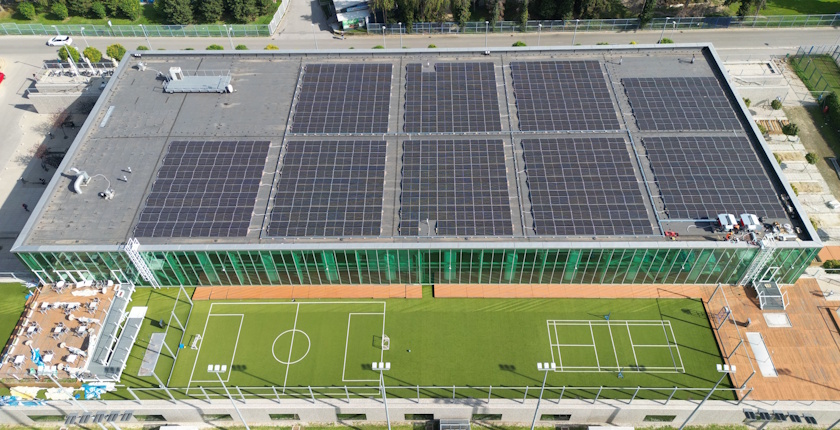
Slovenia’s road management firm Družba za Avtoceste v Republiki Sloveniji has installed a solar power plant on a noise barrier alongside a highway. It is the first such photovoltaic system in the country.

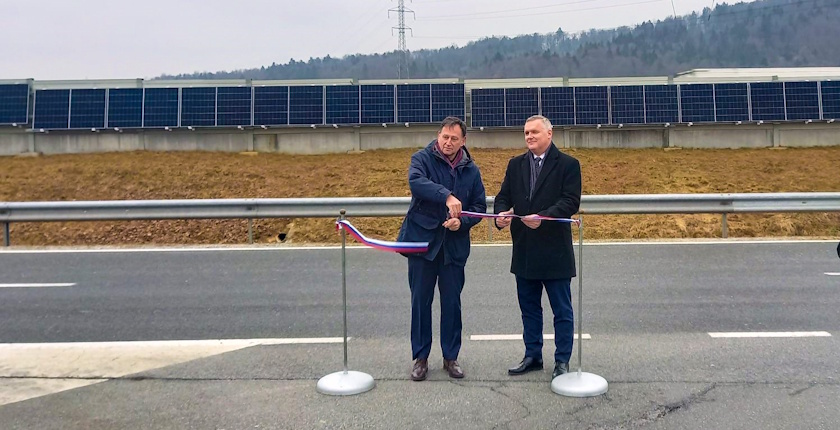
Družba za avtoceste v Republiki Sloveniji (DARS) has officially opened its first photovoltaic plant on a noise barrier at the Šmarje Sap West rest area. It is about ten kilometers from Ljubljana on the motorway connecting the Slovenian capital and Zagreb.

According to DARS, the project is part of a series of activities to achieve the company’s strategic goals in sustainable development, decarbonization, and efficient energy use.

The firm announced the development of such projects in July 2023. A pioneering idea in the region, it was later followed by Bosnia and Herzegovina, Montenegro, and Croatia.

Ribič: An example of thoughtful siting of renewable power plants

The opening ceremony was attended by the Chairman of the Management Board of DARS Andrej Ribič, Minister of the Environment, Climate and Energy Bojan Kumer, representatives of the contractor – Solvera Lynx, and representatives of distribution system operator Elektro Ljubljana.

Andrej Ribič stressed that the project is significant for electricity production but also as an example of thoughtful siting of renewable energy power plants without impacting traffic safety or routine highway maintenance.

The electricity generated by the PV system will be used for DARS’s own consumption, including public lighting and tunnel systems, he explained. This will ensure greater energy independence and more rational management of the energy system, Ribič added.

DARS plans to continue building PV plants

In line with its strategy, DARS aims to gradually reduce energy consumption from the grid and lower CO2 emissions in scopes 1 and 2. By 2030, the goal is to reduce energy consumption and carbon emissions by 30% from the 2024 levels, according to the firm.

Based on its revised strategy, DARS adopted several energy measures in 2024. They included the establishment of an energy department and the implementation of the first phase of solar installations across its five facilities, with a total capacity of 420 kW.

These plants can cover approximately 2% of the company’s annual electricity consumption.

DARS intends to further expand its solar energy projects. The plan includes building bigger plants in degraded areas and more PV systems on buildings and along highway tunnels.

The electricity produced would primarily power lighting and other road systems to ensure the safe and smooth operation of the motorway network, the company added.

Careful site selection for solar plants is crucial

In July 2023, DARS and state-owned hydropower operator Soške Elektrarne Nova Gorica (SENG) announced plans to build solar power plants along highways.

The first one was planned in the Slovenian Littoral and Coastal-Karst area. However, the new solar power plant is not located there.

The two firms later established similar cooperation with the Ministry of Defense and the Municipality of Vipava.

Solar energy use is expanding all over the planet. Experts warn that the optimal siting of PV panels is crucial to avoid occupying large areas of arable land or harming the environment. Therefore, the best solution is to install solar panels in locations that cannot be used for other purposes, such as alongside railways and roads, or on rooftops.

by in News

Zagreb to invest EUR 56 million in waste management, low-emission machinery

Croatia’s capital, Zagreb, intends to invest EUR 56 million in waste management, green areas, and low-emission machinery. It expects the investment to reduce the environmental footprint of its municipal utilities and their operating costs.

Zagreb Holding (ZGH), the umbrella firm for the city’s utility companies, has requested approval from the authorities for a long-term EUR 56 million green loan agreement.

The Zagreb city assembly will decide on the request on December 16.

The green loan agreement with the International Finance Corporation (IFC) would finance investments aimed at supporting the development of circular waste management by procuring lower-emission vehicles and machinery for separate waste collection, developing green spaces, and maintaining roads.

ZGH to introduce smart waste management technologies

The loan would also be used for primary waste separation infrastructure, bio-waste treatment facilities, as well as information and communication technologies for data-driven smart waste management operations, ZGH said.

The company intends to replace its existing outdated machinery by acquiring municipal vehicles, machines, and equipment, with the aim of increasing operational efficiency and the scope of services provided to citizens.

Additionally, this investment will have a significant environmental impact by reducing greenhouse gas emissions.

NOx and PM emissions will be reduced by up to 80%

According to an analysis by ZGH, the average age of more than 300 vehicles, machines, and pieces of equipment is 14 years, which significantly exceeds the average economic service life of vehicles and machines. More than 70% of the vehicles do not meet current environmental standards (EURO 6), which leads to negative impacts on the environment and rising maintenance costs.

Thanks to the investment in EURO 6 and Stage V compliant vehicles, emissions of nitrogen oxides (NOx) and PM particles would be reduced by up to 80%, the update reads.

ZGH plans to introduce digital systems to increase the operational efficiency of its vehicles and machinery, such as monitoring fuel consumption, technical condition, and mileage.

The loan proceeds will be allocated to the city’s public utilities.

The waste utility Čistoća will receive EUR 22.2 million, road utility Zagrebačke Ceste EUR 14.9 million, green areas utility Zrinjevac EUR 16.4 million, cemetery utility Gradska Groblja EUR 861,000, the ICT Sector EUR 1.5 million, and the customer relations sector EUR 120,000.

by in News

Zagreb kicks off decarbonization of public transport

Zagreb’s public transport utility ZET has received EUR 21 million from the Government of Croatia to install chargers for electric buses.

Croatia has earmarked EUR 50 million for firms providing public urban and suburban transport services to install chargers for electric buses. Zagreb is also in the process of procuring 70 electric buses.

The grant agreement was signed by Minister of Economy Ante Šušnjar, public transport utility ZET’s CEO Marko Bogdanović, and Luka Balen, manager of the Environmental Protection and Energy Efficiency Fund.

The EUR 21 million agreement is from the public call on charging infrastructure for electric buses, according to the Ministry of Economy.

ZET will install 62 dual e-chargers

The funds are from the National Recovery and Resilience Plan 2021-2026.

ZET intends to build the devices at the Podsused location. As part of the project, the company will install 62 dual chargers, providing 124 charging points for low-floor electric buses.

Minister Ante Šušnjar underlined that it is an important step toward decarbonizing public city transportation.

With an investment worth over EUR 21 million, the government is backing the decarbonization and sustainable future of Zagreb, Šušnjar added.

Balen: Other cities and municipalities are also committed to decarbonization through smart city projects

Luka Balen, manager of the Environmental Protection and Energy Efficiency Fund, pointed out that other Croatian cities and municipalities are also committed to decarbonizing transportation. It is evident from the smart city projects co-financed by the fund.

Local authorities, through projects involving smart management, aim to reduce traffic jams and to offer citizens alternative transport options, such as urban bike systems, and cleaner urban transportation, Balen stressed.

ZET CEO Marko Bogdanović highlighted the agreement as a historic step and the start of the decarbonization of public transport in Zagreb.

After purchasing the first electric buses in Croatia, ZET and Zagreb are once again leading the implementation of new technologies in the region by signing the agreement for the installation of chargers for e-buses, Balen said.

ZET is one of 18 pre-selected public transport operators eligible for grants under the public call. The total value of ZET’s project is EUR 27.4 million.

by in News

Zagreb on track to reach almost 20 MW of solar on public buildings

Zagreb operates solar power plants with a total capacity of 2.43 MW on public buildings, and an additional 16 MW is set to be installed on roofs, according to Mayor Tomislav Tomašević.

In 2021, the capital city of Croatia presented the Sunny Roofs program for the installation of photovoltaic plants with a combined capacity of 50 MW. Implementation began three years ago with the Solarization of Institutions of the City of Zagreb (SOLIZAG) project.

It was worth EUR 1,1 million. Within SOLIZAG, power plants were installed on eight city buildings – swimming pools Utrina, Svetice, and Jelkovec, kindergarten Trnsko, psychiatric hospital Sv. Ivan, homes for the elderly Trešnjevka 1 and 2 and waste management utility Čistoća. They have a total capacity of 1.6 MW.

The city currently has 2.43 MW of solar power plants in operation on public buildings

“In total, we currently have 2.43 MW of solar power plants in operation on public buildings owned by the City of Zagreb. It is three times the capacity we found in June 2021, only 0.7 MW,” Tomašević stated.

Currently, a total of 16 MW of solar power plants on city-owned buildings have been contracted or are in the process of being contracted. A firm has been selected for the design and construction of 10 MW of solar panels on approximately 200 city buildings, with implementation set to begin this year.

The mayor describes it as the largest investment in the solarization of public buildings in Zagreb’s history. In his view, it is a key step toward the goal of a more energy self-sufficient city.

Residents of Zagreb have a digital platform for assessing the solar potential of their roofs

In addition to the investments, commercial projects are being developed through the company Zagrebački Sunčani Krovovi. The PVMax project, supported by the North-West Croatia Regional Energy Agency (REGEA), is also underway for 41 MW in total on company buildings. So far, 6 MW has been installed.

Residents of Zagreb can assess the solar potential of their roof on a digital platform. It also calculates the cost-effectiveness.

Croatia’s capital is also participating in the Climate City Contract, which unites 100 cities committed to achieving climate neutrality by 2030. As part of the initiative, Zagreb is preparing a climate neutrality plan, expecting to adopt it this year.

Marking Earth Day, Mayor Tomašević visited one of the PV plants built within the SOLIZAG project, at the Svetice swimming pool complex. He was accompanied by his deputies Danijela Dolenec and Luka Korlaet.

Photo: City of Zagreb