by in News

Federation of BiH to upgrade air quality monitoring with EUR 1.1 million

The Federation of Bosnia and Herzegovina is investing BAM 2.2 million to upgrade the air quality monitoring system.

Federal Minister of Environment and Tourism Nasiha Pozder has signed contracts worth BAM 2.19 million (EUR 1.1 million) for the procurement of up-to-date equipment to upgrade the measurement program of the stations in the Federal Air Quality Monitoring Network.

The units are managed by the Federal Hydrometeorological Institute (FHMZ).

The procurement of the equipment is financed by a loan from the International Bank for Reconstruction and Development (IBRD), as part of the Air Quality Improvement Project in Bosnia and Herzegovina. It is being implemented with the support of the World Bank.

The equipment will be supplied by two firms

The contracts envisage the purchase of air quality equipment worth BAM 1.8 million KM (about EUR 920,000) to be supplied by Sarajevo-based firm E3, and laboratory equipment worth BAM 142.422 KM (about EUR 73,000), to be delivered by Altium International, registered in Sarajevo. The third one – worth BAM 218,040 KM (EUR 111,500) – is for spare parts, and the supplier is also E3.

The equipment will enable the full implementation of the measurement program at all stations of the federal network, including all key parameters for assessing air quality, according to the Ministry of Environment and Tourism.

Mostar and Tuzla will get two stations

The system has been further expanded with the installation of two fixed stations in Mostar and Tuzla. FHMZ also received one mobile station for emergency field measurements in case of accidents.

The FHMZ laboratory has also been improved. Now it has the capacity to conduct analyses of polycyclic aromatic hydrocarbons (PAHs), important indicators of pollution and health risks to the population.

The equipment represents a significant step toward a more comprehensive, reliable, and modern air quality monitoring system in FBiH, the ministry underlined.

Pozder: Faster response to increases in air pollution

Minister Pozder stressed it is one of the most concrete steps toward strengthening the infrastructure for air quality monitoring.

She recalled that the public has the right to accurate information about the air it breathes and that institutions are obligated to provide reliable data and modern systems.

“Today, we are entering a new phase of modernization that will enable better planning and faster responses to increased air pollution,” Pozder said.

Almir Bijedić, director of FHMZ, pointed out that the new equipment and information system would significantly improve the accuracy and reliability of the institution’s work. It is the largest investment to date, he added.

Bijedić: It is very important that now we have the ability to analyze the concentration of PAHs

“FHMZ will be able to provide higher quality and faster information to citizens and institutions. It is very important that the new system enables the analysis of PAHs, allowing us for the first time to fully monitor the parameters critical for assessing health risks. This is a major step forward for the institute and the Federation of BiH,” Bijedić said.

The ministry noted it is completing the procurement of a new air quality information system, estimated at BAM 150,000 (EUR 77,000). It will significantly improve the digital capabilities of the monitoring system.

The new software will enable faster and more reliable validation and verification of data, real-time data display, centralized management, and more secure data storage, as well as more detailed trend analyses and automated reporting to the European Environment Agency (EEA), the Ministry of Environment and Tourism explained.
by in News

North Macedonia’s ESM needs investments of EUR 3 billion to replace coal power

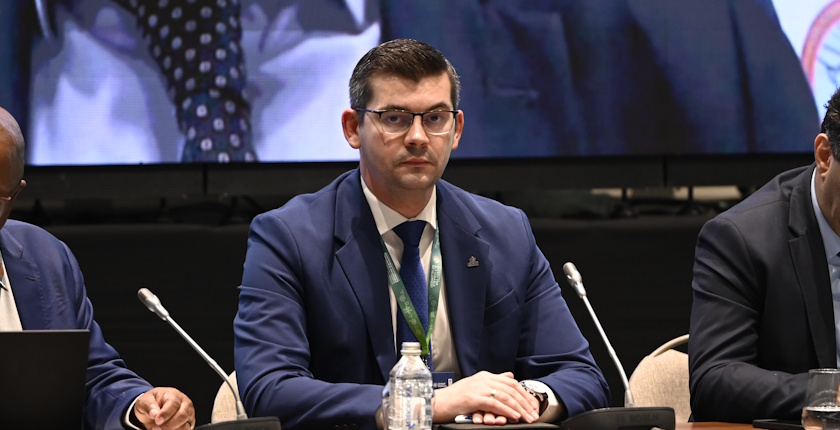
Power utility Elektrani na Severna Makedonija estimated that it requires EUR 3 billion by 2040 to replace electricity from its lignite-fired power plants. According to member of the Board of Directors Ivan Stojanovski, the state-owned company is preparing investments in gas power plants, solar, wind, hydropower and energy storage. He highlighted its plans for a 300 MWh battery and the Bogdanci hybrid energy park.

North Macedonia’s utility Elektrani na Severna Makedonija (ESM), the country’s main electricity producer, generated 60% of the 2024 output in the Bitola and Oslomej coal plants.

A rough estimate is that ESM would have to invest around EUR 3 billion in the next 15 years to replace its power production from lignite, which is baseload energy, Ivan Stojanovski, a member of the Board of Directors and the company’s Chief Financial Officer, told Balkan Green Energy News on the sidelines of the International Forum on Energy for Sustainable Development (IFESD-14).

He explained that the transition to green energy is quite expensive. ESM needs to replace the 840 MW in baseload production that the Bitola and Oslomej thermal power plants provide, the executive added.

Hydropower is a domestic electricity source, unlike natural gas

The company opted for investments in diverse energy sources to achieve it, Stojanovski stressed.

Gas power plants provide baseload energy, but at the same time, they turn the spotlight on national security as well as the security of supply, in his words.

Lignite is currently mined in North Macedonia while natural gas must be imported, so gas supply interruption is possible, ESM’s CFO added.

Gas power plants are required, but it is necessary to invest in hydropower as it is a domestic resource, Stojanovski said. On the other hand, hydroelectric plants are more expensive and it takes longer to build them, he noted.

ESM launched the Bitola 3 solar power project

ESM is developing wind and solar power projects as well. Stojanovski highlighted the planned expansion of its Bogdanci wind farm. The European Bank for Reconstruction and Development (EBRD) is participating in the development of the Miravci wind power project, of at least 100 MW, he recalled.

The company is working on solar power projects Oslomej 1 (10 MW), Oslomej 2 (10 MW), Bitola 1 (20 MW) and Bitola 2 (60 MW), Stojanovski asserted. Bitola 3 endeavor is underway, too, and the financing contract is expected to be signed by the end of the year, he revealed.

The photovoltaic system will have at least 100 MW, Stojanovski asserted.

“We plan to sign a contract next year with Agence Française de Développement (AFD) for a solar power plant in Bogdanci of at least 30 MW and to create a hybrid energy park there – wind, solar, and a battery,” he stated.

According to Stojanovski, the company is developing a battery energy storage project with the EBRD, for up to 300 MWh in capacity. The site is within the REK Bitola coal complex and the facility will be a systemic solution for all the solar power plants there, he explained.

Blended financing as a solution

“EUR 1 billion to EUR 1.3 billion is needed just for solar, wind and batteries. We will need between EUR 500 million and EUR 700 million for gas power plants. Another EUR 1 billion to EUR 1.3 billion would be for large hydropower plants such as Čebren and Vardar Valley, and some smaller projects,” Stojanovski explained.

Asked how the company plans to secure financing, he pointed to blended financing – own sources combined with some participation from international financial institutions. It is important to diversify the sources by opening cooperation with as many financial institutions as possible, in Stojanovski’s view.

ESM traditionally cooperates with the EBRD and KfW. Stojanovski announced that the company would diversify financing by launching cooperation with the World Bank, Italy’s development bank Cassa Depositi e Prestiti, and AFD.

“It will enable us to access more sources and complement them with financing from local banks. We also tend to obtain support from the state budget over a longer period, 10-15 years, and state guarantees, but also additional funds. This is a financial model that can secure long-term and sustainable financing of infrastructure projects,” Stojanovski said.

by in News

Turkey’s TEİAŞ signs USD 750 million loan contract with World Bank

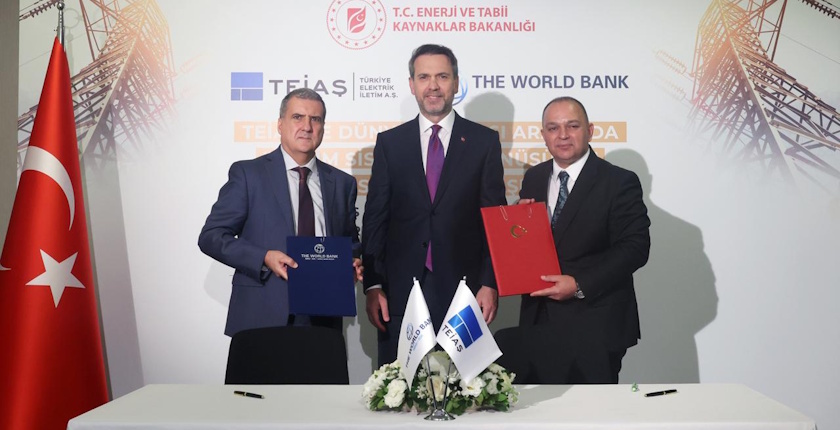
Turkish Electricity Transmission Corporation and the World Bank signed a USD 750 million loan agreement.

A USD 750 million loan will be used for the Transforming Power Transmission System Project. It would make the country’s energy future more reliable and efficient, Turkey’s transmission system operator (TSO) TEİAŞ said.

The agreement was signed in Istanbul vby the bank’s Country Director Humberto Lopez and Orhan Kaldırım, the company’s Chairman of the Board, in the presence of Minister of Energy and Natural Resources Alparslan Bayraktar, at the 11th Energy Efficiency Forum and Exhibition.

Bayraktar: Turkey plans to invest USD 28 billion in the transmission grid

“The World Bank and international financial institutions have a significant interest in Turkey’s energy infrastructure, particularly its electricity and natural gas sectors. Turkey is a hub country,” Bayraktar stated.

He recalled that the country plans to invest USD 28 billion in electricity transmission infrastructure by 2035.

The minister revealed that discussions on such projects are ongoing with financial institutions from both Asia and the West. Financing agreements can be expected in the foreseeable future, he added.

Lopez: The transition requires reliable transmission

World Bank Country Director Humberto Lopez stressed that Turkey’s clean energy ambitions depend on strong transmission infrastructure.

“Turkey has one of the most ambitious renewable energy plans, and this transition requires reliable transmission,” he said, as quoted by Anadolu Agency.

Lopez explained that it is very difficult for a new company to install solar or wind power facilities without a transmission grid connection secured. The USD 750 million investment aims to address the need and it is central to the government’s energy transition plan, he underlined.

The Transforming Power Transmission System Project marks the first phase of a USD 1.5 billion financing package aimed at expanding grid capacity, enhancing digital management, and accelerating the integration of renewable energy.

It will include feasibility studies for Turkey’s first high-voltage direct current (HVDC) transmission line, according to the article.

by in News

Germany supports Serbia in clean energy supply, environmental protection

The Republic of Serbia and Germany’s KfW Development Bank signed a loan agreement on July 18 for EUR 135 million for the second phase of the credit program Green Transition Development Policy Operation (DPO II).

The signatures underscore the joint activities by Germany and Serbia aimed at a climate-compliant and socially just energy transition, said Chargés d’Affaires ad interim Carsten Meyer-Wiefhausen from the Embassy of the Federal Republic of Germany in Serbia. “We will continue to be with Serbia on this path and support its reform efforts,” he stressed.

Within the financing for the reforms, the World Bank, French Development Agency (AFD) and the German KfW Development Bank are supporting the Republic of Serbia in conducting its ambitious reform agenda. The goal is to accelerate the transition to energy from clean sources and align with EU standards in environmental protection and climate.

Series of reforms through DPO II

Several successful reforms have been materialized within DPO II, among which:

  1. Promoting investments that are acceptable in environmental and climate terms: Public investments are graded under environmental criteria and with regard to the risk of natural disasters, and with models developed solely for the purpose. The citizens of Serbia benefit from the government’s more sustainable investment decisions.
  2. Enhanced transparency in the public budget: The Government of the Republic of Serbia has committed to publishing information on the execution of the public budget, not only at the end of the fiscal year, but also during the year. It improves the transparency of public expenditures, primarily concerning investments in environmental and climate protection.
  3. Affordable energy prices: The Government of the Republic of Serbia has rolled out temporary targeted subsidies for households with low income, like citizens with low pensions. The share of households receiving such aid has grown from 2.7%, registered in 2021, to last year’s 8%.
  4. Improvement in waste disposal: Aligning with EU standards brings a better approach to sanitary landfills, namely from 42% (2021) to last year’s 50%. The citizens of Serbia benefit from improved waste disposal and a cleaner environment.
  5. Prepared for CBAM: Since this year, large industrial facilities and power plants report their CO2 emissions in line with EU standards. That way Serbia is more prepared for the upcoming full implementation of the European Carbon Border Adjustment Mechanism (CBAM) for carbon prices. For instance, the country would be able to price CO2 emissions and charge them.

Financing reforms within climate partnership

Germany’s contribution to financing reforms is an integral part of Germany’s climate partnership with Serbia and the entire Western Balkans. The purpose of the partnership is to support Serbia’s work on achieving its national climate goals and adapting to climate change. The key goal of the partnerships is for the transformation that is necessary to meet climate goals, in the interest of Serbian citizens, to be socially just, a just transition.

This year, Serbia and Germany are celebrating the 25th anniversary of their development cooperation. In the meantime, KfW financed projects worth EUR 2.5 billion in Serbia.

by in News

World Bank to back nuclear projects again amid rising electricity needs

The World Bank has decided to end its 2013 moratorium on financing nuclear energy projects amid growing global electricity demand. The move means the lender would support projects to extend the operating life of existing nuclear power plants and speed up the rollout of small modular reactors (SMRs).

The World Bank board’s decision comes at a time when nuclear energy is experiencing a global revival, as electricity demand in developing countries is projected to more than double by 2035.

Ajay Banga, the president of the World Bank Group, said the institution would work closely with the International Atomic Energy Agency (IAEA) on the issues of safety, security, and regulation.

Banga: Delivering electricity as a driver of development

“We’ve made real progress toward a clear path forward on delivering electricity as a driver of development,” Banga said.

Recently, Germany agreed with France to end its opposition to new nuclear power technologies in the European Union. Economy and energy minister Katherina Reiche said Germany would respect other EU member states’ choice of energy mix, but would not return to nuclear power itself. The country shut down its last remaining nuclear reactors in 2023.

Nuclear energy is making a comeback in Southeast Europe as well

The global nuclear energy revival includes the region tracked by Balkan Green Energy News as well. Slovenia is developing its second reactor, Krško 2, while Romania and Bulgaria are planning new units, as well as SMR projects. Croatia is also taking steps to introduce nuclear energy, including SMRs.

Hungary is already building new reactors at the Paks nuclear power plant, as is Turkey, while Serbia is considering the use of nuclear energy.

Banga said the World Bank’s revised strategy would allow countries to determine the best energy mix, with some choosing solar, wind, geothermal, or hydroelectric power, while others might opt for natural gas or nuclear.

However, no agreement has been reached yet on ending a ban on upstream natural gas projects, with further discussions needed on the issue, according to him.

by in News

Federation of BiH secures EUR 83 million for just transition of coal regions

Bosnia and Herzegovina has secured EUR 83 million for a just transition project, which includes installing renewable power plants, social protection measures, and skills development in coal regions.

The funds are for the Federation of BiH, one of the two entities constituting Bosnia and Herzegovina.

The Board of Executive Directors of the World Bank has approved a EUR 79.90 million loan and a EUR 2.89 million grant to support Bosnia and Herzegovina’s National Energy and Climate Plan, enhance energy independence, foster job opportunities, and strengthen local economies in former coal regions.

It explained that the Just Transition in Select Coal Regions of Bosnia and Herzegovina Project would help repurpose post-mining lands in Banovići, Zenica, and Kreka, and facilitate the closure of underground works in Zenica. The project entails support for the installation of renewable energy systems at Banovići and Kreka mines.

The project has four components

The measures also involve social protection and skills development for workers and communities seeking opportunities outside the coal sector, the international financing institution noted.

The project will be implemented by the Federal Ministry of Energy, Mining and Industry and the state-owned RMU Banovići coal mine operator and power utility Elektroprivreda Bosne i Hercegovine (EPBiH). It has four components.

The first focuses on enhancing the capacity of coal regions, their entities, and the state-level government to manage a just transition. It will support the Committee on Just Transition at the State Level, a state-level knowledge platform, and capacity building of the Interministerial Committee on Just Transition in the Federation of BiH.

The project includes the land repurposing master plans in Banovići, Zenica, and Kreka

Technical assistance to relevant FBiH ministries to enhance the existing regulatory laws on labor transitions will be provided.

Component 2 supports the repurposing of select post-mining lands in Banovići, Zenica, and Kreka, and closure of specific underground works in the Zenica mine. The segment includes implementing the land repurposing master plans in all three areas

The third part envisages the construction of new power plants. A photovoltaic system of 27 MW in peak capacity will be installed at two identified sites at the Banovići and Kreka mines. Annual power production is projected at over 30 GWh.

Sheldon: To make sure no one is left behind

Component 4 aims to mitigate the social and labor impacts of coal transition on workers and communities by covering the financial obligations toward the miners in Zenica, reskilling and retraining eligible workers in Banovići and Zenica, and supporting affected communities through community investment, the project reads.

According to the World Bank, BiH is developing a National Energy and Climate Plan (NECP). The lender intends to ensure that mine closure is environmentally and socially responsible, supporting new job opportunities and strengthening local economies in former coal regions.

“This new project is an opportunity to boost BiH’s energy security while supporting communities, making sure no one is left behind,” said Christopher Sheldon, World Bank Country Manager for BiH and Montenegro.

by in News

World Bank Agrees $800 mln loan for Turkey, Azerbaijan gas pipeline

The World Bank’s board of directors approved loans of $400 million each for Turkey and Azerbaijan, for the Trans-Anatolian Natural Gas Pipeline (TANAP) project late Tuesday, December 20, Anadolu Agency reports.

The loans will be supplied through the World Bank’s subsidiary, the International Bank for Reconstruction and Development (IBRD).

Turkey’s Petroleum Pipeline Corporation (BOTAS) will be in receipt of the loan in Turkey guaranteed by the Republic of Turkey with a maturity of 24 years.

In Azerbaijan, the Southern Gas Corridor (SGC) closed Joint Stock Company will obtain the loan with a guarantee from the Republic of Azerbaijan based on a 30 year maturity period.

Around $4 billion in external financing is anticipated for the $8.5 billion project, SOCAR’s President Rovnaq Abdullayev said in previous interview with Anadolu Agency.

In addition to the World Bank, the Multilateral Investment Guarantee Agency, Asian Infrastructure and Investment Bank, European Investment Bank and European Bank for Reconstruction and Development are among the proposed supporters of the project.

“The slump in global oil prices and low commodity prices also gives the TANAP project an opportunity to shrink its budget and save up to $3.2 billion. Initially, the investment budget for TANAP was estimated at $11.7 billion, but with the help of low oil prices, we reduced our budget to $8.5 billion,” TANAP General Manager Saltuk Duzyol said in an interview with journalists last week.

The TANAP project plans to be operational in 2018 with an initial capacity to carry 16 billion cubic meters (bcm) of Azeri gas through Georgia to Turkey. While 6 bcm will be for Turkey’s domestic gas consumption, the rest is destined for transfer to Greece, Albania, and Italy and further into Europe.

Azeri energy giant State Oil Company of Azerbaijan (SOCAR) holds a 58 percent interest in TANAP, Turkey’s BOTAS has a 30 percent share while BP owns a 12 percent stake.

by in News

World Bank set to finance criticised mega gas pipeline from Azerbaijan to Europe

Defined as “the biggest infrastructure project of our times“ by the European Commission and a priority for the European Union, the Southern Gas Corridor was always going to attract the attention of the World Bank. As part of Turkey‘s Country Partnership Strategy (CPS), the Bank has announced its intention to finance the project through a double loan to Azerbaijan and Turkey. In addition, in June the World Bank’s Azerbaijan office announcedpossible loan guarantees for the construction of the Trans-Anatolian section of the corridor (TANAP) through the Bank’s Multilateral Investment Guarantee Agency.

Tapping gas from the Shaz Deniz II field in Azerbaijan, TANAP stretches for 1,820 km from Georgia to Greece and will cross Turkey. TANAP is expected to bring 16 billion cubic metres of gas per year to Turkey by 2018, subsequently increasing capacity with the construction of the western section of the Southern Gas Corridor, running to Italy through Greece and Albania.

The Southern Gas Corridor is a priority for the European institutions as part of their Energy Union strategy to secure alternatives to gas imports from Russia. According to press reports by Reuters, the World Bank loans – scheduled for approval in 2017 – would amount to $500 million for Azerbaijan and $1 billion for Turkey and would help cover the overall $45 billion project cost. Other funders include the European Investment Bank. The World Bank’s principal proposed development objective is the enhancement of Azerbaijan’s gas exports up to three times the current volumes and the improvement of “the security and diversity of Turkey’s and Europe’s energy supply.“

It is concerning that the World Bank risks ruining its reputation for a project that will contravene the Bank’s safeguard standards, while harming the environment and supporting controversial regimes.

The wide range of risks and consequences associated with the construction of this megapipeline has provoked a heated debate. Concerned about the support that such a controversial project has received from public international financial institutions, civil society across Europe has mobilised to raise awareness among citizens and decision makers about the project‘s environmental and geopolitical implications and to prevent its funding, arguing that the project contradicts with the climate goals that the World Bank and the European public banks committed to in Paris last December.  By considering financing the Southern Gas Corridor, yet another mega fossil fuel project, the World Bank is contradicting its commitment to integrate climate risks and opportunities into all of its development work and is disregarding the agreed upon urgency to shift to a different energy model based on renewables and energy efficiency. Furthermore, it means that the Bank is ignoring calls by the scientific community to leave the majority of remaining fossil fuels reserves in the ground. As the world’s leading development finance institution and self-professed advocate of environmental sustainability, it should set an example and stop supporting such emblematic fossil fuel projects.

The geopolitical context surrounding the  Southern Gas Corridor is just as worrisome. Neither the autocratic regime of Ilham Aliyev in Azerbaijan nor the increasingly repressive rule of Recep Tayyip Erdoğan in Turkey are ideal partners for such an enormous project. Ilham Aliyev, who has ruled the country for decades, has attracted international attention following a severecrackdown on dissent in 2014 that resulted in mass jailings of journalists, intellectuals, human rights activists and lawyers. The unacceptable human rights situation in Azerbaijan has been repeatedly denounced by governments and media worldwide. This led to offical warnings by theEuropean Parliament, the Organisation for Cooperation and Security in Europe and the Council of Europe throughout autumn 2015, all overtly discouraging Europe from directly financing the regime, let alone sealing a historic business deal worth billions of dollars.

Moreover, this project would not bring major development improvements to Azerbaijan. Heavily dependent on fossil fuel exports, the Azeri economy has recently faced a deep crisis due to the fall in oil prices which led to the devaluation of the national currency. Instead of diversifying the sources of revenue in Azerbaijan and promoting its sustainable development, the Southern Gas Corridor would exacerbate this dependence, consolidating the hold of the existing ruling elite while bringing little or no benefit to the Azeri people.

The World Bank can also not turn a blind eye to the current situation in Turkey. While Erdoğan’s control of the press increasingly limits citizens‘ freedom of speech and opinion, the pipeline would cross Kurdish regions that are currently affected by an escalation of  violence following the breakdown of peace talks in July 2015.

Civil society organisations have highlighted these concerns and challenged the public financing of the Southern Gas Corridor. It is concerning that the World Bank risks ruining its reputation for a project that will contravene the Bank’s safeguard standards, while harming the environment and supporting controversial regimes. If the Bank does not want to bear this responsibility, it should not be part of the Southern Gas Corridor deal.

Guest analysis by Xavier Sol, Counter Balance

by in News

IFC Supports Albania as it Increases Security of Energy Supplies

albaniaIFC, a member of the World Bank Group, and the Albanian Ministry of Energy and Industry have signed a Memorandum of Understanding designed to establish the day-ahead electricity market in Albania, bolster country’s electricity supplies and better connect it to the rest of Europe. 

IFC will advise the Albanian government on the creation of the day-ahead electricity market. The market will become the main arena for trading power, allowing Albania to buy electricity from and sell electricity to its neighbours quickly and easily. The day-ahead market is expected to help promote the integration of Albania’s electric grid with the rest of Europe, including neighboring Kosovo. It will also increase price transparency, and improve the investment climate for new power projects, according to IFC.

“Albania is committed to the liberalization of its power market, and we have recently adopted new energy laws,” said Damian Gjiknuri, Albanian Minister of Energy and Industry. “The establishment of the day-ahead electricity market is an important step in that process.” 

Albania is a candidate to join the European Union and has recently joined the Energy Community, a multi-national body, with the EU and other Balkan countries. 

“IFC is supporting the establishment of the electricity market in Albania through a combination of advisory and investment services,” said Thomas Lubeck, IFC Manager for the Western Balkans. “We are looking forward to working with our partners on the establishment of the day-ahead electricity market, which is going to benefit producers, traders, and customers in Albania.” 

This project is implemented by IFC’s public-private partnerships transaction advisory unit, supported by the Ministry of Foreign Affairs of Norway, the Swiss State Secretariat for Economic Affairs (SECO) and the Ministry of Finance of Austria. 

Albania became a shareholder and member of IFC in 1991. Since then, IFC has invested $762.3 million in the country, including $279 million mobilized from our partners, in 24 projects across a variety of sectors. In addition, IFC has supported trade flows of $6 million through its trade finance program. 

Currently, IFC’s committed investment portfolio in Albania is $187 million.  IFC’s advisory services in Albania, some offered in partnership with the World Bank, aim to improve the investment climate, boost the performance of private sector companies, increase access to finance, and help attract private sector participation in development of infrastructure projects.