by in News

City of Osijek has highest waste separation rate in Croatia

Osijek has reached a 57.92% waste separation rate in 2024, the highest score among the four largest cities in the country.

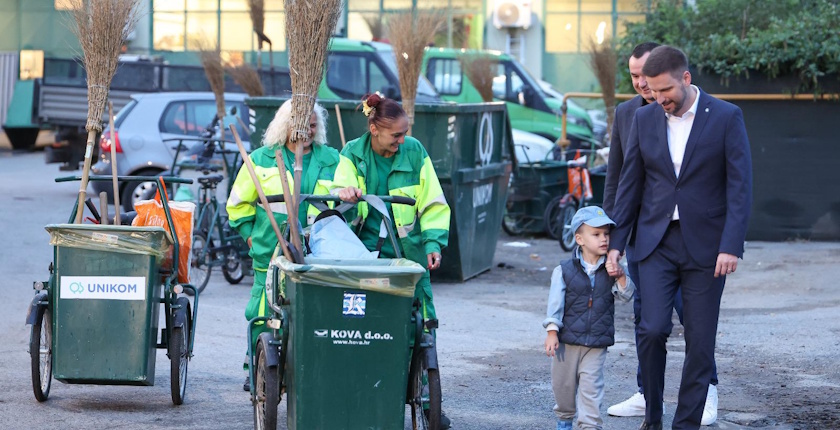
Osijek, with a share of 57.92% of separately collected waste, is again the best among large cities in Croatia, according to Mayor Ivan Radić. Because of the achievement, he visited the employees of the city’s waste utility Unikom in the early morning hours.

He stressed that the success is the result of responsible citizens who separate waste, the dedicated work of Unikom employees, and ongoing investments in infrastructure.

Osijek has four recycling yards, including a mobile one. They are able to separate 52 types of waste. There is also a composting facility. As the mayor pointed out, the local authority invests in consumer education, from kindergartens to its Eco City Waste Fest, because it aims to maintain and improve the achieved results.

Osijek is the only major Croatian city that doesn’t pay penalties for not achieving waste separation targets

Radić underlined that Osijek is the only large Croatian city that, thanks to waste separation above 50%, doesn’t pay penalties.

Municipal authorities in Croatia pay fines per ton of landfilled waste that was supposed to be separated and properly processed in line with waste management rules. The fine for 2025 was set at EUR 30 per ton. The obligatory separation rate for 2025 is 50%.

Unikom CEO Igor Pandžić highlighted that in 2024, a total of 36,000 tons of municipal waste were collected, of which nearly 21,000 tons were recyclable waste. The largest portion was biodegradable waste, thanks to the composting unit, into which the city continues to invest.

Osijek has maintained a waste separation rate above 57% for two consecutive years

Paper, plastic, glass, and metal accounted for over 9,000 tons, Pandžić said, and recalled that Osijek achieved a waste separation rate above 57% for two consecutive years.

He said more projects are underway, including the expansion of the composting facility and the establishment of a center for recycling bulky waste, which would further reduce the quantities ending up at the Lončarica Velika landfill.

In Pandžić’s words, they are important steps in terms of the circular economy. “What our fellow citizens separate, we process into a new product like compost, which then goes back into gardens and yards,” he explained.

At the meeting with the workers, the mayor and the CEO announced a 10% salary bonus as a reward for their work.
by in News

Croatia changing law on renewables – new rules for prosumers, decentralized power production

The Government of Croatia has adopted the amendments to the law on renewable energy sources and high-efficiency cogeneration. They change rules for consumers producing electricity for self-consumption, facilitate the establishment of citizen energy communities and regulate decentralized energy production.

The amendments align the Croatian legislation with the European Union’s Renewable Energy Directive and bring benefits to citizens, entrepreneurs, and investors, the Ministry of Economy said.

One of important innovations is a new scheme for the production of energy for self-consumption. Instead of the current net metering mechanism, the new law introduces net billing. It values more fairly the surplus electricity that prosumers deliver to the grid, according to the ministry.

The grid costs charged to prosumers will be aligned with the actual amount of electricity that they take from the grid

Consumers – citizens and entrepreneurs that produce energy for their own needs, will pay grid costs matching the amount of electricity they actually take from it, enabling a sustainable and fair system for all users, the ministry added.

Existing prosumers will have ten years for the transition to the new scheme.

The bill enables the production of electricity for self-consumption in remote locations, provided that all metering points are registered with the same consumer. The ministry expects the measure to pave the way for greater investments, flexibility, and decentralized energy production.

Waste separation is a condition for granting incentives for waste incineration

The rules for establishing citizen energy communities have been simplified, to further strengthen their role in the energy transition. The amendments stricten the criteria for the sustainability of biofuels and they prohibit incentivizing the incineration of waste not from a system of separate collection.

The upcoming law sets the basis for a plan for the development of electricity infrastructure and storage capacities. It will create the conditions for greater integration of renewable energy sources into the grid, the ministry stressed.

“With this law we are taking an important step forward in the energy transition, ensuring a balance between the interests of citizens, the economy, and the energy system, and creating the foundations for a sustainable development of the Croatian energy sector in the long term,” Minister Ante Šušnjar stated.