by in News

From Austria to Albania: Verbund, Nordex to deploy 105 wind turbines across Europe

Verbund Green Power has forged a partnership with Nordex Group for the potential procurement of wind turbines.

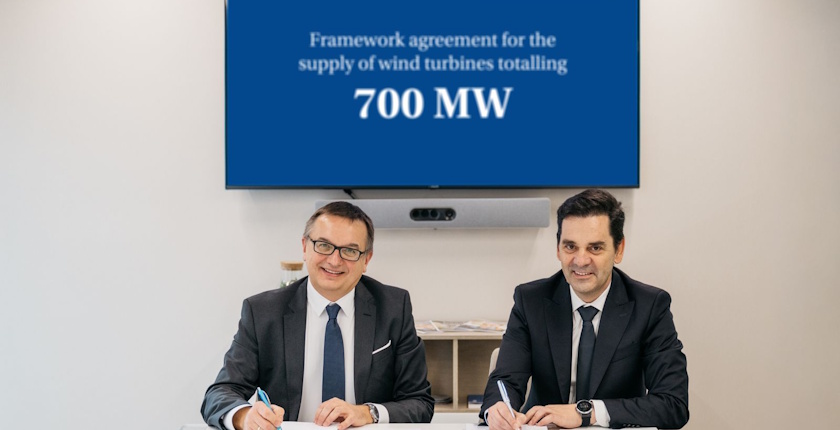
Verbund Green Power, a subsidiary of Austrian state-owned energy utility Verbund, has entered into a multiyear framework agreement with leading wind turbine producer Nordex Group for the potential procurement of wind turbines of up to 700 MW in total capacity, according to a joint press release.

The agreement runs through 2030.

The power plants are planned in six markets

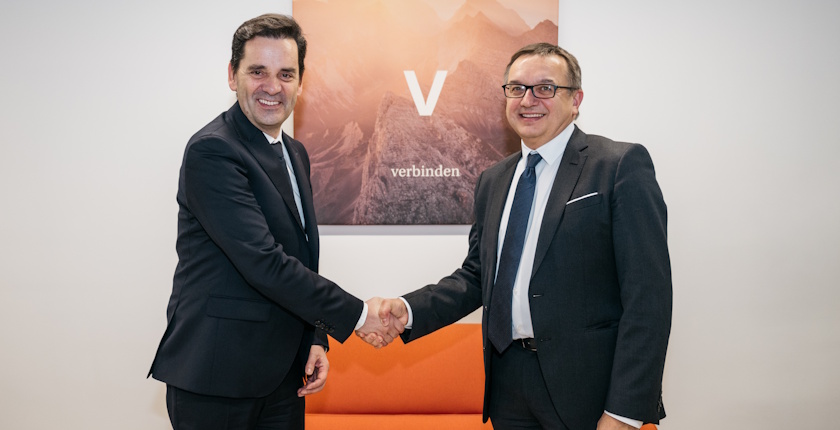
The agreement was officially signed in Verbund Green Power’s Madrid office by Dietmar Reiner, Managing Director of Verbund Green Power, and José Luis Blanco, CEO of Nordex Group.

They expressed willingness to facilitate the supply and delivery of up to 105 Nordex onshore wind turbines for Verbund Green Power’s wind projects. They are are planned in Austria, Germany, Spain, Italy, Romania and Albania, the update reads.
europe verbund nordex Dietmar Reiner José Luis Blanco
José Luis Blanco and Dietmar Reiner (photo: Verbund)

Of note, Christopher Billot, Sales Director for the Mediterranean region of Nordex Group, said at Belgrade Energy Forum 2025 that the Balkans is a key region for his company.

The deal would cover approximately 50% of Verbund Green Power’s wind project pipeline.

Blanco: We’re creating a clear path to deliver reliable, cost-efficient wind energy together with Verbund

Nordex Group CEO José Luis Blanco explained that through this multi‑year framework, the company would provide the turbine capacity to convert an ambitious pipeline into clean generation across six multi‑country markets in Europe.

“With up to 700 MW of our latest 7 MW class onshore turbines slated across Austria, Germany, Spain, Italy, Romania and Albania, we’re creating a clear path to deliver reliable, cost-efficient wind energy together with Verbund through 2030,” he stressed.

Strugl: The collaboration with Nordex strengthens our supply options as our projects mature

Blanco recalled that late last year Nordex received a first order from Verbund for nine N175/6.X turbines for Romania. “We’re expanding our footprint in this country,” he added.

According to Verbund CEO Michael Strugl, the collaboration with Nordex supports his company’s strategic objective of scaling up renewable generation across Europe.

“It strengthens our supply options as our projects mature, allowing us to secure the supply chain in a very competitive environment and deliver on Mission V targets, contributing to a secure and accelerated energy transition in our markets,” Strugl added.

by in News

From Austria to Albania: Verbund, Nordex to deploy 105 wind turbines across Europe

Verbund Green Power has forged a partnership with Nordex Group for the potential procurement of wind turbines.

Verbund Green Power, a subsidiary of Austrian state-owned energy utility Verbund, has entered into a multiyear framework agreement with leading wind turbine producer Nordex Group for the potential procurement of wind turbines of up to 700 MW in total capacity, according to a joint press release.

The agreement runs through 2030.

The power plants are planned in six markets

The agreement was officially signed in Verbund Green Power’s Madrid office by Dietmar Reiner, Managing Director of Verbund Green Power, and José Luis Blanco, CEO of Nordex Group.

They expressed willingness to facilitate the supply and delivery of up to 105 Nordex onshore wind turbines for Verbund Green Power’s wind projects. They are are planned in Austria, Germany, Spain, Italy, Romania and Albania, the update reads.

europe verbund nordex Dietmar Reiner José Luis Blanco
José Luis Blanco and Dietmar Reiner (photo: Verbund)

Of note, Christopher Billot, Sales Director for the Mediterranean region of Nordex Group, said at Belgrade Energy Forum 2025 that the Balkans is a key region for his company.

The deal would cover approximately 50% of Verbund Green Power’s wind project pipeline.

Blanco: We’re creating a clear path to deliver reliable, cost-efficient wind energy together with Verbund

Nordex Group CEO José Luis Blanco explained that through this multi‑year framework, the company would provide the turbine capacity to convert an ambitious pipeline into clean generation across six multi‑country markets in Europe.

“With up to 700 MW of our latest 7 MW class onshore turbines slated across Austria, Germany, Spain, Italy, Romania and Albania, we’re creating a clear path to deliver reliable, cost-efficient wind energy together with Verbund through 2030,” he stressed.

Strugl: The collaboration with Nordex strengthens our supply options as our projects mature

Blanco recalled that late last year Nordex received a first order from Verbund for nine N175/6.X turbines for Romania. “We’re expanding our footprint in this country,” he added.

According to Verbund CEO Michael Strugl, the collaboration with Nordex supports his company’s strategic objective of scaling up renewable generation across Europe.

“It strengthens our supply options as our projects mature, allowing us to secure the supply chain in a very competitive environment and deliver on Mission V targets, contributing to a secure and accelerated energy transition in our markets,” Strugl added.
by in News

European electricity industry issues Paris Pledge on pumped storage hydropower

The International Hydropower Association (IHA) and Eurelectric launched the Paris Pledge. It is a collective call to action, aimed at unlocking the potential of pumped storage hydropower in Europe. The signatories urge the European Union and national governments to create the right conditions for long-duration storage to meet clean energy goals.

Over 50 utilities, hydropower suppliers and energy-focused associations have signed the Paris Pledge. The document’s alternative headline is Committing to Pumped Storage to Secure Europe’s Clean Energy Future.

The International Hydropower Association (IHA) and Eurelectric – Union of the Electricity Industry launched the initiative. They warned that Europe faces an urgent and growing need for long-duration electricity storage to secure a reliable, affordable and sustainable energy future.

Amid the transition to a renewables-dominated power system, the ability to store and dispatch electricity over long periods will be critical to balance variable generation from wind and solar, ensure grid stability and resilience, and reduce reliance on imported fossil fuels, the authors stressed. They called pumped storage hydropower or PSH the most important, scalable and cost-effective long-duration electricity storage solution available today. It still provides over 90% of the world’s long-duration electricity storage capacity.

PSH is currently the most important, scalable and cost-effective long-duration electricity storage solution, the industry pointed out

By 2050, around 86% of production capacity in Europe will come from variable sources, according to the material accompanying the Paris Pledge. Encouragingly, 78 pumped storage hydropower projects are under development, for 35 GW overall. The EU accounts for over 32 GW, and the rest is in Switzerland, Norway and Turkey.

The combined pipeline would provide storage capacity in excess of 700 GWh, equivalent to more than 10 hours of consumption of Italy and Spain taken together. There is 3.9 GW in the ready-to-build phase, and 2.8 GW is under construction. Of note, an earlier report showed 52.9 GW of PSH was under development.

The existing capacity amounts to 48 GW, compared to 190 GW globally. In the EU, pumped storage hydropower systems can store 1.2 TWh overall.

Photo: Types of pumped storage (IHA, Eurelectric)

Paris Pledge calls for separate legislation for long-duration energy storage

Among other proposals, the signatories are asking the EU for a dedicated initiative to boost the rollout of electricity storage. They suggested legislation to be separate for long duration, short duration and other solutions.

The Paris Pledge calls on member states to remunerate the provision of system services and security of supply for all time frames. They should eliminate double grid fees on electricity storage technologies and accelerate permitting for PSH, the document reads.

With strong political commitment, Europe can double its pumped storage hydropower capacity in the next 25 years, according to the Paris Pledge. In-person signatories represent EDP, EDF, Iberdrola, Andritz, Enel, Statkraft, Voith, Hydrogrid, Verbund, Landsvirkjun and GE Vernova.

Pumped storage hydropower’s contribution during Iberian Peninsula blackout

During the power blackout in Spain and Portugal on April 28, pumped storage played a pivotal role in balancing and supporting the recovery of the system. In Spain, PSH generated 11 GWh of electricity in the first 12 hours, instead of the planned 12 GWh recharge. Similarly, in Portugal, hydropower and pumped storage covered 80% of the demand in the first ten hours.

Such facilities also made a major contribution to restoring the electricity grid in the entire peninsula, thanks to their so-called black start capability. It allows the power plant to be restarted without relying on external power sources and to reenergise the power system.

“Very few technologies can provide this function. As a result, within a few minutes, the first pumped storage plants were ready for synchronization and awaiting dispatch instruction” from transmission system operators, notes the report published with the Paris Pledge.

by in News

Battery storage investors in Romania rapidly expanding project pipeline

In an accelerating investment wave, companies in Romania are combining BESS with solar power, hydropower and wind power, or building standalone energy storage facilities. The group includes R.Power, Hidroelectrica, Engie and more big names.

Recent updates about investments in battery energy storage systems (BESS) in Romania indicate the technology is becoming another pillar of the country’s energy transition alongside wind power. For several years now, photovoltaics, and prosumers in particular – including municipal authorities, have dominated the scene. Geothermal energy is another emerging segment.

The government has provided incentives both for households and utility-scale battery storage. Companies are combining batteries with solar and wind power as well as hydropower capacity.

Investing in BESS colocated with renewable electricity plants or as standalone facilities in Southeastern Europe enables income from high spreads between wholesale power prices in daily trading. It is especially significant given the increase in the occurrence of zero and negative prices.

Notably, neighboring Bulgaria has earmarked massive funds for support to BESS investments while also focusing on pumped storage hydropower projects. Greece also held several rounds of auctions for battery storage.

R.Power to start building 127 MW standalone battery

R.Power is investing in BESS in Romania, which is one of its strategic markets, together with Poland, where it is headquartered, and Italy, Germany, Spain and Portugal. Battery storage makes up 17.5 GW or more than half of its total development pipeline in Europe.

The company said it would hybridize its existing and future PV assets and scale the integrated capacity to several gigawatts in the coming years. It has over 1.2 GW of projects for standalone BESS in Romania. “And that’s just the beginning,” R.Power said.

It obtained EUR 15 million in funding for a future 127 MW facility. It is about to start building the BESS in Scornicești in Olt county, west of Bucharest. R.Power is planning to complete it in a year. The battery energy storage system would have a duration of two hours, translating to 254 MWh in capacity. The project received funding from the National Recovery and Resilience Plan (NRRP or, in Romanian, PNRR).

Still, in the company’s view, further legislative changes are needed to fully harness the potential of the technology.

Hidroelectrica to add large battery to Iron Gate 2 hydroelectric plant

State-owned Hidroelectrica, the largest electricity producer in Romania, wants to install a battery storage system at Iron Gate 2 (Porțile de Fier 2) on the Danube. Located on the border with Serbia, it is the second-largest hydroelectric plant in the country, at 252 MW in nominal capacity. The complex, which the two countries share, is known as Đerdap in Serbian.

The BESS would have 64 MW in nominal power and a four-hour duration (256 MWh), Profit.ro reported. Hidroelectrica plans to use it for providing balancing services to the national electricity system (SEN) and adjust the time intervals of its hydropower production.

The contract for the installation of the facility is estimated at EUR 61.2 million plus value-added tax, according to the article. It would be integrated with the hydroelectric plant. The company is receiving bids from potential contractors by August 28.

French Engie has BESS projects for its existing PV plant, wind park

France-based Engie’s subsidiary in Romania intends to install a BESS at its newest solar power plant, of 37.2 MW in peak capacity, in Ariceștii Rahtivani. It commissioned the PV facility in June. The location is north of Bucharest, in Prahova county.

The battery energy storage system project is for 20 MW in operating power and 80 MWh. It would consist of 16 containers, 192 inverters and four transformer units.

The wind park in Băleni will reportedly add a small BESS facility

Engie Romania is working on another investment, through its Alizeu Eolian project firm. It plans to add batteries to a 50 MW wind park in Băleni, Galați county, which was built in 2013.

The company obtained the building permit last year. It also got clearance two months ago for connecting the BESS with a 110/20 kV transformer station via an underground line. Economica.net learned that the battery storage facility would have 5 MW and a two-hour duration, costing the firm EUR 2 million.

Engie’s project was included in the reserve list last September after a public call for support to battery storage. The Ministry of Energy selected 13 applications for grants from NRRP. Another 25 passed, but remained below the line.

Government bolstering battery investments with grants

The state aid scheme was worth EUR 103.5 million, of which EUR 79.6 million came from the European Union’s Recovery and Resilience Facility (RRF).

Among the beneficiaries are Electrica, in which the government holds just under 50%. Renovatio Trading. OMV Petrom, Public Power Corp. (PPC) and Verbund have projects on the B list.

For its 65 MWh project in Toplița in Harghita county, in eastern Transylvania, Renovatio Trading is buying the equipment from Trina Storage. The firm is part of Trina Solar.

Visual Fan is winning major contracts for the procurement and installation of batteries

Allview Energy, part of Romanian company Visual Fan, is handling the alternating current (AC) side in Renovatio Trading’s investment.

In addition, Visual Fan became the contractor for a BESS within Eurowind Energy’s Teiuș solar park.

The Danish developer intends to deploy a 117 MWh energy storage unit with lithium-iron-phosphate (LFP) batteries, within a year. It valued the project at over EUR 16.6 million. The companies said they would carry out the works in partnership with TQM Services and Voltlink. The investment includes the battery management system and liquid cooling.

In June, the ministry approved a EUR 3.4 million grant from the EU’s Modernisation Fund to Termoficare Oradea. It has a project for a 10 MW solar park with a 15 MWh storage unit, worth EUR 18.6 million altogether.

Austria’s Verbund conducting EUR 22.7 million project

Verbund has almost all the permits for a BESS project at its 226 MW wind farm in Casimcea in Tulcea county. The company headquartered in Austria said it has secured financing as well and that it is already contracting the equipment.

The wind farm was commissioned in 2012. The energy storage segment would have up to 50 MW and up to 100 MWh. It would be located at the Alpha Wind Nord section of the existing facility, of 81 MW.

Still, the basic variant’s size will be 48.3 MW, with 76 MWh in capacity, according to Profit.ro. There would be 34 containers at the site selected for the BESS.

The majority government-controlled utility values the investment at EUR 22.7 million, of which more than EUR 10.7 million is for the storage facility itself. The location spans five hectares.

After coming up short in the public call, Verbund submitted the project for a grant from the Modernisation Fund.

In mid-May, Romania hosted 240.7 MW of battery capability and a total capacity of 404.9 MWh.

by in News

Austria’s Verbund acquires 272 MW wind project in Romania

Verbund Wind Power Romania, a subsidiary of Austria’s Verbund, has acquired a 272 MW wind project from Monsson, a Sweden-based renewable energy group. The project, taken over at a ready-to-build stage, is expected to enter the construction phase in 2026.

The planned wind farm in Caraș-Severin county in Romania is expected to produce 569 GWh of electricity annually, Verbund said in a press release.

Verbund has been present in the Romanian renewables market since 2012, operating the 226 MW Casimcea wind farm in Tulcea county. It also has a portfolio of wind and photovoltaic projects under development.

Verbund already operates a 226 MW wind farm in Romania

Adrian Borotea, General Manager of Verbund Wind Power Romania, said the company looks forward to future opportunities that can help speed up the country’s energy transition. “In Verbund, we continuously seek to stimulate the growth of the clean energy sector in Romania, in line with our sustainable approach to business,” he stressed.

Sebastian Enache, Head of Mergers and Acquisitions and member of the Board of Directors of Monsson, said the need for clean energy as a central point of the energy sector development in Romania and Europe is growing, adding that the company is proud to have started this cooperation with Verbund, one of the largest producers of electricity from renewable sources in Europe.

The Austrian utility expects 25% of its overall electricity output to be generated from solar and wind energy by 2030, with Romania seen as one of the strategic target markets to achieve the objective.

Monsson has over 5 GW of solar and wind projects in Romania

Monsson has a portfolio of more than 5 GW of wind and solar projects in Romania. It offers a full range of services, including the design, development, construction, and operation of renewable energy power plants, as well as the construction and operation of battery-based energy storage solutions.

The company recently said it was preparing to build a manufacturing facility in the Romanian town of Petrila to produce renewable energy equipment, including robots that clean solar panels.