by in News

COP30 in Brazil: one decade after Paris Agreement, world is still far from its climate goals

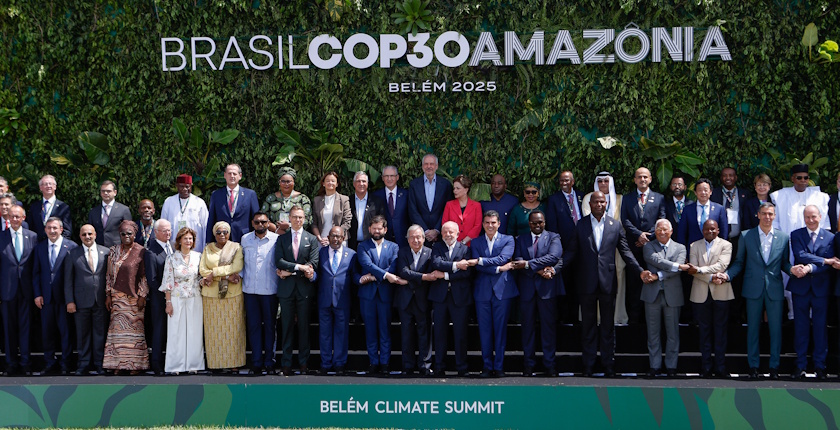
The two-week United Nations Climate Change Conference COP30 is taking place in Brazil. It brought together delegations from more than 190 countries to discuss the challenges of climate change and measures for mitigation and adaptation. The current COP marks ten years since the Paris Agreement, at a time of significant hurdles on the path to achieving global climate goals.

According to preliminary data from the World Meteorological Organization, this year will be the second or third warmest ever recorded on the planet. The 30th Conference of the Parties (COP30) to the United Nations Framework Convention on Climate Change (UNFCCC) is being held in Belém, Brazil — a city situated in the heart of our planet’s lungs, the Amazon rainforest.

Brazil carries symbolic weight, as the UNFCCC was signed there in 1992.

Lula da Silva: Climate change is no longer a threat of the future, it is a tragedy of the present

In the decade following the adoption of the Paris Agreement at COP21, some progress has been made in the fight against climate change — but it remains insufficient. In his opening speech, Brazilian President Luiz Inácio Lula da Silva stressed that climate change is no longer a threat of the future but a tragedy of the present. He called this year’s summit a “moment of truth.”

When the Paris Agreement was signed, scientific projections were showing that without decisive climate action, global temperatures could rise by more than four degrees Celsius before the end of the 21st century. “We are moving in the right direction, but at the wrong speed,” Lula said, also pointing to climate misinformation as a major obstacle to planning and implementing effective measures.

Guterres: We have failed to stop global warming

United Nations Secretary-General António Guterres said in his address that the harsh truth is that the world has failed to keep global warming within 1.5 degrees Celsius.

Just days before the summit, the UN Environment Programme (UNEP) released its annual report showing that, under current policies, the 1.5-degree limit will be reached within the next decade – and the planet will warm by 2.8 degrees by the end of the century.

Guterres: This is moral failure – and deadly negligence

“Even a temporary overshoot will have dramatic consequences. It could push ecosystems past irreversible tipping points, expose billions to unlivable conditions, and amplify threats to peace and security. Every fraction of a degree means more hunger, displacement, and loss – especially for those least responsible. This is moral failure – and deadly negligence,” Guterres warned.

Still, he emphasized that the UN has not given up on the 1.5-degree goal. “We have never been better equipped to fight back,” he said, adding that the clean energy revolution is gaining unstoppable momentum.

In the first half of 2025, renewables overtook coal as the top source of global electricity. Renewable energy is now cheaper than fossil fuels, and the cost of electricity storage continues to decline.

The US will not participate in negotiations

One of the world’s largest greenhouse gas emitters – the United States – has sent representatives to the summit, but President Donald Trump’s administration announced it would not take part in negotiations. In January, he announced that his country would withdraw from the Paris Agreement, and later called climate change “the greatest con job ever perpetrated on the world” during a speech at the UN in September.

Focus on implementing existing commitments

The main focus of COP30 in Belém is the implementation of previously agreed commitments and the enforcement of the Paris Agreement. The reduction of greenhouse gas emissions remains a key topic, alongside the first Global Stocktake – a comprehensive assessment of progress toward the Paris goals, aimed at encouraging countries to submit more ambitious national climate plans.

Despite some progress, the latest nationally determined contributions (NDCs) remain far from sufficient to prevent the most severe effects of climate change.

Another central issue will be the establishment of a New Collective Quantified Goal on Climate Finance – determining the scale, timelines, and mechanisms for funding, as well as the share of resources that must go toward adaptation and support for the most vulnerable communities.

According to UNEP’s Adaptation Gap Report 2025, developing countries will need more than USD 310 billion annually by 2035 to adapt to climate impacts, yet they currently have access to only a fraction of that amount.

Toward a just transition and nature protection

Delegates will also discuss operationalizing the Global Goal on Adaptation, which aims to measure progress in building climate resilience.

Another key topic will be the concept of a just transition, with a proposal to establish the Belém Action Mechanism for Just Transition – a new framework to ensure that climate and economic transitions put people at the center. It would include job creation, retraining programs, and support for communities dependent on fossil fuel industries.

Given that COP30 is taking place in the heart of the Amazon, particular attention is dedicated to nature and forest conservation. Brazil plans to present the Tropical Forests Forever Facility, an initiative designed to secure long-term funding for the protection of tropical forests.

by in News

Earth would become 2.8 degrees warmer by 2100 without additional measures

The United Nations Environment Programme (UNEP) has released its annual Emissions Gap Report 2025: Off Target, assessing the state of global greenhouse gas emissions. The document outlines the gap between where global emissions are headed – based on announced national policies and pledges – and what is needed to meet international temperature targets.

Ten years after the adoption of the Paris Agreement, UNEP claims the accord has played a key role in lowering global temperature projections and spurring the development of renewable energy, policies, and targets. Due to countries’ slow progress in reducing emissions, the world is likely to exceed the Paris Agreement’s target of limiting warming to 1.5 degrees Celsius above pre-industrial levels, possibly within this decade.

Under the Paris Agreement, countries are required to submit their nationally determined contributions (NDCs) every five years — their plans for reducing emissions and adapting to climate change.

Implementation of current policies alone would lead to a warming of 2.8 degrees

The report states that by September 30, 2025, only 64 signatory countries, responsible for 63% of global emissions,  had submitted or announced NDC plans with mitigation targets for 2035. However, just 13 countries, accounting for less than 1% of global emissions, have updated their reduction targets.

In addition to the lack of progress in commitments, the report highlights a massive implementation gap. “In addition to the lack of progress in pledges, a huge implementation gap remains, with countries not on track to meet their 2030 NDCs, let alone new 2035 targets,” the report warns.

According to the report, full implementation of all NDCs would lead to a temperature rise of between 2.3 and 2.5 degrees Celsius by the end of the century, compared to last year’s projected range of 2.6 to 2.8 degrees. Implementation of current policies alone would result in a warming of 2.8 degrees, slightly lower than the 3.1 degrees that were projected in last year’s assessment.

Implementing all NDCs by 2035 would cut emissions by 12%-15% from the 2019 levels. However, if the United States withdraws from the Paris Agreement, the reduction would drop to between 9% and 11%.

It is far below the 35% reduction needed to limit warming to two degrees and the 55% required to stay within 1.5 degrees Celsius.

Greenhouse gas emissions continue to rise

Global emissions of greenhouse gases: carbon dioxide (CO2), methane (CH4), nitrous oxide (N2O), and fluorinated gases (F-gases), reached a record 57.7 billion tons of CO2 equivalent last year or 2.3% more than in 2023.

The largest share of emissions comes from the combustion of coal, oil, and gas, about 69% of the total. Combined emissions of CH4, N2O, and F-gases make up about 24%. In addition to fossil fuels, deforestation and land use change were key drivers of the sharp rise in emissions in 2024, according to the report.

Developed countries account for 77% of global emissions

The world’s most developed countries, the G20 group (Argentina, Australia, Brazil, Canada, China, France, Germany, India, Indonesia, Italy, Japan, Mexico, Russia, Saudi Arabia, South Africa, South Korea, Turkey, the United Kingdom, the United States, and the European Union), are responsible for 77% of global emissions, while the least developed countries contribute just 3%.

The largest emitters are China, the US, India, the EU, Russia, and Indonesia. The biggest absolute increase was recorded in India, followed by China and Indonesia, which is also among the world’s most populous nations. Meanwhile, emissions in the EU fell by 2.1%.

Paris Agreement goals are still achievable – but barely

“Urgent and stringent emission reductions” are essential to achieve the goals of the Paris Agreement, yet new NDCs and the current geopolitical context offer little reassurance that such reductions will be realized, the authors stressed.

UNEP Executive Director Inger Andersen emphasized that the pace of change is insufficient, pointing out that emission reductions are “still possible – just.”

“Proven solutions already exist. From the rapid growth in cheap renewable energy to tackling methane emissions, we know what needs to be done. Now is the time for countries to go all in and invest in their future with ambitious climate action – action that delivers faster economic growth, better human health, more jobs, energy security, and resilience,” she said.

To reverse every 0.1 degrees Celsius of warming, about 220 billion tons of CO2 must be removed

To offset every 0.1 degrees Celsius of global temperature rise, approximately 220 billion tons of CO2, equivalent to five years of global emissions, would need to be removed from the atmosphere. While many impacts cannot be fully reversed, UNEP underscores that the 1.5-degree target remains a legal, moral, and political obligation for all governments.

“Scientists tell us that a temporary overshoot above 1.5 degrees is now inevitable – starting, at the latest, in the early 2030s. And the path to a livable future gets steeper by the day. But this is no reason to surrender. It’s a reason to step up and speed up. 1.5 degrees by the end of the century remains our North Star. And the science is clear: this goal is still within reach. But only if we meaningfully increase our ambition,” UN Secretary-General António Guterres said in his message on the report.