by in News

Skopje Declaration signed as International Forum on Energy for Sustainable Development wraps up

The 14th International Forum on Energy for Sustainable Development (IFESD-14) concluded yesterday with the signing of the Skopje Declaration. During the three-day summit, North Macedonia’s capital became a global center of dialogue, ideas, and visions for the future, according to the Ministry of Energy, Mining and Mineral Resources of North Macedonia.

This year’s edition of the International Forum on Energy for Sustainable Development (IFESD-14), themed From Goals to Action: Powering the Future with Sustainable Energy, was closed in Skopje yesterday. The event was organized by the Ministry of Energy, Mining and Mineral Resources of North Macedonia, in cooperation with the United Nations Development Programme (UNDP) and the UN’s five regional commissions – UNECE, UNESCAP, UNECLAC, UNECA, and UNESCWA.

Representatives of the UN and the five regional commissions described the organization of the event as flawless, and praised North Macedonia and Skopje as excellent hosts on the global energy scene, the Ministry pointed out.

The forum brought together over 500 participants from more than 70 countries

The forum brought together over 500 participants from more than 70 countries. Over 150 speakers took part in 35 themed sessions and panels, presenting ideas, solutions, and concrete steps for the future of the global energy transition.

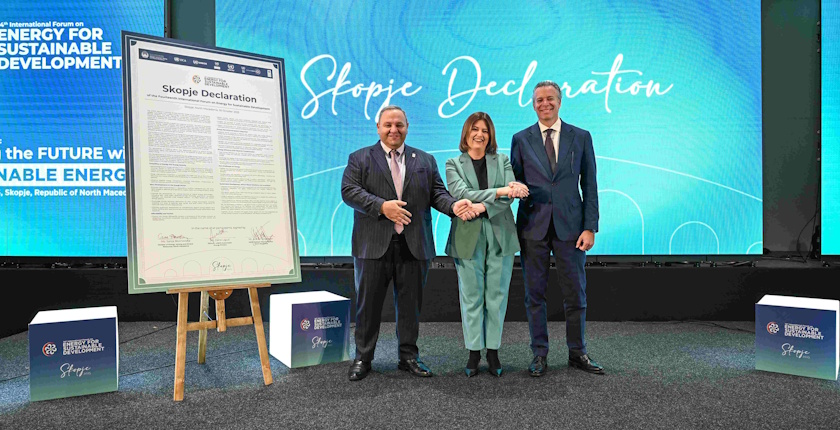
On behalf of all participants, the Declaration was signed by Minister of Energy, Mining and Mineral Resources Sanja Božinovska, UNDP Resident Representative for North Macedonia Armen Grigoryan, and Dario Liguti, Director of the Sustainable Energy Division at UNECE.

The signatories agreed that the way forward requires regional connectivity, smart investments, digital transformation, and an inclusive energy transition that leaves no one behind.

Božinovska: A new impetus for energy cooperation, solidarity, and vision

[wpcc-iframe title=”Sanja Božinovska statement on the occasion of IFEST25 Skopje and signing the Skopje Declaration” width=”500″ height=”281″ src=”https://www.youtube.com/embed/ZgcrsSuNVes?start=1&feature=oembed” frameborder=”0″ allow=”accelerometer; autoplay; clipboard-write; encrypted-media; gyroscope; picture-in-picture; web-share” referrerpolicy=”strict-origin-when-cross-origin” allowfullscreen=””]

In her closing address, Božinovska emphasized that the forum represented a turning point for the region.

“Over the past three days, Skopje has been a global stage for energy vision and dialogue on sustainable development. What we witnessed here was a wave of knowledge, cooperation, and ambition – a forum that demonstrated that when institutions, scientists, businesses, and international partners sit at the same table, change happens,” she stressed.

Božinovska emphasized that the Skopje Declaration sends a strong signal that the Western Balkan region is not just a follower of the global energy transition, but an active driver.

The future was not just discussed, but also set in motion

“I am proud that it is from Skopje, at the heart of the Balkans, that a new impetus for energy cooperation, solidarity, and vision is emerging. This is proof that North Macedonia can be a platform for ideas that will transform the region. The 14th International Forum on Energy for Sustainable Development will be remembered as the place where the future was not just discussed, but also set in motion. Let us continue to build the energy future that our citizens deserve,” said Božinovska.

Grigoryan: Skopje has demonstrated global solidarity in action

[wpcc-iframe title=”Mr Armen Grigoryan, UNDP Resident Representative, statement on IFESD25 Skopje” width=”500″ height=”281″ src=”https://www.youtube.com/embed/uH2-5cr5ju0?feature=oembed” frameborder=”0″ allow=”accelerometer; autoplay; clipboard-write; encrypted-media; gyroscope; picture-in-picture; web-share” referrerpolicy=”strict-origin-when-cross-origin” allowfullscreen=””]

Armen Grigoryan, UNDP Resident Representative for North Macedonia, said that the path to sustainable, reliable, and affordable energy is clear, but that it requires unity and vision.

According to him, it requires political will, global solidarity, and commitment.

UNDP is pleased to work together with the Government and the Ministry of Mining, Energy and Mineral Resources, as well as regional commissions, on policies, emission reduction solutions, inclusivity, and air quality improvements, according to him. UNDP invests in people and innovation to achieve measurable results that citizens can feel at home, at work, and everywhere, he added.

Liguti: The Skopje Declaration is a signal of the region’s ambition and vision

According to Dario Liguti, Director of the UNECE Sustainable Energy Division, the document signed in Skopje will remain an important reference point in global energy processes.

He said that the Skopje Declaration represents a strong signal of the regional and global cooperation and ambition, confirming the shared commitment to accelerating a just and inclusive energy transition – a transition that delivers real progress for people and the planet.

Conclusion: smart technologies, a just transition, and green investments

Božinovska, Grigorian, and Liguti (phto: Ministry of Mining, Energy and Mineral Resources)

The document states that signatories will work on integrated and inclusive energy policies; the modernization of power grids and digitalization; investments in renewable energy sources and a just transition; and the promotion of green financing and gender equality in energy.

“Together, we can transform the global energy system into one that safeguards our climate, drives innovation, ensures affordability, and delivers prosperity for all,” reads the closing paragraph of the Skopje Declaration.
by in News

BEF 2025: Regional cooperation can facilitate energy transition, energy security

Montenegro, Serbia, and the Republic of Srpska don’t have a problem attracting investments in electricity production, but they do have issues when it comes to investments in transmission networks. If the introduction of CBAM is not postponed, it will greatly burden their economies. Hungary is interested in strengthening energy ties with them as well as the rest of the Western Balkans, which would bolster energy security for the whole region. Croatia could also assist it in strengthening employment in the green technologies sector, to counter the loss of jobs due to decarbonization. These are the main messages from the High-ministerial panel on SEE regional cooperation and energy transition strategies.

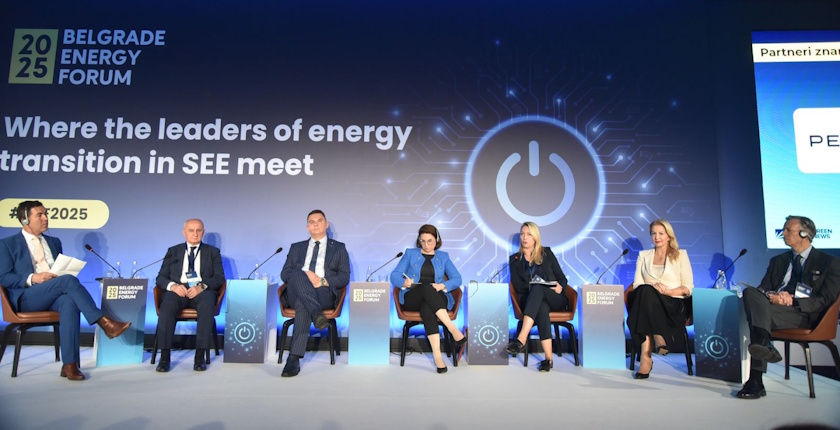
The ministerial panel was the first of eight at this year’s Belgrade Energy Forum 2025 (BEF 2025). The conference, organized by Balkan Green Energy News, welcomed four hundred participants from more than 30 countries from the region, Europe, and beyond.

The panel featured representatives of the governments of Montenegro, Croatia, Hungary, the Republic of Srpska – one of the two political entities in Bosnia and Herzegovina – Serbia, and the United Nations Economic Commission for Europe (UNECE). The moderator of the panel was Dirk Buschle, who until recently was a key figure in the Energy Community Secretariat, and now is a partner at law firm Becker Büttner Held.

He noted it is a mistake to say that the contracting parties of the Energy Community are lagging behind EU countries in the energy transition. They all face the same issues, which are energy accessibility, supply security, and sustainability, Buschle added.

Additional proof, in his words, are the similar issues faced by investors – in grid connections and permitting.

Investments in production are coming, the issues are grids, CBAM

Dirk Buschle, Petar Đokić and Admir Šahmanović

According to Minister of Energy and Mining of the Republic of Srpska Petar Đokić, the entity has made significant progress in defining a regulatory framework that aligns with the rules of the Energy Community and the European Union.

He noted that with the help of the Energy Community Secretariat, the two entities of BiH recently reached an agreement on adopting a law on the electricity regulator, transmission, and market. It is one of the cornerstones for establishing an organized electricity market.

The Republic of Srpska was successful in attracting investments in green energy in recent years, Đokić added. It established concessions and partnerships for the construction of 2,200 MW of renewable energy power plants – wind, solar, and hydropower.

However, large investments in transmission networks are also necessary, he pointed out and said he expects assistance from the European Union’s financial institutions such as the European Bank for Reconstruction and Development (EBRD) and the European Investment Bank (EIB), as well as the World Bank.

Đokić: CBAM to hit hard BiH’s economy

The minister called on them to set up such partnerships.

Regarding the EU’s Carbon Border Adjustment Mechanism (CBAM), he said that measures have been taken to change the domestic energy mix. Until recently, the share of fossil fuels was 62%, but it has now dropped to 54%, he recalled.

By 2028, the Republic of Srpska will have two new hydropower plants, of 159 MW and 36 MW, and new solar power plants with a total capacity of 250 MW, the minister asserted. It would additionally green the energy mix, Đokić said.

CBAM, in his words, could harm the economy of the Republic of Srpska and BiH.

If it is applied the way it is apparently envisaged, it would result in a significant increase in costs, with a severe negative impact, he underlined. Đoković expressed hope that the rollout would be separately discussed in the case of BiH.

Šahmanović: Montenegro is finishing its NECP

Montenegro also enjoys great interest from investors. It has received applications for building solar power plants and wind farms with a total capacity of 5.5 GW, said Admir Šahmanović, Minister of Energy and Mining.

The country’s current capacity is slightly over 1 GW.

It is, in his words, the result of improving the regulatory framework including the adoption of laws on renewable energy sources and energy. However, investment in the transmission grid is also necessary. The government plans to discuss with Italy the possibility of installing another subsea cable for electricity transmission, while the national energy and climate plan (NECP) will be completed by the end of next month, the minister revealed.

Montenegro is requesting a postponement of CBAM until 2030

In addition, renewable energy auctions are being prepared with the EBRD, and a memorandum on market coupling with Italy will be signed, he added.

As for CBAM, the minister stressed that Montenegro doesn’t believe the EU wants to harm its economy, but argued that the country isn’t ready for the mechanism’s implementation.

“Perhaps we are now in a situation similar to where our EU partners were 20 years ago. So, we need to invest a lot in our production capacities, grid, storage. It will take years, so if we don’t receive an exemption by 2030, I believe we won’t be able to handle this challenge,” Šahmanović stressed.

Secure supply of the national market is the highest priority

Boglárka Illés, Admir Šahmanović and Jovana Joksimović

Jovana Joksimović, Serbian assistant minister of mining and energy for international cooperation, European integration, and project management, expressed the opinion that the energy transition is a long and intensive process, technically, operationally, and financially.

Since October 2022, renewable energy in the energy mix has increased by 83%, which demonstrates the progress of the energy transition in Serbia, Joksimović asserted.

“We need to be realistic, as well as socially aware, because a fair and sustainable transition is something that should be carefully considered when changing the energy mix, where coal accounts for 60%,” she noted.

Joksimović: The priority is to ensure a sufficient supply of electricity at the most affordable prices for citizens and the economy

It is necessary, in her words, to be ambitious and dedicated to the energy transition goals, but she is convinced that there is a higher objective.

At the country level, it is to ensure enough electricity at the most affordable prices for both citizens and the economy, she underlined. “That’s what our top priority is,” Joksimović underscored.

Guided by the said goal, Serbia is also considering the use of nuclear energy and a study on possible options is currently being prepared.

Boglárka Illés, State Secretary for Bilateral Relations at Hungary’s Ministry of Foreign Affairs and Trade, also stressed that the government’s primary duty is to ensure not only climate neutrality and sustainable energy but also affordable energy with a stable supply for households and businesses.

She pointed out that diversifying energy imports and the energy mix plays a key role in securing energy sovereignty. It is the reason why cooperation with the Western Balkans, and especially Serbia, is important to Hungary, Illés asserted.

Illés: Europe’s energy security has been demolished

A few days before, Hungary’s Prime Minister Viktor Orbán said the EU has abandoned a successful economic strategy, based on cheap Russian gas and advanced German technology.

“And now we don’t see any other strategy within the EU,” she stated.

Due to ideologically driven sanctions against Russia, and the European Green Deal, the energy security of Europe is demolished, in Illés’s opinion. The region is located at the intersection of essential energy routes, connecting the East and the West, and also South and North, she underlined.

“We, as an EU member country, can act as a bridge between non-EU member countries and also the EU,” the state secretary stressed.

As an example of good cooperation with Serbia, she highlighted the supply of gas through the TurkStream pipeline and the Pannonian Corridor project for doubling the capacity for power exchange between the two countries.

The energy transition is an opportunity

Jovana Joksimović, Marija Pujo Tadić and Dario Liguti

In one respect, Marija Pujo Tadić, Special Envoy for Climate Action from the Government of Croatia, doesn’t share the opinion of the Hungarian official. She argued it isn’t true that Europe lacks a plan.

The EU has a clear plan and a well-defined strategy – it is the Clean Industrial Deal, she stressed.

She highlighted two important strategies relevant to the region: the Paris Agreement and the Green Agenda for the Western Balkans.

As a member of the scientific advisory board for the COP 29 presidency, she recalled that this year a review of nationally determined contributions (NDCs) would be conducted. It is an assessment of how countries are meeting their plans for lowering CO2 emissions.

Pujo Tadić: Education and workforce specialization are essential

She underlined the Green Agenda for the Western Balkans also envisages reducing net greenhouse gas emissions to zero by 2050, which is essentially the shared goal of the EU.

However, Pujo Tadić expressed the belief that policies and laws alone are not enough. Public education and workforce specialization are also necessary because the transition will create many new jobs, she added.

Croatia could be of great support to the Western Balkans, having launched such educational programs five years ago, according to Pujo Tadić.

The link between the energy transition and the creation of new jobs was also stressed by Dario Liguti, Director of Sustainable Energy at UNECE. In his view, the region has a huge opportunity to become part of the supply chains for green technologies by greening the domestic power generation and by leaning on the EU’s energy transition.

He sees the main factors for it in the region’s geographic proximity to the large European market, and the large, skilled workforce that can be educated for other tasks. Liguti drew a connection with the expected job loss from decarbonization measures and the related need for a just transition.

Liguti: There is great potential for energy efficiency in the region

Liguti praised the forthcoming investments in renewable energy production, but warned it is only one side of the story, arguing that the other one is energy efficiency. He reminded the audience that the region’s energy intensity is high, saying there is room for savings.

The installation of big solar plants and wind farms, in his words, is great because it’s very visible.

“It’s a great investment and makes a lot of sense. The harder part is making energy efficiency investments, whether in buildings or the industrial processes in large, small, or medium enterprises,” Liguti stated.

As an example, he recalled that UNECE is running a project with the EBRD in North Macedonia to support households and small and medium enterprises to lower the costs of liquid fuels and electricity.