
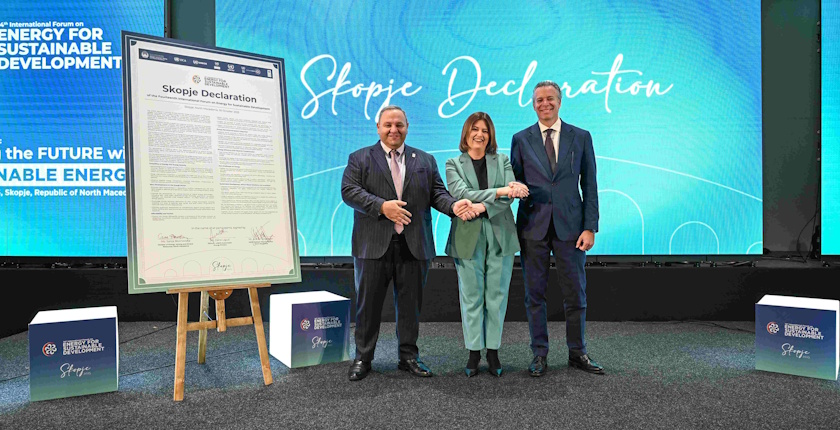
Skopje Declaration signed as International Forum on Energy for Sustainable Development wraps up
The 14th International Forum on Energy for Sustainable Development (IFESD-14) concluded yesterday with the signing of the Skopje Declaration. During the three-day summit, North Macedonia’s capital became a global center of dialogue, ideas, and visions for the future, according to the Ministry of Energy, Mining and Mineral Resources of North Macedonia.
This year’s edition of the International Forum on Energy for Sustainable Development (IFESD-14), themed From Goals to Action: Powering the Future with Sustainable Energy, was closed in Skopje yesterday. The event was organized by the Ministry of Energy, Mining and Mineral Resources of North Macedonia, in cooperation with the United Nations Development Programme (UNDP) and the UN’s five regional commissions – UNECE, UNESCAP, UNECLAC, UNECA, and UNESCWA.
Representatives of the UN and the five regional commissions described the organization of the event as flawless, and praised North Macedonia and Skopje as excellent hosts on the global energy scene, the Ministry pointed out.
The forum brought together over 500 participants from more than 70 countries
The forum brought together over 500 participants from more than 70 countries. Over 150 speakers took part in 35 themed sessions and panels, presenting ideas, solutions, and concrete steps for the future of the global energy transition.
On behalf of all participants, the Declaration was signed by Minister of Energy, Mining and Mineral Resources Sanja Božinovska, UNDP Resident Representative for North Macedonia Armen Grigoryan, and Dario Liguti, Director of the Sustainable Energy Division at UNECE.
The signatories agreed that the way forward requires regional connectivity, smart investments, digital transformation, and an inclusive energy transition that leaves no one behind.
Božinovska: A new impetus for energy cooperation, solidarity, and vision
[wpcc-iframe title=”Sanja Božinovska statement on the occasion of IFEST25 Skopje and signing the Skopje Declaration” width=”500″ height=”281″ src=”https://www.youtube.com/embed/ZgcrsSuNVes?start=1&feature=oembed” frameborder=”0″ allow=”accelerometer; autoplay; clipboard-write; encrypted-media; gyroscope; picture-in-picture; web-share” referrerpolicy=”strict-origin-when-cross-origin” allowfullscreen=””]
In her closing address, Božinovska emphasized that the forum represented a turning point for the region.
“Over the past three days, Skopje has been a global stage for energy vision and dialogue on sustainable development. What we witnessed here was a wave of knowledge, cooperation, and ambition – a forum that demonstrated that when institutions, scientists, businesses, and international partners sit at the same table, change happens,” she stressed.
Božinovska emphasized that the Skopje Declaration sends a strong signal that the Western Balkan region is not just a follower of the global energy transition, but an active driver.
The future was not just discussed, but also set in motion
“I am proud that it is from Skopje, at the heart of the Balkans, that a new impetus for energy cooperation, solidarity, and vision is emerging. This is proof that North Macedonia can be a platform for ideas that will transform the region. The 14th International Forum on Energy for Sustainable Development will be remembered as the place where the future was not just discussed, but also set in motion. Let us continue to build the energy future that our citizens deserve,” said Božinovska.
Grigoryan: Skopje has demonstrated global solidarity in action
[wpcc-iframe title=”Mr Armen Grigoryan, UNDP Resident Representative, statement on IFESD25 Skopje” width=”500″ height=”281″ src=”https://www.youtube.com/embed/uH2-5cr5ju0?feature=oembed” frameborder=”0″ allow=”accelerometer; autoplay; clipboard-write; encrypted-media; gyroscope; picture-in-picture; web-share” referrerpolicy=”strict-origin-when-cross-origin” allowfullscreen=””]
Armen Grigoryan, UNDP Resident Representative for North Macedonia, said that the path to sustainable, reliable, and affordable energy is clear, but that it requires unity and vision.
According to him, it requires political will, global solidarity, and commitment.
UNDP is pleased to work together with the Government and the Ministry of Mining, Energy and Mineral Resources, as well as regional commissions, on policies, emission reduction solutions, inclusivity, and air quality improvements, according to him. UNDP invests in people and innovation to achieve measurable results that citizens can feel at home, at work, and everywhere, he added.
Liguti: The Skopje Declaration is a signal of the region’s ambition and vision
According to Dario Liguti, Director of the UNECE Sustainable Energy Division, the document signed in Skopje will remain an important reference point in global energy processes.
He said that the Skopje Declaration represents a strong signal of the regional and global cooperation and ambition, confirming the shared commitment to accelerating a just and inclusive energy transition – a transition that delivers real progress for people and the planet.
Conclusion: smart technologies, a just transition, and green investments
Božinovska, Grigorian, and Liguti (phto: Ministry of Mining, Energy and Mineral Resources)
The document states that signatories will work on integrated and inclusive energy policies; the modernization of power grids and digitalization; investments in renewable energy sources and a just transition; and the promotion of green financing and gender equality in energy.
“Together, we can transform the global energy system into one that safeguards our climate, drives innovation, ensures affordability, and delivers prosperity for all,” reads the closing paragraph of the Skopje Declaration.
