by in News

Engie Romania to double its renewables capacity with 253.1 MW wind farm project

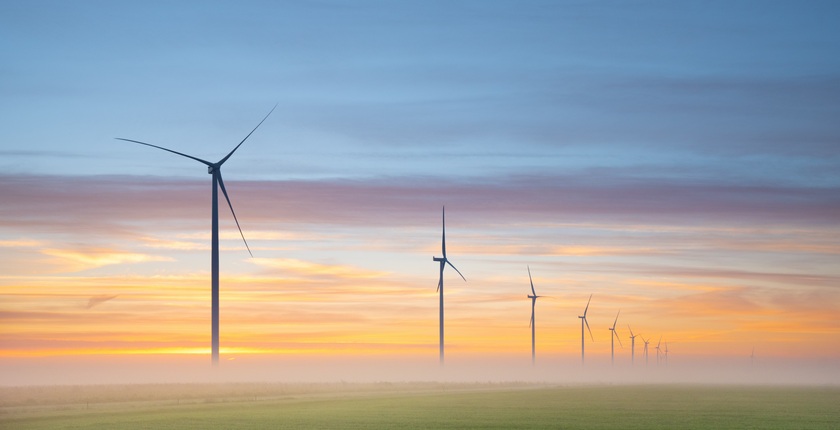
Engie Romania, a subsidiary of French energy giant Engie, has bought a 253.1 MW wind farm project in Ialomiţa County. The wind farm, currently under construction, will double the company’s renewable energy portfolio in Romania to over 500 MW.

The Ialomiţa Nord wind farm project was acquired from the Romanian subsidiary of Portugal-based Greenvolt, owned by US investment fund KKR. The value of the transaction was not disclosed. According to earlier reports, the project is valued at EUR 400 million.

With 42 turbines, Ialomiţa Nord will be among the largest wind farms in Romania. It is expected to become fully operational in 2027, local media reported, and sell electricity through a 15-year contract for difference (CfD).

The project will benefit from a 15-year contract for difference

Engie Romania currently owns and operates a total of 248 MW of renewable energy facilities – three wind farms, with a total capacity of 178 MW, and six solar power plants, totaling 70 MW. Ialomiţa Nord will increase its total renewables generation capacity in the country to 501.1 MW.

“With this acquisition, Engie continues to make significant progress in achieving its development plans in Romania, doubling its installed capacity for renewable energy production and consolidating its position in a market with remarkable potential,” said Cristian Buzan, Executive Vice President of Engie Romania.

The company has also secured CfDs for two other projects – one wind farm and one solar park – with a combined capacity of 224 MW. Earlier this year, it completed the acquisition of a 54 MW wind power project. The site is in Mereni in central Romania.

Engie plans to boost its renewables production and energy storage capacity in Romania to 1 GW

Engie’s objective is to increase its renewable energy production and storage capacity in Romania to 1 GW by 2030. The company supplies natural gas and electricity to over 2.3 million customers in Romania.

by in News

Turkey’s Guris Holding to build windfarms in Kosovo and Ukraine

The Turkish company Guris Holding has announced the construction of new wind power plants in Kosovo and the Ukraine, the Turkish press reported. The reports said that the company plans to build the plant in Ukraine outside the city of Odessa but do not specify the exact location of the site of the power plant in Kosovo.

Güriş Holding has plans for a wind farm with a total power of 32 MW in Kosovo and a wind power plant of 80 MW in the Ukraine. Turkish daily Dunya reported that construction work on both wind power plants has been started, specifying that work on the 30 MW segments of both facilities was underway.

Müşfik Yamantürk, the general manager of Güriş Holding, which is considered to be one of Turkey’s leading renewable energy-based power producers, said that the company had been issued a license for the windfarm outside the city of Odessa which will be built using GE wind generator turbines. The 50 MW segment of that plant, which is the company’s first investment in the Ukraine, is due to be started at the beginning of next year.

He said GE turbines will also be used for the wind power plant in Kosovo, adding that the guaranteed price of power from that windfarm is 8.5 cents per kilowatt-hour.

Yamantürk said that both the 30 MW power plant in Ukraine and the 32 MW plant in Kosovo will be commissioned in August or September of 2018.

Kosovo energy production insufficient

Kosovo has faced serious power supply problems in the past few years with frequent power outages which is a problem in attracting foreign investments. Kosovo’s government has made improvements to the energy sector a priority and has requested assistance from a number of international aid and financial organizations.

Kosovo relies heavily on its two coal powered plants with a capacity of 900 MW which account for 97 percent of the power produced domestically and on imports of electricity while power from renewable energy sources account for just 3 percent of production at home.

The Kosovo state radio and TV service (RTK) has reported that business people have expressed great concern over the power shortage and that the Kosovo Power Corporation has warned of a possible energy crisis because its coal reserves have dropped to a level sufficient for two weeks of power production.

Kosovo has the fifth largest lignite coal reserves in the world but those reserves lie under private land which the government has not been able to purchase. The state power company KEK said it needs to take over 52 hectares of private land whose owners are unwilling to sell at the price offered by the government.

by in News

How many turbines are required?

At the end of 2005, an estimated 47,000 wind turbines were installed in Europe, generating 83 TWh of electricity, equal to about 2.8% of European electricity demand.

The average size of turbines delivered to the European market in 2004 was about 1.3 MW onshore and 2.1 MW offshore. Under the assumption that by 2030, the average size of a wind turbine will be 2 MW onshore and 10 MW offshore, this will result in a total of 90,000 turbines (75,000 onshore and 15,000 offshore machines) to fulfi l the 300 GW target.

In 2030, 90,000 wind turbines would generate 965 TWh, and provide 23% of European electricity demand in 2030.

This takes into account rising demand, so the 90,000 machines would meet 32% of current European electricity demand.

By doubling the number of turbines in Europe from 2005 to 2030, 12 times more electricity can be generated.