by in News

Corridor VIII Emerges as a Strategic Pillar for Balkan Integration and NATO Security

TIRANA — High-level officials and international stakeholders gathered in the Albanian capital this week to chart the future of Pan-European Corridor VIII, a multi-billion euro infrastructure project designed to bridge the Adriatic and Black Seas. Billed as a modern successor to the ancient Roman Via Egnatia, the corridor is increasingly viewed by regional leaders and Western allies not merely as a transport route, but as a critical component of economic sovereignty and Euro-Atlantic security.

ECONOMIC FORUM: “Strategic Connectivity and Regional Economic Growth: The Economic Potential of Corridor VIII”

ECONOMIC FORUM: “Strategic Connectivity and Regional Economic Growth: The Economic Potential of Corridor VIII”

The forum, titled “Strategic Interconnectivity and Regional Economic Growth: The Economic Potential of Corridor VIII,” held on February 18, 2026, served as a platform for Albania and North Macedonia to reaffirm their commitment to the project. The discussions highlighted a shift in the corridor’s narrative, moving from a long-delayed logistical ambition to a certified strategic priority.

A Security Necessity: The NATO Dimension

In a significant development for the region’s geopolitical standing, Albanian Deputy Prime Minister and Minister of Infrastructure and Energy, Belinda Balluku, revealed that Corridor VIII has now received NATO certification. This designation elevates the project from a civilian transport initiative to a vital military and security asset for the alliance’s eastern flank.

“Corridor VIII is no longer just a road for the movement of goods and citizens,” Balluku stated during the forum. She characterized the project as a “safe infrastructure for Euro-Atlantic security,” noting that its completion would allow for the rapid deployment of resources between the Mediterranean and the Black Sea—a necessity brought into sharp focus by shifting security dynamics in Eastern Europe.

The certification ensures that the technical specifications of the roads and railways—connecting the port of Durrës in Albania to Varna and Burgas in Bulgaria—meet the rigorous standards required for military mobility, effectively integrating the Western Balkans into NATO’s logistical architecture.

Economic Integration and the EU Path

While security dominated the high-level briefings, the forum’s primary focus remained the economic transformation of the Balkan interior. For decades, the lack of east-west connectivity has been cited as a major bottleneck for regional trade.

ECONOMIC FORUM: “Strategic Connectivity and Regional Economic Growth: The Economic Potential of Corridor VIII”

ECONOMIC FORUM: “Strategic Connectivity and Regional Economic Growth: The Economic Potential of Corridor VIII”

Delina Ibrahimaj, Albania’s Minister of State for Local Government, described the corridor as a “key instrument for European integration and regional stability.” Ibrahimaj emphasized that the project is now a formal part of the Trans-European Transport Network (TEN-T), a status that unlocks significant funding from the European Union.

“The development of this corridor is synonymous with the development of our economies,” Ibrahimaj noted, arguing that the project will reduce transport costs, attract foreign investment, and foster a more unified regional market. Officials at the forum suggested that by linking the ports of Albania with the industrial hubs of North Macedonia and Bulgaria, the corridor would create a “short-circuit” for trade that currently relies on longer, more congested routes.

Strengthening the Balkan Backbone

Representing North Macedonia, Igor Hoxha echoed the sentiment of regional interdependence. He framed Corridor VIII as the “backbone of regional development,” essential for the landlocked nation’s access to international maritime routes.

The cooperation between Tirana and Skopje has intensified as both nations seek to synchronize their construction timelines. The project involves a complex mix of highway expansion and the modernization of ageing railway tracks, many of which have remained dormant since the end of the Cold War.

Corridor VIII connection.

Corridor VIII connection.

“From the Via Egnatia to Corridor VIII, the plan to connect East and West is finally making its definitive stop in Tirana,” noted reports from the forum, highlighting the historical weight of the project. By reviving this ancient trade artery, the participating nations aim to reverse a history of fragmentation and replace it with a corridor of “peace and prosperity.”

Challenges and the Road Ahead

Despite the diplomatic optimism, the path to completion remains fraught with logistical and financial hurdles. The rugged terrain of the Balkan interior requires extensive tunnelling and bridge construction, driving up costs. Furthermore, the synchronization of three different national bureaucracies—Albania, North Macedonia, and Bulgaria—remains a persistent challenge.

However, the consensus in Tirana was clear: the project has reached a point of no return. With the backing of the European Union’s Western Balkans Investment Framework and the newfound urgency of NATO’s security requirements, Corridor VIII is moving from a blueprint to a reality.

As the forum concluded, the message from the Albanian Ministry of Foreign Affairs was definitive: Corridor VIII is the strategic link that will finally anchor the Western Balkans into the broader European family, transforming the region from a “grey zone” of infrastructure into a modern hub of global connectivity.

by in News

Croatia drafts EUR 1.68 billion Social Climate Plan

Croatia has prepared a Social Climate Plan for the period 2026-2032, worth EUR 1.68 billion. It would introduce measures for the buildings and road transport sectors aimed at supporting households and small businesses.

The draft of Croatia’s Social Climate Plan is under public discussion, which will last until December 22.

The process of adopting the most important national instrument for protecting citizens from the adverse effects of climate transition and the introduction of the European Union’s Emissions Trading System 2 (EU ETS 2) has begun, the Ministry of Environmental Protection and Green Transition stressed.

The plan will be financed with EUR 1.26 billion from the EU’s Social Climate Fund, and the remainder from Croatia’s national budget. Essentially, all the funds are coming from the auctions of emission allowances in the EU and Croatia under the EU ETS 2. It is an expansion of the EU ETS to the buildings sector (heating and cooling) and road transport.

The EU established the Social Climate Fund in May 2023 to protect households and small businesses

The expansion could increase the costs of heating, cooling, and transport. In May 2023, the EU established the Social Climate Fund to protect low-income households, micro enterprises, and transport users that could be affected by the cost increase.

The measures and investments also contribute to the implementation of the goals of the National Energy and Climate Plan (NECP).

The Social Climate Plan allocates EUR 658.1 million (39%) for the buildings sector, and EUR 958.4 million (57%) for road transport. Technical assistance is the third component, with EUR 42 million (2.5%).

The measures planned for the buildings sector include support for the establishment of energy communities and subsidies for the energy renovation of family homes. In the road transport sector, the plan envisages investments in cycling, on-demand mobility services, zero-emission vehicles, and railway infrastructure.

Vučković: Restoration planned for 180 kilometers of bike trails

croatia social climate policy plan EU ets 2 marija vuckovic plenkovic
Photo: Government of Croatia

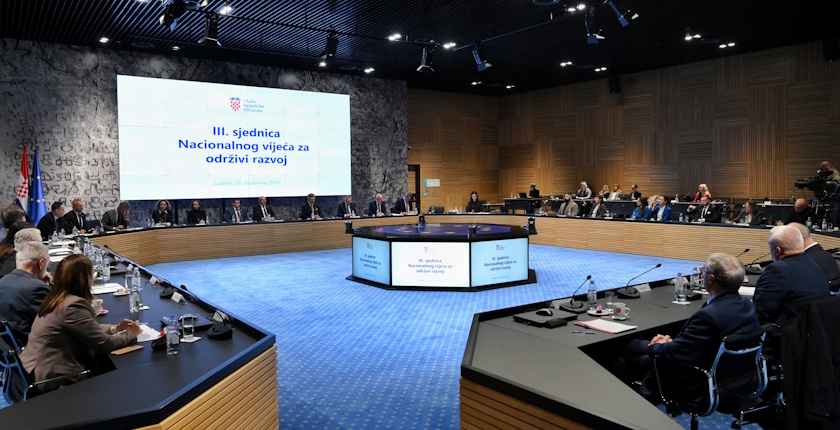
​While presenting the draft plan at a session of the National Council for Sustainable Development, Minister of Environmental Protection and Green Transition Marija Vučković said it identifies two groups: the energy poor or vulnerable, and transport poor or vulnerable.

“The plan provides for 10 measures, four of which relate to so-called stationary or energy poverty, and the remaining six to achieving affordable and favorable mobility and reducing the risk of transport poverty,” she explained.

According to the ministry, the plan provides for the renovation of 180 kilometers of bicycle paths, 80 kilometers of railway lines, as well as the procurement of 30 electric trains, 80 electric buses, and 3,000 electric cars.

Prime Minister Andrej Plenković stressed that the plan isn’t just a technical and administrative document, arguing that it determines what Croatia would become in ten, twenty, and fifty years.

“And we want a Croatia that is economically strong, socially just, and sovereign,” Plenković underlined.

by in News

Balkan Leaders Discuss Energy, Transport at Summit

EBRD2 640The Western Balkans Investment Summit in London on Monday brought together the prime ministers of Albania, Bosnia and Herzegovina, Croatia, Kosovo, Macedonia, Montenegro and Serbia with investors to discuss the development of transport links, energy projects and privatization.

“We are encouraged by the fact that all of the region’s economies grew last year. And our economists expect growth to rise further in most Western Balkans countries in 2016, albeit still at levels below their potential,” said the EBRD’s president, Suma Chakrabarti.

Chakrabarti praised what he called “a reform momentum across the region”, with Montenegro advancing along its EU path, Serbia restructuring its public companies, Albania continuing a programme of modernization and Bosnia and Herzegovina starting to implement a reform agenda prepared with the help of the European Commission.

The Balkan prime ministers expressed determination to continue their progress towards the EU.

“I don’t agree with [London mayor] Boris Johnson that the EU has become very boring,” said Albanian Prime Minister Edi Rama, referring to Johnson’s decision to campaign for Britain to vote to leave the EU in a referendum in June.

“Regardless of all challenges, Western Balkans countries believe in a united Europe,” added his Montenegrin counterpart Milo Djukanovic.

The main part of the summit saw Balkan leaders concentrating on major infrastructure and energy investments, including the Nis-Pristina highway and an electricity transmission line between Macedonia and Albania.

“We don’t just expect money, we need political support for reforms, education and the creation of a unique market,” Serbian PM Aleksandar Vucic said.

The vision of integrated market in the Balkans came a step closer, the regional leaders argued, as Serbia and Slovenia confirmed their intention to join SEE Link, an EBRD-supported regional network for trading securities that will help to integrate domestic stock markets. SEE Link was started by the Bulgarian, Macedonian and Croatian stock exchanges.

The EBRD is one of the largest investors in the Western Balkans and last year alone the bank invested around a billion euro in various projects from energy efficiency to infrastructure and from support for financial institutions to agribusiness.

Its first Western Balkans summit was held two years ago. Participants included government officials, policy-makers and experts as well as leading domestic and international business representatives.

Source Birn