by in News

Slovenia and Italy to upgrade electricity interconnectors

Slovenian transmission and distribution system operator ELES and Italian transmission system operator Terna agreed to upgrade their cross-border electricity network in an investment of EUR 250 million. The project aims to increase the transmission capacity between the two countries by 600 MW, strengthening supply and trade.

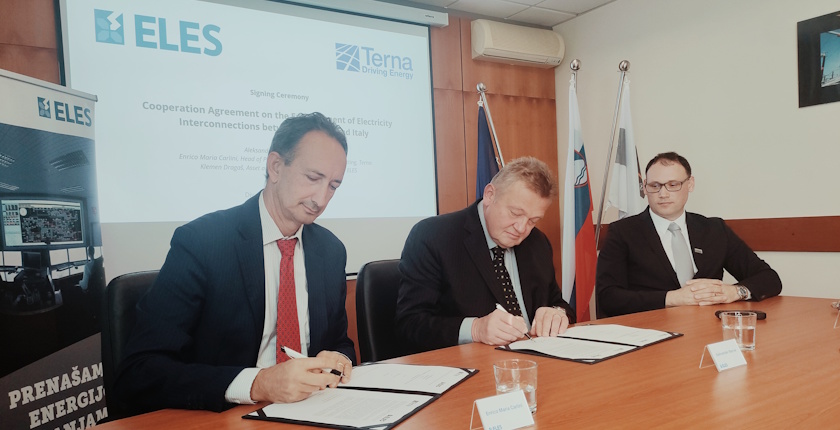
After a decade of coordination, ELES and Terna signed an agreement to raise the electricity transmission capacity between Slovenia and Italy by 600 MW or more than 50%. According to ELES, it is an important step in market integration and strengthening the reliability of the interconnected electricity system.

Interconnections between Slovenia and Italy are currently among the most heavily loaded ones in the Slovenian network, the country’s TSO pointed out.

As ELES further explained, with the growth of electricity imports and exports, there is an increasing need to strengthen transmission routes between the two countries. The company expects a rise in electricity imports in the countries gradually phasing out fossil fuel–based production to further increase the demand for cross-border transmission capacity.

The project consists of three upgrades

The project includes three main improvements. On the Slovenian side, the phase-shifting transformer at the Divača substation would be upgraded, alongside adding a third unit, which enables full utilization of the capacity of the 400 kV transmission line between Divača and Redipuglia (Sredipolje). The current transmission capacity, 1,200 megavolt-amperes (MVA), would be lifted to 1,800 MVA.

On the 220 kV transmission line between Divača and Padrice in Italy, low-sag conductors, capable of withstanding higher temperatures will be installed, ELES said. The transmission capacity would be doubled to 700 MVA.

On the Italian side, the existing 220 kV Padriče-Redipuglia connection and the Redipuglia substation are to be upgraded with a new phase-shifting transformer. It is crucial for managing internal power flows, the update reads.

“With an additional 600 MW of cross-border capacity, Slovenia is solidifying its role as a key electricity hub between Central and Southern Europe and as a reliable regional partner. This is a strategic investment in the future, ensuring reliability, resilience, and connectivity of our grid in the decades when electricity will become the main energy currency,” said ELES CEO Aleksander Mervar.

Slovenia’s share of the project is estimated at EUR 90 million

The total value of the project is EUR 250 million, with the Slovenian share estimated at EUR 90 million and the Italian side securing EUR 160 million. Pending all necessary permits and documentation, construction is planned to begin in 2029, and completion is expected by the end of 2031.

ELES announced it would seek European funds to finance the Slovenian side of the investment.

“The agreement not only strengthens the historic partnership between the two transmission system operators but also marks an important step toward developing and implementing innovative solutions that enhance the efficiency of transmission network investments. The agreement encourages system operators to introduce not only capital-intensive projects but also solutions with lower capital requirements that can increase net benefits and investment returns for all electricity system users,” said Enrico Maria Carlini, Head of Power System Planning and Permitting at Terna.

by in News

Investment risk highest for nuclear power, lowest for solar

Nuclear power plants have the highest construction cost overrun and the longest time delays of all energy projects. In the clean energy sector, the worst marks for violation of set construction cost and timelines go to hydrogen, carbon capture and storage as well as gas power plants, according to a study by the Boston University Institute for Global Sustainability.

The average project costs 40% more than expected for construction and takes almost two years longer than planned, the Boston University Institute for Global Sustainability (IGS) said.

Its researchers used an original dataset 50% larger than the ones in previous literature. They examined cost overrun risks for 662 energy infrastructure projects across 83 countries built between 1936 and 2024, covering USD 1.358 trillion in investment and a total capacity of more than 400 GW.

In total, the study evaluated ten types of projects: coal-, oil-, and natural gas–fueled power plants; nuclear reactors; hydropower plants; utility-scale wind farms; utility-scale solar photovoltaic and concentrated solar power (CSP) facilities; high-voltage transmission lines; bioenergy and geothermal power plants; hydrogen production units; and carbon capture and storage (CCS) facilities.

Both hydrogen and CCS projects exhibited significant time and cost overruns

“We found that more than three fifths of the projects experienced cost overruns, with these overruns being particularly prominent in projects exceeding 1,561 MW in capacity. Positively, the escalation rate in cost overruns has been declining since 1976,” reads the study, published in the Energy Research & Social Science journal.

However, the findings show patterns of cost overruns varied by fuel source. Nuclear and fossil thermal projects exhibited higher cost escalation rates over time, whereas solar power projects showed a decline.

Critically, both hydrogen and CCS projects exhibited significant time and cost overruns, casting doubt on their ability to be rapidly scaled up, to address climate change or meet energy and climate policy priorities, the authors underlined.

The average nuclear power plant has a construction cost overrun of 102.5% and ends up costing USD 1.56 billion more than expected, IGS said.

Red flag for efforts to substantially push forward a hydrogen economy

“Worryingly, these findings raise a legitimate red flag concerning efforts to substantially push forward a hydrogen economy,” said Benjamin Sovacool, lead and first author of the study, director of IGS, and professor at Boston University’s Department of Earth and Environment.

In the results, solar energy and electricity grid transmission projects have the best construction track record and that they are often completed ahead of schedule or below expected cost.

Wind farms also performed favorably in the financial risk assessment, according to the study, called ‘Beyond economies of scale: Learning from construction cost overrun risks and time delays in global energy infrastructure projects’.

“Low-carbon sources of energy such as wind and solar not only have huge climatic and energy security benefits, but also financial advantages related to less construction risk and less chance of delays,” Sovacool stated.

For him, it’s further evidence that such technologies have an array of underrated and underappreciated social and economic value.

by in News

Serbia’s TSO EMS inks contract for Obrenovac – Bajina Bašta power line within Trans-Balkan Corridor

Serbia’s transmission system operator Elektromreža Srbije signed a contract for the construction of a two-system 400 kV transmission line from the Obrenovac substation to the Bajina Bašta substation.

The power line from the Obrenovac substation to the Bajina Bašta substation is part of the third section of the Trans-Balkan Corridor for the transmission of electricity, a project of national and regional significance, TSO Elektromreža Srbija (EMS) said.

The Trans-Balkan Corridor connects Romania, Serbia, Bosnia and Herzegovina, Montenegro and Italy.

Apart from the transmission line, the third section comprises equipping two switchyards in the Obrenovac substation and upgrading the Bajina Bašta substation to 400 kV.

The job was awarded to Kodar Energomotaža at an international tender

The transmission line will be 109 kilometers long. The start of construction is planned for April, while the completion is expected in 2027.

The project is financed by EMS, a donation from the Western Balkans Investment Framework (WBIF), and a loan from Germany’s KfW Development Bank.

The EUR 71 million contract was signed by EMS CEO Jelena Matejić and Mladen Žujković, the representative of Kodar Energomontaža, the contractor. The company was selected after a complex international tender, according to Serbia’s TSO.

The first section of the Trans-Balkan Corridor, from Pančevo to the Romanian border, was completed and put online in December 2017.

The second section was finished in June 2022. It consisted of transmission lines between Kragujevac and Kraljevo and upgrading the substations in the two cities.

Matejić: Serbia is a crucial electricity hub in this part of Europe

The corridor plan also has a fourth section. It envisages a double 400 kV power line between the substations in Bajina Bašta in Serbia, Višegrad in Bosnia and Herzegovina and Pljevlja in Montenegro.

“The Trans-Balkan electricity transmission corridor is certainly one of the most important infrastructure projects to safeguard a stable supply of electricity in our country. It will also enable the integration of the electricity market and position Serbia as a crucial electricity hub in this part of Europe,” Matejić stressed.

The importance of the Trans-Balkan Corridor was demonstrated recently by the commissioning of the second system within the transmission link between Romania and Serbia. It increased the cross-border transmission capacity by 80% – from 500 MW to 900 MW.