by in News

El-Mor Pushes Two 203 MW Stand-Alone BESS Projects Toward Delivery in Romania

Romania’s grid-scale energy storage market is rapidly shifting from development into execution, making time-to-market an increasingly decisive differentiator. In this context, El-Mor Electric Installations & Services is progressing two large stand-alone Battery Energy Storage System (BESS) projects structured for fast delivery: BRADU BESS (Argeș) and BRAZI BESS (Prahova).

Each project is planned at 203 MW with up to 800 MWh of energy capacity (4-hour duration) and is designed to connect at 110 kV to substations operated by Romania’s transmission system operator, Transelectrica. Both projects already hold an ATR (technical connection approval) and are targeted to achieve RTB (ready-to-build) status in Q1 2026, with a defined pathway to commissioning in H1 2027, subject to investor execution and financing.

As Romania’s BESS market expands and moves into what many describe as a “delivery phase,” projects can look similar on paper. Increasingly, however, the separation between bankable opportunities and speculative pipelines comes down to execution certainty—particularly connection clarity, permitting maturity, optimized grid-connection CAPEX, and documentation capable of meeting lender-grade due diligence requirements.

El-Mor’s development model is focused on de-risking the items that most commonly delay BESS delivery—especially the grid interface and permitting quality—so investors can move quickly with fewer late-stage disruptions.

Quality control, risk management, and bankability

El-Mor Electric Installations & Services is a public company listed on the Tel Aviv Stock Exchange, reporting over €200 million in 2025 sales. Across its PV and BESS activities, the company highlights an engineering-led approach supported by decades of high-voltage experience, shaping a development practice centered on quality control, risk management, and overall bankability of the permitting package.

A key element of El-Mor’s strategy is technology flexibility. The projects are permitted on an equipment-agnostic basis, enabling investors to select BESS containers and Power Conversion System (PCS) technology during detailed design. This approach is intended to protect schedules as equipment availability, pricing, and lender requirements evolve—while avoiding the need to reopen permits to accommodate technology decisions.

BRADU BESS: permits issued, grid agreement targeted for March

BRADU BESS is a 203 MW / up to 800 MWh project located in Bradu commune (Argeș), planned to connect to Transelectrica’s BRADU 400/220/110 kV substation. El-Mor said the underground 110 kV cable route is approximately 0.6 km, supporting both schedule execution and connection cost optimization. The company noted that building permits were issued in January 2026, with Grid Connection Agreement (GCA) signature targeted for March 2026.

BRAZI BESS: advanced development track toward RTB in Q1 2026

BRAZI BESS is a 203 MW / up to 800 MWh project in Brazi commune (Prahova), planned to connect to Transelectrica’s BRAZI 400/220/110 kV substation via an underground 110 kV cable route of approximately 1.2 km. Development began in 2023, and the project remains on track to reach full RTB in Q1 2026.

In a market where speed and certainty are becoming core investment criteria, “delivery-ready” must withstand rigorous diligence to be meaningful. El-Mor’s positioning centers on disciplined VDR (virtual data room) management and a permitting approach designed to keep technology options open while enabling rapid execution.

by in News

Romania to roll out flexibility market where you get paid to consume less power

Companies and, eventually, households will be able to participate in the Romanian flexibility services market, getting compensated for cutting their electricity use at a time scheduled one day earlier. The aim is to prevent power outages during peak loads in the transmission grid.

The National Energy Regulatory Authority (ANRE) of Romania published a draft regulation that would allow payments to electricity consumers – companies or, in the future, even households – for temporarily reducing their consumption. The mechanism is called the consumption flexibility service. Its purpose is to balance the grid and prevent power outages during peak consumption.

Romania’s transmission system operator Transelectrica would be able to purchase consumption reduction services from market participants: large companies, suppliers and aggregators. They would commit to temporarily limiting energy use.

Demand response also replaces expensive emergency power imports.

Day-ahead market for demand response

Transelectrica will schedule the service through auctions organized a day earlier. Market participants would be able to bid with available consumption capacity reductions and prices.

The proposed regulation requires providers or aggregators to transfer at least half of the revenues to their end customers who contributed to the consumption cut.

Renewable electricity production – especially solar – has increased significantly over the previous years. During the day, Romania sometimes produces more energy than it consumes, but in the evening, when people return home and consumption increases sharply, production no longer covers demand.

The trend is known as the duck curve, per the shape of the daily chart of demand and solar power production. It leads to imbalances and bolsters the risk of grid overload. Through flexibility services, Transelectrica will be able to shave the peaks.

Households to eventually join through their aggregators

In the first stage, the mechanism will involve large consumers such as factories, retail chains, logistics operators and office buildings. They would be able to bid with a minimum of 500 kW. Households could join at some point through so-called flexibility aggregators.

It is also important that demand response decreases balancing costs, which spill over to electricity bills.

The draft regulation is undergoing a public consultation process until December 3. According to the schedule, the flexibility market will be established in the spring.

by in News

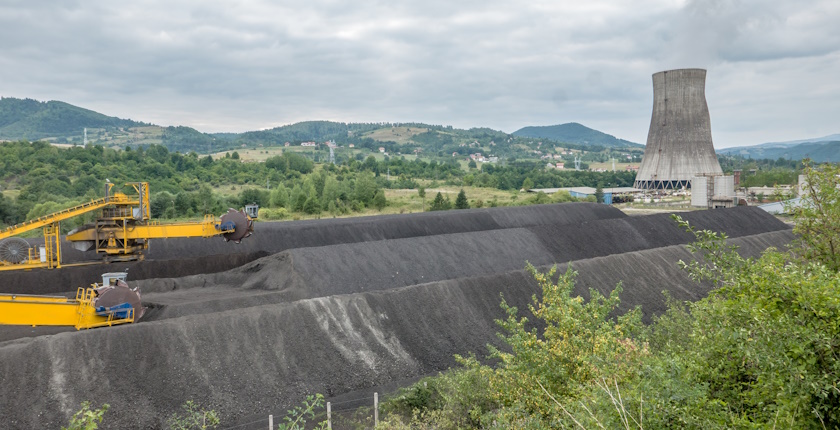
EU allows Romania to delay shutdown of coal plants until end-2029

Amid severe delays in projects for gas power plants, the European Commission approved Romania’s request to push back the closure of several coal-fired systems. The country is increasingly risking electricity shortages due to the lack of baseload capacity.

Romania will be able to keep three coal plants in operation until the end of 2029, following the renegotiation with the European Commission of the decarbonization calendar for electricity production, Minister of Energy Bogdan Ivan said. In a social media post, he announced that 900 MW would remain online.

Two other coal plants can operate at least until the end of August next year, Ivan revealed earlier at a press conference, where he first said the closure of 990 MW would be postponed until the end of 2029.

Turceni, Ișalnița gas power plants must be completed by 2029

State-owned Complexul Energetic Oltenia (CE Oltenia) remains fully active until the end of the summer, he added. “We will continue to have active coal-fired units in the city of Craiova, in order to continue to supply heat to the population, electricity, and steam to the Ford company. And those in Govora, which will produce heat for the inhabitants this winter, until the summer, when the municipality’s [Râmnicu Vâlcea] new energy system comes into operation,” the minister stated, as quoted by Profit.ro.

Romania was supposed to take 1.76 GW of coal power capacity offline at the end of this year. Ivan earlier warned of the risk of energy poverty and even blackouts. He explained that the European Commission accepted the 2029 deadline for the commissioning of CCGT (combined-cycle gas turbine) power plants in Turceni and Ișalnița.

Ivan: Romania will have 1.5 GW of coal power available in the winter season

The two new facilities of 1.33 GW would replace the coal plants in the same two towns. Their projects have suffered massive delays. Tender procedures are still ongoing for contracting the works.

Romania will have 1.5 GW of coal power available this winter, the minister claimed. In the amended National Recovery and Resilience Plan (NRRP or PNRR), the Rovinari and Turceni coal plants in Gorj county and one in the Jiu Valley in Hunedoara remain, together with the units in Craiova and Râmnicu Vâlcea.

Deal with EU to halve estimated nominal gap in winter

In a document from the beginning of October, National Energy Dispatcher (DEN), a unit of transmission system operator Transelectrica, said it counted on 850 MW from lignite for the upcoming winter. The season lasts from November through March. It would be one unit in Turceni, of 250 MW, with another one in technical reserve, and two units of 600 MW in total in Rovinari, having a third one as backup.

The electricity production deficit in the peak evening hours would range from 1.12 GW in the moderate scenario, to a stunning 3.8 GW.

The minimum required reserve is 1,000 MW, but only 520 MW would be available, so the expected gap was actually 1.6 MW – or 4.3 GW in the pessimistic version! The report puts transmission capacity at 4.5 GW for exports and 4.2 GW for imports.

Notably, Turceni, a small town in southwestern Romania dependent on the local coal power plant, is kickstarting a EUR 380 million project. The municipal authority is turning to agrivoltaics, energy storage and green hydrogen to replace it.

by in News

Romania risks blackouts if it shuts coal plants as scheduled

Minister of Energy Bogdan Ivan claims that energy poverty or even blackouts could hit Romania if it proceeds with the closure of coal plants. Namely, the gas power projects for replacing them are suffering severe delays.

The European Commission has become flexible for the first time in the last four years, said Romania’s Minister of Energy Bogdan-Gruia Ivan. He has asked for a postponement of the deadline for shutting down a group of coal power plants.

They need to be closed by the end of the year. If the coal plants, run by state-owned Complexul Energetic Oltenia (CE Oltenia) go before gas power plants Iernut and Mintia are commissioned, Romania is jeopardized, according to the minister.

Ivan told Digi24.ro he was negotiating with the European Commission on delaying the closure by “a few months.” Romgaz decided last week to cancel the contract with Duro Felguera, the contractor for the Iernut facility.

Energy poverty risk increasing

A study conducted with Romania’s transmission system operator Transelectrica has shown that Romania can otherwise end up in energy poverty and even risk a blackout, he underscored. “Especially in the winter, when we have no solar, when we have no wind power,” Minister Ivan explained.

Furthermore, Romania would like to keep three large coal units and another two in technical reserve for replacement them in case of damage, Ivan revealed. It would ensure a 1 GW minimum coal power supply, he asserted.

Romania requires at least 1 GW in baseload energy from coal for two more years, according to Minister Bogdan Ivan

Simulations showed that the group would need to operate for two years more, at least, until Iernut and Mintia are completed.

“We are pressed for time. We need to conclude contracts for next year. We need to conclude contracts for energy supply, contracts with suppliers, coal stocks. It is a complex of factors that must be organized very well from now on. It is already late, for Romania and for our energy companies,” Ivan stated.

Gas power projects in constant delay

Additionally, gas power plants Turceni (475 MW) and Ișalnița (850 MW) are supposed to replace some of the capacity in the Oltenia complex. The two projects suffered constant delays. The deadlines in the tenders for construction have been pushed back to September 30 and November 14, respectively.

Romania has received billions of euros from the European Union for gas power plants to substitute coal, the minister noted separately. He acknowledged that the projects are still on paper. That’s why today Romanians have almost the highest electricity price in Europe, Ivan claimed.

by in News

Romanian prosumers propose measures to cut electricity bills by up to 60%

The Association of Energy Prosumers and Communities in Romania has called on the government to implement five measures that could swiftly reduce electricity bills.

The measures target both individual homes and multi-apartment buildings, and results could be visible in up to 12 months, according to the Association of Energy Prosumers and Communities (APCE).

The association pointed out that the measures are needed because consumers in Romania pay some of the highest energy prices in Europe.

The first measure is related to energy communities, as the country is lagging in implementing the relevant EU legislation. The association claims that the introduction of energy communities lowered energy bills in Spain by 60%.

The association called on the authorities to involve civil society in the lawmaking process

Such structures allow citizens to directly manage their energy production, distribution, and storage, achieving independence from traditional suppliers and producers, the APCE noted.

The association called on the authorities to involve civil society in the lawmaking process, and underlined that adoption could be completed in three months, with bill reductions within 3–12 months.

The second measure involves multi-apartment buildings. Through a simple legislative change, residents could become direct beneficiaries of solar energy produced on the roofs of their buildings, the APCE pointed out.

Romania could install up to 4,000 MW of rooftop solar on multi-apartment buildings

Romania, the association notes, could install up to 4,000 MW of solar power plants on 4,200 hectares of apartment building roofs. The proposed legislative changes could be adopted within three months, with results visible after 3–12 months.

Mini-PV systems for balconies have the potential to lower electricity bills by 60%, according to the APCE’s calculation. In Germany, over a million such systems have already been installed, leading to monthly bill reductions of more than 60%.

The association estimates that the legislation needed for their rollout could be adopted within 30 days, and results could be visible immediately after installation.

Tackling suppliers’ excessive profit margins

The regulation of the supply margin for energy produced by prosumers is the fourth proposed measure. The association said that in 2025, a surplus of almost 2 billion kWh of renewable energy would be injected into the grid by prosumers.

Romania’s regulator, ANRE, left it to suppliers to set their profit margins, resulting in high prices for electricity resold to consumers.

PACE calls for a clear regulation of the supply margin to ensure that electricity produced by prosumers reduces consumer bills.

Reducing transmission tariffs for the TSO

The estimated timeframe is up to three months for the measure to be adopted, with visible reductions in bills expected immediately after implementation.

The final measure is a reduction of transmission tariffs for the transmission system operator (TSO) Transelectrica.

Even though the TSO does not transport prosumers’ surplus electricity, it still charges them for the service. It collected over EUR 18 million in 2024, the APCE claims, adding that the figure for 2025 is estimated to be EUR 35 million.

by in News

Romania considers launching new wind auctions

After completing the second round of wind and solar power auctions, Romania’s Ministry of Energy is considering launching new bidding for renewable energy projects, specifically onshore wind.

The Ministry of Energy has issued a call for expressions of interest for a third auction under the State Aid Scheme, in the form of contracts for difference (CfD), for electricity generation from onshore wind energy.

Given the results of the recently organized tendering for the award of CfDs, as well as the provisions of Government Decision 318/2024, the conditions stipulated in the State aid Scheme authorized by the European Commission Decision C (2024) 1596 final, the ministry is exploring the possibility of launching an additional tender, dedicated exclusively to onshore wind technology, according to the call.

All auction rules will be similar to those approved for the last CfD auction

The tender is to be completed by December 31, 2025, by which time the related contracts are to be signed, according to the update.

The ministry pointed out that all auction rules will be similar to those approved for the last CfD auction.

The expressions of interest should include projects that have recently reached or are about to reach a stage of maturity that would allow them to participate in the tender; projects that could not be submitted in the previous tender due to insufficient time to obtain corporate approvals, including to ensure the necessary sources of financing to cover the obligations regarding the participation/good execution guarantee.

Expressions of interest are to be submitted by August 29

The wind capacity to be auctioned will be determined following an analysis conducted by the ministry, based also on the expressions of interest received, provided that sufficient interest is expressed. Expressions of interest must be submitted by August 29.

Two weeks ago, the ministry and transmission system operator (TSO) Transelectrica conducted the country’s second wind and solar power auction for government support in the form of CfDs.

A total of 2 GW was available for wind, but the authorities selected only 1.26 GW under 23 qualified projects – those with bids below the ceiling of EUR 80 per MWh.

by in News

Serbia launches construction of two transmission lines as part of BeoGrid 2025 project

Serbia has launched works as part of the BeoGrid 2025 project, aimed at improving the power transmission infrastructure in Serbia, the region, and Europe, as well as facilitating electricity offtake from renewable energy power plants in the South Banat region of Vojvodina.

The BeoGrid 2025 project, worth EUR 205 million, comprises six distinct components, according to Radoš Popadić, Assistant Minister of Mining and Energy in charge of the power engineering sector. He attended the start of works in Belgrade’s Surčin suburb together with Jelena Matejić, the general manager of Serbia’s transmission system operator, Elektromreža Srbije (EMS).

“Construction is being launched today on two new high-voltage transmission lines that will connect Belgrade and Novi Sad, with a total value of around EUR 22 million,” he said, adding that work on a substation in Belgrade is also expected to begin soon.

The project is valued at EUR 205 million

The substation will be connected to the Čibuk 1 substation [wind farm Čibuk 1] by a new 83-kilometer transmission line, ensuring a stable transmission of electricity produced from renewable energy sources in South Banat, as well as reducing strain on the existing network, Popadić explained.

Radoš Popadić and Jelena Matejić (photo: Ministry of Mining and Energy/Danilo Mijatović)

Two single-circuit 400 kV transmission lines, intended for connecting transmission line 450 (switching station Mladost – substation Novi Sad 3) to the future 400/110 kV substation Beograd 50, will have a total length of 25.5 kilometers.

EMS General Manager Jelena Matejić said that BeoGrid 2025 is of particular importance for Serbia, but also part of the broader North Continental South East (CSE) Corridor project, which includes doubling the existing 400 kV interconnection between hydropower plant Đerdap 1 and Portile de Fier in Romania.

Matejić: The North CSE Corridor is part of the European ten-year network development plan, TYNDP 2020

The North CSE Corridor project is part of the European ten-year network development plan (TYNDP 2020) and the regional investment plan (RgIP 2020). It is supported by the Romanian transmission system operator, Transelectrica, as well as the German development bank KfW, with a feasibility study.

The North CSE Corridor is of regional importance as it increases the transmission capacity between Serbia and Romania, helping create an integrated European electricity market, Matejić pointed out, adding that BeoGrid 2025 is also important for additional backup power supply for the EXPO 2027 project.

The project aims to enable the transmission of electricity generated from renewable sources in the South Banat region and to ease the load on the 220/110/35 kV Beograd 5 substation, which supplies a large part of Belgrade, particularly parts of New Belgrade and Zemun, EMS stated.

Popadić: The total value of all planned projects is EUR 1 billion

Photo: Ministry of Mining and Energy/Danilo Mijatović

Radoš Popadić recalled that large investments in the transmission network are underway.

“Serbia has recognized the importance of investing in the power transmission system to enable the integration of more renewable energy capacity, increase the exchange of electricity with neighbors, and ensure a secure, stable, and efficient supply to consumers. That is why we launched investments in interconnection with the transmission systems of eight neighboring countries, with EUR 500 million to be invested in priority projects by the end of the decade. The total value of all planned projects will amount to around one billion euros,” said Popadić.

BeoGrid 2025 is financed partly from the Serbian budget, as well as from EMS’ own funds. The project consists of six distinct components, or investments:

  • 400/110 kV substation Beograd 50;
  • Two-circuit 400 kV transmission line between substation Beograd 50 and Čibuk 1, including the installation of a 400 kV bay at switching station Čibuk 1;
  • Single-circuit 400 kV transmission lines for the integration of transmission line 450 (switching station Mladost – substation Novi Sad 3) into substation Beograd 50;
  • Two double-circuit 110 kV transmission lines for the integration of transmission line 104/8 (substation Stara Pazova – substation Inđija 2) into substation Beograd 50;
  • two double-circuit 110 kV transmission lines for the integration of transmission line 1178 AB (substation Beograd 5 – substation Beograd 9) into substation Beograd 50;
  • Double-circuit 110 kV cable between substation Beograd 50 and substation Beograd 49 (Airport).

Photo: Ministry of Mining and Energy/Danilo Mijatović

by in News

Romanian bourse BRM joins power auctions within European Single Intraday Coupling

The Romanian Commodities Exchange – Bursa Română de Mărfuri (BRM), the country’s second nominated electricity market operator (NEMO), has joined intraday auctions (IDAs) under the European Single Intraday Coupling (SIDC) framework. With this move, BRM becomes part of the operational IDA system, launched across Europe in June 2024, according to a press release from European power exchange EPEX Spot.

Other partners involved in the Regional Integration Project (RIP) are the Hungarian Power Exchange (HUPX), the Independent Bulgarian Energy Exchange (IBEX), the Romanian Electricity and Gas Market Operator (OPCOM), Bulgaria’s Electricity System Operator (ESO), Hungary’s Independent Transmission Operator Company (MAVIR), and Romanian transmission system operator Transelectrica, said EPEX Spot.

BRM’s integration marks the second wave of the European IDA rollout, which began on June 13, 2024, when NEMOs and transmission system operators (TSOs) introduced the pricing of intraday cross-zonal capacity through three pan-European auctions, it added.

It is another key milestone in enhancing Europe’s single power market

By integrating BRM, the SIDC framework has reached another important milestone, increasing the efficiency of the single European electricity market, EPEX Spot said. The market has become more liquid and increasingly competitive, in line with its core objectives of ensuring efficient, fair, and non-discriminatory functioning.

Future waves of the IDA rollout will expand its geographic scope

The European power exchange added that future waves of the IDA rollout would continue to expand its geographic coverage and product scope, further enhancing the EU’s internal electricity market.

The SIDC is a market mechanism within the intraday timeframe based on continuous trading and complemented by three intraday auctions, or IDAs. It enables market participants to trade electricity continuously across Europe on the day it is needed. Additionally, IDAs enable pricing cross-border capacity within the intraday timeframe, according to the press release.

by in News

Feasibility study complete for Romania’s East-West underground high-voltage line

A project for underground high-voltage power link East-West across Romania entered a new phase with the completion of the feasibility study. It would run alongside existing energy infrastructure.

A year and a half after Minister of Energy Sebastian Burduja declared the project for a high voltage direct current (HVDC) line across Romania “the number one priority,” the feasibility study is complete. Notably, he estimated at the time that it would be done within six months and that the interconnection had to be installed by 2029.

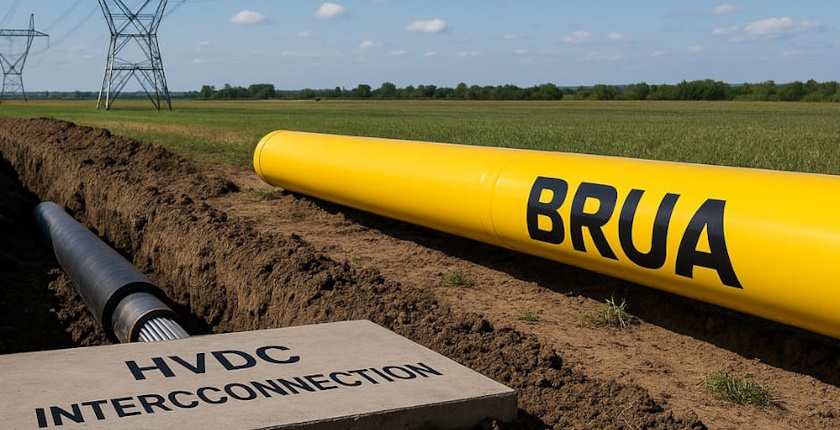
The East-West Interconnector (Est-Vest) project is entering the next phase. It is planned to run underground from the Black Sea coast to the border with Hungary. The endeavor includes utilizing existing infrastructure corridors such as the BRUA and Tuzla-Podișor gas pipelines.

It saves significant time on permits, lowers costs and reduces environmental impact, the ministry pointed out. The project partners are Romania’s transmission system operator Transelectrica, Abu Dhabi National Energy Co. (TAQA) from the United Arab Emirates, the French Meridiam and domestic company E-Infra.

Italian consultancy and engineering services provider CESI conducted the study. It launched the task in May last year.

Burduja: No time to waste in making Romania net exporter of electricity

Minister Sebastian Burduja said it is one of the most ambitious energy infrastructure projects in Central and Eastern Europe. The new study marks an essential stage in Romania’s transformation into a regional energy hub and a strategic actor in Europe’s energy security, he claimed.

“We have no time to waste. We will accelerate all the necessary steps for Romania to become a net exporter of clean energy and a pillar of stability in the region. Moreover, the project is vital for the modernization and balancing of Romania’s electricity transmission network and will ensure the evacuation of significant quantities of electricity that will be generated following the completion of Romania’s strategic investments in units 3 and 4 of the Cernavodă nuclear power plant, as well as in the offshore and onshore wind projects in the Dobruja area,” Burduja stated.

The East-West HVDC will be able to cary electricity from the Cernavodă nuclear power plant as well as from future wind projects in the east

Internationally, the project contributes to strengthening the integration of the regional and European energy market and increasing the security of supply to consumers in the southeastern part of Europe, according to the minister. It contributes to the possibilities for exporting electricity to neighboring countries, he noted.

The project is an integral part of the Green Corridor, which is supposed to connect Azerbaijan, Georgia, Romania and Hungary, as well as other countries in the region. The project includes the proposal for an HVDC cable that would run under the Black Sea.

Energy security comes first

The ministry’s objectives are a secure energy supply, at affordable prices, and for Romanians and the economy, and the energy to be green – all in the same order.

HVDC is currently the prevailing technology for long-distance power transmission. The East-West interconnector is supposed to pass through Bucharest.

The cable would allow the transmission of green energy produced in Romania – including from future offshore wind farms in the Black Sea – to domestic and consumers in other European Union member countries. It will also allow Romania to get green energy from Azerbaijan when there is a deficit in the national power system, the ministry added.