by in News

Serbia plans to stop using coal, fuel oil in district heating by 2040

By 2040, Serbia intends to replace fuel oil and coal in district heating plants with solar, wood biomass, heat pumps, municipal waste and geothermal energy.

Maja Vukadinović, acting Assistant Minister of Mining and Energy for Energy Efficiency and Climate Change, has said that the goal for the district heating sector is to phase out fuel oil and coal by 2040.

She explained that the idea is to replace fossil fuels with solar energy, wood biomass, heat pumps, municipal waste and geothermal energy.

“The list of programs and projects until 2028 is defined in the draft Program for the Implementation of the Energy Development Strategy of the Republic of Serbia until 2040 with projections to 2050, for the period from 2026 to 2028,” Vukadinović told Balkan Green Energy News.

The share of renewables should increase from 2.4% to 5.5%

According to the draft, implementation of decarbonization projects in district heating systems by 2028 should lift the share of renewable energy sources in heat production from 2.4% to 5.5%.

The fuel mix in 2023 was 75% natural gas, 8% petroleum products, 2% coal, 2% wood biomass, and 13% purchased heat. The structure of purchased heat production is 46.8% natural gas, 48.8% coal, 3.3% wood biomass, and 1.1% fuel oil.
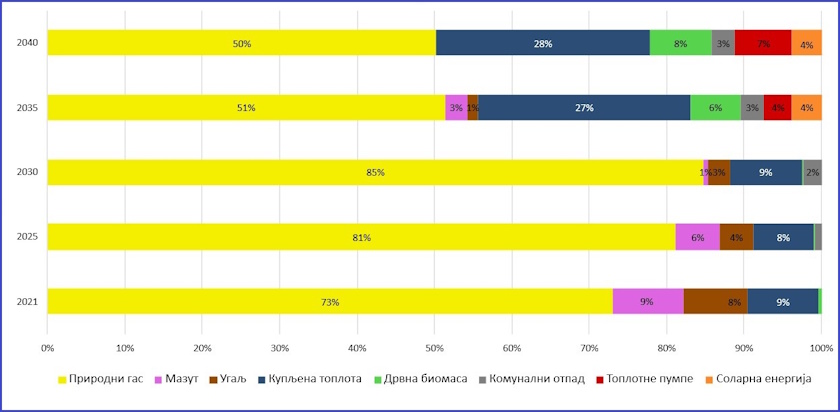
serbia decarbonization district heating mix 2040

Natural gas will remain the dominant source of thermal energy, as it is today, although its share is expected to decrease from 73% to 50% by 2040, according to Vukadinović.

The decarbonization of the district heating system would reduce air pollution in cities, especially where coal or fuel oil is currently used, the ministry added.

A strategic plan for the district heating decarbonization policy is being prepared

“It’s very important that the fuels conversion is carried out in parallel with energy renovation of buildings and a reduction of the energy consumption for heating. It would significantly improve living conditions,” Vukadinović underlined.

Decarbonization would also have to lead to the improvement of the overall operation of the heating plants, as well as a reduction in network losses, the modernization of substations, and the introduction of daily and seasonal thermal energy storage, in her opinion. The operation of the district heating systems should depend less on the price volatility of imported fuels, Vukadinović stressed.

Serbia is preparing a strategic plan for the district heating decarbonization policy. The document is under development in cooperation with the European Bank for Reconstruction and Development (EBRD) and the business association of Serbian heating plants, Toplane Srbije.

The document, she explained, will outline steps to improve the district heating system, including the rollout of thermal energy storage, heat pumps, and heat production from waste, as well as the development of the country’s first district cooling systems.
by in News

World’s largest sand battery commissioned in Finland

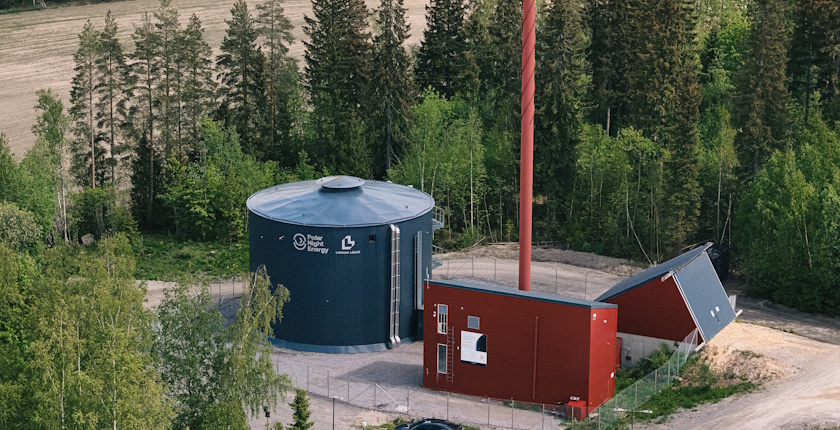
The world’s first industrial-scale sand battery has been commissioned in Pornainen, Finland. It will use surplus renewable energy to generate heat, which will then be supplied to the local district heating network.

The sand battery, which delivers one megawatt of thermal energy and has a storage capacity of 100 megawatt-hours, was installed for the district heating system in the municipality of Pornainen, operated by Loviisan Lämpö.

A sand battery is a high-temperature thermal energy storage system, first developed by the start-up Polar Night Energy.

Finding ways to store energy from variable renewable sources is one of the biggest challenges of the energy transition. In the case of the battery developed by Polar Night Energy, the storage medium is sand or alternative sand-like materials.

The battery uses renewable electricity to power a heater, which then blows hot air into the sand. The sand is heated to between 500 and 600 degrees Celsius and retains that heat. The stored energy can be used for district heating, but also for industrial processes.

A prototype of the battery was installed in 2022 at the Valkeakoski power plant in the town of Kankaanpää, Finland. The new battery in Pornainen is ten times larger than the prototype and represents the first industrial-scale implementation of this technology.

It is 13 meters high and 15 meters wide, filled with 2,000 tons of crushed soapstone, a by-product from the production of fireplaces by Finnish company Tulikivi. During winter, the battery can cover heating needs for about a week.

Emissions in the district heating sector will be reduced by 70% thanks to the battery

“The Sand Battery means a lot to Loviisan Lämpö. It allows us to drastically reduce our emissions and improve the reliability of heat production,” says Mikko Paajanen, CEO of Loviisan Lämpö.

The company aims to become climate-neutral by 2035, and the battery will help it cut emissions by 160 tons of CO₂ equivalent – a reduction of nearly 70% in the district heating sector.

Thanks to the battery, the company will stop using oil for district heating completely, while the consumption of wood chips will be reduced by about 60%. A biomass boiler will be used as a backup during periods of peak demand, the company said.

“This project is a powerful example that effective solutions for mitigating climate change do exist. Loviisan Lämpö is a great example of a company bold enough to invest in new technologies,” says Liisa Naskali, Chief Operating Officer of Polar Night Energy.

Sand battery stabilizes the power grid and contributes to the circular economy

Advancing the circular economy and energy transition requires cross-sectoral cooperation, which the sand battery clearly demonstrates. It is not just a heat storage system – it’s a tool for grid balancing, emissions reduction, smart energy management, and better resource use.

A key factor in the sand battery’s cost-effectiveness lies in optimizing its operation according to electricity prices set by Finnish grid operator Fingrid. In this way, the battery also contributes to the stability of the power grid, which is essential for the further development of wind and solar power.

Thanks to its large storage capacity, the system enables optimization of electricity use over several days, or even weeks.

The thermal storage material in sand batteries can include by-products from industrial or mining processes, avoiding the exploitation of natural resources.

Polar Night Energy is currently in talks with partners in Finland and abroad about new projects. Earlier this year, it announced a pilot project in Valkeakoski to explore the possibility of converting stored heat back into electricity.

by in News

Germany looks into underground heat storage to decarbonize heating

Germany is increasingly looking into geothermal energy storage as a way of decarbonizing its heating sector. The technology allows storing heated water in underground caverns and using it for warming homes and public and private buildings during winter, according to a report by Clean Energy Wire.

This thermal energy storage system, called Geotes, promises “the almost universal availability of cheap and practically inexhaustible storage capacities,” according to Peter Ruschhaupt from the think tank Future Cleantech Architects (FCA), German business daily Handelsblatt reported.

The process involves heating water and injecting it into underground caverns, where heat can be retained for months by the surrounding rock. The warm water can then be pumped back to the surface and used for district heating.

Heat can be retained underground for months

The cost of drilling is the main challenge in ensuring that the process is economically viable, but once the caverns are ready, the technology can be very cost effective, as heat can be stored for an entire season, according to Ruschhaupt.

Such systems already exist in northern Europe

One such research project is currently underway in former coal mines in Germany’s Ruhr valley, the daily wrote. In the Netherlands and Scandinavia, “there are already thousands of Geotes systems,” said Ruschhaupt.

According to the German geothermal association, geothermal energy could cover 40% of the country’s heating needs, Clean Energy Wire wrote, noting that Germany is seeking to phase out fossil-run heating boilers and requiring cities to prepare municipal heat plans by mid-2028 at the latest.

In Serbia, the district heating company in Novi Sad is developing a thermal energy storage project, as part of an innovative hybrid system that would combine solar collectors, seasonal thermal storage, and heat pumps. The investment is aimed at decarbonizing the Serbian city’s district heating and helping balance the power system.