by in News

BYD’s electric vehicles more popular than Tesla in Croatia

Croatian companies have applied for subsidies to buy three times more electric vehicles of Chinese manufacturer BYD than of US-based Tesla.

The situation in Croatia reflects the global market. Last year, Chinese BYD surpassed Tesla, run by Elon Musk, for the first time. It has maintained the top position in electric vehicle production so far this year as well.

The data from Croatia are based on the results of a public call for subsidies for the purchase of new alternative-fuel vehicles. The program is for legal entities and is conducted by the Environmental Protection and Energy Efficiency Fund (FZOEU).

By the end of the application deadline, co-financing was requested for 2,860 vehicles, of which 78% for passenger vehicles. The data was announced at a meeting of the Motor Vehicle Trade Association, part of the Croatian Chamber of Economy (HGK).

Applications for the purchase of 2,860 units have been submitted

Aleksandar Halavanja, head of the Department for Systematic Energy Management at FZOEU, said most applications (78%) were for passenger vehicles with up to eight seats. Applications for cargo vehicles with a maximum permissible mass of 3.5 tons are second, with 12%, while mopeds have an 8% share.

BYD ranks first among brands, with 31.9%, while Tesla accounts for 10%. They are trailed by Hyundai (5.4%), Škoda (5%), Renault (4.8%), BMW (3.6%), Opel and Volkswagen (3%), Toyota (2.8%), and Peugeot (2.4%), according to Halavanja.

The fund provides subsidies of up to EUR 9,000 apiece for passenger and light commercial vehicles, but no more than 40% of the vehicle’s price. An additional condition is that the price of the EV must not exceed EUR 50,000 excluding VAT.

Miletić: Subsidies per vehicle should be reduced

Up to EUR 90,000 is for vehicles with maximum permissible mass of 3.5 tons, but no more than 40% of the vehicle’s value. Moped buyers can receive up to EUR 2,500 each.

FZOEU plans to evaluate all applications by the end of the year. If all funds are not allocated, the remainder from the EUR 21.2 million would be switched to another round until it is exhausted.

Tomislav Miletić, President of HGK’s Motor Vehicle Trade Association, underlined that its members demanded a higher amount for the co-financing of energy-efficient vehicles.

If that is not possible, the subsidy per vehicle should be reduced so that as many interested citizens and companies as possible can get funding, he stressed.
by in News

Agios Efstratios becomes Greece’s first energy-autonomous island

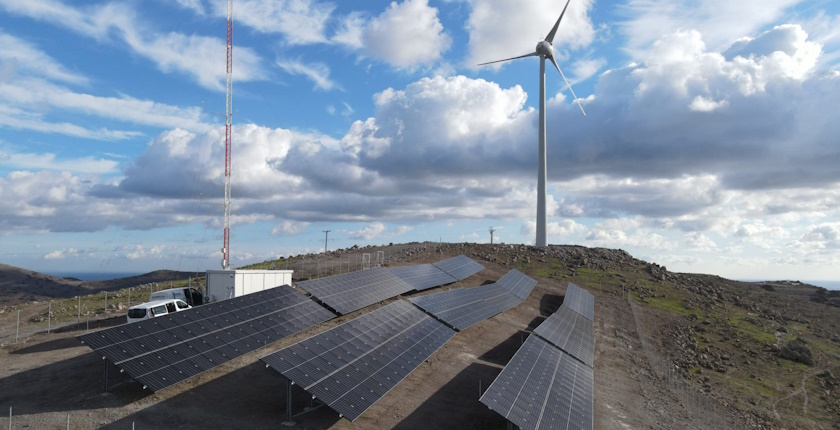
A hybrid energy project transforming Agios Efstratios into the first energy-autonomous island in Greece is in trial operation. The system consists of a wind turbine, solar power plant, batteries, electric boilers and a district heating network.

It is a benchmark for the non-interconnected islands that won’t be connected to the mainland grid with undersea power cables.

Agios Efstratios is no longer renowned only for its history and natural beauty. It is an example of energy autonomy and sustainability. The island, also known as Ai Stratis, became the first non-interconnected Greek island with a 100% electricity supply from renewables. And more.

A pioneering energy complex is in trial operation. Agios Efstratios, which has only some 250 permanent residents, is in a group of small islands undergoing transformation through projects launched at the national level and benefiting from European Union funding.

Terna Energy completed hybrid energy system in Agios Efstratios

The Centre for Renewable Energy Sources and Saving (CRES or KAPE), an independent public entity, is responsible for the endeavor, on behalf of the Municipality of Agios Efstratios. Terna Energy, owned by Masdar, is the contractor for the works in the small North Aegean island.

The new hybrid energy system includes a 900 kW Enercon E44 wind turbine and a solar power unit of 225 kW. Their combined annual output is estimated at above 3 GWh.

Excess electricity is stored. One unit is a Tesla Megapack battery energy storage system (BESS) of 1.25 MW in operating power and a two-hour duration. It means the capacity is 2.5 MWh. There is also an electric boiler facility of 1 MW with hot water storage tanks that can hold 500 cubic meters of water at 120 degrees Celsius. It corresponds to 25 MWh.

The district heating network in Agios Efstratios is four kilometers long. It will be tested in the winter.

An oil-fired generator operated by state-controlled Public Power Corp. (PPC) remains as backup. It can work alongside the hybrid power plant.

Greece is connecting many islands to mainland power grid

The solutions from Agios Efstratios can be applied in other islands or in microgrids, CRES noted and said residents are getting cheaper energy.

The government launched its Islands Decarbonization Fund last year, with financing from the European Investment Bank (EIB). Together they aim to provide at least EUR 1.6 billion, and mobilize total investments of EUR 3 billion to EUR 5 billion.

In the hot summer months, there are many non-interconnected islands that can’t meet their power demand, especially because of the tourist season. Some are also struggling with water supply, prompting the need for desalination, which requires electricity. They rely on fuel oil generators.

The country’s Independent Power Transmission Operator (IPTO or, in Greek, Admie) is investing in major interconnection projects. A link to the mainland grid has improved the living conditions in the Cyclades islands of Syros, Paros and Mykonos. Together with a project for the western part of the archipelago, the transmission system operator is planning subsea cables to the Dodecanese and the Northeast Aegean.