by in News

Slovenia and Italy to upgrade electricity interconnectors

Slovenian transmission and distribution system operator ELES and Italian transmission system operator Terna agreed to upgrade their cross-border electricity network in an investment of EUR 250 million. The project aims to increase the transmission capacity between the two countries by 600 MW, strengthening supply and trade.

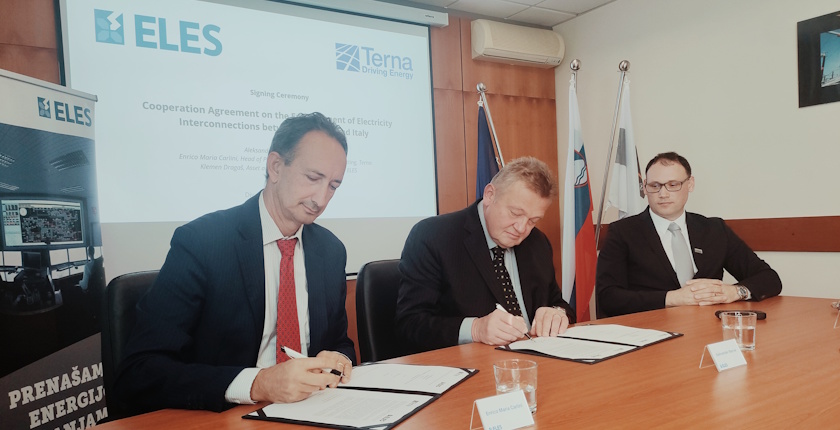
After a decade of coordination, ELES and Terna signed an agreement to raise the electricity transmission capacity between Slovenia and Italy by 600 MW or more than 50%. According to ELES, it is an important step in market integration and strengthening the reliability of the interconnected electricity system.

Interconnections between Slovenia and Italy are currently among the most heavily loaded ones in the Slovenian network, the country’s TSO pointed out.

As ELES further explained, with the growth of electricity imports and exports, there is an increasing need to strengthen transmission routes between the two countries. The company expects a rise in electricity imports in the countries gradually phasing out fossil fuel–based production to further increase the demand for cross-border transmission capacity.

The project consists of three upgrades

The project includes three main improvements. On the Slovenian side, the phase-shifting transformer at the Divača substation would be upgraded, alongside adding a third unit, which enables full utilization of the capacity of the 400 kV transmission line between Divača and Redipuglia (Sredipolje). The current transmission capacity, 1,200 megavolt-amperes (MVA), would be lifted to 1,800 MVA.

On the 220 kV transmission line between Divača and Padrice in Italy, low-sag conductors, capable of withstanding higher temperatures will be installed, ELES said. The transmission capacity would be doubled to 700 MVA.

On the Italian side, the existing 220 kV Padriče-Redipuglia connection and the Redipuglia substation are to be upgraded with a new phase-shifting transformer. It is crucial for managing internal power flows, the update reads.

“With an additional 600 MW of cross-border capacity, Slovenia is solidifying its role as a key electricity hub between Central and Southern Europe and as a reliable regional partner. This is a strategic investment in the future, ensuring reliability, resilience, and connectivity of our grid in the decades when electricity will become the main energy currency,” said ELES CEO Aleksander Mervar.

Slovenia’s share of the project is estimated at EUR 90 million

The total value of the project is EUR 250 million, with the Slovenian share estimated at EUR 90 million and the Italian side securing EUR 160 million. Pending all necessary permits and documentation, construction is planned to begin in 2029, and completion is expected by the end of 2031.

ELES announced it would seek European funds to finance the Slovenian side of the investment.

“The agreement not only strengthens the historic partnership between the two transmission system operators but also marks an important step toward developing and implementing innovative solutions that enhance the efficiency of transmission network investments. The agreement encourages system operators to introduce not only capital-intensive projects but also solutions with lower capital requirements that can increase net benefits and investment returns for all electricity system users,” said Enrico Maria Carlini, Head of Power System Planning and Permitting at Terna.
by in News

Montenegro, Italy sign memorandum on electricity market coupling

A memorandum of understanding on Italy and Montenegro’s electricity market coupling was signed in Rome. It also paves the way for the installation of the second cable of the Monita interconnector, which runs under the Adriatic Sea.

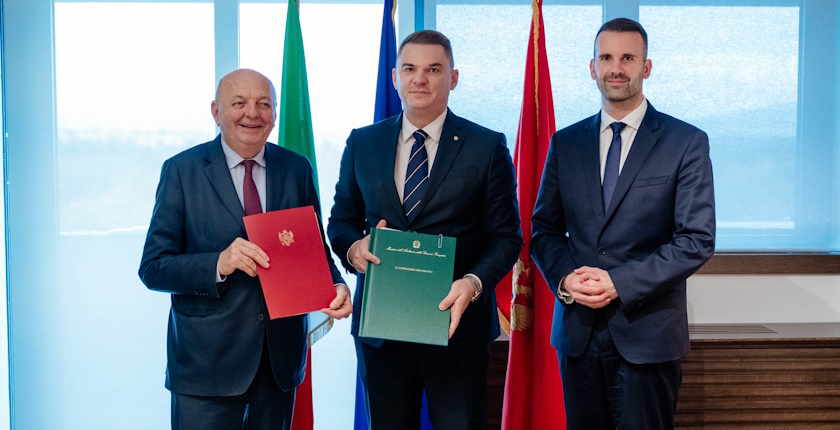
Minister of Energy and Mining of Montenegro Admir Šahmanović (pictured middle) and Italian Minister of the Environment and Energy Security Gilberto Pichetto Fratin (left) pointed out that energy links mean a more secure future, more stable supply and more development possibilities. They signed a bilateral memorandum of understanding on electricity market coupling.

Montenegrin Prime Minister Milojko Spajić (right) attended the ceremony together with Minister of Public Works, Spatial Planning and State Property Majda Adžović. The agreement is opening a new chapter in cooperation between the two countries and further strengthens Montenegro’s position on the European energy map, the Ministry of Energy and Mining said.

Market coupling alongside strengthening interconnection with second cable

Montenegro and Italy are linked with the Monita electricity interconnector, laid below the Adriatic Sea. In the new phase of their cooperation, they intend to couple their electricity markets for a freer power flow and safer functioning of the system, the ministry’s announcement reads.

“With this agreement, Montenegro is confirming its status as a reliable partner and energy bridge between the region and Europe. After several years of stagnation, this is a bit step forward, as it enables us to initiate the continuation of the project and the construction of the second wire of the subsea cable toward Italy. It opens the possibilities for our green, clean energy to become a distinguished export product, which means new income for companies and greater competitiveness in the European market. Today we once again confirmed good neighborly relations with Italy and we are showing that Montenegro is, slowly but firmly, entering the European family through concrete projects and partnerships. This is a step that brings our citizens long-term energy security and new opportunities for development to our companies,” Šahmanović stated.

Trade at Montenegro’s wholesale electricity market is expected to triple

There are 29 companies from 13 countries participating in Montenegro’s electricity market. Since the day-ahead market was established at the Montenegrin Power Exchange (MEPX or Belen) in April 2023, some 900 GWh of electricity changed hands, while the entire volume, together with the long-term market, amounts to about 3 TWh, the statement adds.

The memorandum’s implementation will create the conditions for at least three times higher trading volume, clearer price signal for new investments and a direct contribution to improving the security of supply, the ministry claimed.

National transmission system operators (TSOs) Terna and CGES have commissioned the first part of the interconnection in 2019. The current plan is to double the capacity to 1.2 GW. Šahmanović recently said the second line should be installed by 2031.

The project is valued at EUR 500 million. A double cable enables a two-way exchange at the same time.

by in News

Race against time to secure EU funding for waste-to-energy plants in Greece

Hostile reactions from citizens and the opposition by municipal authorities threaten to derail Greece’s efforts to build six waste-to-energy plants. Moreover, time is running out to secure EUR 800 million in European funding.

The Ministry of Environment and Energy is expected to publish a call for waste-to-energy projects planned in Attica, Western Macedonia, Rodopi, Peloponnese, Boeotia (Viotia) and Crete. Total investment would amount to EUR 1 billion, for 1.19 million tons in capacity. However, time is running out to secure EUR 800 million in European funding set aside for them and the accompanying recycling plants.

Greece has been warned several times by the European Commission and fined for failing to fulfil its obligations in waste management. The country still relies mostly on landfills to handle municipal waste, instead of modern solutions. Ideally, useful materials should be sorted for recycling before the waste gets burned in incinerators to produce energy.

Two of the proposed units, the ones in Rodopi and Western Macedonia, are expected to provide district heating. The Ptolemaida 5 lignite-fired plant supplies district heating in the coal region of Western Macedonia in the country’s north, but it is scheduled to be decommissioned by 2028 at the latest.

Its owner, Public Power Corporation (PPC or DEI) aims to complete a waste-to-energy plant by then. Other prospective investors include GEK Terna, Metlen, Aktor and Motor Oil Hellas, all big players in the country’s energy market.

High fees and pollution worry municipalities

Many local authorities have expressed their objections to hosting these plants, fearing a rise in municipal fees and pollution. A discussion is underway in numerous municipal councils. They could lodge appeals to the Supreme Court and delay the process.

Amanatidis: Cancel all waste-to-energy plans

The regional council of Western Macedonia recently voted overwhelmingly to reject the plan for PPC’s planned unit from the ministry’s strategic environmental assessment (SEA). Governor Giorgos Amanatidis called on the government to withdraw the study and cancel the project. Municipalities in the same region and other institutions are also against an incinerator.

European funding through the National Strategic Reference Framework (NSRF) ends in 2027. The government and investors have until mid-2026 for implementation, Newmoney reported, adding that waste-to-energy projects take two to three years to complete.

Recently, another initiative, the Apollo program, for investments in renewable energy to lower energy costs for vulnerable consumers, lost EUR 100 million from the EU’s Recovery and Resilience Facility (RRF).

by in News

Greece plans six waste-to-energy plants, set to meet EU landfilling limits

Large Greek companies, interested in the construction and operation of waste incinerators producing electricity and heat, are waiting for the government to complete the legal framework and launch tenders. Without the six planned facilities and accompanying infrastructure, the country would substantially lag behind the European Union’s targets for lowering the share of landfilled material.

Greece is transforming its waste management sector – dozens of units mechanically treating the material to feed six incinerators, covering all the regions. The Ministry of Environment and Energy is about to complete a strategic environmental assessment (SEA), after which its plan is to adopt a legal framework, before the end of the year.

Following a public consultation process, the general parameters would be determined including the details of a tender for the waste-to-energy plants. They are valued at EUR 1 billion in total. State-controlled Public Power Corp. (PPC or, in Greek, DEI) has expressed interest in entering the sector, alongside the conglomerates GEK Terna and Metlen, construction company Aktor, oil refinery operator Motor Oil and water, wastewater and waste processing operator Mesogeos.

The ministry intends to complete the competitive process in 2026, followed by a three-year construction period. The Greek media learned that public-private partnership is a favorable model for the investments.

At least two of six plants would provide district heating

In the central scenario, an incinerator in the Rhodope area would serve the wider region of East Macedonia and Thrace. One would be in Kozani, a coal region, for Central and Western Macedonia, Epirus, Thessaly and Corfu.

The government envisaged a unit in the Peloponnese to cover Western Greece, the Peloponnese peninsula itself and the Ionian Sea, excluding Corfu. One waste-to-energy plant is planned in Boeotia (Viotia), covering parts of Central Greece and the western part of Attica.

The waste incinerator in Kozani is likely to be built in the vicinity of Ptolemaida 5, Greece’s last coal power plant

In the same peninsula, where Athens is situated, a unit would also get shipments of waste from the north Aegean islands, one section of the Cyclades archipelago and the Dodecanese. An incineration plant in Heraklion (Iraklio) would be for Crete, Santorini, Karpathos and Rhodes.

The combined annual capacity of the six units is projected at 1.19 million tons. The largest ones are the Attica project (356,000 tons) and the Kozani plant (288,000 tons). The latter, which would probably be located near PPC’s Ptolemaida 5 coal power plant, is also seen providing up to 40% of the district heating needs in the area. The investment is valued at EUR 300 million.

Ptolemaida 5 is scheduled to be closed at the end of next year, marking the completion of Greece’s coal phaseout. The waste incinerator in Boeotia would provide district heating as well, the plan reads.

System for energy recovery clings on construction of mechanical treatment units, waste separation

On the logistics side, there are 13 waste treatment units in operation in Greece and 25 are under construction. The ministry expects all units to be complete by 2029, to feed the incinerators.

The capacity amounts to 1.45 million tons per year altogether, of which 651,000 tons of waste would be processed into solid recovered fuel (SRF), which is of higher quality. The energy-intensive industry would absorb 150,000 tons. The development of the treatment system requires substantial infrastructure including the selection of municipal waste selection at the source.

Up to 651,000 tons of SRF is expected to be produced per year in the waste treatment facilities

The estimated electricity production from 1.19 million tons of waste is 1.03 TWh, equivalent to 2% of the country’s total consumption. Notably, 57.5% of the projected output is considered renewable energy, in line with the portion of biodegradable waste.

In the study, the options to deploy pyrolysis or gasification technologies were rejected. The authors argued they are not viable in Europe. It left incineration as the only option to recover energy from waste.

If the incinerators aren’t built, but the energy-intensive industry receives the same amount of SRF, 22.7% of waste would be landfilled in 2030, projections showed. The European Union’s target is 10%. The share of landfilled waste rises to 29.2% in the same scenario.

by in News

Works beginning on North Macedonian side of gas interconnector with Greece

The North Macedonian section of the gas interconnector with Greece is expected to be completed by early 2027. The construction contract was signed by the Ministry of Energy, Mining and Mineral Resources, domestic contractor Rapid Build and the country’s gas transmission system operator Nomagas.

The construction of the gas pipeline connecting North Macedonia with Greece is set to begin in a month, according to officials. Land expropriation is 90% complete. The initial capacity of the interconnector would be 1.5 billion cubic meters per year, with a potential to double it. The works are expected to be completed within 22 months.

„With the signing of the contract for the construction of the Macedonian section of the gas interconnector with Greece, we are marking the beginning of the largest energy investment in North Macedonia in the last ten years. The interconnector is proof that when there is political will, regional trust, and professional dedication – the results are real and tangible,” said Minister of Energy, Mining and Mineral Resources Sanja Božinovska.

The contract was signed by the ministry, contractor Rapid bild, based in Kumanovo in North Macedonia, and the country’s gas transmission system operator Nomagas. The future pipeline would be able to carry both natural gas and hydrogen.

Repeated tender slashes price by EUR 12 million

The winning bid was EUR 59.9 million or EUR 12 million less than in the initial tender, which was annulled.

The project is worth over MKD 5.1 billion (EUR 82.9 million). It is financed by the European Investment Bank (EIB) and the European Bank for Reconstruction and Development (EBRD). It includes grants of EUR 2.5 million for technical assistance and another EUR 9.9 million via the Western Balkans Investment Framework (WBIF).

The project is financed by the EIB and EBRD

„This contract ensures diversification and access to a greater number of natural gas sources, enables economic development, progress and environmental protection, and contributes to the security of energy supply,” said Executive Director of Nomagas Muhamet Elmazi.

Gasification would significantly improve air quality, especially in areas where wood and fuel oil are currently used for heating.

Greek section of interconnector under construction since February

On the North Macedonian side, the interconnector route is 68 kilometers long, out of a total of 123 kilometers. It will run from Nea Mesimvria in Greece through Evzoni (Mačukovo) and Gevgelija at the border, to Negotino. The next phase involves building gas links from Gostivar to Kičevo (34 kilometers) and from Sveti Nikole to Veles (28 kilometers).

Greek company Terna began constructing its country’s section of the pipeline in February.

Nomagas and Greece’s National Natural Gas System Operator (DESFA) made their final investment decision a year and a half ago.

The companies leaned the investment on the project for the Alexandroupolis LNG Terminal. The liquefied natural gas facility in northeastern Greece was opened on October 1. However, due to a malfunction, it has been out of operation for more than three months. According to the latest update, gradual reactivation is expected to begin by the end of May.

by in News

Construction starting in second phase of giant PV plant in Peloponnese coal land

Terna won the contract for the construction of the second of the three parts of a 490 MW solar park in Megalopolis, on former lignite mines. Public Power Corp. – PPC Group said the third phase would begin next year.

The second phase of the construction of a 490 MW photovoltaic plant in Megalopolis is beginning, transforming former lignite sites in the Peloponnese peninsula into a green energy hub. PPC Group’s subsidiary PPC Renewables signed an engineering, procurement and construction (EPC) contract for 125 MW on 49.4 hectares with Terna, part of the GEK Terna conglomerate.

The first phase, 125 MW, is under construction. PPC intends to complete it by the end of the year. It expects to begin building the third phase, 240 MW, in 2026.

Bifacial panels to be on fixed structures

The second part entails 215,000 bifacial solar panels on fixed structures. The facility would be connected to the Megalopoli Ultra High Voltage Substation via a new high voltage substation at the Neo Choremi site.

The entire 490 MW would generate an estimate 860 GWh per year, the announcement reads. It is equivalent to the electricity needs of 215,000 households. The projected output would prevent carbon dioxide emissions of 430,000 tons per year.

PPC already has a 50 MW photovoltaic plant in Megalopolis, the smaller of the two coal regions in Greece.

Replicating solar makeover from Western Macedonia

Deputy Chief Executive Officer of PPC Group and CEO of PPC Renewables Konstantinos Mavros compared the project in the Peloponnese to the ones in coal land in Western Macedonia in the country’s north. Just like in Ptolemaida, the Megalopoli photovoltaic plant is going to replace the the production of electricity from coal and ensure the historic continuity of the area’s role in energy supply, he pointed out.

The utility’s three-year strategic plan for the period through 2027 is to install 5.6 GW more from renewables in Greece and Southeastern Europe, reaching 11.8 GW in the segment. PPC said it is also looking to expand its portfolio with new technologies such as offshore wind power and floating photovoltaics, also known as floatovoltaics.

by in News

Second HVDC link from mainland Greece to Crete coming online

Greece’s Independent Power Transmission Operator (IPTO) is completing the last elements of the Ariadne Interconnection project, one of the deepest subsea links in the world. The company plans to switch on the double high-voltage direct current (HVDC) cable between Attica and Crete by the end of the month. In addition, IPTO and its Italian counterpart Terna are developing a project for a second interconnector between them.

Final tests and equipment checks are being completed at the Damasta Converter Station in Heraklion ahead of the start of the trial operation of the Crete-Attica electricity link. The management of IPTO, also known by its Greek acronym Admie, and the HDVC Ariadne Interconnection project firm inspected the site.

The transmission system operator said it plans to energize it this week by injecting reactive power into the electricity system in the country’s biggest island.

The transmission of active power from Attica to Crete is set to begin in late May, the update adds. Ariadne consists of two 500 kV cables of  500 MW each. One end is in Pachi in the city of Megara, between Athens and Corinth, and the other one in Korakia in Crete. The submarine and underground cables were tested earlier.

Line on mainland is under trial electrification

At the same time, on the Attica side, a trial electrification of a 400 kV cable system is taking place between the Koumoundouros Converter Station and the adjacent Extra High Voltage Center. Ariadne Interconnection is the largest and most complex electricity transmission project in Greece so far, IPTO underscored.

Furthermore, a 150 kV transmission line between Chania and Damasta recently received the decision on the approval of environmental conditions (AEPO), the company added. It is considered necessary for an optimal combined use of Crete’s two interconnections with the mainland, the announcement reads. The first one, from Peloponnese, was established in 2021.

Ariadne, worth more than EUR 1.1 billion, is one of the three deepest interconnections in the world. The HVDC line’s capacity matches the interconnector to Sardinia, the strongest power link so far with an island.

The project is co-financed through the National Strategic Reference Framework (NSRF 2014-2020 and NSRF 2021-2027), via the European Union, with up to EUR 535.5 million. The idea for the endeavor dates back to the 1990s.

The contractors are Nexans and Prysmian. Each was responsible for one of the two cables while the latter also laid two submarine telecommunication lines.

Erdoğan again taunts Great Sea Interconnector by promising alternative cable

Ariadne is part of a proposed corridor with the Great Sea Interconnector project, formerly EuroAsia Interconnector, envisaged going to Cyprus and Israel. The Crete-Cyprus investment has been suffering heavy delays amid financing issues, ownership disputes and Turkey’s threats.

In early May, President Recep Tayyip Erdoğan visited the Cypriot Turkish breakaway republic, recognized only by Turkey, and promised an interconnection with his country. He compared it to an existing water pipeline.

“Did we bring water from under the sea to Northern Cyprus from Turkey? Now we are in the second stage. God willing, we will bring electricity and with that we will cover the needs of Northern Cyprus in water and electricity,” Erdoğan stated.

Notably, IPTO denied yesterday a press report that it is considering the possibility, together with Nexans, the contractor, to alter the route and connect Crete with the Dodecanese Islands instead of with Cyprus. The archipelago includes Rhodes, Astypalaia (Astypalea), Kos and Tilos.

EBRD is providing a grant for the first studies for an interconnection between Greece and Egypt

In other news, the European Bank for Reconstruction and Development (EBRD) and Elica Interconnector, a member of the Copelouzos Group, signed a grant agreement for the first studies for the planned Egypt-Greece (GREGY) electricity interconnection.

IPTO and its Italian counterpart Terna signed today a memorandum of understanding to install a second undersea HDVC power line. The GR.ITA 2 project is for a double cable, two times 500 MW, scheduled for completion in 2031. The two sides earmarked a total of EUR 1.9 billion.

The existing 500 MW interconnector, in operation since 2002, is temporarily down due to a malfunction.

by in News

Greece’s DEPA Commercial picks contractors for PV plants of 500 MW

Construction companies Terna and Aktor are about to start building a solar power plant of 400 MW in northern Greece and another 100 MW near Larissa, for state-owned DEPA Commercial, according to a new report. In its switch toward cleaner sources, the gas holding has also finished the construction of its biomethane plant.

Greek state-controlled gas supplier, importer and trader DEPA Commercial has completed the tenders for photovoltaic parks of 500 MW overall, OT learned. The 400 MW facility in Kozani in the Western Macedonia province would currently be the largest in the country.

However, Lightsource bp, owned by BP, started the construction of a 560 MW solar park last summer in Central Greece and Thessaly. State-controlled Public Power Corp. (PPC or DEI) is about to finish a 550 MW photovoltaic facility in Ptolemaida, near Kozani.

DEPA Commercial is also known as DEPA Emporias (in Greek), DEPA Commerce and DEPA Trading. Both for the giant PV plant in northern Greece and another 100 MW in Farsala, Larissa, it selected the consortium of Terna, part of the GEK Terna conglomerate, and Ellaktor’s Aktor.

The turnkey deals are worth EUR 270 million in total

The turnkey agreements are worth a combined EUR 270 million. The company obtained a EUR 390 million loan in July from the European Investment Bank (EIB) for its photovoltaic projects. The portfolio amounted to 816 MW.

The projects, which are at various stages of maturity, are conducted under subsidiaries North Solar, North Solar 1 and New Spes Concept.

DEPA Commercial’s new move comes after the government bought a 35% stake from Helleniq Energy. The company is now fully owned by the Hellenic Republic Asset Development Fund (HRADF or TAIPED). The transaction was completed at the turn of the year, when the vehicle also integrated the so-called Superfund.

DEPA Commercial starts producing biomethane for its fuel stations

Within its energy transition efforts, the gas giant is entering biomethane production as well. DEPA Commercial said early this month that it produced Greece’s first quantities of the fuel.

The new pilot unit, Farma Hitas (Chitas) in Filippiada in the country’s west, makes 97% pure methane and compresses it. The bio-CNG goes to the company’s Fisikon gas stations, where it is mixed with natural (fossil) gas and sold as vehicle fuel.

Ownership stakes in Alexandroupolis gas complex, IGB pipeline

As for its conventional business operations, DEPA Commercial holds a 29% stake in special purpose firm Ilektroparagogi Alexandroupolis (Alexandroupolis Electricity Production). PPC is the majority partner, with 71%.

They are building a combined-cycle gas turbine (CCGT) of 840 MW. In addition, DEPA Commercial owns 20% of the Alexandroupolis LNG Terminal and 25% of ICGB, which operates the Interconnector Greece-Bulgaria (IGB) gas pipeline.

The company is participating in the Fier Thermoelectric project for a 174 MW gas power plant in Albania. DEPA Commercial intends to supply some of the renewable electricity that it generates to its wholly-owned subsidiary Fysiko Aerio – Hellenic Energy Co. The gas and electricity distributor has more than 530,000 customers.

Notably, DEPA Commercial already owns an aggregator license – FOSE, allowing it to trade in the wholesale power market on behalf of a group of producers.

by in News

Terna Energy to build solar power plant of 130 MW in Bulgaria

Terna Energy is developing a project for a 130 MW photovoltaic plant near Burgas in Bulgaria. The company, owned by Masdar, plans to connect it to the grid already by the end of next year. Recently it also reached landmark points in the development of wind power projects in Greece.

Abu Dhabi Future Energy Co. (Masdar), which has high ambitions for its expansion in Southeastern Europe, relies to a great extent on its recently acquired subsidiary Terna Energy. The Greek company revealed that it is preparing to install a 130 MW solar park near the village of Vratitsa in eastern Bulgaria.

The project in the municipality of Kameno in Burgas province includes design and procurement, as well as grid connection works including a new 33/110 kV substation. Terna Energy Group said it is targeting completion by the end of 2026.

As part of the strategic cooperation with the former parent company, GEK Terna, its construction arm Terna SA was selected as the contractor, the announcement reads.

Terna Energy operates two wind farms in Bulgaria, with 30 MW in overall capacity.

With its recent share purchases, Masdar boosted its stake in the Greek company to 97.6% from 87.9%. The green energy giant based in the United Arab Emirates acquired Terna Energy last year.

Wind power projects in Evia progressing

In other recent news, Terna Energy received operating licenses for four projects for a wind power complex. The sites are in Karystos in Greece’s second largest island – Evia, also known as Euboea. It is one of the country’s wind power hubs and an important area for the company.

The Terna Energy Omalies subsidiary is responsible for the said investments, of 78 MW in total. They are part of an endeavor consisting of 11 wind farms.

The location for the biggest of the four, at 36 MW and with 12 turbines, is called Praro. The company ordered 3 MW machines from Enercon for all the sites. Molizeza 1 and Kalamaki 2 are for 18 MW each, and Kalamaki would have 6 MW.

Joint venture with MORE for Greece’s first offshore wind farm

Of note, the construction of wind parks in the Balkans has mostly slowed down. Moreover, Bulgaria has been at a standstill since the first wave of investments died down more than a decade ago, while Romania is struggling to pick up pace. Greece added only 125 MW last year.

Terna Energy is counting on opportunities in the offshore wind domain. In January, it joined forces with Greek refiner Motor Oil in the pilot project for the country’s first facility of the kind.

Motor Oil Renewable Energy (MORE) now holds 50% of joint venture Aioliki Provata Traianoupoleos. The project firm is tasked with developing a 400 MW offshore wind power plant on the Ionnian Sea between Alexandroupolis and the island of Samothrace. The two companies aim to complete it by the end of the decade.

by in News

Greek companies expand to Bulgaria with solar power investments

Greece’s government-controlled power utility PPC and Masdar’s subsidiary Terna Energy are separately building two photovoltaic plants in Bulgaria, worth an estimated EUR 190 million in total.

The biggest two renewable energy companies in Greece have taken over one major project each in neighboring Bulgaria, where domestic investors dominated the photovoltaics market until recently. Soon after government-controlled Public Power Corp. (PPC) said it began building a 165 MW solar power plant with batteries, Capital reported that Terna Energy plans to complete a 130 MW project by the end of next year.

The segment appears saturated, given the lack of energy storage capacities in Bulgaria to balance high PV output at times of abundant sunshine. Permits that the Sustainable Energy Development Agency (SEDA) issued show 4 GW in overall installed solar power capacity. Nevertheless, Executive Director of Electricity System Operator (ESO) Angelin Tsachev estimated there is as much as 5 GW, the media outlet noted.

In its annual statistics update, the International Renewable Energy Agency (IRENA) said Bulgaria hosted 3.9 GW of PV capacity at the end of 2024.

Terna Energy bought out initial developer one year ago

Terna Energy became a subsidiary of Abu Dhabi Future Energy Co. (Masdar) last year. The Greek company entered the ownership of the project firm Bio PD Solar Energy for the 130 MW facility three years ago with a 25% stake.

In mid-2024, Terna Energy Overseas Ltd., registered in Cyprus, became the sole owner. It invested some EUR 25 million and bought out Helios Construction Project. According to the article, the previous parent company is associated with businessman Ahmed Dogan. He was the founder and long-time leader of the Movement for Rights and Freedoms party, representing Muslim minorities.

Both projects are on municipal land

The project spanning more than 200 hectares was initially planned at 180 MW. The lot is on municipal land in Kameno in eastern Bulgaria.

According to the news website, the investment amounts to EUR 92 million. The location near the village of Vratitsa isn’t subject to an environmental impact assessment study except for the intended construction of a 33/110 kV substation.

Terna Energy said its former affiliate Terna, part of the GEK Terna conglomerate, is building the solar power plant in Burgas province.

New hybrid power plant in Bulgaria is part of PPC’s regional expansion

PPC is building its PV plant in the Chirpan municipality in Stara Zagora province. Having included a battery energy storage system in the project, and given the power links with its assets in Romania and Greece, the company is counting on a strategic advantage in the market with the new hybrid facility. PPC is pursuing major expansion in the region, including Italy.

The investment is valued at EUR 97 million, of which the energy storage segment accounts for EUR 10.2 million to EUR 12.8 million, the article adds.

The Colosseum site consists of 11 municipal properties formerly designated as agricultural land, on 200 hectares altogether. PPC bought the project from Enery. The company is headquartered in Austria and active in the renewables sector in Romania as well.