by in News

Greece’s IPTO mulls capital increase with existing shareholders

Greece’s Ministry of Environment and Energy is reportedly nearing a final decision regarding a capital increase for Independent Power Transmission Operator. The state-controlled transmission system operator (TSO) needs EUR 1.1 billion to continue its investment projects. The government is said to be in favor of existing shareholders providing the funds. There were rumors earlier that the government was going to sell a stake, where it would become a minority co-owner but remain in the driver’s seat, like it did before with Public Power Corp.

Independent Power Transmission Operator (IPTO) needs a capital injection of some EUR 1.1 billion to keep the ten-year core growth plan worth EUR 7.8 billion on track, according to Greek media reports. The government holds a 51% stake through two entities, and the only other major shareholder is State Grid Corp. of China. It acquired 24% in 2017.

The company, also known for its Greek acronym Admie, is said to require an urgent capital increase as it can’t get loans anymore. The last one amounted to EUR 300 million, from the National Bank of Greece.

Greece aiming to keep 51% stake amid geopolitical uncertainty

Energypress learned, citing unnamed sources in the Ministry of Environment and Energy, that the government is about to make a decision. The latest unofficial information was that, due to unprecedented geopolitical uncertainty, Greece wants to keep its majority stake and raise the capital in tandem with other existing shareholders.

China’s State Grid holds 24% of IPTO since 2017

Earlier reports have indicated that the government was considering a sale of a stake and a stock market listing. It would keep some 34%, allowing it to continue running the Independent Power Transmission Operator, like it did in 2021 with Public Power Corp. – PPC Group.

Major tender already underway for Dodecanese Interconnection

Most of the capital expenditure through 2034 is scheduled for before the end of the decade, EUR 6.5 billion. The biggest projects on the current ten-year list, updated in September, are the Dodecanese Interconnection, North Aegean Interconnection and the one for the second line to Italy. They amount to EUR 5.2 billion in total. All three are for submarine cables.

Last month the TSO published a tender for a bidirectional undersea link between the mainland grid, in Corinth, and the Dodecanese island of Kos. The cable system would be 1,290 kilometers long and have 1 GW in total transmission capacity. The budget is EUR 1.35 billion.

Notably, the company froze another major tender last year after receiving the bids in April.

Interconnections with Egypt and Saudi Arabia are planned in the longer term. The Crete-Cyprus link, part of the Great Sea Interconnector endeavor, is also separate.

BlackRock, Meridiam, Fortress, Fidelity, KKR and Abu Dhabi National Energy Co. (TAQA) were rumored to have expressed interest in entering ownership, among others.
by in News

Greece’s IPTO mulls capital increase with existing shareholders

Greece’s Ministry of Environment and Energy is reportedly nearing a final decision regarding a capital increase for Independent Power Transmission Operator. The state-controlled transmission system operator (TSO) needs EUR 1.1 billion to continue its investment projects. The government is said to be in favor of existing shareholders providing the funds. There were rumors earlier that the government was going to sell a stake, where it would become a minority co-owner but remain in the driver’s seat, like it did before with Public Power Corp.

Independent Power Transmission Operator (IPTO) needs a capital injection of some EUR 1.1 billion to keep the ten-year core growth plan worth EUR 7.8 billion on track, according to Greek media reports. The government holds a 51% stake through two entities, and the only other major shareholder is State Grid Corp. of China. It acquired 24% in 2017.

The company, also known for its Greek acronym Admie, is said to require an urgent capital increase as it can’t get loans anymore. The last one amounted to EUR 300 million, from the National Bank of Greece.

Greece aiming to keep 51% stake amid geopolitical uncertainty

Energypress learned, citing unnamed sources in the Ministry of Environment and Energy, that the government is about to make a decision. The latest unofficial information was that, due to unprecedented geopolitical uncertainty, Greece wants to keep its majority stake and raise the capital in tandem with other existing shareholders.

China’s State Grid holds 24% of IPTO since 2017

Earlier reports have indicated that the government was considering a sale of a stake and a stock market listing. It would keep some 34%, allowing it to continue running the Independent Power Transmission Operator, like it did in 2021 with Public Power Corp. – PPC Group.

Major tender already underway for Dodecanese Interconnection

Most of the capital expenditure through 2034 is scheduled for before the end of the decade, EUR 6.5 billion. The biggest projects on the current ten-year list, updated in September, are the Dodecanese Interconnection, North Aegean Interconnection and the one for the second line to Italy. They amount to EUR 5.2 billion in total. All three are for submarine cables.

Last month the TSO published a tender for a bidirectional undersea link between the mainland grid, in Corinth, and the Dodecanese island of Kos. The cable system would be 1,290 kilometers long and have 1 GW in total transmission capacity. The budget is EUR 1.35 billion.

Notably, the company froze another major tender last year after receiving the bids in April.

Interconnections with Egypt and Saudi Arabia are planned in the longer term. The Crete-Cyprus link, part of the Great Sea Interconnector endeavor, is also separate.

BlackRock, Meridiam, Fortress, Fidelity, KKR and Abu Dhabi National Energy Co. (TAQA) were rumored to have expressed interest in entering ownership, among others.

by in News

Feasibility study complete for Romania’s East-West underground high-voltage line

A project for underground high-voltage power link East-West across Romania entered a new phase with the completion of the feasibility study. It would run alongside existing energy infrastructure.

A year and a half after Minister of Energy Sebastian Burduja declared the project for a high voltage direct current (HVDC) line across Romania “the number one priority,” the feasibility study is complete. Notably, he estimated at the time that it would be done within six months and that the interconnection had to be installed by 2029.

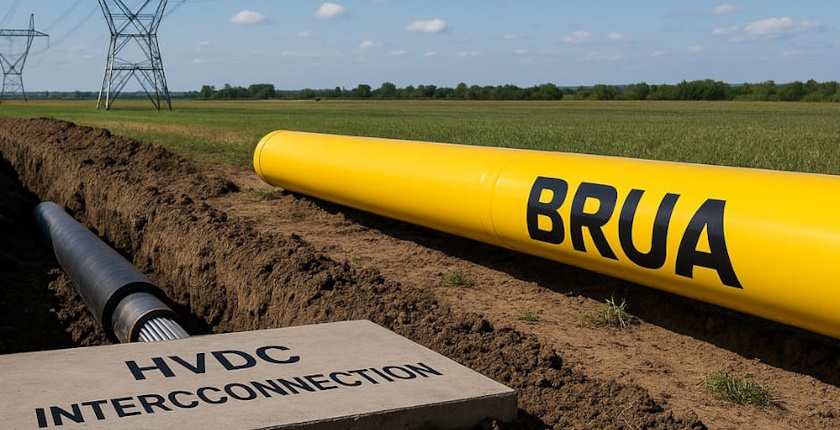
The East-West Interconnector (Est-Vest) project is entering the next phase. It is planned to run underground from the Black Sea coast to the border with Hungary. The endeavor includes utilizing existing infrastructure corridors such as the BRUA and Tuzla-Podișor gas pipelines.

It saves significant time on permits, lowers costs and reduces environmental impact, the ministry pointed out. The project partners are Romania’s transmission system operator Transelectrica, Abu Dhabi National Energy Co. (TAQA) from the United Arab Emirates, the French Meridiam and domestic company E-Infra.

Italian consultancy and engineering services provider CESI conducted the study. It launched the task in May last year.

Burduja: No time to waste in making Romania net exporter of electricity

Minister Sebastian Burduja said it is one of the most ambitious energy infrastructure projects in Central and Eastern Europe. The new study marks an essential stage in Romania’s transformation into a regional energy hub and a strategic actor in Europe’s energy security, he claimed.

“We have no time to waste. We will accelerate all the necessary steps for Romania to become a net exporter of clean energy and a pillar of stability in the region. Moreover, the project is vital for the modernization and balancing of Romania’s electricity transmission network and will ensure the evacuation of significant quantities of electricity that will be generated following the completion of Romania’s strategic investments in units 3 and 4 of the Cernavodă nuclear power plant, as well as in the offshore and onshore wind projects in the Dobruja area,” Burduja stated.

The East-West HVDC will be able to cary electricity from the Cernavodă nuclear power plant as well as from future wind projects in the east

Internationally, the project contributes to strengthening the integration of the regional and European energy market and increasing the security of supply to consumers in the southeastern part of Europe, according to the minister. It contributes to the possibilities for exporting electricity to neighboring countries, he noted.

The project is an integral part of the Green Corridor, which is supposed to connect Azerbaijan, Georgia, Romania and Hungary, as well as other countries in the region. The project includes the proposal for an HVDC cable that would run under the Black Sea.

Energy security comes first

The ministry’s objectives are a secure energy supply, at affordable prices, and for Romanians and the economy, and the energy to be green – all in the same order.

HVDC is currently the prevailing technology for long-distance power transmission. The East-West interconnector is supposed to pass through Bucharest.

The cable would allow the transmission of green energy produced in Romania – including from future offshore wind farms in the Black Sea – to domestic and consumers in other European Union member countries. It will also allow Romania to get green energy from Azerbaijan when there is a deficit in the national power system, the ministry added.