by in News

OECD Launches Strategic Initiative to Modernize South East Europe’s Aging Power Grids

The Organisation for Economic Co-operation and Development (OECD), in partnership with the Delphi Economic Forum, has unveiled a high-level initiative aimed at overhauling the energy and digital landscape of South East Europe.

The project, titled “Electricity, Digital and Regional Interconnectivity in South East Europe,” was officially launched in Thessaloniki—a city historically positioned as a strategic bridge between Europe and the Balkans. The initiative arrives at a critical juncture as the region grapples with inefficient infrastructure and the urgent need for energy security amid shifting geopolitical realities.

Addressing the 14% Efficiency Gap

Data presented at the launch highlighted a stark disparity between the Western Balkans and the broader European Union. OECD Secretary-General Mathias Cormann noted that outdated power grids in the region suffer from electricity losses of approximately 14%, nearly triple the EU average.

The infrastructure deficit is compounded by a slow transition to green energy. Despite significant natural resources, the Western Balkans currently harness only 4% of their solar potential and 2% of their wind potential. Furthermore, regulatory alignment remains a hurdle, with only 48% of relevant EU energy standards currently implemented across the region.

Greece and Romania Spearheading Integration

The project is designed and funded by Greece, with additional co-financing from Romania. For Athens, the initiative reinforces its growing status as a regional energy hub and a net electricity exporter.

Nikos Tsafos, Greece’s Deputy Energy Minister, emphasized that modern energy security is built on three pillars: affordability, strategic autonomy, and robust interconnectivity. This regional push is also deeply tied to EU enlargement. Giorgos Pagoulatos, Greek Ambassador to the OECD, noted that Western Balkan EU accession has gained new urgency. He signaled that regional integration will be a cornerstone of Greece’s upcoming presidency of the Council of the EU in 2027.

A Roadmap to 2027

To bridge the gap, Secretary-General Cormann outlined four strategic priorities for the Western Balkans:

  • Regulatory Convergence: Full alignment with EU energy frameworks.

  • Corporate Governance: Strengthening competition and oversight within state-owned utilities.

  • Infrastructure Modernization: Replacing aging coal-fired plants and upgrading transmission lines.

  • Digital Transformation: Scaling up smart-meter adoption and renewable energy deployment.

The stakes are high: experts at the event warned that European electricity demand could surge by 60% by 2030. To meet this challenge, the OECD plans to conduct a series of technical workshops across the Balkans, culminating in a comprehensive policy roadmap scheduled for release in 2027.

by in News

Electrica and Liberty Galați to Jointly Develop Up to 500 MW of Solar and Storage

Electrica — in which the Romanian Government holds a 49.8% stake — has signed a memorandum of understanding with Liberty Galați to develop up to 500 MW of combined solar generation and energy storage on land owned by the currently inactive steel works. The agreement, disclosed in a stock-exchange filing, sets out an operating model intended to maximise self-consumption, strengthen supply reliability and optimise long-term costs, the company said.

The proposed structure seeks to capitalise on the strategic complementarities between the two firms: Electrica brings experience as an electricity supplier, distributor and renewable investor, while Liberty Galați contributes the site footprint and industrial scale. The memorandum follows Electrica’s recent emergency move to assume the plant’s electricity supply contract — a step taken two weeks earlier to prevent disconnection over unpaid bills.

Electrica noted that cutting power to a blast furnace would effectively shut the facility down permanently. The steel works is the country’s largest, but is currently inactive, insolvent and carrying substantial debt.

Next steps include feasibility studies for the sites, which are located on land beside the Danube in eastern Romania, near the border with Moldova and Ukraine. According to Electrica’s update, the two parties would develop solar and storage assets with combined capacity of up to 500 MW, with detailed terms to be defined after the feasibility work is completed.

Electrica’s chief executive, Alexandru-Aurelian Chiriță, said the partnership is intended to leverage both companies’ technological and financial capabilities as a catalyst for change in Romania’s energy sector. “Final partnership terms are to be defined following feasibility studies and will be implemented once all corporate approvals are secured,” he said, adding that the initiative aims to create “a model of excellence adapted to current sustainability requirements” and to set a new performance benchmark for the national energy industry.

Earlier, Liberty Galați — part of the Liberty Steel Group — outlined a EUR 1 billion plan to reach carbon neutrality by 2030. When Electrica announced it would take over the plant’s power contract, Chiriță emphasised the strategic importance of preserving the works: “Not now, when Europe is rearming. Not now, when the reconstruction of Ukraine will require millions of tons of steel from our border. Not now, when European steel production can be a real competitive advantage for the first time in decades.”

Electrica supplies electricity to about four million end customers across 18 counties in Northern Transylvania, Southern Transylvania and Northern Muntenia. The group recently reported record preliminary results: consolidated net profit jumped 159% in 2025 to RON 1.22 billion (EUR 239 million), while EBITDA rose to RON 2.38 billion — 64.5% higher than the previous year.

On the renewables and storage front, Electrica currently operates 46.5 MW within a 307.5 MW renewables portfolio. The company also plans 19 energy storage facilities totalling 1.17 GWh and three modular, interoperable data centres as part of its broader transition strategy.

by in News

Scatec Secures €121M Financing to Build 189.7 MW Solar Portfolio in Romania

The Scatec has reached financial close for a 189.7 MW photovoltaic portfolio in Romania, enabling the company to commence construction on the three-site project. Most of the planned capacity—in which Defic Globe is a minority shareholder—is covered by contracts-for-difference (CfDs).

A financing package led by the European Investment Bank (EIB), the European Bank for Reconstruction and Development (EBRD) and Banca Comercială Română (BCR) — part of the Erste Group — underpins the development of the Romanian solar portfolio. Equinor, the Norwegian energy company, is the largest shareholder in Scatec. Total capital expenditure for the portfolio is EUR 121 million, to be financed through a mix of non-recourse project debt and equity with roughly 70% leverage.

EBRD and the EIB each allocated EUR 34 million to the financing, while BCR committed EUR 17.3 million in long-term lending alongside other financing components. Scatec said it will procure key components representing about 35% of total capex and will assume responsibility for operations, maintenance and asset management. The company reported a target commercial-operation date in the second half of 2027.

“Reaching financial close and starting construction of our first projects in Romania confirms the market’s attractiveness and the strength of the CfD framework,” said Terje Pilskog. “With long-term revenue visibility and a robust financing structure, the projects are well positioned for construction and delivery. We look forward to advancing them with our partner Defic Globe and contributing to Romania’s energy transition.”

Scatec secured 15-year CfD contracts covering 70% of production for two of the three projects under the country’s first auction for such contracts; the remaining output will be sold in the wholesale market. The sites are located in southern Romania: one in the commune of Dobrun commune, Olt County, Romania and another in the commune of Sadova commune, Dolj County, Romania. CfD-backed capacity totals 127.8 MW, with a further 61.9 MW planned to operate under full merchant exposure, according to the EBRD.

Defic Globe — a joint venture owned by YEO Technology (51%) and Emsolt Investments — holds a 35% stake in the portfolio and has been appointed to deliver turnkey engineering, procurement and construction (EPC) services. The project companies are registered as Solar World, RB Solar Energy and Energie Soleil.

Listed on the Oslo Stock Exchange, Scatec now has 6.2 GW of capacity in operation and under construction across five continents.

by in News

PPC Renewables Romania Adds 60.12 MWh Battery to Sălbatica Wind Complex

PPC Renewables Romania plans to install a battery energy storage system (BESS) with a capacity of 60.12 MWh within its Sălbatica 1 wind farm, as the company accelerates its storage rollout alongside existing renewable assets.

The storage project is valued at RON 68.2 million (EUR 13.4 million), PPC Renewables Romania said. The company operates the Sălbatica 1 and Sălbatica 2 wind farms, which together total 140 MW, located in Tulcea County in southeastern Romania.

PPC Renewables Romania is a subsidiary of Greece’s state-controlled Public Power Corporation (PPC).

Modernization Fund support of EUR 1.9 million

The BESS investment will be supported by the European Union’s Modernization Fund, through a public call aimed at financing electricity storage capacities connected to existing renewable generation facilities.

From the overall investment, RON 9.87 million (EUR 1.9 million) will come from the Modernization Fund, while the remainder will be financed by PPC Renewables Romania.

According to PPC, the battery will contribute to the development of storage capacity and improve the flexibility and efficiency of electricity produced from renewable sources.

Broader storage pipeline underway

PPC Renewables Romania is developing a series of storage projects across the country. The company plans to install:

  • 27 MWh at the Topolog wind farm,

  • 80 MWh at the Corugea wind farm, and

  • 120 MWh in total at the Nicolae Bălcescu and Târgușor wind farms.

PPC operates 1.3 GW of wind, photovoltaic, and hydropower capacity in Romania. Its 600 MW Fântânele–Cogealac–Grădina wind farm is the country’s largest wind facility and already includes a BESS installation.

Romania’s largest BESS commissioned in December 2025

Romania’s largest battery storage system was inaugurated in December 2025 by Nova Power & Gas, doubling the country’s total BESS capacity. The facility in Florești, Cluj County, has an operating power of 200 MW and an energy capacity of 400 MWh.

by in News

CWP Romania’s Largest Solar Plant Studina Goes Live, Battery Storage Next

The Studina solar power plant has entered regular commercial operation, developer CWP Europe announced. With 174 MW of peak capacity, the project is currently Romania’s largest operating photovoltaic plant, although several bigger utility-scale developments are already underway. The next milestone for Studina is the addition of battery energy storage.

Studina to Produce 245 GWh a Year in Olt County

CWP Europe estimates the Studina photovoltaic plant will generate around 245 GWh annually—enough electricity to supply more than 122,500 Romanian households. The site is located in Olt county, southwest of Bucharest.

At 174 MW nameplate capacity, Studina has taken the top spot among Romania’s operational solar facilities, surpassing Econergy’s Rătești plant (155 MW).

Bigger Solar Parks Already in the Pipeline

Studina’s lead is expected to be temporary as Romania’s solar pipeline accelerates. Nofar Energy is constructing the 282 MW Corbii Mari solar park, while the investment arm of Sweden-based Ingka Holding—the world’s largest IKEA franchisee—is developing the 300 MW Butimanu PV project, with completion targeted for April 2027.

Meanwhile, Enery is preparing to start construction on a major project of 750 MW peak capacity near Bucharest, alongside several other large-scale developments in progress.

Battery Storage Next: Permit Secured for Co-Located System

CWP Europe said Studina has also obtained a building permit for a co-located battery energy storage system, with construction planned as the next phase. The company added that the project was built in partnership with Renalfa.

EPC Partners, Contractors and Equipment

CWP Europe credited its construction team and engineering partners for delivering the project safely and on schedule. Chief Financial Officer and Chief Operating Officer Alex Sekulovic said close coordination and disciplined execution—together with EPC partners Solarpro and Eximprod—helped ensure quality standards and compliance with EHS (environmental, health and safety) requirements, with zero accidents reported during construction.

Solarpro is part of the Austria-based Renalfa Solarpro Group. Siemens Energy was among the contractors, while LONGi supplied Hi-MO 7 bifacial solar modules.

CWP Europe Executive Vice President Viktor Garbev said the project highlights the company’s ability to secure sites, build partnerships, navigate permitting, and deliver assets at scale in demanding technical and regulatory environments.

Grid Connection and Ownership: China Huadian Has Minority Stake

According to recent Romanian media updates, Studina has a 134 MW grid connection, and Chinese state-owned China Huadian Corp. holds a minority stake in the project company.

Related Deal: CCE Sells Horia 2 Project to Renalfa Solarpro

In a separate transaction, CCE sold its Horia 2 solar project to Renalfa Solarpro Group in January. The planned facility is sized at 293.3 MW peak capacity with a 269.2 MW grid connection. Located in Arad county, the site covers 349 hectares.

by in News

Romania Nears 3.35 GW in capacity prosumers as residential solar catches up with business installations

Romania had nearly 290,000 prosumers by the end of November, with a combined installed capacity of 3.35 GW, according to the national energy regulator. While prosumer projects have been the main driver of the country’s solar expansion for years, utility-scale developments moved to the forefront in 2025. At the same time, the prosumer segment is showing a notable shift: residential capacity has effectively converged with installations owned by legal entities, including small companies and institutions.

In its latest update, the Romanian Energy Regulatory Authority (ANRE) reported 287,985 prosumers at the end of November, together accounting for 3.35 GW of electricity production capacity. That represents a sharp year-on-year increase of 47.8% in the number of prosumers and 43.4% in installed capacity. The comparison with previous years highlights the scale of the boom: Romania counted just 303 prosumers at the end of 2019, and the country crossed the 3 GW prosumer threshold in August last year.

Households nearly match legal entities in installed capacity

ANRE’s data also point to a narrowing gap between households and non-household prosumers. The number of residential prosumers reached 257,748, compared with 30,237 legal entities. Installed capacity was almost evenly split between the two categories: households held 1.67 GW, while legal entities accounted for 1.68 GW.

Energy storage deployment also continued to accelerate. ANRE said 58,012 prosumers had integrated batteries alongside their rooftop solar systems. Households represented 55,962 of those installations, meaning more than one in five residential prosumers had storage.

Industry estimate: solar capacity exceeded 7 GW in 2025

Separately, the Romanian Photovoltaic Industry Association (RPIA) estimated that Romania’s total installed solar capacity surpassed 7 GW in 2025. The association assessed net additions at 2.2 GW over the year, up from 1.7 GW in the preceding 12-month period.

RPIA attributed the strongest momentum to utility-scale projects, estimating they contributed 1.2 GW of new capacity—almost double the level recorded in 2024—largely supported by renewable energy auctions conducted under contracts for difference (CfDs). Prosumers added an estimated 1 GW. RPIA further said residential systems reached 1.8 GW by the end of last year, broadly in line with commercial and industrial (C&I) installations.

Looking ahead, RPIA projects new solar capacity in 2026 at 2.5 GW. If delivered, that pace would bring Romania to its 10 GW target for 2030 well ahead of schedule.

In wider regional developments, Turkey is preparing to allocate 3.5 GW of capacity for self-consumption in 2026. Energy and Natural Resources Minister Alparslan Bayraktar said recently that priority would be given to local authorities, public institutions, and strategic, export-oriented sectors.

by in News

GEN-I to optimize operation of R.Power’s battery system in Romania

GEN-I and R.Power have signed a long-term optimisation agreement for the Scornicesti battery energy storage system (BESS), one of Romania’s largest utility-scale storage projects currently under development. The project is planned with an installed capacity of 127 MW and an energy storage capacity of 254 MWh.

Under the deal, GEN-I will serve as the exclusive commercial optimiser and trading partner for the Scornicesti BESS, covering the period from the start of commercial operations through to the fifth anniversary of full revenue activation. GEN-I will oversee the asset’s commercial optimisation across wholesale electricity markets and ancillary service mechanisms, including market optimisation, revenue management and real-time dispatching, supported by 24/7 algorithmic trading operations.

Igor Koprivnikar, Ph.D., MBA, Member of the Management Board of GEN-I, and
Rafał Hajduk, Chief Commercial Officer at R.Power.

The partnership is structured around a long-term revenue-sharing model, aligning the interests of R.Power as the asset owner and GEN-I as the optimisation partner. Alongside performance-based revenue sharing, GEN-I will also provide a minimum revenue guarantee, intended to deliver more predictable cash flows for the project while supporting the long-term market value of the battery asset.

“This agreement represents another important step in the expansion of GEN-I’s battery storage optimisation portfolio in Central and South-Eastern Europe,” said Igor Koprivnikar, Ph.D., MBA, a member of GEN-I’s Management Board. He added that Romania is undergoing a power-market transformation, with growing renewable capacity and an increasing role for flexibility and storage solutions in maintaining system balance. According to Koprivnikar, GEN-I aims to translate market complexity into value for asset owners by combining regional market knowledge, real-time trading capabilities and long-term optimisation expertise.

The Scornicesti project is co-owned by R.Power and its joint venture partner Eiffel Investment Group, following Eiffel’s acquisition of a 49.9% equity stake in October 2025. The optimisation agreement marks a key milestone in establishing the project’s long-term commercial strategy ahead of market entry.

GEN-I said the agreement strengthens its position as an independent optimiser for utility-scale battery energy storage systems in Central and South-Eastern Europe. The company added that by supporting efficient market participation, system services provision and dynamic revenue optimisation, it helps investors and developers unlock the value of flexibility assets while contributing to power system stability and the integration of renewable energy.

About GEN-I

Founded in 2004, GEN-I is an energy market participant active across 27 markets in Europe. The company was recognised as Best Energy and Power Dealer in Europe in the Energy Risk Commodity Rankings 2025. GEN-I operates in wholesale energy trading and provides services linked to the green transition, including renewable portfolio management, ancillary services and battery energy storage optimisation. It said its optimisation models, 24/7 trading operations and integrated risk and operational processes support its goal of becoming a leading asset optimiser in Central and South-Eastern Europe.

About R.Power

R.Power is an independent power producer active in renewable energy across multiple European markets, with operations spanning origination and development through to commercialisation and long-term operation. Founded in 2010 and headquartered in Warsaw, the company has 1.4 GW of projects operational or under construction. Its growth strategy includes a pipeline of grid-secured battery energy storage projects, both standalone and hybrid with solar PV. R.Power said it has more than 10 GW of grid-secured, utility-scale BESS, hybrid and renewable generation projects across markets including Poland, Romania, Germany, Italy, Portugal and Spain.

R.Power’s long-term equity investment partners include the European Bank for Reconstruction and Development and the Three Seas Initiative Investment Fund (3SIIF), advised by Amber Infrastructure, while its debt finance partners have included BNP Paribas and ING.

by in News

From Austria to Albania: Verbund, Nordex to deploy 105 wind turbines across Europe

Verbund Green Power has forged a partnership with Nordex Group for the potential procurement of wind turbines.

Verbund Green Power, a subsidiary of Austrian state-owned energy utility Verbund, has entered into a multiyear framework agreement with leading wind turbine producer Nordex Group for the potential procurement of wind turbines of up to 700 MW in total capacity, according to a joint press release.

The agreement runs through 2030.

The power plants are planned in six markets

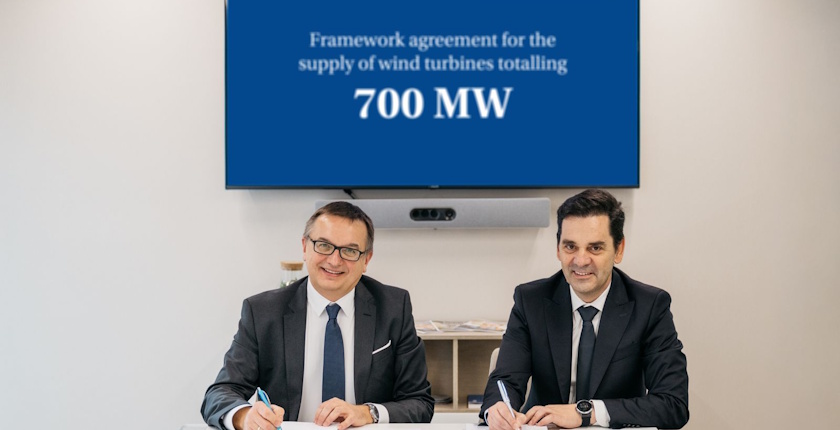
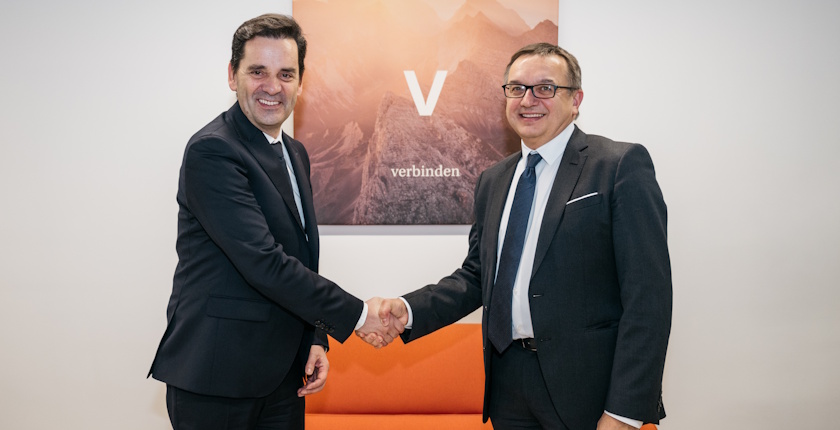
The agreement was officially signed in Verbund Green Power’s Madrid office by Dietmar Reiner, Managing Director of Verbund Green Power, and José Luis Blanco, CEO of Nordex Group.

They expressed willingness to facilitate the supply and delivery of up to 105 Nordex onshore wind turbines for Verbund Green Power’s wind projects. They are are planned in Austria, Germany, Spain, Italy, Romania and Albania, the update reads.

europe verbund nordex Dietmar Reiner José Luis Blanco
José Luis Blanco and Dietmar Reiner (photo: Verbund)

Of note, Christopher Billot, Sales Director for the Mediterranean region of Nordex Group, said at Belgrade Energy Forum 2025 that the Balkans is a key region for his company.

The deal would cover approximately 50% of Verbund Green Power’s wind project pipeline.

Blanco: We’re creating a clear path to deliver reliable, cost-efficient wind energy together with Verbund

Nordex Group CEO José Luis Blanco explained that through this multi‑year framework, the company would provide the turbine capacity to convert an ambitious pipeline into clean generation across six multi‑country markets in Europe.

“With up to 700 MW of our latest 7 MW class onshore turbines slated across Austria, Germany, Spain, Italy, Romania and Albania, we’re creating a clear path to deliver reliable, cost-efficient wind energy together with Verbund through 2030,” he stressed.

Strugl: The collaboration with Nordex strengthens our supply options as our projects mature

Blanco recalled that late last year Nordex received a first order from Verbund for nine N175/6.X turbines for Romania. “We’re expanding our footprint in this country,” he added.

According to Verbund CEO Michael Strugl, the collaboration with Nordex supports his company’s strategic objective of scaling up renewable generation across Europe.

“It strengthens our supply options as our projects mature, allowing us to secure the supply chain in a very competitive environment and deliver on Mission V targets, contributing to a secure and accelerated energy transition in our markets,” Strugl added.

by in News

From Austria to Albania: Verbund, Nordex to deploy 105 wind turbines across Europe

Verbund Green Power has forged a partnership with Nordex Group for the potential procurement of wind turbines.

Verbund Green Power, a subsidiary of Austrian state-owned energy utility Verbund, has entered into a multiyear framework agreement with leading wind turbine producer Nordex Group for the potential procurement of wind turbines of up to 700 MW in total capacity, according to a joint press release.

The agreement runs through 2030.

The power plants are planned in six markets

The agreement was officially signed in Verbund Green Power’s Madrid office by Dietmar Reiner, Managing Director of Verbund Green Power, and José Luis Blanco, CEO of Nordex Group.

They expressed willingness to facilitate the supply and delivery of up to 105 Nordex onshore wind turbines for Verbund Green Power’s wind projects. They are are planned in Austria, Germany, Spain, Italy, Romania and Albania, the update reads.

europe verbund nordex Dietmar Reiner José Luis Blanco
José Luis Blanco and Dietmar Reiner (photo: Verbund)

Of note, Christopher Billot, Sales Director for the Mediterranean region of Nordex Group, said at Belgrade Energy Forum 2025 that the Balkans is a key region for his company.

The deal would cover approximately 50% of Verbund Green Power’s wind project pipeline.

Blanco: We’re creating a clear path to deliver reliable, cost-efficient wind energy together with Verbund

Nordex Group CEO José Luis Blanco explained that through this multi‑year framework, the company would provide the turbine capacity to convert an ambitious pipeline into clean generation across six multi‑country markets in Europe.

“With up to 700 MW of our latest 7 MW class onshore turbines slated across Austria, Germany, Spain, Italy, Romania and Albania, we’re creating a clear path to deliver reliable, cost-efficient wind energy together with Verbund through 2030,” he stressed.

Strugl: The collaboration with Nordex strengthens our supply options as our projects mature

Blanco recalled that late last year Nordex received a first order from Verbund for nine N175/6.X turbines for Romania. “We’re expanding our footprint in this country,” he added.

According to Verbund CEO Michael Strugl, the collaboration with Nordex supports his company’s strategic objective of scaling up renewable generation across Europe.

“It strengthens our supply options as our projects mature, allowing us to secure the supply chain in a very competitive environment and deliver on Mission V targets, contributing to a secure and accelerated energy transition in our markets,” Strugl added.

by in News

ENNA kicks off installation of its first solar power plant outside of Croatia

Romanian ENEVO Group has started the construction of a solar power plant for Croatia-based ENNA Group.

The site for the 87.5 MW photovoltaic plant is 25 kilometers southwest of Romania’s capital Bucharest. It is ENNA Group’s first major investment outside of Croatia.

Installation began after an EPC contract was signed in November between PVP Cepheus, owned by ENNA Solar, which is part of ENNA Group, and Romanian Enevo Group, ENNA said.

The Giurgiu solar power plant will be built in the Mihăilești area on 93 hectares. The expected annual electricity production is 133 GWh, the company added.

The investment is part of ENNA’s ten-year plan

The plant’s commercial operation and power delivery to the grid are scheduled for the first quarter of 2027. It is an investment of around EUR 60 million, according to the update.

“We are extremely pleased to announce the start of construction of our solar power plant just a few months after taking over the project. It is also a confirmation that we have chosen very reliable partners,” ENNA Group CEO Boštjan Napast stressed.

With this investment, the company is proving its commitment to a ten-year business plan with planned investments of EUR 330 million in solar energy in Croatia and abroad, he explained.

Under the EPC contract, Enevo is responsible for the entire solar power project – design, procurement, and construction.

Bureau Veritas is in charge of supervision services

Enevo Group Technical Director Radu Brașoveanu said it supports the expansion of the ENNA Group into the Romanian renewable energy market with this strategic solar investment.

Bureau Veritas will be in charge of supervision services in line with FIDIC standards, ENNA added.

Of note, the project in Romania was acquired in April.

It is implemented by ENNA Solar, which is part of the energy division of the ENNA Group. The parent company said it has around 50 MW in operational renewable energy plants or advanced projects, as well as about 350 MW in various stages of development.

ENNA is developing two geothermal power projects – Zagocha (Slatina) and Babina Greda.

In addition to energy, the company operates in the logistics sector.

  • 1
  • 2