Clock is ticking for introducing carbon tax in Western Balkans, many ambiguities still remain
From January 1st, 2026, Carbon Border Adjustment Mechanism (CBAM) will be effective in the Western Balkans. While the countries are still deciding on the carbon pricing model, the energy intensive industry is advocating for introducing taxation to protect the domestic market from the flood of goods that will not be competitive on the EU market. Even though the Governments might not have been proactive enough in the previous years, the participants of the CBAM panel on BEF 2025 believe there is still time for the regional actors to come up with more proactive approach towards the EU.
Energy Community Contracting Parties are approaching critical choices on carbon pricing that will shape the pathway towards climate neutrality, electricity market integration and sustainable economic development. From January 1, 2026, producers of aluminum, fertilizers, cement, steel, and hydrogen, as well as electricity exporters, will be required to pay the tax on CO2 emissions released during the production of the goods they export to the EU.
At the Ministerial Council in December 2024, four carbon pricing models were presented to the Contracting parties: regional emissions trading system (ETS), national carbon taxes, fixed-price Emissions Trading System (ETS), and full integration with the EU ETS. Upon the request of the Contracting parties, the Energy Community Secretariat provided an impact assessment for all four scenarios. The scenarios differ in structure and scope, but all support a common goal: progressive alignment with the EU ETS and the implementation of the polluter-pays principle.
The Ministerial Council is expected to meet in July to reflect on these scenarios and decide on the preferred regional pathway. This decision will shape the revision of the Decarbonisation Roadmap and guide the implementation of carbon pricing reform up to 2030 and beyond.
Carbon pricing is also central to the region’s electricity market future. The Electricity Integration Package, adopted in 2022, outlines the path to full market coupling between the Energy Community and the EU. To avoid distortions and ensure a level playing field, timely carbon pricing implementation is essential. “The projections shows that if the region would join EU ETS after 2030, the carbon price should reach or even exceed 100 euros per ton of CO2. This would have serious consequences for energy prices, competitiveness and industrial exports. Also, delaying actions could prove to be costly. That’s why contracting parties are expecting to implement domestic ETS for electricity with the price equivalent to EU ETS”, Milica Brkić Vukovljak, from Energy Agency of the Republic of Serbia, explained.
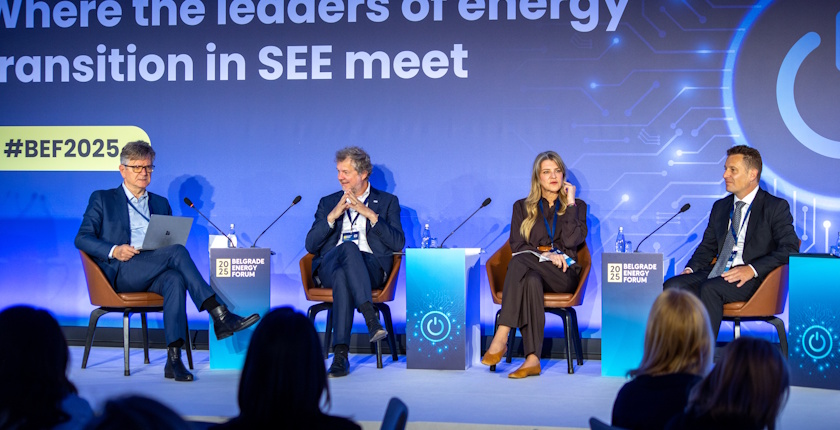
The expectations around the CBAM introduction in the region were the main topic of discussion on the BEF 2025 panel Addressing carbon pricing in the Western Balkans – Turning decarbonization challenges into opportunities through collaboration, innovation and competitiveness, moderated by Brkić Vukovljak.
The key message from the panel is that regional governments need to take a more active role, especially towards the European Union, and numerous arguments were put forward during the discussion in that direction.
As for Serbia, it is worth noting that it is the only Contracting party of the Energy Community that had transposed the Electricity Integration Package, through which transit of importance for traders takes place. Given that the market coupling is scheduled for the beginning of 2027, it would be important to try to get the European Commission to postpone the deadline from 2026 to 2027.
Introduction of CBAM should not interfere with market integration
While admitting that „it’s never a good moment politically to decide on carbon pricing“, Adam Cwetsch, Head of the European Green Deal in the Energy Community Secretariat, said he believed that the current momentum in the region, together with cumulated experiences, could allow making such a decision at this time.
He recalled that the decision on carbon pricing was partially left open with the 2021 Decarbonization Roadmap. At the same time, the Green Agenda for Western Balkans is referring to alignment with the EU ETS, as an objective that countries should aim.
„The role of Secretariat is to facilitate making those decisions, fully informed. It entails certain risks, but it is also helping the countries in their journey to join the EU eventually. Another important consideration is setting standards for monitoring emissions, which the countries are obliged to establish and make as of 2026. This is necessary for any credible carbon pricing system, regardless of the chosen model, as they all require credible data and standards“, Cwetsch said.
He insisted that the market integration and market coupling should not be disturbed with the introduction of CBAM, making it a priority to synchronize the situation within the region.
Any model to be decided has to have, as an end point, alignment with the EU ETS
“The least desirable solution would be that there is a country that progresses faster than others and is forced to implement an internal Energy Community CBAM”, Cwetsch said, advocating for a coordinated approach towards setting up the carbon emissions price.
He also noted that any model to be decided must have, as an end point, alignment with the EU ETS. „That should be taken into account when designing the pathway with selected option“, he added.
As things now stand from January 2026 CBAM will be effective, while the market coupling, that allows for exemptions, will not be yet in place. „It is important not to end up with disintegrating the market“, Cwetsch noted.
On the other hand, he believes there is a space for more proactive policy from the Western Balkans actors. „The region should reach out to the EU with more proactive climate policies, which would make clear how the region could contribute to the 2030 or 2040 targets for climate neutrality that EU is striving“, he concluded.
Without carbon pricing mechanisms, the regional markets will be flooded with imports
The representatives of energy intensive industry are concerned that past discussions about carbon pricing didn’t pay enough attention to the interests of the companies that are going to be directly affected by imposing tariffs on exports to the EU.
Branko Zečević, president of the Metalfer Group and one of the founders of the Association of Serbian Energy Intensive Industry, said that the introduction of CBAM from the beginning of next year will certainly affect Serbian exports, even though many companies have been preparing for this moment and investing in decarbonization. „Some companies are further down that road, some are at the beginning, and the effects can’t be quantified easily right now“, he argued.
Once you have saved the industry, you have somebody to tax. Otherways, there will be nothing to talk about
However, Zečević insisted that much bigger threat for industry in Serbia and the region, is the expected flood of goods that will not be able to enter EU market anymore and will try to find third markets.
„Markets in the region are pretty opened for that sort of import. An imperative is therefore to have our own carbon pricing system, however you may call it. We must protect our market from these consequences, otherways we will not have any industry to protect in the future“, he insisted.
In his opinion, the first step should be to copy-paste what the EU is doing, to protect the industry, and after that we can talk about the models of carbon pricing. „Once you have saved the industry, you have somebody to tax. Otherways, there will be nothing to talk about“, he warned.
Asked about the expectations of the industry from the Government, he said that financial assistance does not seem a realistic option in the Western Balkans, but there are regulatory measures that could help the companies.
„Industry is more complex than coupling the electricity market, as every industry is different. The companies in the EU received billions of euros in grants over the last 15 years, while the companies in the region were left on their own, each individual company, to make its own adjustments. What the governments in the region can do is to put in place regulatory rules to help and protect local industry and then as a next stage to see if it can implement that regionally“, he concluded.
CBAM ambiguities rising concerns for energy traders
The ambiguities that follow the introduction of the emissions trading mechanism in the region are more likely to deter than to attract energy traders. Mark Copley, CEO of Energy Traders Europe, association representing 170 energy traders, some of them being active in the region, noted that there is confusion and concern regarding the implementation of CBAM in Western Balkans.
“Lots of questions have been raised: how is that going to work, how the price of CO2 is going to be calculated, what does this means for market integration, how the traders will actually be able to transit power through this region etc”, he said.
Energy traders are pretty good with price risks and volume risks, what we fear is political risk and regulatory risk
While noting that traders generally think that carbon pricing is a good idea, he warned that a good idea in principle could have significant unintended consequences in practice. Energy traders are pretty good with price risks and volume risks, what we fear is political risk and regulatory risk. „I’d like to think that this moment is an opportunity to sit down with all the parties involved to try to sort out the rules”, Copley said.
Copley insisted that he doesn’t have a specific view on what form of pricing is right from the region, but reminded of the experience when Great Britain created its own ETS, which proved to be more volatile, risky and difficult to operate.
„The bigger, more stable, more integrated market – the better. When you have ETS as a large and liquid system, it is fairly easy to trade and manage risks. However, it gets more difficult where you don’t know what the policies are in the short term or in the long term. While I understand the desire that the model should reflect the specifics of the market, be careful in small markets with not much liquidity, because it is hard to design good systems for them”, Copley noted.
Carbon pricing models should reflect the interests of each country in the region
The regional non-governmental organizations also have been raising their voice over the topic of CBAM in previous years. One of the warnings of possible negative economic and social impacts was the analysis Chaotic and fake decarbonization of power sectors in the Western Balkansin 2023.
“The problem is that the introduction of CBAM in often seen as a kind of natural disaster, something inevitable that is about to happen”, said Damir Miljević, member of the Board of Center for Sustainable Energy Transition, RESET, a think-tank that published the report mentioned.
In his opinion, Western Balkan countries did not participate actively in the process with lobbying and negotiating with the EU. „The policy makers sit in Brussels, while the Energy Community Secretariat is the directorate for the implementation of the international agreement. I don’t recall that some delegation from the Western Balkans went to talk to the EU about exemptions, even though we had at least one strong argument. Stabilization and Association Agreement with the EU states that neither contracting party will introduce additional taxes, or levies on the other, which means that even if they are introduced, we would have to negotiate about it“, Miljević explained.
The advantage should be given to the model that is fastest and simplest to implement, which is direct taxation
Another argument for negotiations is even stronger – the countries that are candidates for EU accession should not have the same treatment as some very distant states on other continents, he argued. Miljević also added that the region should focus on transferring the acquis from the EU, which they are obliged to, not the policies, where the situation is completely different.
„In the present situation, the only viable solution is to introduce some form of taxation of CO2 for the industry“, he said. In his opinion, this means the advantage should be given to the model that is fastest and simplest to implement, which is direct taxation, to eliminate the influence of CBAM on the export of industrial products from the region to the EU.
„It would be difficult to consider regional schemes, due to huge differences within the region. We already lost too much time on it. Each country should do it individually considering its own interest, not the interest of the energy sector, but the interest of the citizens and the economy and the consequences for them. This way, we will get some initial, however small assets, to start solving the core issue. We should also remember that the introduction of levies on CO2 is essential for the creation of any fund for coal regions in transition”, Miljević concluded.