by in News

Romania to take control of Lukoil’s assets

Romania wants to take control of Lukoil’s operations to prevent an imminent freeze from the sanctions imposed by the United States. Bulgaria is already putting the Russian company’s refinery, the largest in the Balkans, under a trusteeship. Serbia announced that similar measures have been proposed to exempt Gazprom-owned NIS and its refinery, the only one in the country, from the sanctions.

Minister of Energy of Romania Bogdan Ivan seems to have endorsed neighboring Bulgaria’s approach to the issue of US sanctions against Lukoil. He said the government has to take control of the Russian company’s operations, Profit.ro reported.

The minister didn’t clarify whether it would be a temporary trusteeship. But President Nicușor Dan, who took the helm half a year ago, said there is an option for Romania to assume control for a limited period.

“We protect Romania’s energy security and firmly enforce international sanctions targeting Lukoil. My colleagues in the Ministry of Energy continue to work, together with all relevant authorities, on creating legislation that will ensure, on the one hand, full compliance with the sanctions regime established by the United States, and on the other hand, the continuity of Petrotel Ploiești’s refining activities, as well as the placement of petroleum products, without jeopardizing the supply of the national fuel market,” Ivan stated.

Minister Ivan turns more hawkish regarding sanctions against Russia

The minister claimed he would not request an extension of the November 21 deadline from the US. “Moreover, I will support the replication and uniform application of the sanctions initiated by the US throughout the European Union,” he stressed.

It marks a shift from the stance that the ministry expressed late last month, saying that the EU needs to adopt a position before Romania decides to move. Notably, Ivan held talks on November 8 in Washington with senior US officials, the article notes.

Ivan held talks on November 8 in Washington with senior US officials

“Romania must take control of the company to guarantee the full implementation of international measures, to protect the jobs of the 5,000 employees and to ensure the stability and security of the national energy system,” Ivan said.

However, the Petrotel Lukoil refinery had 542 employees on average in 2023 and another 203 worked at the company’s gas stations. Altogether, its six firms have a total payroll of under nine hundred, the article notes.

Germany placed Rosneft under state administration in 2022.

Bulgaria, Serbia struggling to keep Russian-owned refineries in operation

Nationalization could backfire because of property rights, though imposing state management is also a complicated matter. Romania earlier signaled that nationalization would be the last option.

Bulgaria has urgently adopted a law facilitating a takeover of Lukoil’s refinery in Burgas, the largest in the region. The state administrator would be authorized to sell it. It is unclear whether the measure could postpone or prevent the sanctions.

President Rumen Radev refused to sign the law and returned it to the National Assembly. It would “undermine the legal order” through “indirect nationalization” and expose public finances to a high risk, he warned.

Oil refiner and service stations operator NIS in Serbia is already under US sanctions. Russian state-owned Gazprom holds a majority stake in the company through two subsidiaries.

Serbian Minister of Mining and Energy Dubravka Đedović Handanović said yesterday that the “Russian owners” sent a request to the US Office of Foreign Assets Control (OFAC) to renew the company’s license due to “negotiations with a third party.”

The government in Belgrade has supported the request, she added. The Russian side is prepared to cede control and influence over NIS to a third party, Đedović Handanović revealed.

According to media speculations, one of the candidates is Hungary-based MOL, given that the country managed to obtain a one-year exemption from the US for Russian oil and gas.

Lukoil is operating in Serbia as well, where it has a chain of fuel stations.
by in News

Oil trader Gunvor set to take over Lukoil’s refineries, fuel chains in Southeast Europe

Russian oil producer Lukoil has accepted an offer from global commodities trader Gunvor Group Ltd. to acquire its international assets, which were put up for sale due to sanctions imposed by the United States over the war in Ukraine. The assets include oil refineries in Bulgaria and Romania, as well as fuel retail chains across Southeast Europe.

Lukoil has decided not to negotiate with other potential buyers. It will sell 100% of Lukoil International GmbH, which owns its assets outside of Russia, to Gunvor under key terms agreed earlier, according to an announcement from the Russian company. The value of the transaction was not disclosed.

Lukoil will not negotiate with other potential buyers

To conclude a binding agreement, the buyer needs to obtain permission from the US Office of Foreign Assets Control (OFAC), along with other approvals in relevant jurisdictions, Lukoil said.

If necessary, the two companies will apply for an extension of the existing OFAC license to ensure uninterrupted operations of Lukoil’s international assets and their banking servicing until the completion of the transaction, it added.

Gunvor is owned by Swedish billionaire Torbjörn Törnqvist

According to its website, Gunvor is one of the world’s largest independent commodities trading houses by turnover and a leading global oil trader. The company is majority‑owned by Swedish billionaire Torbjörn Törnqvist.

Lukoil’s facilities up for sale include the largest oil refinery in the Balkans – Lukoil Neftohim Burgas in Bulgaria, as well as the Petrotel-Lukoil refinery in Romania. The Russian company also has fuel retail networks in Romania, Bulgaria, Turkey, North Macedonia, Croatia, Serbia, and Montenegro.

The US sanctions targeting Russian energy companies took effect earlier this month.

by in News

OMV opens Austria’s largest green hydrogen plant

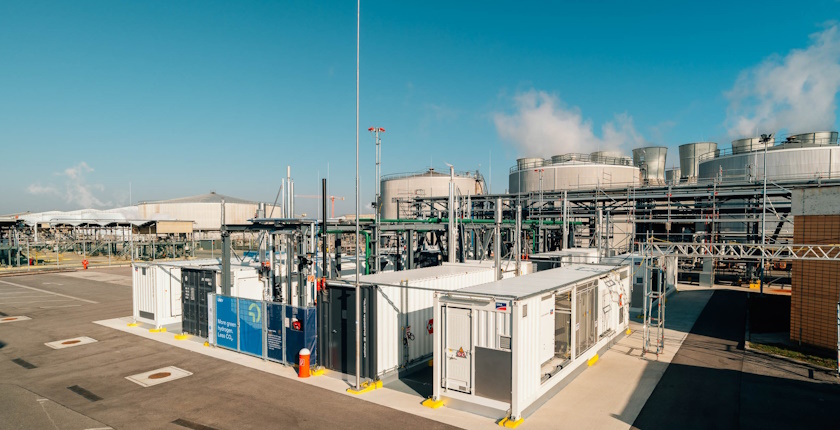
OMV put into operation its green hydrogen plant in Schwechat near Vienna. The facility can produce 1,500 tons per year.

OMV is producing green hydrogen on a commercial scale for the first time. The Vienna-based fossil fuel and petrochemicals producer started up a 10 MW plant at its Schwechat refinery near Austria’s capital. It is the largest in the country.

The investment amounts to EUR 25 million. The electrolyzer system can produce up to 1,500 tons per annum. OMV said the green hydrogen would be used to make more sustainable fuels and chemicals including sustainable aviation fuel (SAF) and renewable diesel (HVO).

PEM electrolyzer uses wind power, hydropower, photovoltaics

The new 10 MW polymer electrolyte membrane (PEM, also called proton exchange membrane) electrolyzer is powered entirely by renewable electricity. It is generated by wind power, hydropower plants and photovoltaics.

The innovation enables annual savings of up to 15,000 metric tons of carbon dioxide emissions, according to the comparator from the European Union’s Renewable Energy Directive. It is equivalent to 2,000 persons per year, based on the EU’s 2024 average of 7.5 tons of CO2 equivalent per capita.

“With the start-up of Austria’s largest electrolysis plant, we are re-inventing how essentials we use in everyday life are produced sustainably. Green hydrogen is at the heart of this transformation, serving as a critical component in producing fuels and chemicals while advancing the decarbonization of our Schwechat site,” said board member Martijn van Koten, responsible for fuels, feedstock and chemicals.

Green hydrogen project is step toward making OMV carbon neutral

The majority owner of Romanian OMV Petrom aims to cut its net emissions to zero by 2050. Its transformation is based on projects including for geothermal energy and chemical recycling. Green hydrogen can be utilized in the production process in refineries.

The green hydrogen plant is certified for producing renewable fuels of non-biological origin (RFNBOs).

Making green hydrogen through PEM electrolysis involves splitting water into hydrogen and oxygen using renewable electricity. At the anode, oxygen and positively charged hydrogen protons are generated. The protons pass through the PEM, and at the cathode, they combine with electrons to form hydrogen gas.