by in News

KESH partners with France’s EDF and AFD to develop Albania’s Energy Storage Roadmap

Tirana — In a decisive move toward modernizing its national grid, the Albanian state-owned power utility, KESH (Albanian Electric Power Corp), has finalized a strategic partnership with Électricité de France (EDF) and the French Development Agency (AFD). The collaboration focuses on the development of a comprehensive energy storage strategy, underpinned by a €400,000 grant earmarked by the AFD.

This initiative arrives at a critical juncture for Albania. While the country boasts a near-total reliance on renewable hydropower for domestic production, its lack of grid-scale energy storage remains a significant structural vulnerability. As the global energy transition demands higher flexibility, the partnership aims to bridge the gap between Albania’s current hydro-centric model and a diversified, resilient future.

Engineering Flexibility: The Scope of the Partnership

The primary objective of the agreement is to identify and evaluate the most effective storage technologies suited for Albania’s existing infrastructure. The resulting study will serve as a technical blueprint for the nation’s Energy Storage Strategy, focusing on several key pillars:

  • Renewable Integration: Facilitating the entry of solar and wind energy into a grid historically dominated by water power.

  • System Modernization: Increasing the security of supply and enhancing operational flexibility.

  • Climate Resilience: Improving the long-term sustainability and management of Albania’s vital water resources and assets.

The technical expertise for this transition will be provided by the French state-owned giant EDF, a global leader in low-carbon energy, while the AFD continues to expand its financial and developmental footprint across the Western Balkans.

High-Level Diplomatic Support

The signing ceremony was attended by Nicolas Forissier, the French Minister Delegate for Foreign Trade and Economic Attractiveness. Minister Forissier emphasized that this agreement underscores Albania’s status as a priority partner for France, reflecting Paris’s commitment to supporting the country’s integration into the European Union through the mobilization of technical and financial instruments.

Under the leadership of Viola Haxhiademi, who assumed the role of CEO in late December, KESH is positioning itself to manage significant future capacities. Currently, planned projects—including KESH’s pumped storage capacity in the Drin (Drim) cascade and Statkraft’s Moglica project—represent a potential 1.6 GW of storage capacity.

A Continuing Collaboration

This latest deal builds upon an existing relationship between KESH and the AFD. Last year, the two entities signed an agreement focused on the advanced management of the Drin River cascade, the backbone of Albania’s energy sector. By adding a formal storage strategy to this framework, Albania is taking a sophisticated step toward aligning its energy sector with EU standards and the exigencies of the green transition.

by in News

MEMO Analysis Links Solar Output to Lower Day-Ahead Power Prices in North Macedonia

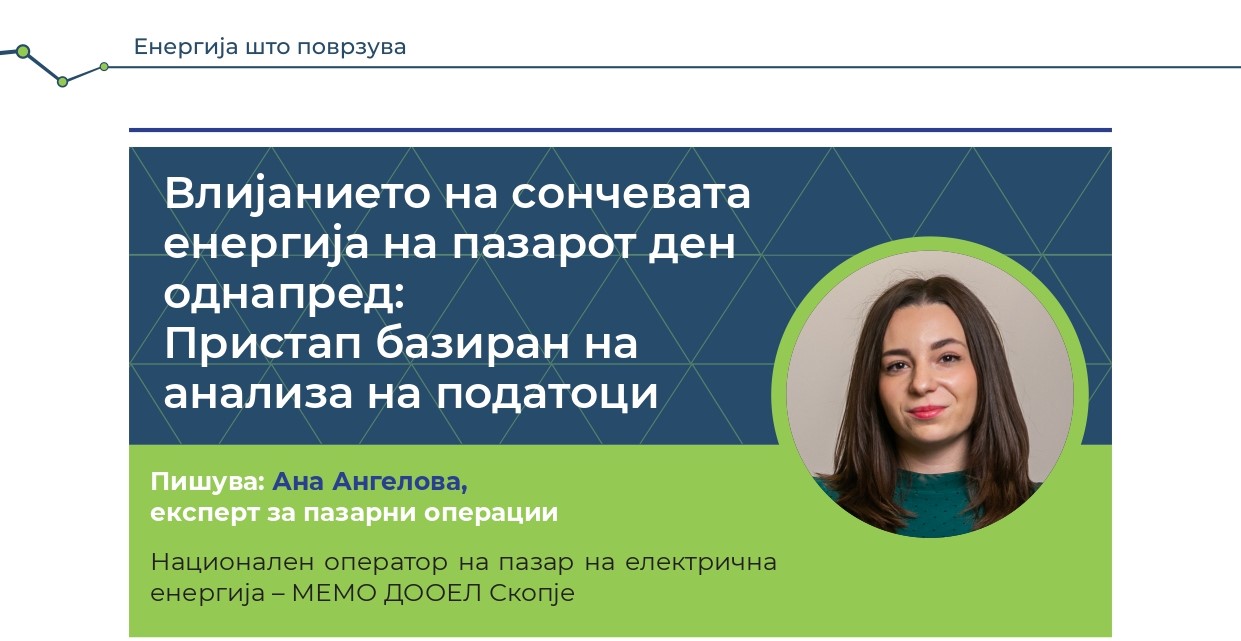
Electricity generation from solar power plants tends to push prices down on the power exchange, while reduced solar output is associated with price increases, according to an analysis by Ana Angelova, a market operations specialist at the National Electricity Market Operator (MEMO).

The analysis aimed to identify seasonal trends and highlight the relationship between photovoltaic (PV) generation, electricity consumption, traded volumes, and day-ahead prices on the North Macedonian power exchange. MEMO noted that the day-ahead market operates in an isolated mode.

Angelova used official power exchange data for 2024, focusing on hours when PV plant efficiency exceeded 30%.

Consumption remains broadly stable across the year

The findings point to a clear seasonal pattern. Electricity consumption stays relatively steady throughout the year, with only minor declines during spring and summer. PV generation, however, shows a pronounced seasonal swing—peaking in summer and reaching its lowest levels in winter.

Angelova also stressed that higher PV output coincides with increased traded volumes on the day-ahead market.

Prices bottom out in April, rise toward winter

According to the analysis, day-ahead prices are lowest in April, a period linked to milder weather, lower demand, and stronger solar production. From summer onward—and particularly during winter—prices trend higher, peaking in November.

The November price peak aligns with a combination of weak PV generation and higher consumption.

“Increased electricity generation from photovoltaic plants is associated with lower prices, while low generation leads to higher market prices, emphasizing the impact of renewable energy availability on price formation. The trend indicates that energy policies should focus on addressing weaknesses during the winter period and harnessing the potential of solar energy in summer,” Angelova wrote.

Proposed measures to strengthen renewables integration

north macedonia solar analysis memo power exchange ana angelova

Photo: MEMO

Angelova outlined several options to improve the integration of renewables—especially solar—into the power system. The proposed mechanisms include:

  • Flexible market mechanisms: introduction of a 15-minute trading interval, creation of an intraday market, dynamic tariffs, and guarantees of origin.

  • Energy storage technologies: battery energy storage systems (BESS) and pumped-storage hydropower plants.

  • Alignment with the European energy framework: adoption of ENTSO-E grid codes, coupling with the single European electricity market, deployment of smart meters, and use of financial instruments such as contracts for difference (CfD) and power purchase agreements (PPA).

by in News

Twin pumped storage hydropower projects in Greece get environmental approval

Proposals for two pumped storage hydropower plants next to each other in northern Greece received the environmental conditions. The Flampouro project is for 450 MW in both modes while Trani Rachi would be able to generate 594 MW and consume up to 600 MW.

Greece has an ambition to become a Mediterranean and European hub for renewable energy and energy transmission. Among other important segments, energy storage is rising in popularity among investors. Such technologies have a major role in accommodating the deployment of renewables and balancing supply and demand.

Within a string of proposed investments in pumped storage hydropower, twin projects Flampouro and Trani Rachi have just passed an important point in development. Both locations are next to the reservoir of the Ilarion dam and hydropower plant, near Kozani in the Western Macedonia province.

The projects were developed by investors from the Katselis family, the country’s media pointed out. The Ministry of Environment and Energy issued environmental terms (AEPO) for the two investment proposals in the north of Greece, under special purpose vehicles Aliakmonas 1 and Aliakmonas 2.

Public Power Corp. (PPC Group) operates the existing facility, of 154 MW, which consists of two turbines. Commissioned in 2014, it is part of a hydropower cascade of 1 GW on the Haliacmon (Aliakmonas) river, the longest in Greece. Government-controlled PPC Group is working on several pumped storage endeavors.

Storage capacity would total 6.2 GWh

The Flampouro pumped storage hydropower plant would work at up to 450 MW both in the generation and pumping modes. In storage capacity terms, it is seen holding 2.7 GWh. The upper reservoir would be at an altitude of 1,065 meters, four kilometers from the lower one.

The location is in municipal units Ventzio, Deskati and Kamvounia in the municipalities of Grevena, Deskati and Servia, respectively.

Trani Rachi is for 594 MW in production capacity and 600 MW in the pumping mode, for 3.5 GWh in storage. The site for the upper reservoir is at 1,380 meters above sea level and three kilometers from the lower reservoir.

Documentation shows that the facility would be in the municipal units of Deskati and Kamvounia.

Combined production estimated at 1.34 TW per year

The developers estimated annual output at 1.34 TWh, of which Flampouro would account for 581 MWh and Trani Rachi for 763 GWh.

Both projects involve road repair and construction, water tunnels and the installation of transformers, substations and 400 kV transmission lines. The investments envisage machine rooms underground.

by in News

Twin pumped storage hydropower projects in Greece get environmental approval

Proposals for two pumped storage hydropower plants next to each other in northern Greece received the environmental conditions. The Flampouro project is for 450 MW in both modes while Trani Rachi would be able to generate 594 MW and consume up to 600 MW.

Greece has an ambition to become a Mediterranean and European hub for renewable energy and energy transmission. Among other important segments, energy storage is rising in popularity among investors. Such technologies have a major role in accommodating the deployment of renewables and balancing supply and demand.

Within a string of proposed investments in pumped storage hydropower, twin projects Flampouro and Trani Rachi have just passed an important point in development. Both locations are next to the reservoir of the Ilarion dam and hydropower plant, near Kozani in the Western Macedonia province.

The projects were developed by investors from the Katselis family, the country’s media pointed out. The Ministry of Environment and Energy issued environmental terms (AEPO) for the two investment proposals in the north of Greece, under special purpose vehicles Aliakmonas 1 and Aliakmonas 2.

Public Power Corp. (PPC Group) operates the existing facility, of 154 MW, which consists of two turbines. Commissioned in 2014, it is part of a hydropower cascade of 1 GW on the Haliacmon (Aliakmonas) river, the longest in Greece. Government-controlled PPC Group is working on several pumped storage endeavors.

Storage capacity would total 6.2 GWh

The Flampouro pumped storage hydropower plant would work at up to 450 MW both in the generation and pumping modes. In storage capacity terms, it is seen holding 2.7 GWh. The upper reservoir would be at an altitude of 1,065 meters, four kilometers from the lower one.

The location is in municipal units Ventzio, Deskati and Kamvounia in the municipalities of Grevena, Deskati and Servia, respectively.

Trani Rachi is for 594 MW in production capacity and 600 MW in the pumping mode, for 3.5 GWh in storage. The site for the upper reservoir is at 1,380 meters above sea level and three kilometers from the lower reservoir.

Documentation shows that the facility would be in the municipal units of Deskati and Kamvounia.

Combined production estimated at 1.34 TW per year

The developers estimated annual output at 1.34 TWh, of which Flampouro would account for 581 MWh and Trani Rachi for 763 GWh.

Both projects involve road repair and construction, water tunnels and the installation of transformers, substations and 400 kV transmission lines. The investments envisage machine rooms underground.

by in News

Albania gives green light to CWP Europe for 600 MW wind park

Prime Minister of Albania Edi Rama and Deputy Prime Minister and Minister of Infrastructure and Energy Belinda Balluku promoted CWP Europe’s wind power project Tropoja of 600 MW. After receiving the ministry’s preliminary approval at the event, the company’s CEO Dimitar Enchev highlighted the importance of local electricity production for a modern economy, including AI and data centers, and for energy independence. Albania still doesn’t host a single operational wind turbine.

CWP Europe will hopefully connect its future wind park Tropoja to the grid within 12 months, excluding the period of harsh winter, according to Albania’s Prime Minister Edi Rama. Speaking at the project’s presentation, he said the investment is a step toward the country’s ambition of becoming self-reliant in energy production.

“For a long time, we had complete dependence on water and rainfall. At the same time, we inherited a system with so many weaknesses that, when rainfall was lacking, we had to go to international markets and purchase large quantities at inflated prices. Meanwhile, when rainfall came in abundance, we often saw much of this potential value, water, go to waste and not only fail to be converted into energy, but at times also cause extraordinary damage,” Rama stated.

Namely, hydropower plants accounted for almost 100% of domestic electricity production until recently. By the end of the decade, the combined share of wind and solar power will reach 30%, Rama underscored.

Preparing final stages of Tropoja wind power project

CWP Global’s Co-founder and Chief Executive Officer for Europe Dimitar Enchev received a preliminary approval from the Ministry of Infrastructure and Energy at the event. He highlighted the importance of local electricity production for a modern economy and energy independence, especially with the expansion of artificial intelligence and data centers.

“The last time I was here was about three months ago, when we decided and signed a joint cooperation agreement with the EU. And now, after three months, we receive the permission that allows us to engage in preparing the final stages of our project,” Enchev stated, as quoted by CNA.

CWP Europe has more than 7 GW under development in Southeast Europe

CWP Europe has 900 MW in wind power projects under development in Albania, part of a portfolio of more than 6 GW across Southeast Europe plus more than 1 GW in photovoltaics.

The Tropoja area is in the country’s far north. Albania still doesn’t host a single operational wind turbine.

Support from European Commission

CWP Europe signed a joint declaration in October with the European Commission, the Albanian Investment Development Agency and the Montenegrin Investment Agency, in support of the Tropoja project and the Montechevo solar farm with battery storage in Montenegro, respectively.

In September, the company’s subsidiary Eralb Invest submitted its wind power project to the Ministry of Infrastructure and Energy, for 603.9 MW. It is not subject to concession and doesn’t benefit from state support measures.

In 2023, the firm sent a proposal to the Strategic Investment Committee (SIC or KIS) in which the project was for a wind and solar park of 826 MW in total capacity. It is an interministerial panel chaired by Prime Minister Edi Rama.

The entire designated area in Tropoja municipality reportedly spanned 385 hectares, encompassing the territories of the villages Viçidol, Berisha, Luzha and Pac, and the investment was valued at EUR 1.2 billion.

In October 2023, CWP and GE Vernova’s Onshore Wind business agreed to develop a large-scale hybrid wind and solar project in Albania. They estimated the investment at more than EUR 1 billion.

Fântânele-Cogealac-Gradina, the biggest onshore wind park in Southeastern Europe and, until recently, in entire Europe, has 600 MW in capacity. It is located in Romania. CWP developed the project and sold it in 2008.

Balluku: Diversification is strategic necessity

Albania is moving to a modern, balanced energy model, where diversification of sources is no longer a solution, but a strategic necessity, according to Deputy Prime Minister and Minister of Infrastructure and Energy Belinda Balluku.

“The Tropoja wind farm is not just an energy investment. It is a symbol of the transformation that Albania is experiencing, a transformation towards a sustainable, stronger and more innovation-friendly economy. This project proves that the Albanian energy sector is entering a new phase, where private investment and foreign direct investment are becoming engines of growth, thanks to serious partnerships and long-term visions,” she stated.

Wind and solar power projects totaling 1.5 GW are under development in Albania

In recent years, Albania added over 700 MW of photovoltaic capacity, and another 400 MW for self-supply, Balluku revealed. Wind and solar power projects totaling 1.5 GW are under development, she added. Future pumped storage hydropower capacity in the Drin (Drim) cascade and Statkraft’s project in Moglica amount to 1.6 GW, Balluku stressed.

Since 2013, losses in the power distribution network have dropped to 16.9% from more than 45%, while total electricity capacity increased by 1.5 GW, the deputy prime minister added. She said outages have been reduced to an all-time low and that they usually only last a few minutes.

The Special Court Against Corruption and Organized Crime suspended Balluku in late November amid an investigation, but the Constitutional Court soon reinstated her.

by in News

Albania gives green light to CWP Europe for 600 MW wind park

Prime Minister of Albania Edi Rama and Deputy Prime Minister and Minister of Infrastructure and Energy Belinda Balluku promoted CWP Europe’s wind power project Tropoja of 600 MW. After receiving the ministry’s preliminary approval at the event, the company’s CEO Dimitar Enchev highlighted the importance of local electricity production for a modern economy, including AI and data centers, and for energy independence. Albania still doesn’t host a single operational wind turbine.

CWP Europe will hopefully connect its future wind park Tropoja to the grid within 12 months, excluding the period of harsh winter, according to Albania’s Prime Minister Edi Rama. Speaking at the project’s presentation, he said the investment is a step toward the country’s ambition of becoming self-reliant in energy production.

“For a long time, we had complete dependence on water and rainfall. At the same time, we inherited a system with so many weaknesses that, when rainfall was lacking, we had to go to international markets and purchase large quantities at inflated prices. Meanwhile, when rainfall came in abundance, we often saw much of this potential value, water, go to waste and not only fail to be converted into energy, but at times also cause extraordinary damage,” Rama stated.

Namely, hydropower plants accounted for almost 100% of domestic electricity production until recently. By the end of the decade, the combined share of wind and solar power will reach 30%, Rama underscored.

Preparing final stages of Tropoja wind power project

CWP Global’s Co-founder and Chief Executive Officer for Europe Dimitar Enchev received a preliminary approval from the Ministry of Infrastructure and Energy at the event. He highlighted the importance of local electricity production for a modern economy and energy independence, especially with the expansion of artificial intelligence and data centers.

“The last time I was here was about three months ago, when we decided and signed a joint cooperation agreement with the EU, and now, after three months, we receive the permission that allows us to engage in preparing the final stages of our project,” he stated, as quoted by CNA.

CWP Europe has more than 7 GW under development in Southeast Europe

CWP Europe has 900 MW in wind power projects under development in Albania, part of a portfolio of more than 6 GW across Southeast Europe plus more than 1 GW in photovoltaics.

The Tropoja area is in the country’s far north. Albania still doesn’t host a single operational wind turbine.

Support from European Commission

CWP Europe signed a joint declaration in October with the European Commission, the Albanian Investment Development Agency and the Montenegrin Investment Agency, in support of the Tropoja project and the Montechevo solar farm with battery storage in Montenegro, respectively.

In September, the company’s subsidiary Eralb Invest submitted its wind power project to the Ministry of Infrastructure and Energy, for 603.9 MW. It is not subject to concession and doesn’t benefit from state support measures.

In 2023, the firm sent a proposal to the Strategic Investment Committee (SIC or KIS) in which the project was for a wind and solar park of 826 MW in total capacity. It is an interministerial panel chaired by Prime Minister Edi Rama.

The entire designated area in Tropoja municipality reportedly spanned 385 hectares, encompassing the territories of the villages Viçidol, Berisha, Luzha and Pac, and the investment was valued at EUR 1.2 billion.

In October 2023, CWP and GE Vernova’s Onshore Wind business agreed to develop a large-scale hybrid wind and solar project in Albania. They estimated the investment at more than EUR 1 billion.

Fântânele-Cogealac-Gradina, the biggest onshore wind park in Southeastern Europe and, until recently, in entire Europe, has 600 MW in capacity. It is located in Romania. CWP developed the project and sold it in 2008.

Balluku: Diversification is strategic necessity

Albania is moving to a modern, balanced energy model, where diversification of sources is no longer a solution, but a strategic necessity, according to Deputy Prime Minister and Minister of Infrastructure and Energy Belinda Balluku.

“The Tropoja wind farm is not just an energy investment. It is a symbol of the transformation that Albania is experiencing, a transformation towards a sustainable, stronger and more innovation-friendly economy. This project proves that the Albanian energy sector is entering a new phase, where private investment and foreign direct investment are becoming engines of growth, thanks to serious partnerships and long-term visions,” she stated.

Wind and solar power projects totaling 1.5 GW are under development in Albania

In recent years, Albania added over 700 MW of photovoltaic capacity, and another 400 MW for self-supply, Balluku revealed. Wind and solar power projects totaling 1.5 GW are under development, she added. Future pumped storage hydropower capacity in the Drin (Drim) cascade and Statkraft’s project in Moglica amount to 1.6 GW, Balluku stressed.

Since 2013, losses in the power distribution network have dropped to 16.9% from more than 45%, while total electricity capacity increased by 1.5 GW, the deputy prime minister added. She said outages have been reduced to an all-time low and that they usually only last a few minutes.

The Special Court Against Corruption and Organized Crime suspended Balluku in late November amid an investigation, but the Constitutional Court soon reinstated her.

by in News

Hidroelectrica to set up joint venture with EDF for 1 GW pumped storage project

After numerous failed attempts for half a century, Romania intends to revive the Tarnița-Lăpuștești pumped storage hydropower project in tandem with France’s EDF. State-owned Hidroelectrica published a proposal to its shareholder assembly to establish a 50%-50% joint venture for the 1 GW endeavor. The utility also intends to buy the Frasin-Pângărați pumped storage facility when Hidro Blue Energy builds it.

The plans for Tarnița-Lăpuștești date back to mid-1970s. According to a feasibility study from 2008, updated in 2014, the pumped storage hydropower plant on the river Someşul Cald in Romania would consist of four units of 250 MW each. After numerous failed attempts, the Ministry of Energy sat with the representatives of Japanese Itochu and French EDF last year to discuss the project.

In November 2024, Romania signed a memorandum of understanding with Itochu. The latest update came from government-controlled hydropower plant operator Hidroelectrica. It has just scheduled an extraordinary general meeting of shareholders for January 27.

Romania may fast-track Tarnița-Lăpuștești project

In a stock exchange filing, Hidroelectrica said it is proposing a joint undertaking with EDF Power Solutions International, where both state-owned companies would have equal stakes.

The location for Tarniţa-Lăpuşteşti is 30 kilometers from Cluj-Napoca, Transylvania’s biggest city. The river is called Meleg-Szamos in Hungarian.

The old study envisages five to seven years of construction. Within a legislative push to unlock dormant hydropower projects, the project could be given a priority status. In that case, it would be exempted from some permits including the obligation to conduct the study all over again.

Hidroelectrica plans to buy Frasin-Pângărați pumped storage hydropower plant upon its commissioning

In another item for the meeting, Hidroelectrica seeks approval for obtaining advisory services with regard to its intention to acquire, upon commissioning, the Frasin-Pângărați pumped storage hydropower plant.

A company called Hidro Blue Energy is working on the project for 300 MW. The location is in Neamț County in the northeast. Lake Bicaz would be the facility’s lower reservoir.

Hidroelectrica said it would update shareholders about the upcoming refurbishment of pumped storage systems Petrimanu, Jidoaia and Lotru, downstream of the Dorin Pavel hydropower plant. The utility has awarded the contract to Electromontaj, with Elin Motoren, Voith Hydro and Butan Grup as subcontractors.

The project is worth EUR 97.9 million, excluding value-added tax.

Hidroelectrica is also rehabilitating hydroelectric plants Gogoșu, Bradișor and Stejaru.

The company has RON 56.23 billion (EUR 11.04 billion) in market capitalization, according to data from the Bucharest Stock Exchange. The government has an 80.1% share.

by in News

Europe’s energy storage capacity to reach 100 GW this year, more than double by 2030

Energy storage in Europe has been expanding rapidly since 2020, with the total installed capacity in the European Union, the United Kingdom, Norway, and Switzerland set to reach 100 GW by the end of November. Pumped hydro storage has the largest share of the existing capacity, 50.6 GW, followed by batteries, with 44.8 GW of operating power, according to an analysis by LCP Delta and Energy Storage Europe.

All energy storage technologies combined are expected to grow by 115%, to 215 GW, by 2030, expanding at a rate of 20 GW to 25 GW per year, according to the report, titled the European Market Monitor on Energy Storage. On November 1, the cumulative figure stood at 99.3 GW.

Battery storage capacity has seen stronger growth than pumped storage hydropower plants this year, with 4 GW of new utility-scale installations, and is projected to expand to 163 GW by 2030.

Battery storage capability is expected to reach 163 GW by 2030

Of the total 44.8 GW of battery capacity, large-scale systems connected to the grid (front of the meter) account for 17 GW, and systems installed on the customer’s side (behind the meter) for 27.8 GW.

According to the report, 18 million homes have a solar system, and four million have battery storage. Residential battery sales are now stabilizing following the 2022-2023 peak, with recovery expected from 2027, supported by a rebounding PV market, rising electrification of homes and transportation, dynamic tariffs, and new financing models.

Europe has 18 million solar homes and four million homes with batteries

Germany has the largest number of home battery systems, 2.1 million, followed by Italy, with 780,000, the UK, with 280,000, Austria, with 200,000, and Belgium, with 160,000.

Jacopo Tosoni, Head of Policy at Energy Storage Europe, hailed energy storage as the fastest-growing clean technology in Europe, with the potential to become the engine of its competitiveness, according to a press release from the association.

Silvestros Vlachopoulos, Energy Storage Research Lead at LCP Delta, said that reaching the 100 GW energy storage capacity marks a key moment for the industry, setting the stage for an even faster renewable energy growth in the coming years.

LCP Delta and Energy Storage Europe believe the energy storage industry is only just getting started and will continue to make a substantial contribution to Europe’s energy transition, according to a press release from the association.

by in News

PPC building three battery storage facilities in Greece

PPC Group has launched the construction of a battery energy storage system in the area of its Amyntaio coal plant. The company is also building BESS facilities at its thermal power plants Kardia and Meliti, as it is preparing to end coal use in Greece. One BESS unit is under construction in Bulgaria, as well. In Romania, PPC is expanding its wind park project Deleni, which would bring its operational portfolio in the country to over 1.5 GW.

Public Power Corp. – PPC Group is investing in energy storage in Greece and surrounding countries, complementing its solar and wind power investments and contributing to the transformation of coal regions. The government-controlled utility revealed that its future battery energy storage system near the Amyntaio coal plant in the Western Macedonia region is under construction.

The new station will consist of batteries with 50 MW in operating power and a duration of four hours, translating to a capacity of 200 MWh. Wholly-owned subsidiary PPC Renewables is responsible for the project. It is for liquid-cooled batteries of the LFP (lithium iron phosphate) technology.

The construction of two more electrochemical storage stations is already underway in the same northern region, in the areas of the Kardia and Meliti thermal power plants, the company pointed out. Their combined capability would be 98 MW, for 196 MWh in capacity.

Western Macedonia region to host 860 MW of energy storage

The role of energy storage units for the system is critical, as they aim to support the operation of adjacent photovoltaic power plants and contribute to the stability of the electricity system, PPC Group added. It is planning 860 MW of energy storage in the Western Macedonia coal region. The company said it would create 1,300 jobs in the construction phase and hundreds during operation.

Two pumped storage hydropower projects are included in the portfolio. The one that would transform the Kardia mine is for 320 MW and eight hours, and the facility at the South Field mine would have 240 MW and a 12-hour duration. PPC Group said it has completed the permitting process for the latter.

Solar power plants of 2.13 GW in northern Greece nearing completion

Earlier this month, the utility said its solar power projects in Western Macedonia of 2.13 GW overall are moving ahead at a fast pace and within schedule, in areas around coal plants Ptolemaida, Kardia, Agios Dimitrios and Amyntaio. Overall, upon their completion, the photovoltaic clusters in the region, largest ones in the entire Europe, will generate almost 3.15 TWh of electricity per year, the company added.

Coal land in the Western Macedonia region is turning into endless solar parks

It is equivalent to over 6% of the annual energy consumption in the Greek mainland. Utilising the land of the former lignite mines of Ptolemaida, Kardia, and Agios Dimitrios, PV plants totaling 1.19 GW are being installed, of which 90% is complete and some is in operation.

The clusters include PPC Group’s flagship project, of 550 MW. It would be the biggest facility of its kind in Southeastern Europe excluding Turkey.

In cooperation with the German company RWE, the construction of photovoltaic plants in Amyntaio of 940 MW overall is also advancing rapidly toward completion, the latest update reads.

Advancing investments in Bulgaria, Romania

In addition, the company said it is building a BESS unit of 25 MW and 55 MWh in neighboring Bulgaria.

As for other recent news, PPC said it is expanding its Deleni wind park project in Vaslui county in northwest Romania. The first phase, 140 MW, is supposed to be completed by the end of the year. The addition would amount to 85 MW, consisting of 14 turbines, the Greek company added.

The site is at the Bogdănița commune. With the 225 MW in Deleni, PPC in Romania would reach 1.5 GW in operational capacity.

by in News

European electricity industry issues Paris Pledge on pumped storage hydropower

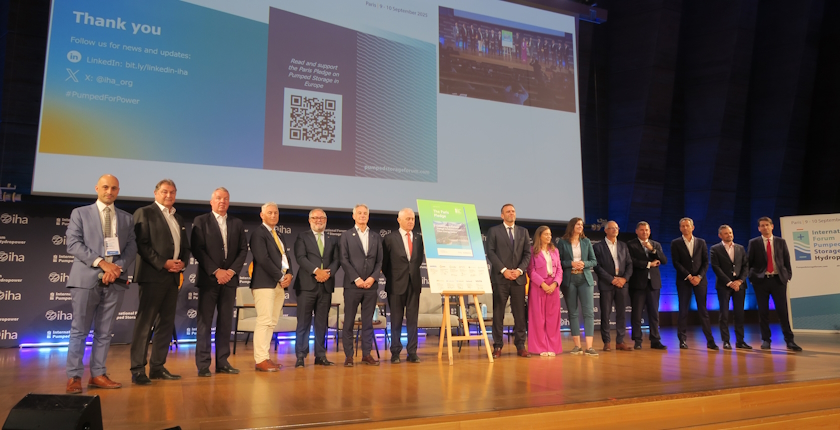
The International Hydropower Association (IHA) and Eurelectric launched the Paris Pledge. It is a collective call to action, aimed at unlocking the potential of pumped storage hydropower in Europe. The signatories urge the European Union and national governments to create the right conditions for long-duration storage to meet clean energy goals.

Over 50 utilities, hydropower suppliers and energy-focused associations have signed the Paris Pledge. The document’s alternative headline is Committing to Pumped Storage to Secure Europe’s Clean Energy Future.

The International Hydropower Association (IHA) and Eurelectric – Union of the Electricity Industry launched the initiative. They warned that Europe faces an urgent and growing need for long-duration electricity storage to secure a reliable, affordable and sustainable energy future.

Amid the transition to a renewables-dominated power system, the ability to store and dispatch electricity over long periods will be critical to balance variable generation from wind and solar, ensure grid stability and resilience, and reduce reliance on imported fossil fuels, the authors stressed. They called pumped storage hydropower or PSH the most important, scalable and cost-effective long-duration electricity storage solution available today. It still provides over 90% of the world’s long-duration electricity storage capacity.

PSH is currently the most important, scalable and cost-effective long-duration electricity storage solution, the industry pointed out

By 2050, around 86% of production capacity in Europe will come from variable sources, according to the material accompanying the Paris Pledge. Encouragingly, 78 pumped storage hydropower projects are under development, for 35 GW overall. The EU accounts for over 32 GW, and the rest is in Switzerland, Norway and Turkey.

The combined pipeline would provide storage capacity in excess of 700 GWh, equivalent to more than 10 hours of consumption of Italy and Spain taken together. There is 3.9 GW in the ready-to-build phase, and 2.8 GW is under construction. Of note, an earlier report showed 52.9 GW of PSH was under development.

The existing capacity amounts to 48 GW, compared to 190 GW globally. In the EU, pumped storage hydropower systems can store 1.2 TWh overall.

Photo: Types of pumped storage (IHA, Eurelectric)

Paris Pledge calls for separate legislation for long-duration energy storage

Among other proposals, the signatories are asking the EU for a dedicated initiative to boost the rollout of electricity storage. They suggested legislation to be separate for long duration, short duration and other solutions.

The Paris Pledge calls on member states to remunerate the provision of system services and security of supply for all time frames. They should eliminate double grid fees on electricity storage technologies and accelerate permitting for PSH, the document reads.

With strong political commitment, Europe can double its pumped storage hydropower capacity in the next 25 years, according to the Paris Pledge. In-person signatories represent EDP, EDF, Iberdrola, Andritz, Enel, Statkraft, Voith, Hydrogrid, Verbund, Landsvirkjun and GE Vernova.

Pumped storage hydropower’s contribution during Iberian Peninsula blackout

During the power blackout in Spain and Portugal on April 28, pumped storage played a pivotal role in balancing and supporting the recovery of the system. In Spain, PSH generated 11 GWh of electricity in the first 12 hours, instead of the planned 12 GWh recharge. Similarly, in Portugal, hydropower and pumped storage covered 80% of the demand in the first ten hours.

Such facilities also made a major contribution to restoring the electricity grid in the entire peninsula, thanks to their so-called black start capability. It allows the power plant to be restarted without relying on external power sources and to reenergise the power system.

“Very few technologies can provide this function. As a result, within a few minutes, the first pumped storage plants were ready for synchronization and awaiting dispatch instruction” from transmission system operators, notes the report published with the Paris Pledge.