by in News

Montenegro launches second BESS tender but for drastically smaller capacity

Power utility Elektroprivreda Crne Gore has launched its second battery energy storage system procurement tender. The required capacity is drastically lower than in the first call.

The initial public procurement was canceled because state-owned energy company Elektroprivreda Crne Gore (EPCG) didn’t obtain approval from the Government of Montenegro to take a loan for a EUR 58 million project.

The new tender envisages the procurement of a battery between 100 kW and 130 kW, with 200 kWh to 260 kWh in capacity. This is a pilot project, and the procurement is valued at EUR 75,000.

The canceled purchase was for two battery energy storage systems (BESS), at 30 MW and 120 MWh each.

The battery will be used on the distribution network

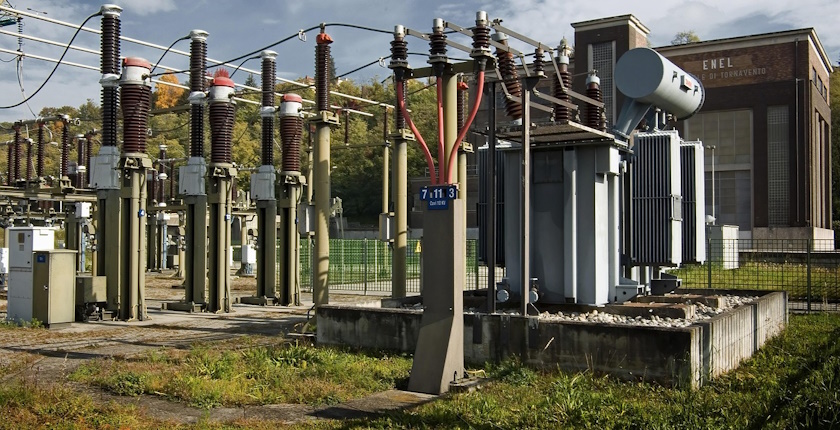
Potential locations include hydropower plant (HPP) Perućica, EPCG’s steel mill Željezara Nikšić, and the Pljevlja thermal power plant.

In the new call, the winning bidder will be obliged to secure a location for installing and testing the pilot BESS, according to the documentation.

EPCG explained that over the previous three years, its projects Solari 3000+, 500+, and 5000+ enabled a strong pace of the addition of prosumer solar power plants to the low-voltage, distribution network in Montenegro.

Although distributed generation has clear financial and ecological benefits, its rapid growth simultaneously brings a string of technical challenges for the distribution network, which was historically developed solely for supplying consumers and for unidirectional energy flow, according to the tender’s documentation.

EPCG sees the installation of batteries in substations as a solution to technical challenges caused by prosumers

The company sees the installation of BESS units within 10/0.4 kV substations as the solution for these challenges.

These batteries would be charged during the hours when photovoltaic facilities have high output in order to reduce and prevent reverse power flow. The idea is to discharge BESS units during hours of peak consumption and low voltage.

The main goal is to minimize voltage deviations in areas that the substations cover, during periods of production and consumption fluctuations. It would increase the hosting capacity for new prosumers, and enhance the stability of the distribution grid under an increased PV plant integration.

Scalability of the battery is one of the conditions for the bidders set by EPCG.
by in News

Greece’s first municipal energy community to be launched in its coal capital Kozani

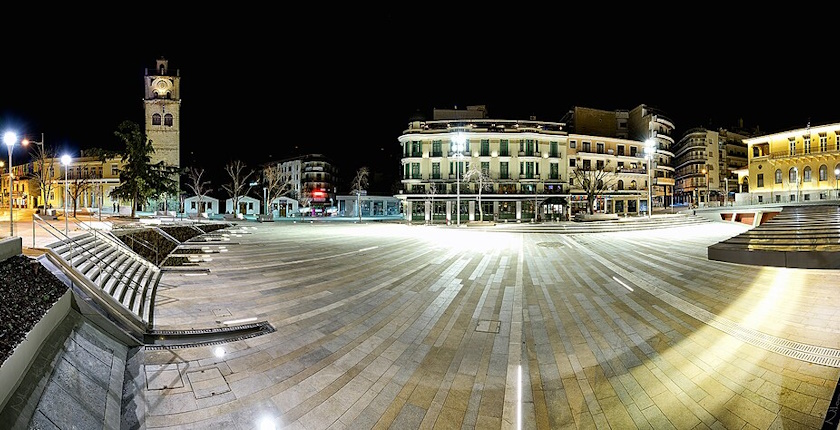
The city of Kozani in northern Greece, home of the country’s dwindling lignite industry, is seeking a contractor for seven photovoltaic systems of 7 MW overall. The municipality said the power plants would supply its buildings, public lighting, pumps and drilling rigs as part of the country’s first energy community led by a local authority. Under a virtual net metering scheme, the facilities are also intended for combating energy poverty.

Energy communities are present all over Greece, but private capital is dominant – instead of individuals, local institutions and small firms. The concept can be especially beneficial for local authorities in coal regions, which are undergoing rapid decarbonization and turning toward cutting-edge technologies.

Job losses and a lack of skills jeopardize communities in such areas. The Municipality of Kozani, the capital of Greece’s coal land, the region of Western Macedonia, is one of them. It was among the first in the country that launched initiatives for energy communities led by local authorities.

Deadline for applications is January 12

Kozani has opened a tender for the selection of a contractor that would build seven photovoltaic plants. The municipal solar power units would operate under a virtual net metering scheme.

It would enable supplying municipal buildings, street lighting, schools, sports facilities, pumps and drilling rigs, but also the means to fight against energy poverty. The municipality received funding via the European Union for the project, under a just development and transition program.

The city claimed that it would be the country’s first energy community of its kind. Prospective candidates can apply by January 12, and the selection is scheduled for January 16. The budget amounts to EUR 6.25 million including value-added tax, and the local authority participates with 20%.

Kozani already invested EUR 650,000 in its energy community

The project is placing the Municipality of Kozani in the lead in energy self-sufficiency and autonomy in the country, Mayor Yiannis Kokkaliaris said.

He revealed that the local authority managed to secure grid connection terms in time not to lose the EUR 650,000 that it spent so far for the purpose.

The Kozani area is already hosting some of Greece’s largest photovoltaic plants and projects. It is envisaged for one of six waste incinerators in the country. Government-controlled Public Power Corp. (PPC Group) plans to build pumped storage hydropower plants on its depleted open pit coal mines in the region.

Of note, Greece recently lost EUR 100 million from the European Union’s Recovery and Resilience Facility (RRF) for the Apollo program. It was aimed for self-consumption for vulnerable households through forming an energy community.

by in News

Energy communities reduce power bills for members, improve electricity market

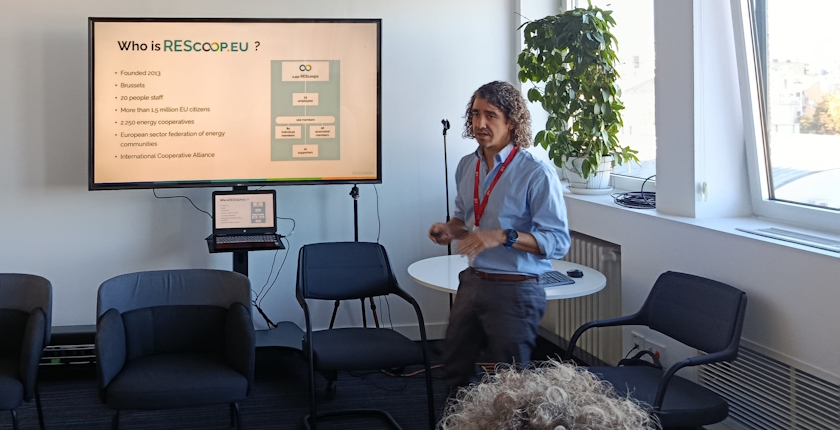
Citizen energy communities make the energy system greener and benefit society at a local level, Josh Roberts from European federation of energy communities REScoop said in his presentation, organized in Belgrade by Deutsche Gesellschaft für Internationale Zusammenarbeit (GIZ) GmbH. It is a form of association that also lowers costs for households, institutions and small firms and entrepreneurs, and contributes to the deployment of progressive technologies. Furthermore, it is a framework for democratic control.

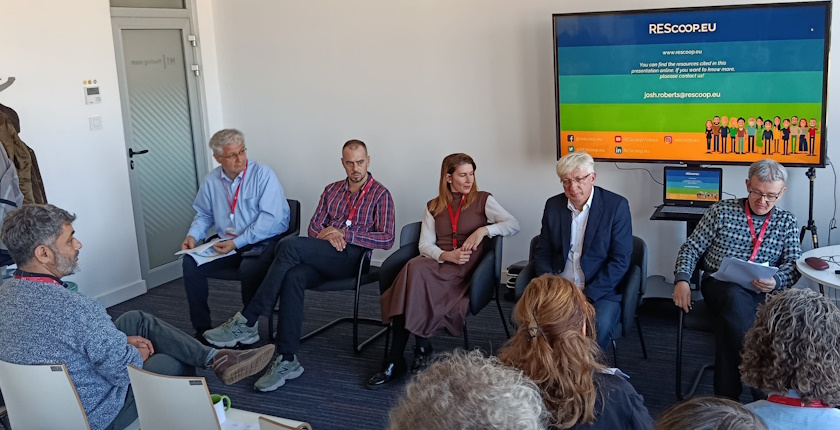
The event included developers from the emerging segment of energy communities and cooperatives in Serbia. They outlined the current initiatives and pointed to challenges regarding market entry, financing and policies.

The establishment and operation of energy communities is arranged through the European Union’s latest legislation, as well as in Serbia and other Western Balkan countries, but they are not a new concept. For instance, such entities still accounted for almost half of wind power output in Denmark in late 1990s, according to Senior Policy Advisor Josh Roberts from REScoop, the European federation of energy communities and cooperatives.

Speaking at a gathering that GIZ organized in Belgrade he pointed to the benefits for citizens, small firms and entrepreneurs and for institutions from setting up or joining energy communities. Initiatives in Serbia were also presented, and their progress in the same field, and the event included dialogue on the necessary technical solutions for connecting to the distribution grid.

Brussels-based REScoop was founded in 2013. In its membership are organizations from 22 European countries. They include Serbian energy cooperative Elektropionir. It gained the most ground regarding association and the implementation of projects.

One coal town has put up signpost for energy communities in Slovenia

Among other examples, Roberts highlighted Slovenia’s first energy community with a rooftop solar power plant for joint use. The facility is on the roof of an elementary school. The project involves aid for people living in energy poverty and it is free to join the group.

It is in the town of Hrastnik in a former coal industry area. The participants already lowered their power bills by 30%, and the gains will be even greater when they pay off the loan, Roberts said.

There are more than 1,600 energy communities in Austria

The representative of the REScoop federation stressed that municipalities in the Belgian region of Wallonia have succeeded in obtaining the right for citizens to participate in investments in green energy projects. It resulted in the foundation of a range of energy communities.

Roberts especially commended Austria’s legal framework with regard to enabling citizens to participate. The country hosts more than 1,600 energy communities.

Udruzivanje energetske zajednice smanjuje troskove trziste elektricne energije Dzos Roberts Josh REScoop GIZ

Energy community eases grid operator’s job

Energy communities are envisaged to return the invested funds to society at the local level. Subsidies are especially favorable for that, Roberts explained. Income is directed to education, infrastructure and aid against energy poverty.

The essence is that the community controls the distribution of the proceeds. In addition, grid operators can communicate more easily with one entity than with a hundred prosumers, Roberts underscored. Prosumers – or buyers-consumers, as they are formally called in Serbia, generate electricity for their own needs.

Pooling together enables providing services in the market, where energy communities can supply and store energy as well as conduct energy efficiency services, among other activities.

It means an entity of such type can ease the evening grid load, in moments of the highest demand, using energy from its batteries. That way, price peak shaving is achieved.

Registration process must be separate from defining activity

As for the procedure, Roberts said registration needs to be only for acknowledgement, rather than for approving specific activities.

“It’s about acknowledging the legal form and it’s about checking about how that legal form ensures compliance with the eligibility criteria. We have found very complex registration procedures. This does not work. It needs to be simple,” he stressed.

There are many activities that energy communities can undertake and they need to be able to enter them gradually, without complex procedures for licenses and permits

Conversely, in some jurisdictions there are simplified ways to get a supplier license. It enables an energy community to enter the activity gradually, instead of having to fulfill the requirements for all segments, even without having a comprehensive business model, the members or a business case, Roberts said.

He mentioned at the same time that one of the basic ideas is promoting inclusiveness.

“It’s already hard to set up an energy community, but it’s even harder to involve members who may have a hard time paying their bills, or have a lot less disposable income. So we found that the best models at the moment are for energy communities either to front the membership fees or for local authorities to pay for this upfront. And in energy sharing, we’re seeing more and more of energy donated to vulnerable households,” he stated.

Energy cooperatives helping improve rural areas from which people are leaving

Energy communities are giving people an opportunity for climate action and to contribute to their community, Roberts said. He added that such projects improve the area where they are conducted, stressing that it is especially important for rural areas from which many people are leaving.

A key point is that they enable participants to control their costs, production, consumption and energy sharing.

 The main challenge in Serbia is how to obtain a grid connection, alongside the matter of accessibility of incentives and loans

Importantly, energy communities are linked to the tradition of cooperatives, for which Serbia used to be known, but there is still much left to do around the legal framework.

There was word at the said gathering with representatives of institutions about the complexity of adjusting the electricity network to the production’s decentralization, as well as about the possibility to streamline the procedure for the establishment of energy communities and their operation.

Serbia is yet to address the accessibility of subsidies and financing, while currently the main issue is how to get grid connection approvals.

Energetsko zadrugarstvo smanjuje troskove trziste elektricne energije GIZ

Enterprise, association or cooperative

The speakers and other participants in the event agreed that the electricity market isn’t complete without energy communities, while that they modernize and democratize it.

When it comes to Serbian regulations, such legal entities have the right to conduct aggregation, but they need a license for it. Notably, aggregators have balancing responsibility, so they need to cover the deviations from the forecasted output.

Energy communities were introduced in the latest version of the Law on Energy. When they become regular in practice, the framework will need to be adjusted gradually to the situation. Citizens, firms and municipal authorities establish energy communities as enterprises, associations or cooperatives.

The bottom line is to enable citizens to take part in the clean energy transition and achieve local environmental, economic and social benefits, as opposed to prioritizing profits. It implies collective ownership, democratic control and reinvestment into the community with the goal of reducing energy poverty and promote energy independence.

The basic technical requirement for members is to have a smart electricity meter.

Elektropionir pioneering agrisolar in Serbia

The event’s organizers gathered the people who achieved the first steps in Serbia – from the Sunčani krovovi (Sunny Roofs) energy cooperative, created in 2019, to Platform for Energy Transition, which participated in uniting three residential buildings in Niš, which have a joint solar power plant and electric vehicle chargers. It is one of the first six prosumers in Serbia in the category of homeowner associations.

The Elektropionir energy cooperative managed through crowdfunding to install two cooperative-owned rooftop solar power systems on the territory of the City of Pirot, on the buildings of a local community council and a cultural center. As part of the Solarna Stara project, on Mt. Stara planina, the two villages receive the income from the sale of surplus electricity.

Srem is set to become the main region in Serbia for community energy

Next, the same organization built the first agrisolar power plant in Serbia. The 20 kV facility is at an organic farm, Organela, near the city of Valjevo.

Another recent undertaking is a rooftop photovoltaic unit on a school in the town of Ruma, envisaged to be the basis for an energy community. In the same area, Elektropionir is working on the installation of several prosumer power plants on house roofs and on aggregating them, inspired by the enthusiasm and the solar system of its member Nenad Maričić.

Owners and neighbors can jointly invest and they will be able to become an energy community and share energy among themselves.

Center for Sustainable Development to integrate string of energy systems of various technologies

Near Ruma, which is in the Srem (Syrmia) region, the City of Sremska Mitrovica and Regional Development Agency Srem have launched a major project. It is for the establishment of renewable energy communities (RECs), which are essentially a subset of citizen energy communities (CECs).

The local authority provided land for research and development. It is next to the regional waste landfill and a wastewater treatment plant. The plan is that the Center for Sustainable Development builds and integrates a string of energy systems.

They would include combined heat and power (CHP) production – cogeneration – from biomass, small wind turbines and a PV plant. The project also involves heat pumps and a storage facility assembled from old batteries.

There would be a facility running on biogas from the landfill within the center, and a magnet electric generator. Residents of the adjacent village of Jarak would be able to join the energy community.

Belgrade Energy Community is focused on equity, solidarity

Another group emerging in community energy is Belgrade Energy Community. It intends to apply a model of collective self-consumption in an urban area, with a focus on trust, equity and solidarity.

Its idea is to enable people to generate, share and use green energy. The plan is to map roofs and consumption and set up the first pilot installations.

According to the Belgrade Energy Community, it will donate 5% of the output to households affected by energy poverty. It consists of a cooperative, a civil society organization, two small enterprises, several prosumers and citizens.

by in News

Greek regulator steps in to prevent energy communities misuse

Legitimate energy communities have suffered in Greece, as private investors have been taking advantage of the status to promote disguised commercial projects.

Normally, energy communities are set up to help citizens, businesses and other special consumer groups to benefit from lower energy costs using renewable energy.

There are two categories: renewable energy communities (RECs) and citizens energy communities (CECs). They have priority in obtaining licenses compared to commercial investments. They are exempt from letters of guarantee and have access to national and European funding and a higher feed-in tariff.

A law was adopted in 2023 to restrict production licenses for energy communities. It also had the goal of excluding other market actors from participating. However, it appears that the attempt was unsuccessful.

A gap in the regulatory framework allowed private companies and individuals to create energy communities and benefit from the various licensing and financial benefits to promote projects that would otherwise not be eligible. In short, such investors appear as legitimate small participants, while actually representing larger private companies.

Psomas: Just 2.8% of installations are for self-consumption

By April 2025, energy communities installed facilities totaling 2.24 GW, of which just 62 MW (or 2.8%) for self-consumption. They also held about 22% of total licensed capacity for photovoltaics in the country, according to energy consultant Stelios Psomas.

The law stipulates that legal entities participating in REC and CEC management boards must be mutually independent and not connected directly or indirectly through other businesses or natural persons.

According to the Regulatory Authority for Energy, Waste and Water (RAAEY or RAEWW), the minimum of 15 legal entities to set up a community refers to 15 independent entities. Otherwise, there is no guarantee they would act towards the benefit of local communities and not as a vehicle to promote the commercial interests of individuals or business groups, it pointed out.

RAAEY said it would intervene to enforce the essence of the law more aggressively. It added that if irregularities are discovered, an energy community may lose its production license. The regulator revealed it would conduct investigations both due to complaints and on its own.

Greece downgraded because of lost EU funds

The government recently lost of EUR 100 million from the European Union’s Recovery and Resilience Facility (RRF), aimed at promoting self-consumption for vulnerable households through forming an energy community.

The loss of funds for the Apollo program triggered a downgrade by REScoop, the European federation of energy communities. It said there were no more dedicated European funds to support energy communities in Greece.

EECF to provide a second chance

Greek energy communities may gain another source of European funding through the European Energy Communities Facility (EECF).

More than 140 of them across Europe will be supported through the program with EUR 45,000 per project. Greece submitted 29 proposals in the recent first call that took place at the end of September. The final list of beneficiaries will be announced in December, with a second call expected in May 2026.

by in News

Corinth Pipeworks commissions Greece’s biggest industrial rooftop PV system

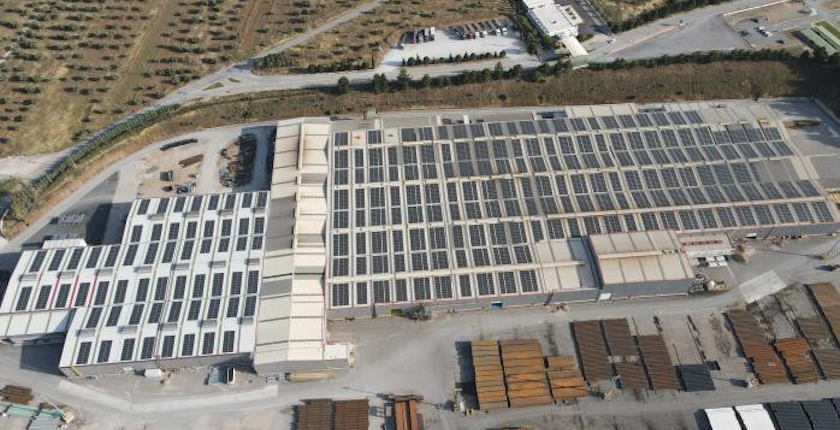
Steel pipe manufacturer Corinth Pipeworks has put into operation a 7.1 MW photovoltaic facility on its plant in the Thisvi Industrial Area. It is the largest industrial rooftop PV system in Greece, the company said.

A steel pipe factory northwest of Athens will cover an estimated 25% of its electricity needs with its new solar power plant, generating some 10 GWh per year. Corinth Pipeworks (CPW) revealed that it has commissioned the 7.1 MW system, pointing out it is the largest industrial rooftop photovoltaic facility in Greece.

The company, owned by Cenergy Holdings, conducted the endeavor under an ESCO scheme. The project was entirely designed and implemented by Survey Digital Photovoltaics. It was financed by investment firm Sirec Energy and Survey Digital Photovoltaics, in collaboration with Piraeus Bank.

Under the terms of the 10-year lease, the system will be transferred at no cost to Corinth Pipeworks. The behind-the-meter PV plant is for own consumption, injecting no electricity into the high-voltage grid.

Corinth Pipeworks surpassed its 2025 target of sourcing 80% of its energy consumption from renewables

The facility spans almost six hectares on two factories, at a height of ten meters. It consists of 12,000 solar panels.

With the photovoltaic plant and a power purchase agreement (PPA) for a wind farm, CPW surpassed its 2025 target of sourcing 80% of its energy consumption from renewables. The company’s portfolio includes pipes for hydrogen pipelines.

“This choice carries particular significance, as it comes from an organization with both the technical capacity to develop the photovoltaic system and manage the generated energy, as well as the financial capacity to finance the investment independently. Yet, it chose to move forward in collaboration with us and Survey Digital Photovoltaics, recognizing the value of strategic partnership,” said Vice President of Sirec Energy Vangelis Bardis.

A subsidiary of Viohalco, Belgium-based Cenergy Holdings also controls Hellenic Cables, which manufactures power and telecommunications cables.

by in News

CMS committed to sustainability – first law firm in Belgrade with solar power plant on its rooftop

CMS is the first law firm in Belgrade to install a solar power plant on the roof of its own building. The plant has been in operation for nine months now.

Two months ago, it also obtained official status as a prosumer (buyer-producer) of electricity. It is an important milestone in CMS Belgrade’s transition to more sustainable energy use, according to the announcement.

Since reaching full operating capacity, the solar plant has covered around 50% of its total electricity consumption.

The long-term goal is ambitious yet achievable, according to CMS Belgrade: 70% of electricity consumption from solar by the end of 2025, and 100% within the next three years.

“Sustainability is not just a goal — it’s a responsibility, and one we are committed to integrating into every part of our business,” the announcement reads.

Radivoje Petrikić, the Managing Partner at CMS Belgrade (Petrikić & Partneri AOD in cooperation with CMS Reich-Rohrwig Hainz), said: “We are committed to integrating eco-friendly practices into every aspect of our business. By embracing sustainability in our daily operations, we are not only shaping a brighter future for our firm but also contributing to a greener planet for generations to come.”

The office is part of international law firm CMS CEE, based in Vienna.

by in News

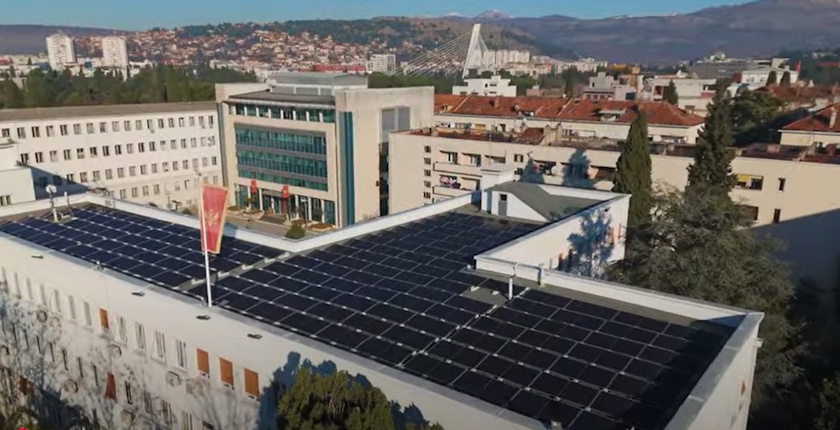
Parliament of Montenegro installs solar power plant

The solar power plant on the roof of the Parliament of Montenegro in Podgorica has started producing electricity. The plant’s total peak capacity is 81 kW, and it is expected to generate approximately 100,000 kWh per year.

Montenegro is likely the first country in the former Yugoslavia to install solar panels on the roof of its parliament. This project represents an important step towards sustainable development and the efficient use of energy resources, according to the Parliament of Montenegro.

The installed photovoltaic system consists of 150 monocrystalline solar panels, each with a capacity of 540 W. The total peak capacity of the plant is 81 kW. Electricity is delivered to the grid through a 70 kVA inverter.

The estimated annual power production of 100,000 kWh will cover a significant portion of the assembly’s consumption and contribute to reducing greenhouse gas emissions. This achievement will promote the parliament into a prosumer.

The solar plant will cover a significant part of the parliament’s consumption

The parliament underlined that the implementation of the project represents its commitment to improving energy efficiency. It recalled that the previous renovation enabled a significant decrease in the power consumption.

This year, the assembly plans to start modernizing its cooling system and boost energy efficiency with a new facade. The activities are set to be finished in 2026, further enhancing the overall energy balance of the building.

For years now Montenegro has been implementing a program for the installation of solar panels on the roofs of households and businesses

The Parliament of Montenegro said that, as a socially responsible institution, it is strategically oriented towards modern sustainability standards, rational management of public funds, and environmental protection.

For years now, Montenegro has been implementing a program for the installation of solar panels on the roofs of households and businesses. Power utility Elektroprivreda Crne Gore (EPCG) is in charge of the program. Solari 3000+ and Solari 500+ are finished, and Solari 5000+ is underway.

Of note, the Government of Serbia also announced its intention to install photovoltaic units and become a prosumer. However, there are currently no new updates regarding the implementation of this project.

by in News

Croatia installs one million smart meters, Serbia reaches 650,000

Croatia has so far installed one million smart meters, while Serbia has reached 650,000. They make up 40% of all power metering devices in Croatia, compared to a 17% level in Serbia.

Digital or smart meters offer numerous advantages for consumers and distribution system operators (DSOs). The devices are a cornerstone of future distribution networks – smart grids that will allow consumers, including many prosumers, to both draw electricity from the network and inject it. Smart grids also enable consumers to provide various flexibility and demand response services.

The smart meters rollout in Croatia is being implemented across the country, with about 40,000 new devices installed per month. Croatia’s DSO HEP-Operator Distribucijskog Sustava (HEP ODS), a subsidiary of state-owned power utility Hrvatska Elektroprivreda (HEP), has previously announced that it intends to replace all 2.5 million devices by the end of 2029.

Nearly all users in the business category have received new devices

Installation of new meters is completely free of charge for customers. It takes about twenty minutes. HEP underlined that smart meters offer a range of benefits – enabling simpler and remote reading of consumption, more precise consumption management, better planning, and savings.

Danijela Žaja, chief of the metering and market support sector of HEP ODS, told RTL that more than one million smart meters have been installed so far for households and firms. In the business category, almost all meters have already been replaced, she said, Poslovni Dnevnik reported.

In her words, new devices help consumption management.

Serbia is financing new meters with loans

According to Ana Pavlović, head of the electricity markets support sector of neighboring Serbia’s DSO Elektrodistribucija Srbije (EDS), so far the company has installed almost 650,000 smart meters.

EDS plans to set up another 200,000 units in the next round, financed by a loan from the European Bank for Reconstruction and Development (EBRD), she said at a conference organized by Energija Balkana.

Out of the 200,000 meters, the cities of Čačak and Kraljevo are earmarked for 30,000 each, and 140,000 are for consumers in Niš. The next project is the installation of 400,000 smart meters, to be financed by a loan from the European Investment Bank (EIB).

Niš will be one of the first cities in Serbia to be almost entirely covered by smart meters, Pavlović stressed, as quoted by Tanjug.

by in News

Romanian prosumers propose measures to cut electricity bills by up to 60%

The Association of Energy Prosumers and Communities in Romania has called on the government to implement five measures that could swiftly reduce electricity bills.

The measures target both individual homes and multi-apartment buildings, and results could be visible in up to 12 months, according to the Association of Energy Prosumers and Communities (APCE).

The association pointed out that the measures are needed because consumers in Romania pay some of the highest energy prices in Europe.

The first measure is related to energy communities, as the country is lagging in implementing the relevant EU legislation. The association claims that the introduction of energy communities lowered energy bills in Spain by 60%.

The association called on the authorities to involve civil society in the lawmaking process

Such structures allow citizens to directly manage their energy production, distribution, and storage, achieving independence from traditional suppliers and producers, the APCE noted.

The association called on the authorities to involve civil society in the lawmaking process, and underlined that adoption could be completed in three months, with bill reductions within 3–12 months.

The second measure involves multi-apartment buildings. Through a simple legislative change, residents could become direct beneficiaries of solar energy produced on the roofs of their buildings, the APCE pointed out.

Romania could install up to 4,000 MW of rooftop solar on multi-apartment buildings

Romania, the association notes, could install up to 4,000 MW of solar power plants on 4,200 hectares of apartment building roofs. The proposed legislative changes could be adopted within three months, with results visible after 3–12 months.

Mini-PV systems for balconies have the potential to lower electricity bills by 60%, according to the APCE’s calculation. In Germany, over a million such systems have already been installed, leading to monthly bill reductions of more than 60%.

The association estimates that the legislation needed for their rollout could be adopted within 30 days, and results could be visible immediately after installation.

Tackling suppliers’ excessive profit margins

The regulation of the supply margin for energy produced by prosumers is the fourth proposed measure. The association said that in 2025, a surplus of almost 2 billion kWh of renewable energy would be injected into the grid by prosumers.

Romania’s regulator, ANRE, left it to suppliers to set their profit margins, resulting in high prices for electricity resold to consumers.

PACE calls for a clear regulation of the supply margin to ensure that electricity produced by prosumers reduces consumer bills.

Reducing transmission tariffs for the TSO

The estimated timeframe is up to three months for the measure to be adopted, with visible reductions in bills expected immediately after implementation.

The final measure is a reduction of transmission tariffs for the transmission system operator (TSO) Transelectrica.

Even though the TSO does not transport prosumers’ surplus electricity, it still charges them for the service. It collected over EUR 18 million in 2024, the APCE claims, adding that the figure for 2025 is estimated to be EUR 35 million.

by in News

Prosumers in Romania are neck and neck with commercial PV plants in capacity

The latest data showed that prosumers in Romania don’t have a much larger total capacity anymore than commercial solar power plants, a segment accelerating in expansion. The share of units for self-consumption that include energy storage reached 5.8% in the first half of the year, compared to 1.2% six months earlier.

Total number of prosumers in Romania increased by 8,950 in June, to 237,252, Profit.ro reported. The installed capacity, consisting overwhelmingly of photovoltaic panels, rose by 95 MW, to 2.82 GW, the media outlet added, citing data from the National Energy Regulatory Authority (ANRE).

Total installed capacity of large, commercial solar parks is 2.77 GW, according to the article. Both segments are expanding strongly, but the latter has lately accelerated, with new utility-scale PV facilities coming online week after week. Of note, wind power and battery energy storage systems (BESS) are catching up.

On that note, 5.8% of prosumers also had batteries integrated with their self-consumption units on June 30. It compares to 1.2% at the end of last year.

Prosumers have led the energy transition for the past two years. Their overall capacity surpassed 2 GW just a year ago, translating to 37% growth in ten months.

Output in the segment amounted to 434 GWh in the first half of the year, where net domestic consumption declined 1% and net energy production surged 10%. Namely, as the duration of the daily solar radiation interval rose, prosumers in Romania drew less power from the grid and consumed more of what they generated themselves.

At the end of the first half of 2025, 210,714 households were prosumers, versus 26,538 legal entities. They had 1.34 GW and 1.48 GW installed, respectively.