by in News

Under Reform Agenda, BiH commits to aligning electricity prices with market

By adopting the Reform Agenda, Bosnia and Herzegovina committed to liberalizing the electricity market, aligning electricity prices with market levels, and supporting the green transition through renewable energy sources and energy efficiency.

The Council of Ministers of Bosnia and Herzegovina adopted the Reform Agenda, after a delay longer than one year, and submitted it to the European Commission. It made the move just as the deadline, set by the commission, was about to expire on September 30.

If it failed to adopt the document, BiH would have lost EUR 108 million out of a total of EUR 976.6 million that was allocated to the country under the Growth Plan for the Western Balkans, worth around EUR 6 billion overall. Due to the delay, BiH already lost EUR 108 million in July.

The first step in price harmonization is to conduct a study on different scenarios

One of the obligations from the Reform Agenda is to align household electricity prices with market prices in the region and the European Union by 2027, domestic media reported.

The measure is aimed at making price formation more transparent and integrating BiH better into the regional and European electricity markets.

The first step in price harmonization would be to conduct a study on different scenarios for price deregulation for households. It will serve as a tool to plan price increases. The study is expected to be completed before the end of the year.

The current price of electricity in BiH is below ten eurocents

According to the latest Eurostat data, for the second half of last year, the price of electricity for households in BiH was below ten eurocents. Prices in the European Union ranged from ten eurocents in Hungary to 40 in Ireland.

The European Commission is required to assess the Reform Agenda and approve it if it matches expectations. Payments are directly linked to the measures that governments in the region vow to implement.

Of note, in early July, the European Commission proposed the first tranches from the support package, worth EUR 87.7 million in total, for projects in Albania, Montenegro, and Serbia.
by in News

Von der Leyen: EU needs more homegrown renewables with nuclear as baseload

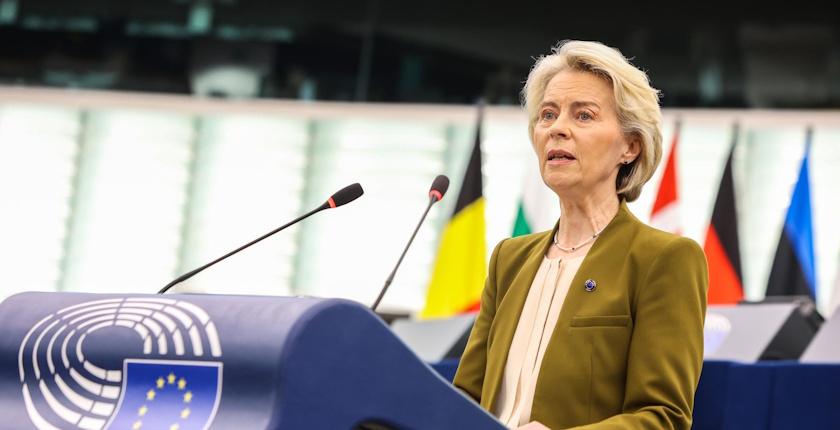
European Commission President Ursula von der Leyen delivered her 2025 State of the Union address at the European Parliament in Strasbourg. She said the single energy market would be completed and pointed out that clean homegrown energy is a tool to lower energy prices.

Ursula von der Leyen said the European Union’s greatest asset is the single market, but that it remains incomplete. The IMF, she noted, has estimated that the internal barriers within the single market are equivalent to a 45% tariff on goods, and 110% on services.

Most gaps are in three domains: finance, energy, and telecommunications.

“We need clear political deadlines. This is why we will present a single market roadmap to 2028. On capital, services, energy, telecoms,” she stated.

Energy bills are still a real source of anxiety for millions of Europeans

The EU’s top official said the commission would put forward a series of packages on affordability and the cost of living. One would be for energy.

Von der Leyen recalled that the EU managed to stabilize prices and secure supply during the energy crisis, and insisted that the 27-member bloc is now on the path to energy independence.

But, she told EU lawmakers, energy bills are still a real source of anxiety for millions of Europeans.

Von der Leyen unveiled an initiative called Energy Highways

“We know what drove prices up: dependency on Russian fossil fuels. So it is time to get rid of dirty Russian fossil fuels. And we know what brings prices down: clean homegrown energy. We need to generate more homegrown renewables – with nuclear as a baseload,” Von der Leyen stressed.

She reiterated that the commission would propose a grids package to strengthen infrastructure and speed up permitting.

Von der Leyen unveiled an initiative called Energy Highways. “We have identified eight critical bottlenecks in our energy infrastructure. From the Øresund Strait to the Sicilian Canal. We will now work to remove these bottlenecks one by one,” the European Commission president asserted.

by in News

US electricity prices soar 40% in H1 2025, outpacing EU’s 30% increase

In the first half of 2025, wholesale electricity prices in the European Union were about 30% higher than in same period of 2024, while a 40% increase was recorded in the United States. The penetration of negative prices in the EU continues, with their share doubling in H1 2025, according to the latest report of the International Energy Agency.

Wholesale electricity prices in the EU averaged around USD 90 per MWh as costs were mostly underpinned by natural gas prices, which were on average about 20% above the levels from 2024, IEA’s Electricity Mid-Year Update 2025 reads.

Prices saw upward pressure from a boost in fossil-fired generation due to a year-on-year drop in electricity generation from wind and hydropower.

While average power prices remained below the 2023 levels, they were higher than in 2019, according to IEA. The latter is a reference year because it was the last one before turbulences started – the COVID-19 pandemic, energy crisis, and the war in Ukraine.

Electricity prices in the Nordics remained the lowest in Europe

Latest futures prices in the EU average USD 80 per MWh for 2026, indicating a decline of around 15% from 2025, the report underlines.

High gas prices also affected the electricity market in the US, combined with colder weather. Power prices averaged around USD 48 per MWh. However, the increase was from a low base, as prices in the first half of 2024 were the lowest for the first half of the year since 2020, the report notes.

Average electricity prices in the Nordics remained the lowest in Europe, falling by more than 20% year-over-year in the first six months of 2025 to about USD 40 per MWh. It was the result of an increase in wind power generation and higher hydropower output, according to the report.

The update brings details on Germany, France, Japan, India, Australia, and the United Kingdom as well.

Occurence of negative prices doubled

IEA notes that the frequency of negative wholesale prices is increasing in various markets, underscoring the need for greater flexibility in supply and demand. The authors of the report propose appropriate regulatory frameworks and market designs to boost greater demand response and energy storage.

The share of hours with negative prices on the wholesale market reached 8% to 9% in the first half of the year in countries such as Germany, the Netherlands, and Spain – up from between 4% and 5% in 2024, the report reads.

The average price this year in the EU is expected to be twice as high as in the US and about 50% higher than in China

Electricity prices for energy-intensive industries continued to vary significantly across regions. After declining since their 2022 peak, they are expected to rise year-on-year in 2025 in the EU, driven by higher wholesale price levels.

The average price this year in the EU is expected to be twice as high as in the US and about 50% higher than in China, according to IEA projections. By comparison, in 2019, prices in the EU were approximately 50% higher than in the United States and 20% higher than in China.

The cost differences continue to pose challenges for the competitiveness of energy-intensive industries in the EU, IEA stressed.

by in News

Electricity prices for Slovenian firms among highest in EU in 2024

Last year, Slovenian households had cheaper electricity than the European Union average while the tariffs for other categories of consumers, including businesses, were among the highest in the EU, according to an analysis by Slovenia’s transmission system operator ELES.

The analysis, conducted by ELES CEO Aleksander Mervar, also showed network fees are significantly lower than the EU’s average.

Slovenia is in the bottom third of the list of the 27 member countries. As for its neighbors, domestic prices were higher than in Hungary and Croatia, and lower than in Austria and Italy, Naš Stik reported.

Last year, Bulgaria had the lowest prices in the EU, followed by Malta, Luxembourg, Hungary, and Croatia. When measured against purchasing power, prices in Slovenia are in the lower half of the list.

The Government of Slovenia has capped electricity prices for households

The analysis attributes the lower tariffs for households mainly to measures that the Government of Slovenia introduced. The two main interventions were setting a maximum price for 90% of consumption, and freezing the payment of a fee for subsidizing electricity production from renewables and high-efficiency cogeneration.

From January 1 to October 31, the maximum price was 8.2 eurocents per kWh in the lower tariff and 11.8 eurocents per kWh in the higher one. They were the maximum prices for 90% of consumption, while the remainder was set by suppliers in line with the market conditions.

Without government measures, the annual bill of the average Slovenian household, with an annual consumption of 4,000 kWh, would be higher by EUR 345.89 or 45.77%, according to the calculation.

ELES denies network fees impacted competitiveness of firms

The conditions for businesses were different. Prices for commercial and industrial consumers were among the highest in the EU. However, the domestic average was lower than in neighboring countries.

Businesses in Serbia experienced a similar issue last year.

ELES denied the claim by the Chamber of Commerce and Industry of Slovenia that high network fees lowered corporate competitiveness. The company argued they were significantly lower for commercial consumers, by 36.5% to 49%, than the EU average.

In addition, network fees are as much as 53% below the level in the countries surrounding Slovenia, according to the ELES analysis.

Network fees for households in Slovenia are among the lowest in the EU.