by in News

Apple signs PPAs in Greece, Romania as part of drive to green its devices’ consumption

As part of efforts to ensure that all electricity consumed by Apple devices is matched with green energy, the United States–based tech giant is facilitating 650 MW of renewables projects across Europe, including through power purchase agreements (PPA). By 2030, wind and solar power plants in Spain, Greece, Italy, Latvia, Poland, and Romania are expected to generate over 1 TWh of clean electricity on behalf of Apple users, the company said.

“By 2030, we want our users to know that all the energy it takes to charge their iPhone or power their Mac is matched with clean electricity,” said Lisa Jackson, Apple’s vice president of environment, policy, and social initiatives.

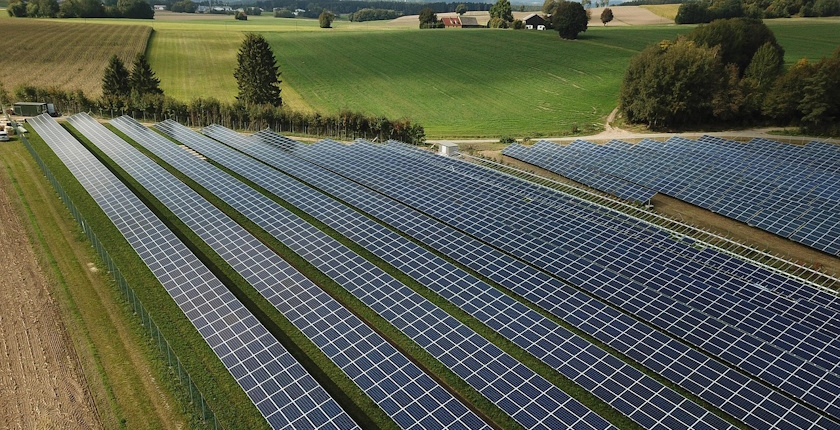
In Greece, Apple has signed a long-term PPA to procure power from a 110 MW solar project owned by HELLENiQ Energy. The plant, which is already fully operational, is located in Kozani in northern Greece.

Apple has signed a long-term power purchase agreement for a 110 MW solar plant in Greece

In Romania, the company plans to procure power from the 99 MW Green Breeze wind farm, located in Galați County, through a long-term virtual power purchase agreement (vPPA). The facility, which is scheduled to start operations in the first half of 2026, was initiated by Sweden-based OX2 and later sold to Nala Renewables.

In Italy, Apple is supporting the development of a 129 MW portfolio of solar and wind projects. The first of the facilities, a photovoltaic plant in Sicily, is expected to come online this month.

The project backed by Apple in Poland is for Econergy’s 40 MW solar array, which is expected to be operational later this year. In Latvia, the tech giant has signed one of the country’s first corporate PPAs. It will procure electricity from European Energy’s 110 MW solar power plant, set to be one of the largest in Latvia once completed.

The 131 MW Castaño solar farm in Spain came online earlier this year

The 131 MW Castaño solar farm in Segovia in Spain, operated by ib vogt, became operational earlier this year.
by in News

Corinth Pipeworks commissions Greece’s biggest industrial rooftop PV system

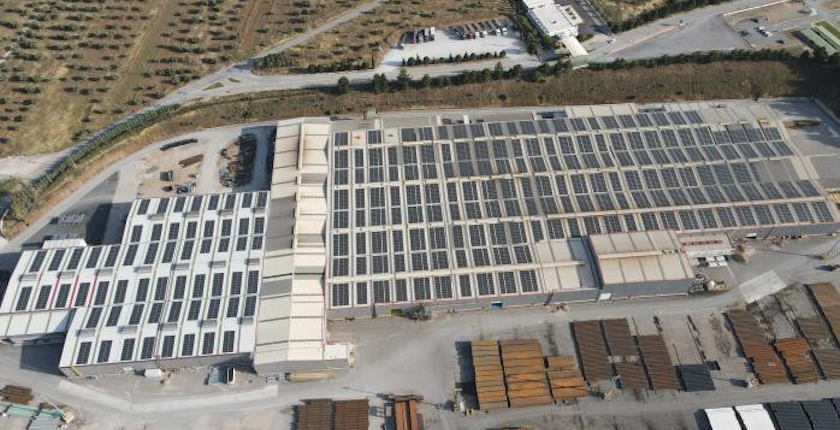
Steel pipe manufacturer Corinth Pipeworks has put into operation a 7.1 MW photovoltaic facility on its plant in the Thisvi Industrial Area. It is the largest industrial rooftop PV system in Greece, the company said.

A steel pipe factory northwest of Athens will cover an estimated 25% of its electricity needs with its new solar power plant, generating some 10 GWh per year. Corinth Pipeworks (CPW) revealed that it has commissioned the 7.1 MW system, pointing out it is the largest industrial rooftop photovoltaic facility in Greece.

The company, owned by Cenergy Holdings, conducted the endeavor under an ESCO scheme. The project was entirely designed and implemented by Survey Digital Photovoltaics. It was financed by investment firm Sirec Energy and Survey Digital Photovoltaics, in collaboration with Piraeus Bank.

Under the terms of the 10-year lease, the system will be transferred at no cost to Corinth Pipeworks. The behind-the-meter PV plant is for own consumption, injecting no electricity into the high-voltage grid.

Corinth Pipeworks surpassed its 2025 target of sourcing 80% of its energy consumption from renewables

The facility spans almost six hectares on two factories, at a height of ten meters. It consists of 12,000 solar panels.

With the photovoltaic plant and a power purchase agreement (PPA) for a wind farm, CPW surpassed its 2025 target of sourcing 80% of its energy consumption from renewables. The company’s portfolio includes pipes for hydrogen pipelines.

“This choice carries particular significance, as it comes from an organization with both the technical capacity to develop the photovoltaic system and manage the generated energy, as well as the financial capacity to finance the investment independently. Yet, it chose to move forward in collaboration with us and Survey Digital Photovoltaics, recognizing the value of strategic partnership,” said Vice President of Sirec Energy Vangelis Bardis.

A subsidiary of Viohalco, Belgium-based Cenergy Holdings also controls Hellenic Cables, which manufactures power and telecommunications cables.

by in News

Aurora: Romania’s third CfD auction is key for 2030 targets as solar outpaced wind

Aurora Energy Research expects strike prices at the additional renewable energy auction in Romania, for the remaining wind power quota, to land near the ceiling, set at EUR 80 per MWh. In the previous round, there was strong competition between the bidders for the photovoltaic segment, while developers of wind energy projects may have seen more value in PPAs and merchant options.

Increased costs and stricter eligibility rules constrained wind participation in Romania’s second contracts-for-difference (CfD) round in August, which fell short of the 2 GW wind target. Developers may have seen more value outside the CfD framework, according to Aurora experts, who stressed that power purchase agreements (PPAs) and merchant options offer higher returns than the capped CfD strike prices.

Solar projects showed stronger economics, with strike prices between EUR 35 per MWh and EUR 45 per MWh, compared to wind at EUR 65 per MWh to EUR 79.5 per MWh.

“Using the same commercial operation date for both PV and wind projects has disincentivised wind participation in CfD rounds, since wind developments are far more complex. Their permitting, grid connection, and EPC timelines are significantly longer than solar, making the uniform deadline misaligned with project realities,” said Project Leader at Research Associate at Aurora Energy Research Filippos Falieros.

Dedicated auctions can influence market dynamics

As wind is essential for achieving 2030 renewable targets, the Romanian Ministry of Energy invited developers to submit expressions of interest for mature wind projects only, with contracts expected to be signed by the end of 2025. The third auction will focus on wind energy solely, with a maximum strike price set at EUR 80 per MWh, and Aurora expects strike prices near the ceiling.

In the second auction, accepted wind power bids were between EUR 65 per MWh and EUR 79.5 per MWh

The move underscores the growing divergence in Romania between solar’s strong economics and wind’s slower progress, while also showing how policy adjustments – such as dedicated auctions – can influence market dynamics.

CfD state aid scheme was approved through Modernisation Fund

The overall CfD scheme is supported by EUR 3 billion in total state aid that the European Union approved through the Modernisation Fund, aiming to keep costs low for consumers.

Established in 2013, Aurora Energy Research provides power market forecasting and analytics for critical investment and financing decisions. Headquartered in Oxford, it operates out of 17 offices worldwide covering Europe, North and South America, Asia and Australia.

The firm’s comprehensive services include market outlook packages for energy industry participants, advisory support, and software solutions. Aurora fosters diversity with a team of one thousand experts with backgrounds in energy, finance, and consulting, offering expertise across power, renewables, storage, hydrogen, carbon, and fossil commodities.

by in News

Zen Energy Group kicks off construction of hybrid PV-BESS project in North Macedonia

Luxembourg-based Zen Energy Group has started the installation of a hybrid energy project in North Macedonia, combining a solar power plant and a battery energy storage system.

A solar power plant with a battery energy storage system (BESS) could become the country’s second hybrid power plant, with Fortis Energy installing energy storage near Oslomej solar park.

Zen Energy Group kicked off the construction of a landmark solar plus storage project in North Macedonia, Yossi Edelstein, Chief Executive Officer of Zen Energy Group, wrote on LinkedIn.

From concept to construction, Zen Energy Group is making the future of energy a reality in the country, he added.

“We are proud to share that our 82 MW utility-scale solar project with 50 MWh BESS in North Macedonia has officially entered the construction phase,” Edelstein stated.

The PV plant will use LONGi bifacial solar panels

The company’s team kicked off earthworks, development of access roada and cut-and-fill activities. The project is scheduled to start delivering green electricity to the national grid by late April 2026 and to achieve full commercial operation date in August 2026, according to Edelstein.

The project marks another significant step toward advancing clean energy generation in the region, he added.

According to the firm’s website, the photovoltaic plant will be located near Negotino. It will use LONGi bifacial solar panels for the expected annual production of 124,198 MWh.

The financing was secured from NLB bank, the website reads.

The developer revealed that it has signed a power purchase agreement (PPA) for 10 years in total, with a six-year fixed price period.

Seven projects in the pipeline

Works near Negotino (photo: Zen Energy Group/LinkedIn)

Zen Energy Group is developing seven energy investments – for three solar parks, two wind farms, a standalone BESS, and a commercial and industrial (C&I) portfolio in the UK.

Wind farms Unirea (102 MW) and Traian (78 MW) are located in Romania, while two PV facilities in North Macedonia would have a total capacity of 137 MW. The Negotino endeavor is for 82 MW and the Armatus investment envisages 55 MW.

Solar project Hajdučica of 125 MW is planned in Serbia. All three PV plants would have BESS. The company is developing the Lacu Sarat standalone battery facility in Romania. If it were in operation now, it would be the largest BESS in Europe.

by in News

Turkey launches solar, wind power auctions with November deadlines

The Ministry of Energy and Natural Resources of Turkey issued a public call for solar and wind power auctions for 2 GW in total. It will receive the applications on November 4 and November 18, respectively. One competitive bidding process is for a floating solar power project of 35 MW.

Following the successful auctions for renewable energy projects that were completed early this year, Turkey kicked off another round. It is also for 2 GW of overall connection capacity, in light of the country’s ambition to grow its combined solar and wind power capacity to 120 GW by 2035. The two technologies reached 37.1 GW together a month ago, out of 120.2 GW in total.

Auctions are held under the Renewable Energy Zones (REZ) state support mechanism. The scheme is better known by its Turkish acronym YEKA.

Ten solar power areas in eight provinces

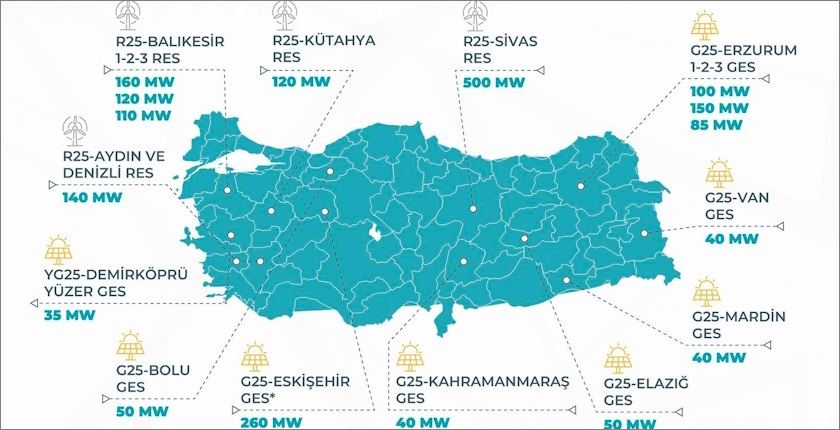
The upcoming solar energy auctions, REZ SPP 2025 (YEKA GES 2025), are for 850 MW altogether. There are ten areas in eight provinces designated for bidding: Kahramanmaraş, Mardin and Van, with 40 MW each, Bolu and Elazığ (50 MW each), Erzurum 1-3 (100 MW, 150 MW and 85 MW), Eskişehir (260 MW) and Demirköprü in Manisa province, with 35 MW.

The upcoming solar power auctions will include Turkey’s first bidding for a floating photovoltaic plant

Notably, the last one is for a planned floating solar power plant on the reservoir of the Demirköprü hydropower plant. The facility on the Gediz river, east of Izmir, is owned by state-owned Electricity Generation Corp. (EÜAŞ). Turkey now hosts only two small floating photovoltaic units, and the auction will be the first of its kind.

Applications will be received on November 4, the ministry said and added it would subsequently publish a schedule for bidding.

Wind power capacity quota is 1.15 GW

Participants can apply on November 18 for the wind energy round of auctions, REZ WPP 2025 (YEKA RES 2025). It is for an overall 1.15 GW in six areas.

Investors will compete for 500 MW in Sivas province, a 140 MW project in Aydın and Denizli, 120 MW in Kütahya and three areas in Balıkesir – 160 MW, 120 MW and 110 MW.

Winners to submit guarantees of EUR 75,000 per MW for PV projects, EUR 100,000 per MW for wind

Potential bidders will pay a fee of EUR 1,550 for each auction they apply for. They must submit letters of guarantee lasting one year and worth EUR 15,000 per MW for photovoltaics and EUR 20,000 per MW for wind power. Winners will submit 10-year guarantees before signing their contracts: EUR 75,000 per MW and EUR 100,000 per MW, respectively.

The ceiling or starting price is EUR 55 per MWh and the floor prices are EUR 32.5 per MWh for solar power and EUR 35 per MWh for wind. If bids hit the floor, another auction will be held between the competitors, like in the previous round. It is for a so-called contribution share that they are ready to pay. The minimum is EUR 10,000 per MW of planned capacity and the highest bid wins.

Successful participants can sell electricity on the free market for five years in the case of solar power plants, while the period lasts six years for wind. After that, both categories enter a 20-year scheme with a guaranteed price.

Turkey tops 120 GW in total electricity capacity

At the end of July, electricity capacity in Turkey totaled 120.2 GW, the ministry revealed. Hydropower accounted for 26.9% or 32.3 GW, compared to 23.4 GW in photovoltaics (19.5%) and 13.7 GW of wind power, translating to 11.4%.

The share of biofuel and waste was 1.9%, with 2.34 GW, and geothermal power plants had 1.73 GW altogether, which is 1.4%. Gas power plants in Turkey had 24.7 GW in combined capacity (20.6%). The remainder is coal: 21.9 GW or 18.3%.

by in News

Google secures 50 MW of nuclear power for data centers

Google has secured a new source of clean energy for its data centers in the US states of Tennessee and Alabama through collaboration with nuclear technology company Kairos Power and public power utility Tennessee Valley Authority (TVA). The deal involves a 50 MW advanced nuclear reactor to feed TVA’s grid, which supplies the tech giant’s data centers.

Kairos Power’s advanced nuclear facility Hermes 2, which is set to go online in 2030, will supply electricity to the grid under a power purchase agreement (PPA) with TVA. It is the first-ever offtake agreement in the United States for a generation IV reactor.

Hermes 2, located in Oak Ridge, is the first facility under Kairos Power’s broader deal with Google to enable 500 MW of new, advanced nuclear capacity to come online by 2035, aimed at supporting Google’s growing energy needs. The long-term agreement, signed in October 2024, involves the deployment of multiple small modular reactors (SMRs), Google recalled.

Google’s long-term deal with Kairos involves deploying 500 MW of nuclear capacity by 2035

Amanda Peterson Corio, Google’s Global Head of Data Center Energy, said the collaboration would speed up the deployment of innovative nuclear technologies and help support the needs of the growing digital economy while also bringing firm carbon-free energy to the electricity system.

As part of efforts to meet its growing energy needs, Google recently signed the world’s largest corporate PPA for hydropower. The agreement, signed with global investment firm Brookfield, involves developing 3 GW of hydropower capacity in the United States.

Google has signed similar deals for hydropower, geothermal, and fusion energy

Google has also signed similar agreements for next-generation geothermal energy as well as for fusion energy. The company recently revealed plans to invest over USD 25 billion in data center and AI infrastructure in the next two years.

Rapid AI development and digitalization are making power supply crucial for tech companies. Goldman Sachs Research forecasts that global power demand from data centers will increase by 165% by 2030 from the 2023 level.

by in News

Wind power takes lead in new renewables investment wave in Romania

The rising number of maturing wind power projects and the ones under construction in Romania has highlighted the increasing role of the technology for the country’s energy transition. The recent updates are for three locations in the country’s east.

Investments in wind power in Romania are rebounding from a long lull. According to the International Renewable Energy Agency (IRENA), the country hosted nearly 3.1 GW in wind power capacity at the end of 2024. It achieved a peak of 3.24 GW a decade before. Investors are maturing an increasing number of projects or beginning construction, alongside significant acquisition activity.

Together with a wave of investments in battery storage, the wind power segment is making the domestic renewable energy market more balanced. It was dominated by photovoltaics for several years – primarily by the meteoric rise in the number of prosumers. Of note, there were 228,302 at the end of May, operating 2.73 GW in capacity.

New Minister of Energy Bogdan Ivan recently estimated that another 3.2 GW of solar and wind power combined would come online in Romania by the end of 2026.

Wind park of over 250 MW in Ialomița to be completed in 2027

The administration of Ialomița County in the country’s east announced that KKR, its subsidiary Greenvolt and Renovatio would build a wind park of more than 250 MW. It would consist of three power plants in the area around Țăndărei, Gheorghe Lazăr, Grivița and Ograda.

According to the regional authority, the Ialomița wind farm project east of Bucharest is worth more than EUR 400 million. Its completion is expected in 2027.

Greenvolt has won support for more than half of capacity in its Ialomița Nord wind power project at the government’s first wind and solar power auction, through a contract for difference (CfD). Total investment is for 246.4 MW.

Greek renewables giant to start construction of two wind power plants

HELLENiQ Renewables Romania, operating under Greece-based HELLENiQ Energy, acquired Ansthall Green Energy from OX2. The project firm owns a ready-to-build wind project in Scânteiesti in Galaţi in eastern Romania, with a licensed capacity of 96 MW.

The Greek parent company said construction is starting immediately through a deal with OX2 Construction. It expects to put the facility into operation in 2027.

It has a 12-year virtual power purchase agreement (PPA) with Koninklijke Ahold Delhaize, for 158 GWh per year. The company operates supermarket chains. Total annual output is estimated at 309 GWh.

HELLENiQ Energy revealed that it has bought two ready-to-build projects of 282 MW in total

HELLENiQ Energy’s Romanian company also signed a contract to take over Helios and Wind Energy, a special purpose vehicle owning a ready-to-build wind project in the nearby Vaslui region. The licensed capacity is 186 MW and there is an option to add a battery energy storage system (BESS). It would have 186 MW in operational power as well and a duration of one hour, translating to 186 MWh.

Regulators in Romania must approve the agreement before the transaction.

In addition, the company completed the purchase of a ready-to-build PV project of 123 MW in peak capacity. The location is in Haskovo region in southern Bulgaria, which marks HELLENiQ’s entry into the country. The solar power plant can include a BESS facility of 90 MW and 180 MWh.

The company previously known as Hellenic Petroleum (HELPE) intends to start the construction of two BESS in its home market. They would have 50 MW and 200 MWh altogether. The two endeavors in Florina were among the winners in the third auction for battery storage in Greece.

Turkish company, Romanian footbal star’s daughter advance joint project

The third recent update is for one of the biggest planned wind farms in Romania, also in the east. The location for the Dăeni project is in Tulcea county. It has received the grid connection approval from Transelectrica and an environmental permit from the National Environment Protection Agency (NEPA or, in Romanian, ANPM).

Project documentation for the wind power plant of 56 turbines of 7.2 MW each shows the facility should be commissioned by the end of 2031, Profit.ro reported. It translates to 403.2 MW in nominal capacity. Dăeni would have a connection to the transmission grid of over 394 MW.

Oxigen Delta is 50% owned by a subsidiary of Turkey-based Sanko Enerji

The developer is Oxigen Delta, in which 50% is owned by a subsidiary of Turkey-based Sanko Enerji, part of Sanko Holding. Milana-Maria Ilie, daughter of famous former Romanian football player Adrian Ilie, is among the main shareholders, the article adds. The investment was valued at some EUR 800 million last year.

Eximprod, which installed the first wind turbine in Romania more than two decades ago, has delivered the first megawatt-hours to the grid from its new wind farm in the country’s east. Rezolv secured a financing package for the second phase of its giant Vifor wind farm in Buzău county

Eurowind Energy built the turbines earlier this year at its Pecineaga wind park. Greece-based Public Power Corp. (PPC) is supposed to connect its Deleni facility to the grid before the end of the year.

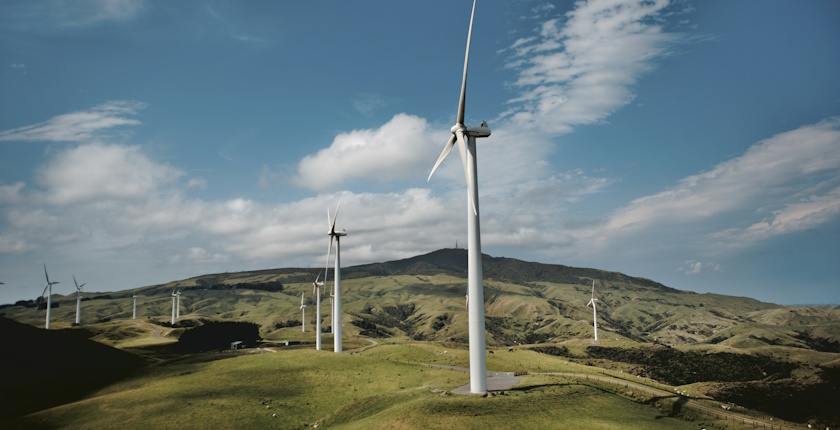
OX2 is constructing the Green Breeze wind farm as the turnkey contractor for the investor, Nala Renewables.

by in News

Pexapark: PPA activity in Europe drops in first half of 2025

The number of power purchase agreements (PPAs) for renewables in Europe fell by 31% and the volume tumbled 26% in the first half of the year from the levels in the same period of 2024, Pexapark found. Germany and France registered sharp declines in the photovoltaics segment, but a surge in Italy and Spain has more than offset the drop.

The meteoric rise in deals for battery energy storage systems, BESS, is a clear sign of its maturity.

In its latest report, analytics and advisory firm Pexapark provided a detailed look into PPAs and contracts for battery energy storage systems in the first six months of 2025. It found that PPA activity shrank by more than a quarter in year-over-year terms, but not everywhere and not due to solar power.

Across 124 deals, 6.08 GW of renewable electricity capacity was contracted in the first half, which is 31% and 26% down, respectively, from the same period of 2024. Conversely, the average deal size advanced 5% to 48.2 MW.

Notably, the April-June period was much weaker than the first quarter of the year, with just 50 deals, but the volumes were almost evenly split.

The main technologies in the first half were solar power, 4.2 GW from 73 deals, onshore wind (1.4 GW and 32 PPAs), mixed technology (290 MW and nine deals) and offshore wind (134 MW and four deals). The result is proportionate to the picture from January through June 2024.

Despite concerns over saturation of demand for standalone solar, volumes have firmed. The 4.2 GW of solar capacity contracted under PPAs compares to 3.9 GW of the first half of last year. The deal count landed at 73, against 95, which is in line with the overall trend.

PPA activity in Germany plunged 84% in terms of volume

Solar offtake activity reveals a clear split in market momentum. It is slowing down in markets where cannibalization has worsened drastically and rapidly – such as Germany and France. In fact, Germany saw the largest decline in volumes – a remarkable 84% year-on-year decrease in terms of overall volumes, with 228 MW across eight deals in the last six months, versus 1.2 GW and 31 deals in last year’s equivalent.

There is stable or even upward appetite in markets which have had time to adjust to cannibalization and the lower valuation of solar production, or where cannibalization levels are still very low

Conversely, solar PPA activity in Italy and Spain spiked, more than making up for the said decline.

“These numbers support the hypothesis that there is stable, or even upward appetite in markets which have had time to adjust to cannibalization and the lower valuation of solar production – i.e., Spain, or cannibalization levels are still very low – such as Italy. Italy’s solar PPA volumes grew 184% year-on-year, with nearly an additional 700 MW procured compared to the same period last year. Corporate appetite in the country is growing, and so is deal size – with a 420 MW solar corporate deal announced in June comprising the country’s largest PPA ever recorded,” the analysis reads.

As for Southeastern Europe, OMV Petrom’s deal with Enery for their joint solar power project Gabare in Bulgaria was Europe’ third-largest PPA in June.

Flexibility monetization is opportunity for market players with right profile

In a market increasingly driven by flexibility monetization, today’s challenges – cannibalization, future capture dynamics and balancing risks – are becoming opportunities for market players with the right profile. And with corporate buyers more hesitant to pay premiums for solar, transactable prices are—perhaps for the first time in a while – closer to perceived fair value, according to the report’s authors.

Wholesale electricity prices in Sweden were negative for almost two fifths of the time in the first six months of 2025

Hourly periods with negative prices at wholesale electricity markets continued strong in the first half. Sweden maintained its top position by far, with most such events. There were 1,635 hours with negative prices from January until the end of June. It is a stunning 37.8% share of the entire period and already 63% of the tally from all last year.

The other jurisdictions that make up the top five in Europe: Finland, Germany, the Netherlands and Belgium, remained the same since 2024.

On average, European countries have already reached around 67% of the number of hours counted in 2024 as a whole. Norway hit 90%, Denmark 87% and Spain climbed to 86%, suggesting that last year’s records would fall.

Top five European markets by number of negative price hours, 2024 vs. the first half of 2025

BESS deal volumes already three times higher than in all 2024

The maturity of the BESS industry is clearly reflected in the deal count and contracted volumes over the past 18 months, with the trend increasingly pronounced in 2025.

Battery storage capacity being contracted under optimization or fixed-revenue offtake contracts (so-called floors and tolls, respectively) amounted to a total of 4.6 GW in capability and 9.2 GWh in capacity across 36 deals. It is just over three times more than in entire 2024 in both benchmarks. The deal count was 44% up from all last year.

The lion’s share of the deal count concerns BESS assets with a two-hour duration

The rapid growth was driven by a wave of new agreements in the two most advanced markets – Great Britain and Germany – alongside first-ever BESS deals emerging in Belgium, Poland, Greece, and Bulgaria. The lion’s share of the deal count concerns BESS assets with a two-hour duration, which the ratio of operating power and capacity also indicates.

Pexapark provides of price data, market intelligence, and advisory services for renewable energy. It was one of the knowledge partners at this year’s edition of Belgrade Energy Forum, organized by Balkan Green Energy News.

by in News

Montenegro sets November 10 deadline for first solar power auction

Legal entities and entrepreneurs in Montenegro are preparing to compete for market premiums with their solar power projects. The quota for the first such auction in the country is 250 MW, and applications close on November 10.

Following the completion of the legal framework with laws and decrees, the Montenegrin Ministry of Energy and Mining issued a public call for investors to participate in an auction for market premiums with their solar power projects. The government would provide support for 12 years.

Legal entities and entrepreneurs have until November 10 to send the envelopes with bank guarantees, documents proving that they are qualified, and their financial bids. The address is: Ministarstvo energetike i rudarstva, Rimski trg 46, 81000 Podgorica. The first such auction in Montenegro will be held for “unspecified locations,” which means that the planned photovoltaic systems can be located in any area in the country.

The available capacity is 250 MW, and eligible projects are for at least 400 kW each. There is no nominal upper limit for project capacity for which a potential participant bids, except the total quota itself.

However, the quota can be extended, by a maximum of 20%. The government said there is an extra 50 MW available for the inclusion of an entire eligible project that entered the quota only partially, or more such projects, in case the bids for them were equal. But if the part of the capacity that surpassed the quota is larger than the possible extension, the commission would award a market premium only for the part that did fit the quota.

Price to be adjusted for inflation every year

The accepted price, from the financial offer of a participant that obtained the status of a temporarily privileged producer through the auction, will be adjusted for the Eurozone inflation rate once per year.

Some of the qualification conditions are that the project didn’t or doesn’t benefit from government incentives, that construction works haven’t begun and that the developer hasn’t secured financing for their completion.

The lowest bids win, and the maximum allowed price is EUR 65 per MWh. The market premium is awarded via a contract for difference (CfD).

Namely, the operator of a renewable electricity plant has a guaranteed price, approved through the auction. When the firm sells electricity in the market at a higher price, it must return the difference. And vice versa: when the beneficiary gets less per megawatt-hour than the contract price, they are reimbursed.

Bank guarantees are EUR 20 per kW or EUR 40 per kW

As for the bank guarantees, they are determined at EUR 20 per kW (EUR 20,000 per MW) of the offered capacity for participants that have signed a contract for the construction of the infrastructure for a grid connection and for connecting the facility, or EUR 40 per kW for ones that have at least obtained an analysis of the possibility for a grid connection, from the transmission or distribution system operator, according to the documentation.

Upon the expiration of the deadline, the commission conducts the process of determining the eligibility of the bidders and projects, after which it opens and ranks the financial bids.

Minister of Energy and Mining Admir Šahmanović said the competitive bidding process is in the public interest: for the security of supply, opening the way for investments in other sectors and for investor confidence. He told the Mina-business news agency that the auction would bring more stable prices in the long run.

Conducting renewable electricity auctions is one of the commitments toward the European Union that were defined by the Reform Agenda of Montenegro 2024-2027. It contains the conditions for the approval of up to EUR 383 million from the Growth Plan for the Western Balkans and the Reform and Growth Facility (RGF).

by in News

INA, E.ON sign power purchase agreement in Croatia

Croatian oil and gas company INA and German energy giant E.ON’s subsidiary in the Southeastern European country have signed a power purchase agreement for electricity from renewable sources.

The power purchase agreement (PPA) will enable INA, majority-owned by Hungarian MOL, to use energy from its own power plants, even from remote locations where the produced electricity or surplus is fed into the grid, the companies said.

The electricity purchase covers three cogeneration plants and 18 photovoltaic plants with a total annual production of 20 GWh. INA’s largest solar power units, Virje and Sisak, have a combined capacity of about 13 MW.

The companies said it is a 2-in-1 solution – supply and purchase of electricity, creating a long-term sustainable energy system and allowing energy produced at one location to be used at another.

E.ON Croatia said it is connecting production and consumption into one efficient, closed energy system

With the partnership, the two firms are connecting production and consumption into one efficient, closed energy system, said E.ON Croatia.

It marks a new phase of cooperation, focused on developing a smarter, more flexible energy system, sustainable in the long term, according to the German energy giant’s subsidiary.

Ivica Kuliš, manager of the energy retail division of E.ON Croatia, said the utility is proud to become INA’s key partner in its electrification efforts, not only through supply but also by purchasing electricity. It directly enables flexible, locally produced energy to be available where it is needed most, he added.

Sokolović: INA is laying the foundation for long-term energy independence and decarbonization

By investing in its own production and using the PPA model, INA is laying the foundation for long-term energy independence and the decarbonization of its operations, said Dalibor Sokolović, head of the company’s department for new and sustainable businesses.

Such solutions enable more flexible and responsible resource management, Sokolović added.

Of note, according to an earlier analysis by Pexapark, the European PPA market entered an adjustment chapter last year, characterized by record deal-making for smaller volumes. Namely, the firm’s tracker registered a decrease of around 11% in total disclosed contracted volumes vis-à-vis 2023, to 15.2 GW.