by in News

IRENA: Global daily flexibility needs are quadrupling by 2050

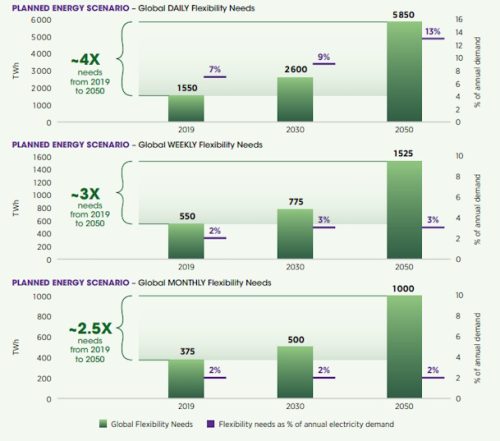
In IRENA’s Planned Energy Scenario at the global level, electricity system flexibility needs on a daily timescale are four times higher in 2050 than in 2019. In the weekly and monthly timescales, the energy required for the purpose grows by three and 2.5 times, respectively. As for the 1.5°C Scenario, implying a much higher share of renewables, the daily flexibility needs jump ten times by mid-century, versus six times for both remaining segments.

Electrification of end-use energy, large-scale deployment of distributed energy resources and the emergence of large new electricity loads from data centres are increasing demand and adding new layers of complexity. It means power systems will need stronger grids and more flexibility to ensure that electricity is available when and where needed and at the lowest possible cost, the International Renewable Energy Agency (IRENA) pointed out in a brief called Flexibility for a secure and affordable power sector transformation.

Aside from buildings and transportation, new demand is coming from the growing adoption of artificial intelligence (AI), driving the expansion of data center capacity. In 2024, data centers consumed 1.5% of electricity. The International Energy Agency expects the share to double by 2030.

The share of variable renewable energy is increasing – wind and solar power in particular. Demand patterns become more complex, so the potential for mismatches between supply and demand is likely to grow, becoming more frequent and significant. It highlights the increasing importance of system flexibility. It is the capacity to respond to expected and unexpected fluctuations in the demand for and supply of electricity in a cost-effective manner.

Some forms of flexibility act automatically to keep the system stable, while others can be scheduled and operate over hours, days or even seasons

Insufficient system flexibility can result in excessive curtailment or, in market-based systems, negative electricity prices. It can also result in shortages, jeopardising the reliable supply of electricity.

System flexibility is needed by the power system to adjust to the variability of generation and demand patterns across different timescales. Some forms of flexibility act automatically within seconds to keep the system stable, while others can be scheduled in anticipation and operate over hours, days or even seasons, through market adjustments and operational and resource planning.

Network flexibility, which isn’t covered in IRENA’s brief, is different. It is the capacity to adjust for grid availability by means of preventing or solving congestion or voltage issues.

Required flexibility depends on numerous factors

In the timescale of seconds to minutes, flexibility is needed to maintain the balance during sudden changes in demand or supply, such as the
disconnection of an interconnector or a major load or generator. The hours and days timescale has daily ups and downs of solar and wind generation alongside the peaks and troughs in demand throughout the day.

In the weeks and seasons segment, flexibility enables covering longer weather patterns caused by changes in the season or low-wind periods. In power systems mainly supplied by renewables, flexibility is also needed at inter-annual timescales. The main factors are climate-driven variations in resource availability. It especially concerns hydrology, but also wind and solar, as well as year-to-year differences in seasonal heating and cooling demand.

In power systems mainly supplied by renewables, flexibility is also needed at inter-annual timescales

Flexibility is not a single asset or function; instead it corresponds to a capability provided by a portfolio of different technologies, operational practices and market mechanisms. The required level of flexibility in a power system depends on, among other factors, the prevailing generation mix, geography, power sector structure and affected timescales.

Storage, demand-side management (DSM), interconnections and dispatchable resources each contribute differently.

Advances in forecasting and the introduction of shorter dispatch intervals, scheduled closer to real-time operation, allow more frequent and precise adjustments of generation and demand before electricity is delivered. One example are intraday markets complementing day-ahead markets.

Electricity must become main energy carrier by mid-century to keep global warming in check

In IRENA’s 1.5°C Scenario, the energy transition will be driven by the deployment of renewable energy, improvements in energy efficiency and the electrification of end-use sectors. The aim is to limit global warming to 1.5 degrees Celsius by 2100.

Electricity would need to become the main energy carrier by 2050. It would account for over half of total final energy consumption. The 2022 level was 23%.

Global electricity generation is projected to be 36% higher in 2030 and three times higher in 2050 than in 2023. Renewable resources would supply 68% of electricity in 2030 and 91% in 2050. Renewables would account for 77% of total installed power capacity in 2030 and 94% in 2050.

In the same setting, 70% of electricity generated in 2050 comes from wind and photovoltaics, taken together. In IRENA’s Planned Energy Scenario, not projecting full decarbonization, the level is 53%.

In IRENA’s 1.5°C Scenario, the share of electricity in total final energy consumption more than doubles by 2050, surpassing 50%

Flexibility needs are calculated as total cumulated annual energy deviation from the average net load (which excludes variable renewable energy generation).

In the 1.5°C Scenario, the power sector requires ten times more flexibility in 2050 than in 2019 to manage the daily variability of net load. In terms of share of annual electricity demand, the authors observed a surge to 30% from 7%. Flexibility needs for managing the variability in weekly and monthly timescales are both six times higher.

In IRENA’s Planned Energy Scenario, daily flexibility needs in 2050 are four times higher. In the weekly timescale, the level triples from 2019, and the monthly item is 2.5 times higher.
IRENA Global daily flexibility needs quadrupling by 2050
Photo: The height of bars indicates flexibility requirements in terawatt-hours per year. Purple horizontal markers show flexibility needs as a percentage of annual electricity demand. (IRENA)

Batteries perform best in daily segment

Battery energy storage is the most effective in addressing daily flexibility needs, the report finds. It is only 24% as effective at meeting weekly needs and 12% as effective for monthly needs.

Interconnections and LDES are effective on the weekly and monthly scales

Interconnections are the most effective in addressing weekly flexibility needs, but also 98% as effective for monthly needs. As for the daily segment, the coverage is just 28%.

The numbers for long-duration energy storage (LDES) solutions are similar. Compared with addressing weekly flexibility needs, LDES is 90% as effective for monthly needs and 34% as effective in the daily item.

by in News

IRENA: Global daily flexibility needs are quadrupling by 2050

In IRENA’s Planned Energy Scenario at the global level, electricity system flexibility needs on a daily timescale are four times higher in 2050 than in 2019. In the weekly and monthly timescales, the energy required for the purpose grows by three and 2.5 times, respectively. As for the 1.5°C Scenario, implying a much higher share of renewables, the daily flexibility needs jump ten times by mid-century, versus six times for both remaining segments.

Electrification of end-use energy, large-scale deployment of distributed energy resources and the emergence of large new electricity loads from data centres are increasing demand and adding new layers of complexity. It means power systems will need stronger grids and more flexibility to ensure that electricity is available when and where needed and at the lowest possible cost, the International Renewable Energy Agency (IRENA) pointed out in a brief called Flexibility for a secure and affordable power sector transformation.

Aside from buildings and transportation, new demand is coming from the growing adoption of artificial intelligence (AI), driving the expansion of data center capacity. In 2024, data centers consumed 1.5% of electricity. The International Energy Agency expects the share to double by 2030.

The share of variable renewable energy is increasing – wind and solar power in particular. Demand patterns become more complex, so the potential for mismatches between supply and demand is likely to grow, becoming more frequent and significant. It highlights the increasing importance of system flexibility. It is the capacity to respond to expected and unexpected fluctuations in the demand for and supply of electricity in a cost-effective manner.

Some forms of flexibility act automatically to keep the system stable, while others can be scheduled and operate over hours, days or even seasons

Insufficient system flexibility can result in excessive curtailment or, in market-based systems, negative electricity prices. It can also result in shortages, jeopardising the reliable supply of electricity.

System flexibility is needed by the power system to adjust to the variability of generation and demand patterns across different timescales. Some forms of flexibility act automatically within seconds to keep the system stable, while others can be scheduled in anticipation and operate over hours, days or even seasons, through market adjustments and operational and resource planning.

Network flexibility, which isn’t covered in IRENA’s brief, is different. It is the capacity to adjust for grid availability by means of preventing or solving congestion or voltage issues.

Required flexibility depends on numerous factors

In the timescale of seconds to minutes, flexibility is needed to maintain the balance during sudden changes in demand or supply, such as the
disconnection of an interconnector or a major load or generator. The hours and days timescale has daily ups and downs of solar and wind generation alongside the peaks and troughs in demand throughout the day.

In the weeks and seasons segment, flexibility enables covering longer weather patterns caused by changes in the season or low-wind periods. In power systems mainly supplied by renewables, flexibility is also needed at inter-annual timescales. The main factors are climate-driven variations in resource availability. It especially concerns hydrology, but also wind and solar, as well as year-to-year differences in seasonal heating and cooling demand.

In power systems mainly supplied by renewables, flexibility is also needed at inter-annual timescales

Flexibility is not a single asset or function; instead it corresponds to a capability provided by a portfolio of different technologies, operational practices and market mechanisms. The required level of flexibility in a power system depends on, among other factors, the prevailing generation mix, geography, power sector structure and affected timescales.

Storage, demand-side management (DSM), interconnections and dispatchable resources each contribute differently.

Advances in forecasting and the introduction of shorter dispatch intervals, scheduled closer to real-time operation, allow more frequent and precise adjustments of generation and demand before electricity is delivered. One example are intraday markets complementing day-ahead markets.

Electricity must become main energy carrier by mid-century to keep global warming in check

In IRENA’s 1.5°C Scenario, the energy transition will be driven by the deployment of renewable energy, improvements in energy efficiency and the electrification of end-use sectors. The aim is to limit global warming to 1.5 degrees Celsius by 2100.

Electricity would need to become the main energy carrier by 2050. It would account for over half of total final energy consumption. The 2022 level was 23%.

Global electricity generation is projected to be 36% higher in 2030 and three times higher in 2050 than in 2023. Renewable resources would supply 68% of electricity in 2030 and 91% in 2050. Renewables would account for 77% of total installed power capacity in 2030 and 94% in 2050.

In the same setting, 70% of electricity generated in 2050 comes from wind and photovoltaics, taken together. In IRENA’s Planned Energy Scenario, not projecting full decarbonization, the level is 53%.

In IRENA’s 1.5°C Scenario, the share of electricity in total final energy consumption more than doubles by 2050, surpassing 50%

Flexibility needs are calculated as total cumulated annual energy deviation from the average net load (which excludes variable renewable energy generation).

In the 1.5°C Scenario, the power sector requires ten times more flexibility in 2050 than in 2019 to manage the daily variability of net load. In terms of share of annual electricity demand, the authors observed a surge to 30% from 7%. Flexibility needs for managing the variability in weekly and monthly timescales are both six times higher.

In IRENA’s Planned Energy Scenario, daily flexibility needs in 2050 are four times higher. In the weekly timescale, the level triples from 2019, and the monthly item is 2.5 times higher.

IRENA Global daily flexibility needs quadrupling by 2050
Photo: The height of bars indicates flexibility requirements in terawatt-hours per year. Purple horizontal markers show flexibility needs as a percentage of annual electricity demand. (IRENA)

Batteries perform best in daily segment

Battery energy storage is the most effective in addressing daily flexibility needs, the report finds. It is only 24% as effective at meeting weekly needs and 12% as effective for monthly needs.

Interconnections and LDES are effective on the weekly and monthly scales

Interconnections are the most effective in addressing weekly flexibility needs, but also 98% as effective for monthly needs. As for the daily segment, the coverage is just 28%.

The numbers for long-duration energy storage (LDES) solutions are similar. Compared with addressing weekly flexibility needs, LDES is 90% as effective for monthly needs and 34% as effective in the daily item.

by in News

Albania gives green light to CWP Europe for 600 MW wind park

Prime Minister of Albania Edi Rama and Deputy Prime Minister and Minister of Infrastructure and Energy Belinda Balluku promoted CWP Europe’s wind power project Tropoja of 600 MW. After receiving the ministry’s preliminary approval at the event, the company’s CEO Dimitar Enchev highlighted the importance of local electricity production for a modern economy, including AI and data centers, and for energy independence. Albania still doesn’t host a single operational wind turbine.

CWP Europe will hopefully connect its future wind park Tropoja to the grid within 12 months, excluding the period of harsh winter, according to Albania’s Prime Minister Edi Rama. Speaking at the project’s presentation, he said the investment is a step toward the country’s ambition of becoming self-reliant in energy production.

“For a long time, we had complete dependence on water and rainfall. At the same time, we inherited a system with so many weaknesses that, when rainfall was lacking, we had to go to international markets and purchase large quantities at inflated prices. Meanwhile, when rainfall came in abundance, we often saw much of this potential value, water, go to waste and not only fail to be converted into energy, but at times also cause extraordinary damage,” Rama stated.

Namely, hydropower plants accounted for almost 100% of domestic electricity production until recently. By the end of the decade, the combined share of wind and solar power will reach 30%, Rama underscored.

Preparing final stages of Tropoja wind power project

CWP Global’s Co-founder and Chief Executive Officer for Europe Dimitar Enchev received a preliminary approval from the Ministry of Infrastructure and Energy at the event. He highlighted the importance of local electricity production for a modern economy and energy independence, especially with the expansion of artificial intelligence and data centers.

“The last time I was here was about three months ago, when we decided and signed a joint cooperation agreement with the EU. And now, after three months, we receive the permission that allows us to engage in preparing the final stages of our project,” Enchev stated, as quoted by CNA.

CWP Europe has more than 7 GW under development in Southeast Europe

CWP Europe has 900 MW in wind power projects under development in Albania, part of a portfolio of more than 6 GW across Southeast Europe plus more than 1 GW in photovoltaics.

The Tropoja area is in the country’s far north. Albania still doesn’t host a single operational wind turbine.

Support from European Commission

CWP Europe signed a joint declaration in October with the European Commission, the Albanian Investment Development Agency and the Montenegrin Investment Agency, in support of the Tropoja project and the Montechevo solar farm with battery storage in Montenegro, respectively.

In September, the company’s subsidiary Eralb Invest submitted its wind power project to the Ministry of Infrastructure and Energy, for 603.9 MW. It is not subject to concession and doesn’t benefit from state support measures.

In 2023, the firm sent a proposal to the Strategic Investment Committee (SIC or KIS) in which the project was for a wind and solar park of 826 MW in total capacity. It is an interministerial panel chaired by Prime Minister Edi Rama.

The entire designated area in Tropoja municipality reportedly spanned 385 hectares, encompassing the territories of the villages Viçidol, Berisha, Luzha and Pac, and the investment was valued at EUR 1.2 billion.

In October 2023, CWP and GE Vernova’s Onshore Wind business agreed to develop a large-scale hybrid wind and solar project in Albania. They estimated the investment at more than EUR 1 billion.

Fântânele-Cogealac-Gradina, the biggest onshore wind park in Southeastern Europe and, until recently, in entire Europe, has 600 MW in capacity. It is located in Romania. CWP developed the project and sold it in 2008.

Balluku: Diversification is strategic necessity

Albania is moving to a modern, balanced energy model, where diversification of sources is no longer a solution, but a strategic necessity, according to Deputy Prime Minister and Minister of Infrastructure and Energy Belinda Balluku.

“The Tropoja wind farm is not just an energy investment. It is a symbol of the transformation that Albania is experiencing, a transformation towards a sustainable, stronger and more innovation-friendly economy. This project proves that the Albanian energy sector is entering a new phase, where private investment and foreign direct investment are becoming engines of growth, thanks to serious partnerships and long-term visions,” she stated.

Wind and solar power projects totaling 1.5 GW are under development in Albania

In recent years, Albania added over 700 MW of photovoltaic capacity, and another 400 MW for self-supply, Balluku revealed. Wind and solar power projects totaling 1.5 GW are under development, she added. Future pumped storage hydropower capacity in the Drin (Drim) cascade and Statkraft’s project in Moglica amount to 1.6 GW, Balluku stressed.

Since 2013, losses in the power distribution network have dropped to 16.9% from more than 45%, while total electricity capacity increased by 1.5 GW, the deputy prime minister added. She said outages have been reduced to an all-time low and that they usually only last a few minutes.

The Special Court Against Corruption and Organized Crime suspended Balluku in late November amid an investigation, but the Constitutional Court soon reinstated her.

by in News

Albania gives green light to CWP Europe for 600 MW wind park

Prime Minister of Albania Edi Rama and Deputy Prime Minister and Minister of Infrastructure and Energy Belinda Balluku promoted CWP Europe’s wind power project Tropoja of 600 MW. After receiving the ministry’s preliminary approval at the event, the company’s CEO Dimitar Enchev highlighted the importance of local electricity production for a modern economy, including AI and data centers, and for energy independence. Albania still doesn’t host a single operational wind turbine.

CWP Europe will hopefully connect its future wind park Tropoja to the grid within 12 months, excluding the period of harsh winter, according to Albania’s Prime Minister Edi Rama. Speaking at the project’s presentation, he said the investment is a step toward the country’s ambition of becoming self-reliant in energy production.

“For a long time, we had complete dependence on water and rainfall. At the same time, we inherited a system with so many weaknesses that, when rainfall was lacking, we had to go to international markets and purchase large quantities at inflated prices. Meanwhile, when rainfall came in abundance, we often saw much of this potential value, water, go to waste and not only fail to be converted into energy, but at times also cause extraordinary damage,” Rama stated.

Namely, hydropower plants accounted for almost 100% of domestic electricity production until recently. By the end of the decade, the combined share of wind and solar power will reach 30%, Rama underscored.

Preparing final stages of Tropoja wind power project

CWP Global’s Co-founder and Chief Executive Officer for Europe Dimitar Enchev received a preliminary approval from the Ministry of Infrastructure and Energy at the event. He highlighted the importance of local electricity production for a modern economy and energy independence, especially with the expansion of artificial intelligence and data centers.

“The last time I was here was about three months ago, when we decided and signed a joint cooperation agreement with the EU, and now, after three months, we receive the permission that allows us to engage in preparing the final stages of our project,” he stated, as quoted by CNA.

CWP Europe has more than 7 GW under development in Southeast Europe

CWP Europe has 900 MW in wind power projects under development in Albania, part of a portfolio of more than 6 GW across Southeast Europe plus more than 1 GW in photovoltaics.

The Tropoja area is in the country’s far north. Albania still doesn’t host a single operational wind turbine.

Support from European Commission

CWP Europe signed a joint declaration in October with the European Commission, the Albanian Investment Development Agency and the Montenegrin Investment Agency, in support of the Tropoja project and the Montechevo solar farm with battery storage in Montenegro, respectively.

In September, the company’s subsidiary Eralb Invest submitted its wind power project to the Ministry of Infrastructure and Energy, for 603.9 MW. It is not subject to concession and doesn’t benefit from state support measures.

In 2023, the firm sent a proposal to the Strategic Investment Committee (SIC or KIS) in which the project was for a wind and solar park of 826 MW in total capacity. It is an interministerial panel chaired by Prime Minister Edi Rama.

The entire designated area in Tropoja municipality reportedly spanned 385 hectares, encompassing the territories of the villages Viçidol, Berisha, Luzha and Pac, and the investment was valued at EUR 1.2 billion.

In October 2023, CWP and GE Vernova’s Onshore Wind business agreed to develop a large-scale hybrid wind and solar project in Albania. They estimated the investment at more than EUR 1 billion.

Fântânele-Cogealac-Gradina, the biggest onshore wind park in Southeastern Europe and, until recently, in entire Europe, has 600 MW in capacity. It is located in Romania. CWP developed the project and sold it in 2008.

Balluku: Diversification is strategic necessity

Albania is moving to a modern, balanced energy model, where diversification of sources is no longer a solution, but a strategic necessity, according to Deputy Prime Minister and Minister of Infrastructure and Energy Belinda Balluku.

“The Tropoja wind farm is not just an energy investment. It is a symbol of the transformation that Albania is experiencing, a transformation towards a sustainable, stronger and more innovation-friendly economy. This project proves that the Albanian energy sector is entering a new phase, where private investment and foreign direct investment are becoming engines of growth, thanks to serious partnerships and long-term visions,” she stated.

Wind and solar power projects totaling 1.5 GW are under development in Albania

In recent years, Albania added over 700 MW of photovoltaic capacity, and another 400 MW for self-supply, Balluku revealed. Wind and solar power projects totaling 1.5 GW are under development, she added. Future pumped storage hydropower capacity in the Drin (Drim) cascade and Statkraft’s project in Moglica amount to 1.6 GW, Balluku stressed.

Since 2013, losses in the power distribution network have dropped to 16.9% from more than 45%, while total electricity capacity increased by 1.5 GW, the deputy prime minister added. She said outages have been reduced to an all-time low and that they usually only last a few minutes.

The Special Court Against Corruption and Organized Crime suspended Balluku in late November amid an investigation, but the Constitutional Court soon reinstated her.

by in News

Energy communities reduce power bills for members, improve electricity market

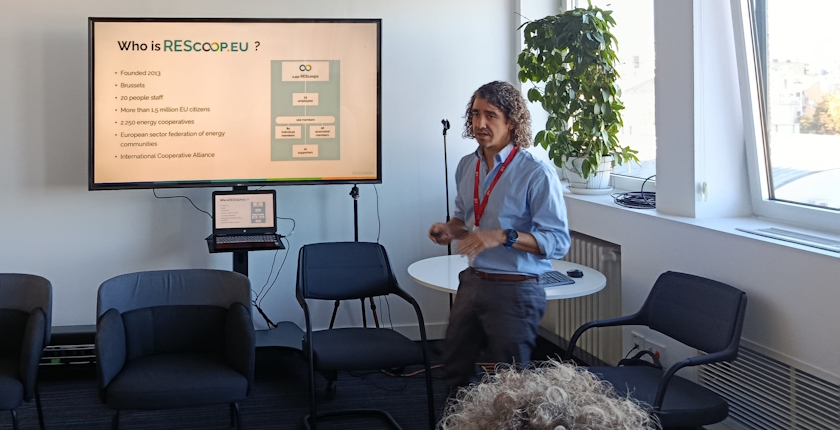
Citizen energy communities make the energy system greener and benefit society at a local level, Josh Roberts from European federation of energy communities REScoop said in his presentation, organized in Belgrade by Deutsche Gesellschaft für Internationale Zusammenarbeit (GIZ) GmbH. It is a form of association that also lowers costs for households, institutions and small firms and entrepreneurs, and contributes to the deployment of progressive technologies. Furthermore, it is a framework for democratic control.

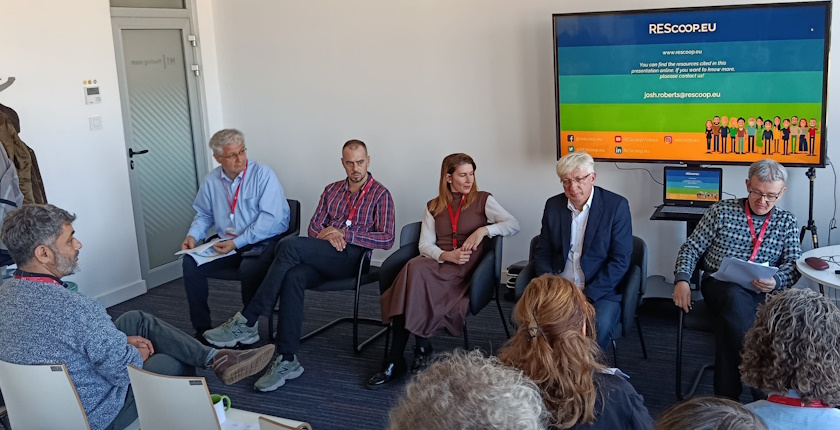
The event included developers from the emerging segment of energy communities and cooperatives in Serbia. They outlined the current initiatives and pointed to challenges regarding market entry, financing and policies.

The establishment and operation of energy communities is arranged through the European Union’s latest legislation, as well as in Serbia and other Western Balkan countries, but they are not a new concept. For instance, such entities still accounted for almost half of wind power output in Denmark in late 1990s, according to Senior Policy Advisor Josh Roberts from REScoop, the European federation of energy communities and cooperatives.

Speaking at a gathering that GIZ organized in Belgrade he pointed to the benefits for citizens, small firms and entrepreneurs and for institutions from setting up or joining energy communities. Initiatives in Serbia were also presented, and their progress in the same field, and the event included dialogue on the necessary technical solutions for connecting to the distribution grid.

Brussels-based REScoop was founded in 2013. In its membership are organizations from 22 European countries. They include Serbian energy cooperative Elektropionir. It gained the most ground regarding association and the implementation of projects.

One coal town has put up signpost for energy communities in Slovenia

Among other examples, Roberts highlighted Slovenia’s first energy community with a rooftop solar power plant for joint use. The facility is on the roof of an elementary school. The project involves aid for people living in energy poverty and it is free to join the group.

It is in the town of Hrastnik in a former coal industry area. The participants already lowered their power bills by 30%, and the gains will be even greater when they pay off the loan, Roberts said.

There are more than 1,600 energy communities in Austria

The representative of the REScoop federation stressed that municipalities in the Belgian region of Wallonia have succeeded in obtaining the right for citizens to participate in investments in green energy projects. It resulted in the foundation of a range of energy communities.

Roberts especially commended Austria’s legal framework with regard to enabling citizens to participate. The country hosts more than 1,600 energy communities.

Udruzivanje energetske zajednice smanjuje troskove trziste elektricne energije Dzos Roberts Josh REScoop GIZ

Energy community eases grid operator’s job

Energy communities are envisaged to return the invested funds to society at the local level. Subsidies are especially favorable for that, Roberts explained. Income is directed to education, infrastructure and aid against energy poverty.

The essence is that the community controls the distribution of the proceeds. In addition, grid operators can communicate more easily with one entity than with a hundred prosumers, Roberts underscored. Prosumers – or buyers-consumers, as they are formally called in Serbia, generate electricity for their own needs.

Pooling together enables providing services in the market, where energy communities can supply and store energy as well as conduct energy efficiency services, among other activities.

It means an entity of such type can ease the evening grid load, in moments of the highest demand, using energy from its batteries. That way, price peak shaving is achieved.

Registration process must be separate from defining activity

As for the procedure, Roberts said registration needs to be only for acknowledgement, rather than for approving specific activities.

“It’s about acknowledging the legal form and it’s about checking about how that legal form ensures compliance with the eligibility criteria. We have found very complex registration procedures. This does not work. It needs to be simple,” he stressed.

There are many activities that energy communities can undertake and they need to be able to enter them gradually, without complex procedures for licenses and permits

Conversely, in some jurisdictions there are simplified ways to get a supplier license. It enables an energy community to enter the activity gradually, instead of having to fulfill the requirements for all segments, even without having a comprehensive business model, the members or a business case, Roberts said.

He mentioned at the same time that one of the basic ideas is promoting inclusiveness.

“It’s already hard to set up an energy community, but it’s even harder to involve members who may have a hard time paying their bills, or have a lot less disposable income. So we found that the best models at the moment are for energy communities either to front the membership fees or for local authorities to pay for this upfront. And in energy sharing, we’re seeing more and more of energy donated to vulnerable households,” he stated.

Energy cooperatives helping improve rural areas from which people are leaving

Energy communities are giving people an opportunity for climate action and to contribute to their community, Roberts said. He added that such projects improve the area where they are conducted, stressing that it is especially important for rural areas from which many people are leaving.

A key point is that they enable participants to control their costs, production, consumption and energy sharing.

 The main challenge in Serbia is how to obtain a grid connection, alongside the matter of accessibility of incentives and loans

Importantly, energy communities are linked to the tradition of cooperatives, for which Serbia used to be known, but there is still much left to do around the legal framework.

There was word at the said gathering with representatives of institutions about the complexity of adjusting the electricity network to the production’s decentralization, as well as about the possibility to streamline the procedure for the establishment of energy communities and their operation.

Serbia is yet to address the accessibility of subsidies and financing, while currently the main issue is how to get grid connection approvals.

Energetsko zadrugarstvo smanjuje troskove trziste elektricne energije GIZ

Enterprise, association or cooperative

The speakers and other participants in the event agreed that the electricity market isn’t complete without energy communities, while that they modernize and democratize it.

When it comes to Serbian regulations, such legal entities have the right to conduct aggregation, but they need a license for it. Notably, aggregators have balancing responsibility, so they need to cover the deviations from the forecasted output.

Energy communities were introduced in the latest version of the Law on Energy. When they become regular in practice, the framework will need to be adjusted gradually to the situation. Citizens, firms and municipal authorities establish energy communities as enterprises, associations or cooperatives.

The bottom line is to enable citizens to take part in the clean energy transition and achieve local environmental, economic and social benefits, as opposed to prioritizing profits. It implies collective ownership, democratic control and reinvestment into the community with the goal of reducing energy poverty and promote energy independence.

The basic technical requirement for members is to have a smart electricity meter.

Elektropionir pioneering agrisolar in Serbia

The event’s organizers gathered the people who achieved the first steps in Serbia – from the Sunčani krovovi (Sunny Roofs) energy cooperative, created in 2019, to Platform for Energy Transition, which participated in uniting three residential buildings in Niš, which have a joint solar power plant and electric vehicle chargers. It is one of the first six prosumers in Serbia in the category of homeowner associations.

The Elektropionir energy cooperative managed through crowdfunding to install two cooperative-owned rooftop solar power systems on the territory of the City of Pirot, on the buildings of a local community council and a cultural center. As part of the Solarna Stara project, on Mt. Stara planina, the two villages receive the income from the sale of surplus electricity.

Srem is set to become the main region in Serbia for community energy

Next, the same organization built the first agrisolar power plant in Serbia. The 20 kV facility is at an organic farm, Organela, near the city of Valjevo.

Another recent undertaking is a rooftop photovoltaic unit on a school in the town of Ruma, envisaged to be the basis for an energy community. In the same area, Elektropionir is working on the installation of several prosumer power plants on house roofs and on aggregating them, inspired by the enthusiasm and the solar system of its member Nenad Maričić.

Owners and neighbors can jointly invest and they will be able to become an energy community and share energy among themselves.

Center for Sustainable Development to integrate string of energy systems of various technologies

Near Ruma, which is in the Srem (Syrmia) region, the City of Sremska Mitrovica and Regional Development Agency Srem have launched a major project. It is for the establishment of renewable energy communities (RECs), which are essentially a subset of citizen energy communities (CECs).

The local authority provided land for research and development. It is next to the regional waste landfill and a wastewater treatment plant. The plan is that the Center for Sustainable Development builds and integrates a string of energy systems.

They would include combined heat and power (CHP) production – cogeneration – from biomass, small wind turbines and a PV plant. The project also involves heat pumps and a storage facility assembled from old batteries.

There would be a facility running on biogas from the landfill within the center, and a magnet electric generator. Residents of the adjacent village of Jarak would be able to join the energy community.

Belgrade Energy Community is focused on equity, solidarity

Another group emerging in community energy is Belgrade Energy Community. It intends to apply a model of collective self-consumption in an urban area, with a focus on trust, equity and solidarity.

Its idea is to enable people to generate, share and use green energy. The plan is to map roofs and consumption and set up the first pilot installations.

According to the Belgrade Energy Community, it will donate 5% of the output to households affected by energy poverty. It consists of a cooperative, a civil society organization, two small enterprises, several prosumers and citizens.

by in News

Serbia’s distribution system operator plans comprehensive restructuring

Serbia’s distribution system operator, Elektrodistribucija Srbije (EDS), plans a comprehensive restructuring to improve financial stability, operational efficiency, and investment planning capacity, in line with the country’s stand-by arrangement with the International Monetary Fund (IMF).

EDS has launched a tender to select a consultant to develop a restructuring plan. The deadline for submitting bids is set for November 28.

The consultant’s job will consist of two phases. The first phase involves analyzing the existing business model and designing and developing a new sustainable model. In the second phase, the consultant will support the implementation of the recommendations defined in the first phase, as well as the guidelines arising from the proposed financial restructuring plan, EDS has announced.

The consultant is to develop a restructuring plan and support its implementation

During the first phase, the consultant will analyze EDS’ current operations, including its financial position, key business processes, management structure, and IT systems. Based on the analysis, a target business model and a financial restructuring plan will be developed, including scenarios and stress tests to assess the company’s resilience to potential challenges.

The second phase will focus on implementing the recommendations and the proposed model, including coordination with internal teams, monitoring progress, evaluating the effectiveness of changes, and supporting employee training. Special attention will be given to digitalization, business process optimization, and customer service improvements.

The project should help digitalize business processes

Some elements of EDS’s operations that are expected to be improved include meter issuance and reading, as well as electricity loss management. The consultant’s job also involves mapping IT systems and projects that support the automation and digitalization of business processes, according to EDS.

The consultant will also be expected to develop a comprehensive implementation plan, including timelines, resource allocation, and project risk management strategies, and provide regular progress reports highlighting challenges and proposing steps to address them.

A final report on the restructuring efforts will also be required, including lessons learned and recommendations for future initiatives, according to EDS.

by in News

Domac: No energy transition without much stronger grid investments

Croatia is investing only half as much in the electricity network as Slovenia and Austria, said Managing Director of North-West Croatia Regional Energy and Climate Agency (REGEA) Julije Domac. He warned that without an acceleration in grid investments, there are no renewable sources and no energy transition.

Croatia is about to overcome one of the biggest obstacles to investments in green energy, with its proposed methodology for the grid connection fee. However, there are several more bottlenecks in the sector, and they mostly also concern the electricity network.

The grid is apparently not among priority segments in Croatia, which depends to a large extent on electricity imports. The situation is similar throughout the Balkans and Europe, and beyond, and the basic question is who will cover the expenses as well as which projects are the most important for enabling the deployment of renewables. Among other difficulties, the administrative capacity for permitting for grid improvements and expansion is too weak, alongside complex environmental and spatial planning requirements.

Managing Director of REGEA Julije Domac outlined his view on the matter in a LinkedIn post. “Without an electricity network, there are no grid connections, no RES, no transition… There is more than 13 GW of solar and wind power projects under development today, but the network cannot integrate it without accelerated investments,” he wrote.

Photo: Julije Domac (REGEA)

Grid operators reacting with emergency measures instead of long-term strategy

The free capacity in the power distribution grid is estimated at 3.7 GW, but a large part is in areas with low interest for investing, Domac pointed out. Of note, he is also Croatian President Zoran Milanović’s special advisor on energy and climate.

“In the coastal area and Dalmatia, where the resources are the best, the network is near the maximum load in many parts – it means a malfunction of one element could jeopardize the system’s stability. To avoid that, the operators are already often turning to emergency measures in dispatching now: shutting down parts of the network, redirecting flows, pausing works. It is ‘putting out fires’ – and not a long-term strategy,” the head of REGEA said.

The regulated income from tariffs limits investments as the transition’s urgency isn’t acknowledged

Domac stressed that Croatia is investing less than EUR 20 per customer per year, only half as much as Slovenia and Austria. In his opinion, the tariff-based methodology is limiting investments. Namely, Croatian Transmission System Operator (HOPS) and HEP-ODS, the national distribution system operator, are funded through regulated income under the Croatian Energy Regulatory Agency (HERA), and the mechanism doesn’t acknowledge the urgency of the transition, according to the energy expert.

Another point is delayed digitalization, as Croatia has a much lower share of smart meters than neighboring Slovenia, where it surpassed 99%, or Italy, where the level is around 95%, he underscored. There is no domestic market for flexibility and no contracts with batteries and with consumers that could help ease the pressure on the grid, Domac claims.

In addition, he highlighted the sluggish grid connection procedure, saying it lasts ten years for wind power plants and four years for photovoltaics, the most in all European Union.

Grid connection costs can be covered with EU funding, green bonds

Domac is recommending to the authorities to introduce temporary connection points, with a controlled power delivery – limited until network enhancements are completed. HERA did envisage such a possibility in its draft methodology.

The grid connection fee for renewable electricity plants should be abolished, which was already promised, Domac recalled. It is an obstacle blocking 60 projects for 3.5 GW in total, he noted. It is the grid operator that should bear the cost and, aside from the tariff items, it can finance them through EU funds and green bonds, like most member states do, Domac added.

He expressed the belief that ten or so most important grid interventions should be accelerated – transformer stations and transmission lines in particular and especially in Dalmatia. Pilot projects for batteries and flexibility would pave the way for more grid connections without the wires, and public procurements need to be streamlined as well for works worth up to EUR 1 million, for instance, so that the replacement of one transformer doesn’t last twelver months, Domac asserted.

by in News

Reverse energy flows turn Slovenian distributors into power producers

On May 1 and 2 this year, for the first time ever, five Slovenian power distribution companies fed more electricity into the transmission network than they drew from it. This shift is creating challenges for distribution grid operators while also highlighting the core reality of the energy transition.

Indeed, the circumstances were extraordinary during the first two days of May, writes Slovenia’s Naš stik. The weather was clear, but not warm enough for people to use air conditioners, while solar power plants connected to the distribution grid were generating electricity at nearly full capacity.

Industrial plants were not working due to the holiday, and many people were away from home, so electricity consumption from the transmission network fell sharply, reaching only 150 MW between 12 and 1 p.m. In winter, peak hourly consumption reaches around 2,200 MW.

Pumped storage hydropower plant Avče was operating at full capacity

Pumped storage hydropower plant Avče was operating at full capacity, receiving 157 MW from the transmission network. All Slovenian power distribution companies supplied more electricity to the transmission network than they received from it.

Elektro Ljubljana and Elektro Primorska drew energy from the transmission grid, but Elektro Maribor, Elektro Celje, and Elektro Gorenjska delivered significant amounts, resulting in a negative overall balance.

For four hours, the distribution network was a net electricity producer

The distribution network as a whole was a net producer of electricity for four hours on May 1, between 11 a.m. and 3 p.m. On the same day last year, the minimum hourly load of the transmission network was 770 MW, and power distribution companies drew 450-500 MW from the grid. The same thing happened on May 2.

It is worth noting that the total capacity of solar power plants in Slovenia is 1.4 GW, half of which was installed in 2023 and 2024, with the largest part connected to the distribution grid. The overall electricity generation capacity in Slovenia is 7.47 GW.

Managing voltage profiles on the grid poses the greatest challenge

The most pronounced change in energy flows was recorded at Elektro Celje. Boštjan Turinek, director of operations and development, said that a reverse flow of energy from the distribution network to the transmission network was first recorded in July 2022. At that time, the amount was minimal, around 4 MW.

However, in 2023, the reverse flow reached 40 MW, and this year it has already hit 100 MW. The biggest challenge, he explains, is managing voltage profiles on the grid.

The distribution network was built for one-way “traffic” – toward the end user – with the highest voltage at substations and the lowest at end consumers. The mass integration of distributed energy sources has disrupted these voltage profiles, Turinek stressed.

Distributed power plants like emergency vehicles

Ordinary consumers usually don’t notice this – perhaps only a slightly shortened lifespan of their LED bulbs, he said. However, according to him, solar power plant owners often experience automatic inverter shutdowns caused by overvoltage.

Besides holidays, changes in energy flows also occur during collective shutdowns of Slovenian industrial plants during the summer and spring breaks. If the weather is sunny at that time, the output from distributed energy sources is very high.

Turinek recalls that distributed power plants have been granted the same rights as emergency vehicles, so their output always takes priority, regardless of the state of the grid.

If the power system is to be properly managed, he adds, these plants should be placed on an equal footing with all others.

The net metering system for prosumers has had many positive effects, but it has also created numerous problems, Turinek concluded.

by in News

Over 20,000 prosumer units connected in Greece in last 18 months

Greece’s distribution system operator HEDNO added more than 20,000 prosumers in the past year and a half, although the new net billing program faces delays.

Last year the government in Athens formally ended the net metering scheme and enacted net billing, aligning with the European Union’s regulations. Any aspiring prosumer with an existing application can switch to the new mechanism for free. The connection charge is EUR 370 per unit.

In the net billing mechanism, the compensation for the prosumer for the electricity delivered to the grid is based on the hourly wholesale price of electricity, instead of a fixed tariff. Projects are limited to a maximum 10.8 kW for households and 100 kW for businesses and energy communities. Virtual billing is also allowed, meaning that production and consumption can be in different locations.

Total capacity almost at 1 GW

According to data from the Hellenic Electricity Distribution Network Operator (HEDNO or DEDDIE), more than 20,000 individual prosumer units have been connected to the grid over the last 18 months, with the majority being connected under net metering.

It brought the overall number of prosumer installations to 35,312, with a total capacity of 995 MW, according to the update.

HEDNO also said 705 applications were in the final stages of the licensing process.

Limited interest from suppliers and aggregators

Despite high interest, progress in adding units within the net billing scheme has been slow. Only two electricity suppliers currently provide such contracts to prosumers and just one of them includes businesses, Energypress reported.

There is limited interest among aggregators to represent corporate net billing installations in the market. As for household units, the Renewable Energy Sources Operator and Guarantees of Origin (DAPEEP) provides the service free of charge.

Market participants are urging improvements in the relevant ministerial decree on net billing, for things to move forward. One of them would be to simplify contracts.

by in News

Slovenia’s EUR 150 million smart grid leap

The five electricity distribution firms in Slovenia will invest more than EUR 150 million by the end of March 2026 in upgrading the network and the addition of smart grid components.

Elektro Primorska, Elektro Ljubljana, Elektro Gorenjska, Elektro Celje, and Elektro Maribor will build 1,300 kilometers of low-voltage grid and 838 transformer stations with smart grid elements, Naš Stik reported.

Of note, the five firms are essentially performing the duties of the country’s nominal distribution system operator, ELES.

Out of the total investment, EUR 71 million was allocated from the National Recovery and Resilience Plan (NRRP). In the first public call launched by the Ministry of the Environment, Climate and Energy, the distribution companies won EUR 37.5 million, and EUR 33.5 million in the second one, for projects planned to be conducted through 2026.

Elektro Primorska received EUR 11.4 million, with total investments estimated at EUR 21 million. The firm will build 204 kilometers of low-voltage network and install 132 transformer stations, according to its website.

Among the five firms, the largest investments are planned by Elektro Maribor

Elektro Ljubljana is eligible for EUR 19 million, to build 373 kilometers of low-voltage network and 240 transformer stations. Its investments are estimated at EUR 40 million in total. The construction of 169 kilometers of low-voltage network and the installation of or reconstruction of 108 transformer stations will cost Elektro Gorenjska EUR 18.9 million. Half of the funds are secured from the NRRP.

Elektro Celje got EUR 15.1 million to build 278 kilometers of low-voltage network and install 179 transformer stations. The projects are estimated at EUR 28.5 million overall.

Elektro Maribor was granted EUR 16 million for total investments of EUR 43.5 million. The company plans to build 278 kilometers of low-voltage network and 179 transformer stations.

Ćatić: Investments to provide greater grid visibility

According to Damir Ćatić, business units and investment sector manager of Elektro Maribor, the investments will make the distribution network more reliable for end users.

The company aims to improve the quality of electricity supply and to enable the connection of solar power plants, battery energy storage systems, and chargers for electric vehicles, he emphasized.

By installing smart grid components, Elektro Maribor will gain greater visibility into the network’s condition, which will enable better management and planning, as well as adapt the network to current energy flows.

Conditions are being created for the efficient use of energy storage

They are the key factors for integrating distributed renewable energy production sources such as solar power plants, as well as e-chargers, into the distribution network, Ćatić explained.

Such an approach, in his words, allows for managing the variability of these sources, meaning it creates conditions for the efficient use of energy storage.

The use of technologies such as databases, artificial intelligence, and the IoT will enable Elektro Maribor to achieve greater efficiency, reliability, and resilience of the distribution system, as well as improved data management, Ćatić stressed.

  • 1
  • 2