by in News

Spajić: Japanese company Itochu eyes Montenegro’s waste-to-energy project

Prime Minister of Montenegro Milojko Spajić said an incinerator of up to 50 MW is about to be built, resolving the municipal waste management issue. He added that Itochu from Japan is interested in the investment.

Following a public call for a feasibility study for a waste-to-energy facility in Podgorica, Prime Minister Milojko Spajić said Montenegro would soon build the first incineration plant. It will enable up to 50 MW of renewable energy from waste, sorting out the matter of municipal waste management in accordance with the European Union’s directives and in an environmentally friendly way, in his words.

The public-private partnership will facilitate the construction of an incinerator for the capital city, but it would also be an option for other municipalities, according to Spajić. The prime minister revealed that Japan-based engineering giant Itochu is among the companies interested in the project.

Deponija, the utility in charge of waste management in Podgorica, launched the public call in September. The contract was awarded last month to a consortium of local firms Vatreks Rescue CG and Medix, and Slovenia-based GP sistemi.

A consortium has won the contract for the feasibility study for the incineration facility in Podgorica

They are due to deliver the documentation within two months. The job is worth EUR 435,600 including value-added tax.

There was no indication in the project task about the preferred technology for the incinerator. Such facilities are usually cogeneration plants, combined heat and power (CHP).

In the Western Balkans, there is only one municipal waste incinerator that recovers energy. It is located in Belgrade, the capital of Serbia. Utilizing waste to generate energy is a component of the waste management hierarchy. Incinerators are present all over Europe.

Podgorica’s waste utility Deponija runs the city’s landfill. It already captures biogas, but it flares it without utilizing the energy.

Executive director Aleksandar Božović said the firm would soon obtain the licenses and documentation to build a biogas power plant. The study has been completed, and Deponija is working to secure a grant from an international financial institution, he asserted.

by in News

Spajić: Japanese company Itochu eyes Montenegro’s waste-to-energy project

Prime Minister of Montenegro Milojko Spajić said an incinerator of up to 50 MW is about to be built, resolving the municipal waste management issue. He added that Itochu from Japan is interested in the investment.

Following a public call for a feasibility study for a waste-to-energy facility in Podgorica, Prime Minister Milojko Spajić said Montenegro would soon build the first incineration plant. It will enable up to 50 MW of renewable energy from waste, sorting out the matter of municipal waste management in accordance with the European Union’s directives and in an environmentally friendly way, in his words.

The public-private partnership will facilitate the construction of an incinerator for the capital city, but it would also be an option for other municipalities, according to Spajić. The prime minister revealed that Japan-based engineering giant Itochu is among the companies interested in the project.

Deponija, the utility in charge of waste management in Podgorica, launched the public call in September. The contract was awarded last month to a consortium of local firms Vatreks Rescue CG and Medix, and Slovenia-based GP sistemi.

A consortium has won the contract for the feasibility study for the incineration facility in Podgorica

They are due to deliver the documentation within two months. The job is worth EUR 435,600 including value-added tax.

There was no indication in the project task about the preferred technology for the incinerator. Such facilities are usually cogeneration plants, combined heat and power (CHP).

In the Western Balkans, there is only one municipal waste incinerator that recovers energy. It is located in Belgrade, the capital of Serbia. Utilizing waste to generate energy is a component of the waste management hierarchy. Incinerators are present all over Europe.

Podgorica’s waste utility Deponija runs the city’s landfill. It already captures biogas, but it flares it without utilizing the energy.

Executive director Aleksandar Božović said the firm would soon obtain the licenses and documentation to build a biogas power plant. The study has been completed, and Deponija is working to secure a grant from an international financial institution, he asserted.
by in News

Nearly 9 in 10 citizens in Serbia call for deposit return system – survey

Almost 90% of citizens in Serbia support the introduction of a deposit return scheme, according to a survey conducted by Every Can Counts. It is also the highest level of support among all 16 countries where the poll was conducted.

The report titled Global Recycling Habits and Attitudes 2025, based on the survey’s results, represents another confirmation that citizens in Serbia support the introduction of a deposit return scheme (DRS). Similar survey results were published in 2021 and 2022.

Despite officially planning it for many years, the authorities in Serbia haven’t rolled out such a deposit mechanism yet. According to one of the latest announcements, from October 2023, the introduction is set for 2027.

The benefits of a deposit system are well known. Romania is among the countries that introduced it relatively recently.

Following its 2020 and 2022 campaigns, Every Can Counts (ECC) commissioned another global research in 2025 into people’s recycling behaviours and attitudes. The study was designed and analysed by Made with Insight.

It covered 16 countries: Belgium, Brazil, the Czech Republic, France, Greece, Hungary, Ireland, Italy, the Netherlands, Poland, Romania, Serbia, Spain, the United Arab Emirates, the United Kingdom and the United States.

Plastic pollution tops global concerns

world Every Can Counts report 2025 serbia drs plastic pollution

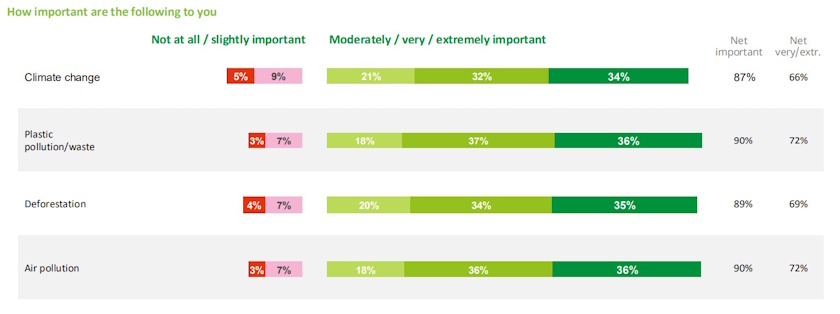
Plastic pollution tops global concerns, matching climate change, deforestation, and air pollution in public priority. Nearly 9 in 10 people worldwide see plastic waste as an important issue and 72% say it is very/extremely important.

The strong consensus highlights growing public demand for action to reduce plastic waste alongside broader climate and environmental goals, according to ECC.

Perceptions of drink cans vary notably by market but remain relatively low across all measures. For recyclability, the highest scores come from the USA (25%), Serbia (24%), and Greece (23%). Sustainability perceptions peak in the UAE (22%) while circularity scores are highest in Greece (23%) and Serbia (22%).

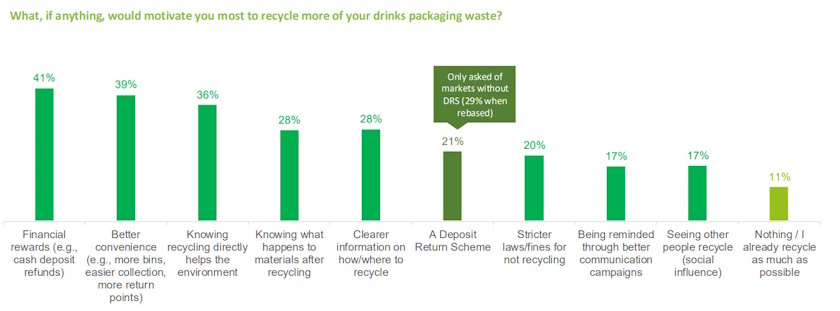
While there is no silver bullet, the strongest motivators for recycling are financial rewards such as deposit refunds (41%) and better convenience (39%), the report reads.

world Every Can Counts report 2025 serbia drs recyclng motivation

Financial incentives resonate most in Romania (53%), and convenience is the strongest in Greece. Brazil is exceptional for environmental impact (55%), followed by Romania, Serbia and the UAE – all with 46%.

Attitudes towards recycling show two clear patterns, according to the report. First, making recycling more engaging through rewards, games or interactive apps could boost participation, particularly in Brazil (83%), Greece (81%) and Serbia (88%), while interest is lower in markets such as the Netherlands (53%) and Belgium (60%).

Second, there is near universal agreement that manufacturers and brands should be required to use fully recyclable or recycled materials, the report underlines.

DRS is less supported in the USA

world Every Can Counts report 2025 serbia drs support

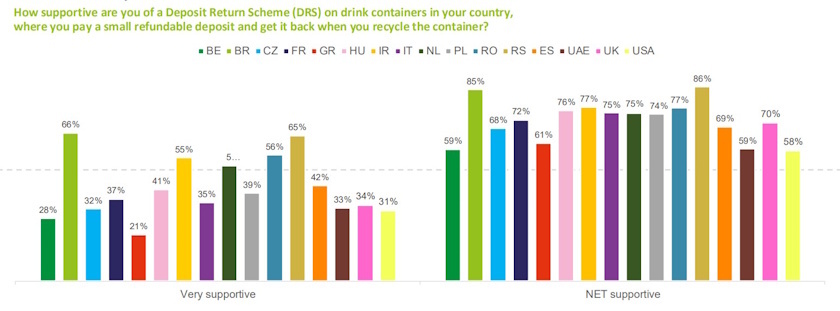
A majority supports DRS in all markets, but the intensity of support varies considerably. Net support ranges from 58% in the USA to 86% in Serbia.

Levels of strong, “very supportive” sentiment show sharper contrasts. Brazil (66%), Serbia (65%), Romania (56%), Ireland (55%) and the Netherlands (51%) stand out as markets with a majority of strong supporters.

At the other end of the spectrum, Greece (21%), Belgium (28%), the USA (31%), the Czech Republic (32%) and the UK (34%) record the lowest intensity.

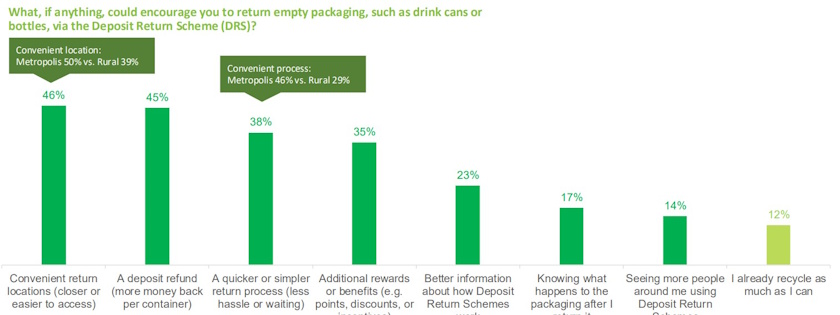
Convenience and incentives are the top drivers overall while information is generally a weaker motivator, but the mix differs by market, the report reads.


world Every Can Counts 2025 report serbia drs recyclng motivation

Higher deposit refunds are most influential in the Czech Republic and Spain, while Serbia and Greece balance convenience and refunds more evenly.

When looking only at those who “strongly agree,” support levels show sharper contrasts.

Romania and Serbia stand out with strong calls for all one-way packaging to be included (67%). Brazil scores high across most categories but is weaker on personal responsibility for returning cans.

Hungary, Ireland, Romania and Serbia show high trust that returned containers are recycled, while trust is lower in the Czech Republic, Belgium, France or Greece, ECC concluded.

by in News

World Environment Day 2025: Beat Plastic Pollution

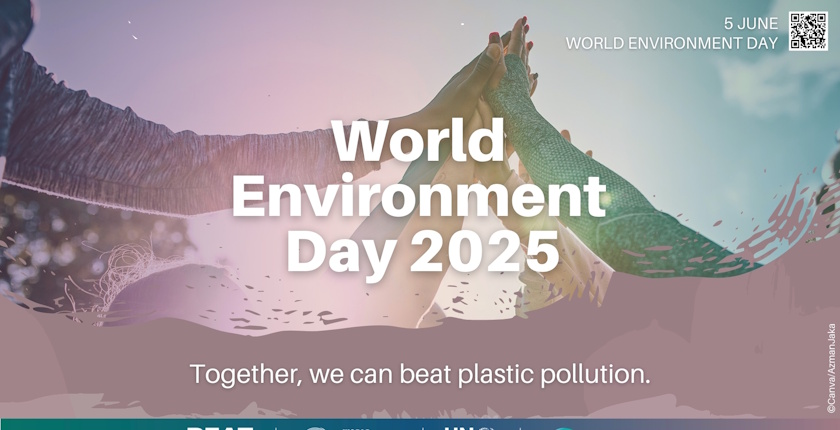
World Environment Day, celebrated on June 5, was established by the United Nations in 1973. This year’s host country is South Korea and the main messages are focused on fighting plastic pollution.

The theme of this year’s World Environment Day calls for action to address plastic pollution. The hashtag #BeatPlasticPollution is part of the global campaign, led by the United Nations Environment Programme (UNEP), aiming to mobilize communities worldwide to implement solutions. It builds on growing scientific evidence of the impact of plastic pollution and calls for reducing plastic use, reusing it, recycling it, and rethinking our consumption habits.

Plastics are part of everyday life, used in everything from kitchenware to medical devices. It’s estimated that humanity has produced about 9.2 billion tonnes of plastic since the mid-20th century, of which seven billion tonnes have become waste. In addition, plastic production is a major contributor to the climate crisis. It is among the most energy-intensive industrial processes, accounting for approximately 6% of global oil consumption.

Each year, some 11 million tonnes of plastic waste end up in rivers, lakes, seas, and finally, oceans. Plastic breaks down into microplastics—tiny fragments measuring between one nanometer and five millimeters. Such particles have been found in the deepest part of the ocean, the Mariana Trench, as well as on the highest point on Earth – Mount Everest.

An individual consumes over 50,000 plastic particles per year on average

Plastic enters the bodies of humans and animals through breathing and ingestion. It is estimated that each person on the planet consumes more than 50,000 plastic particles annually, and much more when inhalation is taken into account. Some studies suggest that nanoplastics smaller than one micrometer can even pass through the skin.

Microplastics also accumulate in soil through sewage, landfills, and the use of plastic in agriculture. One study found that microplastics disrupt photosynthesis, which may threaten food production.

The annual social and environmental cost of plastic pollution is estimated to be between USD 300 billion and USD 600 billion.

[wpcc-iframe title=”Together, we can #beatplasticpollution” width=”500″ height=”281″ src=”https://www.youtube.com/embed/eqapZ8obCGs?feature=oembed” frameborder=”0″ allow=”accelerometer; autoplay; clipboard-write; encrypted-media; gyroscope; picture-in-picture; web-share” referrerpolicy=”strict-origin-when-cross-origin” allowfullscreen=””]

Circular economy as a solution

The key to reducing plastic waste lies in shifting to the principles of a circular economy. It involves rethinking how plastic products are designed, produced, and used. Current estimates show that only 21% of plastic is economically recyclable, meaning the value of the recycled material is high enough to cover the cost of collection, sorting, and processing. In reality, only around 9% of the plastic produced is recycled.

Plastic products should be designed to be reusable, and recyclable at the end of their life cycle. Additionally, companies should stop adding unnecessary microplastics to their products.

Strengthening waste collection and recycling systems would help prevent plastic products from entering the environment, where they break down into microplastics.

South Korea is among the trailblazers in tackling plastic waste

This year’s host of World Environment Day is the Jeju province in South Korea, which is among the countries leading the efforts to tackle plastic waste. It relies on decades of its experience engaging businesses through extended producer responsibility.

South Korea’s plastics strategy addresses the entire life cycle – from production and design to use, reuse, and recycling. Through collaboration between the government, industry, and citizens, the country is building a circular economy and reducing waste at the source.

In 2022, Jeju, an island and archipelago, set the goal to become free of plastic pollution by 2040. It is the only province in South Korea where residents are required to dispose of waste at specialized recycling centers, encouraging better waste separation and higher recycling rates. Jeju was also the first to introduce a deposit-refund system for single-use cups.