by in News

Davos: China reaffirms green agenda as US slams EU’s net-zero goal

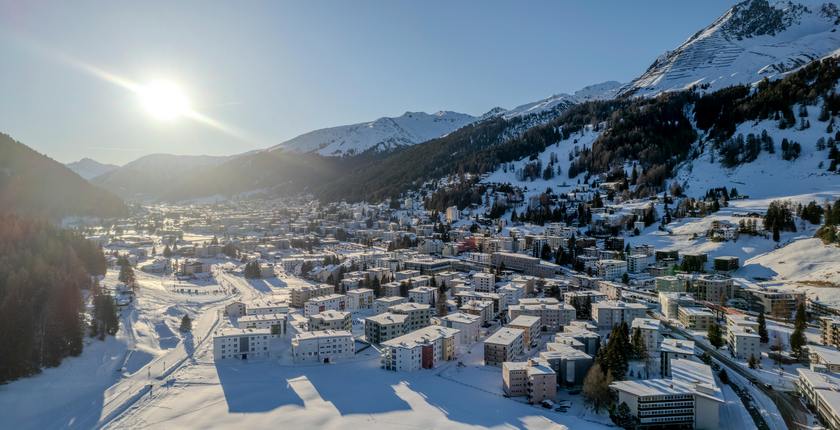
At the World Economic Forum (WEF) in Davos, China reiterated its commitment to green development, in contrast to the United States, whose secretary of commerce said America should rely on oil and gas instead of pursuing a green transition and criticized the European Union’s (EU) net-zero target. US President Donald Trump, for his part, described the energy transition as a “scam” that caused an energy collapse in Europe.

Speaking at the WEF Annual Meeting 2026 in Davos, Switzerland, Chinese Vice Premier He Lifeng emphasized China’s resolve to reduce its greenhouse gas emissions, adding that the country’s upcoming five-year plan would keep the focus on green growth fueled by solar, batteries, and electric vehicles (EVs).

China’s Vice Premier urged other countries to help combat emissions

He also urged other nations and foreign companies to collaborate with China on creating “a green and prosperous future.”

“We invite enterprises from all over the world to embrace the opportunities from the green and low-carbon transition, and work closely with China in such areas as green infrastructure, green energy, green minerals, and green finance,” He said in a speech at Davos.

In contrast, US Commerce Secretary Howard Lutnick criticized the EU’s solar and wind development, as well as its net-zero goal, adding that the green transition is not something the US should pursue. Lutnick also said that the world should focus on coal as an energy source rather than renewables, according to reports.

In January 2025, President Donald Trump signed executive orders reversing much of the previous administration’s climate policy and withdrawing the US from the Paris Agreement once again.

US Commerce Secretary claims seeking net zero without battery production would make the EU subservient to China

“Why are you going to do solar and wind? Why would Europe agree to be net zero in 2030 when they don’t make a battery? So, if they go 2030, they are deciding to be subservient to China, who makes the batteries,” Lutnick said.

“Why would the US, which has oil and natural gas, try to convert to all-electricity? China does not have oil and natural gas – electricity and electric cars make perfect sense to them,” Lutnick said at a WEF panel.

According to news agencies, Lutnick’s harsh criticism of Europe at a VIP dinner on Tuesday made European Central Bank President Christine Lagarde walk out of the event.

Trump slams “the green new scam” and claims China sells wind turbines to others, but does not build its own wind farms

For his part, Trump also criticized the EU’s transition to renewables, claiming that the US had avoided “the catastrophic energy collapse which befell every European nation that pursued the green new scam.” He also described the green transition as “perhaps the greatest hoax in history.”

In his speech in Davos, the US president claimed that wind farms “lose money” and that China only sells wind turbines without building any wind farms itself.

“They sell them to the stupid people that buy them. They don’t use them themselves,” Trump said, adding that China has only built a “couple of wind farms” in order to “show people what they could look like.”

According to available data, China has the largest wind power capacity in the world, at around 600 GW.
by in News

Davos: China reaffirms green agenda as US slams EU’s net-zero goal

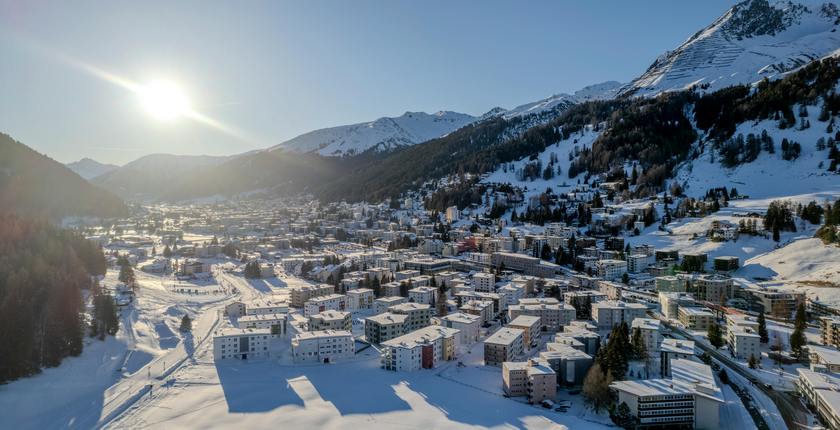
At the World Economic Forum (WEF) in Davos, China reiterated its commitment to green development, in contrast to the United States, whose secretary of commerce said America should rely on oil and gas instead of pursuing a green transition and criticized the European Union’s (EU) net-zero target. US President Donald Trump, for his part, described the energy transition as a “scam” that caused an energy collapse in Europe.

Speaking at the WEF Annual Meeting 2026 in Davos, Switzerland, Chinese Vice Premier He Lifeng emphasized China’s resolve to reduce its greenhouse gas emissions, adding that the country’s upcoming five-year plan would keep the focus on green growth fueled by solar, batteries, and electric vehicles (EVs).

China’s Vice Premier urged other countries to help combat emissions

He also urged other nations and foreign companies to collaborate with China on creating “a green and prosperous future.”

“We invite enterprises from all over the world to embrace the opportunities from the green and low-carbon transition, and work closely with China in such areas as green infrastructure, green energy, green minerals, and green finance,” He said in a speech at Davos.

In contrast, US Commerce Secretary Howard Lutnick criticized the EU’s solar and wind development, as well as its net-zero goal, adding that the green transition is not something the US should pursue. Lutnick also said that the world should focus on coal as an energy source rather than renewables, according to reports.

In January 2025, President Donald Trump signed executive orders reversing much of the previous administration’s climate policy and withdrawing the US from the Paris Agreement once again.

US Commerce Secretary claims seeking net zero without battery production would make the EU subservient to China

“Why are you going to do solar and wind? Why would Europe agree to be net zero in 2030 when they don’t make a battery? So, if they go 2030, they are deciding to be subservient to China, who makes the batteries,” Lutnick said.

“Why would the US, which has oil and natural gas, try to convert to all-electricity? China does not have oil and natural gas – electricity and electric cars make perfect sense to them,” Lutnick said at a WEF panel.

According to news agencies, Lutnick’s harsh criticism of Europe at a VIP dinner on Tuesday made European Central Bank President Christine Lagarde walk out of the event.

Trump slams “the green new scam” and claims China sells wind turbines to others, but does not build its own wind farms

For his part, Trump also criticized the EU’s transition to renewables, claiming that the US had avoided “the catastrophic energy collapse which befell every European nation that pursued the green new scam.” He also described the green transition as “perhaps the greatest hoax in history.”

In his speech in Davos, the US president claimed that wind farms “lose money” and that China only sells wind turbines without building any wind farms itself.

“They sell them to the stupid people that buy them. They don’t use them themselves,” Trump said, adding that China has only built a “couple of wind farms” in order to “show people what they could look like.”

According to available data, China has the largest wind power capacity in the world, at around 600 GW.
by in News

Gazprom’s NIS can restart Serbian refinery as US suspends sanctions

Croatian oil pipeline operator JANAF said it received a license from the United States and that it is prepared to resume supply to NIS. The Serbian company, controlled by Russian state-owned Gazprom, came under American sanctions and ceased fuel production a month ago.

Serbian officials announced that the Office of Foreign Assets Control of the US Treasury Department has issued a license to NIS – Naftna industrija Srbije – to restart operations at its refinery. They said the approval lasts until January 23. It means the country’s only refinery can work again after almost three months since oil deliveries ceased.

The Serbian company, controlled by Russian state-owned Gazprom, came under US sanctions in January. After several postponements, the punitive measures came into force in early October. The oil refiner and fuel station chain operator halted production a month ago.

Croatian state-owned oil pipeline operator Jadranski naftovod (JANAF) said it has obtained a US license, valid also until January 23, in cooperation with the Government of Croatia. The company is “fully prepared to immediately ensure uninterrupted transport and supply of crude oil to the Pančevo refinery,” the announcement reads.

Serbian public broadcaster RTS learned from unnamed sources familiar with the matter that President Aleksandar Vučić earlier spoke to OFAC and the US Department of State, as well as with Hungarian Prime Minister Viktor Orbán. The negotiations between Gazprom and Hungarian MOL about the sale of the entire Russian majority stake could be completed before the license expires, according to the report.

Notably, it could take several weeks to restart the refinery, located near Belgrade.

by in News

Serbia developing legal framework for CO2 storage

The draft law on hydrocarbon exploration and exploitation will include permanent disposal of carbon dioxide in geological formations of depleted deposits, the Ministry of Mining and Energy of Serbia said.

Serbia has begun work on a draft bill on hydrocarbon exploration and exploitation and the basic principles for the law. The Ministry of Mining and Energy invited interested individuals, expert institutions, representatives of companies and scientific and academic bodies as well as civil society organizations to submit proposals and suggestions via the email address [email protected].

The deadline is January 18. Under development is one of the key regulatory frameworks for mining, given that it entails exploration, exploitation, preparation and transport of hydrocarbons within the process of exploration and exploitation ‒ in particular, oil, natural gas, condensates and other hydrocarbon resources.

In Serbia, the sector is regulated by the Law on Mining and Geological Explorations. It treats hydrocarbons as mineral raw materials for energy. The aim of the forthcoming law is to establish a unique legal and institutional framework for hydrocarbon exploration and exploitation as well as for the exploration of geological structures suitable for underground storage of natural gas and permanent disposal of CO2 in geological formations of depleted deposits in exploitation zones, in line with the highest security and environmental standards.

The forthcoming law needs to facilitate incentives for exploration and the use of geological structures for storing gas and carbon dioxide

The ministry explained that the regulatory framework needs improvement as regards the process of approving exploration and exploitation rights, including alignment with European regulations. It especially concerns directive 94/22/EC on the conditions for granting and using authorizations for the prospection, exploration and production of hydrocarbons, directive 2009/31/EC on the geological storage of carbon dioxide and directive 2013/30/EU on safety of offshore oil and gas operations.

Among the specific goals is the introduction of environmental standards and environmental protection measures in all phases of the process. In the law, the ministry also intends to define investors’ obligations when it comes to remediation, rehabilitation and monitoring. As for gas and CO2 storage, the new framework needs to facilitate incentives for exploration and the use of geological structures for the purpose, within the strategy to lower greenhouse gas emissions.

by in News

Serbia backs talks on sale of NIS to Hungary’s MOL – energy minister

Serbian Minister of Mining and Energy Dubravka Đedović Handanović has confirmed that Russian shareholders are negotiating the sale of their stake in Serbia-based oil company NIS to Hungarian oil and gas company MOL, and that the Government of Serbia supports the talks. NIS is majority-owned by Russian energy giant Gazprom, whose exit from the ownership structure is a requirement for lifting US sanctions against the oil company.

Đedović Handanović added that both NIS and MOL have approached the US Office of Foreign Assets Control (OFAC). According to her, the negotiations on the exit of Russian capital from NIS’s ownership structure are supported by the Russian, Hungarian and Serbian governments.

“The Government of Hungary has supported those talks, and we, as the Government of Serbia, will also provide support, with the aim of finding a solution to lift the sanctions and to create the conditions for granting an operating license to NIS,” she stated.

NIS has applied for an OFAC license to continue operating, but has not yet received approval.

Serbia supports the sale of the Russian stake in NIS to enable the lifting of US sanctions

Recently, Serbian President Aleksandar Vučić also confirmed that information had emerged about negotiations between Gazprom and MOL, adding that Serbia had no objections to the sale of NIS to the Hungarian company.

Serbian officials previously said that the Russian side had agreed to sell the company and that negotiations were underway with several firms. According to unofficial information at the time, one of the suitors was Abu Dhabi National Oil Co. (ADNOC) from the United Arab Emirates.

The US sanctions against NIS, which supplies 70–80% of petroleum products to the Serbian market, came into effect on October 9. The sanctions have blocked NIS from importing crude oil, forcing its Pančevo refinery to halt production.

Đedović Handanović: Serbia still has enough fuel, but reserves are depleting

Đedović Handanović said that citizens have not felt the impact of the sanctions and that Serbia still has sufficient fuel, from diesel and gasoline to fuel oil and kerosene, to get through the crisis. However, she noted that these reserves are depleting and that people need to understand that Serbia lacks the logistical capacity to import the volumes of petroleum products it requires.

She stressed that Serbia will continue the dialogue to ensure that NIS can continue operating, regardless of the time required to complete the transaction between MOL and the Russian shareholders.

by in News

Israel, Greece, Cyprus reaffirm commitment to joint energy projects

Amid chronic delays in the projects for offshore gas and the Great Sea Interconnector and Turkey’s warnings, the leaders of Israel, Greece and Cyprus said after a trilateral summit that they would safeguard their sea lanes and critical infrastructure against emerging threats.

Prime Minister of Israel Benjamin Netanyahu, Prime Minister of Greece Kyriakos Mitsotakis and President of Cyprus Nikos Christodoulides agreed to reinforce trilateral cooperation on security, defense and military matters. In a declaration from their summit in Jerusalem, they reaffirmed the importance of the dialogue in a 3+1 format with the United States.

The joint statement came amid chronic delays in the projects for offshore gas and the Great Sea Interconnector. The latter, an undersea electricity link, is planned to run from the island of Crete in Greece to Cyprus and, from there, to Israel.

Turkey has been openly opposing such projects and even sending its navy to disturb research and exploration. Countering the Great Sea Interconnector, the government in Ankara is apparently planning to establish a power link with the northern Cypriot Turkish-dominated entity.

Netanyahu, Mitsotakis and Christodoulides particularly emphasized the importance of the Great Sea Interconnector project

“Today’s trilateral summit reaffirms our unwavering commitment to strengthen our cooperation, enhancing the security and resilience of our nations for generations to come… We reaffirm our determination to advance joint energy projects, including natural gas development, electricity interconnectors, and renewable energy initiatives, as a solid foundation for cooperation in the region, based on international law, including the law of the sea and the respect of all states to exercise their rights in their respective EEZ / continental shelf,” the document reads.

EEZ is exclusive economic zone, a maritime area in which a country claims exclusive rights. Netanyahu, Mitsotakis and Christodoulides particularly emphasized the importance of the Great Sea Interconnector project.

“We underscore the importance of maritime security and pledge to deepen collaboration in safeguarding sea lanes and critical infrastructure against emerging threats,” they said. The three leaders added they would collaborate regional interconnectivity projects within the so-called India – Middle East – Europe Economic Corridor (IMEC).

by in News

Fearful about oil sanctions, Serbia’s Vučić seeks support from EU leaders

Facing an imminent halt of the Gazprom-owned Serbian oil company NIS due to US sanctions, President Aleksandar Vučić met with EU leaders António Costa and Ursula von der Leyen in Brussels. “I don’t have such a strong fear regarding gas as I do about oil,” he revealed and said they spoke about the possibilities for importing derivatives from Romania, Bulgaria and other countries in the region. Costa and Von der Leyen urged Serbia to further align with the EU’s foreign and security policy.

Serbia hasn’t received a single drop of crude oil for two months, President Aleksandar Vučić noted as he addressed the press in Brussels after meeting European Council President António Costa and European Commission President Ursula von der Leyen. The country’s only refinery is run by NIS (Naftna industrija Srbije), which Russian state-owned Gazprom controls through its subsidiaries. Entirely stripped of oil supply since United States sanctions against the Serbian company kicked in, the facility recently ground to a halt.

There is apparently no progress in talks about the sale of Gazprom’s share. The authorities expect that Serbia will have to freeze NIS completely in the next few days, for its financial system to avoid secondary sanctions.

NIS and Lukoil together hold over one quarter of fuel stations in Serbia

The company, which is also present in some neighboring countries, supplied 80% of derivatives in the domestic market. Moreover, one in five fuel stations in Serbia is branded NIS or Gazprom. They account for more than a quarter together with Russia-based Lukoil. It is also under US sanctions, though able to operate almost until the end of April.

Vučić: It will only get harder each coming day

Vučić said he and Costa and Von der Leyen spoke about the key energy concerns that Serbia is facing. “It’s not easy for us already today, and it will only get harder each coming day… I don’t have such a strong fear regarding gas as I do about oil. Of course I am fearful, as a responsible man. I am always fearful, but we sought solutions and worked on it and I hope we will have EU’s support in these very important matters,” he stated.

Namely, Serbia is dependent on Russian gas and its transit through Bulgaria. The fuel comes via the Balkan Stream pipeline, an extension of TurkStream. If NIS is nationalized, the Kremlin could slash or even end the supply in case. Serbia is buying gas under short-term arrangements since May. The EU has launched measures to end most of the remaining supply from Russia next year.

According to the president, possibilities were discussed at the meeting of importing oil derivatives from Romania, Bulgaria and other countries in the region.

There was also word about where Serbia would build gas and oil pipelines, Vučić added and hinted at projects for liquid fuel pipelines as well. He mentioned the possibility of transporting diesel that way from Constanța, Romania’s Black Sea port city. Near it is the Petromidia refinery, owned by Rompetrol, a 100% subsidiary of Kazakhstan’s state-owned KazMunayGas (KMG).

Vučić said he spoke with the two top officials about the plan for a gas interconnector with North Macedonia.

Europe has consistently shown solidarity with Serbia, according to both top officials

Costa and Von der Leyen issued short and essentially identical messages after the meeting with the Serbian president. They highlighted the importance of accelerating reforms in the country, particularly with regard to the rule of law and media freedom.

“We stressed that enlargement is a geostrategic imperative and the need for Serbia to further align with the EU’s foreign and security policy. We also welcomed Serbia’s steps to diversify its energy sources and routes and to reduce dependency on Russia, whose unreliability has been repeatedly demonstrated. Europe has consistently shown solidarity with Serbia through major investments in energy infrastructure and support to vulnerable households,” they wrote on social media.

Two months ago, Von der Leyen said the EU is a guarantee that Serbian families would be safe and warm in winter and that the country can enter its joint gas procurement mechanism.

by in News

MOL in talks about possibility of purchasing stake in Serbian NIS

Hungary acknowledged that state-controlled oil and gas company MOL is in discussions aimed at exploring the possibility of acquiring a stake in NIS. Based in neighboring Serbia, the oil refiner and service station chain operator is under sanctions that the United States imposed on its owner, Russian Gazprom Neft.

Gergely Gulyás, chief of staff of Hungarian Prime Minister Viktor Orbán, revealed today that integrated oil and gas company MOL, headquartered in Budapest, is conducting talks about the possibility of taking over an ownership stake in NIS – Naftna industrija Srbije. Speaking at a media briefing, he added that it is in the Serbian company’s interest to end Russian ownership, pointing out that US sanctions are jeopardizing its operations.

NIS, which runs the only refinery in the country and a service station chain, hasn’t received any oil in a month and a half. The facility, located in Pančevo near Belgrade, is about to halt its operations. NIS came under sanctions because it was majority-owned by Gazprom Neft.

Its parent company Gazprom later reduced Gazprom Neft’s stake to 44.5% and switched the remainder to another subsidiary. The US apparently demands a complete Russian exit.

MOL, not Hungarian government, is in discussions concerning NIS

Gulyás clarified that MOL, a public company, is the one in discussions about a potential stake purchase – not the government. Notably, Hungary controls the company indirectly, through several entities.

The government is ready to help neighboring Serbia with regard to a deal with MOL, the official stressed. Gulyás didn’t confirm or deny speculation that his prime minister would travel to Moscow tomorrow to meet with Vladimir Putin.

Orbán visited Serbia and met with President Aleksandar Vučić today. The Hungarian leader, who managed to get an exemption earlier from the US sanctions on Russian oil and gas, said he would engage in negotiations “in the coming days or tomorrow” to secure the actual supply and “not just papers and permits.”

Russian oil and gas will continue to flow to Hungary, so Serbia will be getting it, too, Orbán claimed.

Gulyás: Fuel export boost to Serbia not to disturb domestic supply

According to earlier media reports, Abu Dhabi National Oil Co. (ADNOC) from the United Arab Emirates is among the suitors for NIS.

Serbia has asked the US to suspend sanctions for 50 days. Vučić said the government would take over NIS if a buyer isn’t found.

Hungarian Minister of Foreign Affairs and Trade Péter Szijjártó said yesterday that MOL’s fuel deliveries to Serbia have been doubled and that they would be 2.5 higher in December on an annual scale.

Gulyás denied that the increase in exports to the neighboring country would disturb domestic supply.

by in News

Siemens Energy, Končar to install electrolyzer, solar power plant for INA

Siemens Energy and Končar will install an electrolyzer and a solar power plant for Croatian oil and gas company INA.

INA said it has signed two important contracts for the implementation of the green hydrogen production project at its Rijeka refinery.

By signing contracts with reputable companies, with a total value of EU 33 million, INA has secured the preconditions for the implementation of the first commercial green hydrogen production plant in Croatia, according to the update.

A contract with Siemens Energy and Končar was signed for the construction of a 10 MW green hydrogen production and distribution plant. The order is estimated at EUR 22.5 million excluding VAT.

INA has already secured the delivery of the electrolyzer

The second contract, worth nearly EUR 11 million excluding VAT, was signed with Končar. It envisages the construction of a 11 MW photovoltaic plant. The facility would supply electricity to the electrolyzer.

As part of the project, INA has already secured the electrolyzer, a key system for water electrolysis and hydrogen production from renewable sources. Its majority owner, Hungarian MOL, inaugurated its first 10 MW electrolyzer in April last year.

Green hydrogen is intended for use in transportation

The green hydrogen that would be produced is intended for the market, primarily for transportation purposes, and it could also be used in the refinery’s production process. The company recalled that, by a decision of the Ministry of Economy, it received a EUR 15 million grant from the National Recovery and Resilience Plan.

The program is for the production and distribution of hydrogen in transportation.

The hydrogen market in Croatia is in an early development phase. INA’s plant could produce about 1,500 tons of green hydrogen annually.

Of note, Croatia adopted a hydrogen strategy in 2022. The government subsidizes the installation of chargers for hydrogen fueled vehicles.

Ortutay: Hydrogen could open new market opportunities for INA

INA CEO Zsuzsanna Ortutay said European and national strategies consider renewable hydrogen a technology of the future.

The renewable hydrogen that INA will produce can open new opportunities for the company in the market, but also improve the sustainability of Rijeka refinery through emission reductions, Ortutay stressed.

According to Končar CEO Gordan Kolak, green hydrogen isn’t only a technology of the future but a key element for decarbonizing industry and transport.

As the main contractor for the construction of this plant, Končar confirmed its role as a reliable partner developing key expertise for the European energy infrastructure in the decades to come, Kolak added.

by in News

Tens of thousands of tons of waste motor oil unaccounted for in Serbia

Waste motor oil is classified as hazardous waste as it can contaminate soil, water, and air. Although Serbian regulations for its management are clear, tens of thousands of tons are unaccounted for every year. Auto repair shops, obliged to dispose of it, often sell the material to individuals who use it for heating. Burning used motor oil is extremely dangerous because of the release of substances similar to chemical warfare agents into the air, warns Dejan Lekić from the National Ecological Association.

Just one liter of used motor oil can pollute up to one million liters of drinking water, making it one of the most harmful pollutants.

UAS, a Serbian association of auto repair shops, pointed out after the public debate on the draft Law on Waste Management that Serbia does not need cosmetic legal changes, but solutions to prevent the country from being buried under all types of hazardous and non-hazardous waste.

According to the latest report by the Serbian Environmental Protection Agency (SEPA), about 40,311 tons of oil were placed on the Serbian market in 2023. Of the 40,311 tons, only 440 tons of waste motor oil were processed in Serbia, and 1,660 tons were exported. It means 38,000 tons likely ended up in soil, sewage systems, waterways, or household furnaces.

Burning waste motor oil releases toxic substances

Dejan Lekić from the National Ecological Association, the creator of the xEco app for real-time air pollution monitoring, warned that waste motor oil must never be used as fuel in household stoves, nor discharged into soil or sewage.

“The only correct approach is to collect it and hand it over to licensed operators. Once the operator takes it, the oil can follow two paths: regeneration or destruction. Ideally, it is regenerated – technologically purified to produce base oil for reuse,” he explained.

Waste oil can be regenerated or destroyed

Regenerating waste oil is an example of the circular economy. From one ton of crude oil, only 2% can be turned into base oil, while 65% of collected waste oil can be processed into base oil.

“The second option is using it as a fuel, but only in specialized industrial facilities such as cement plants, which have furnaces operating above 1,200 degrees Celsius and appropriate filtration systems. Such facilities are the only ones that can safely destroy hazardous substances and prevent their release into the atmosphere,” Lekić asserted.

Using waste oil as fuel in household stoves is extremely dangerous to health

As it is cheap and easily available, waste motor oil is often used for heating in Serbia. But when burned in ordinary stoves, it releases large amounts of carcinogenic gases and heavy metals. According to Dejan Lekić, using waste oil for heating poses a serious threat to human health.

He explained that waste motor oil contains heavy metals such as lead, mercury, and cadmium, along with various additives. Regular stoves cannot reach temperatures high enough to burn these substances safely, so they are released directly into the air.

Lekić warned that incomplete combustion also produces extremely toxic compounds, including dioxins and furans – substances known to cause cancer and linked to severe neurological damage, hormonal disorders, and fertility problems. “People who burn this oil are literally releasing chemical warfare agents into their surroundings,” he said.

Serbia is among the top European countries in premature deaths caused by air pollution

Serbia is among the top European countries in premature deaths caused by air pollution, and it ranks first in Europe for lung cancer mortality linked to pollution, according to the World Health Organization. UAS, the Serbian group of car repair shops, described the situation as a “silent ecological catastrophe” that has been ongoing for decades and added that the system remains unable to stop it.

During the recent public debate on the new Law on Waste Management, the relevant ministry rejected most of the association’s proposals for managing waste oils. UAS emphasized that these suggestions were based on the best practices for reducing hazardous waste in the European Union and the region.