by in News

RE-Source Platform: Number of PPAs in Europe drops by 60%

The number of power purchase agreements in Europe decreased by 60% compared to the same period last year, while contracted capacity has dropped by 40%, according to RE-Source Platform.

Europe’s power purchase agreement (PPA) market is facing headwinds in grid development, permitting and electrification and from negative electricity prices, RE-Source Platform warned.

RE-Source Platform facilitates corporate renewable energy sourcing in Europe. It was founded by WindEurope, SolarPower Europe, Climate Group RE100, and World Business Council for Sustainable Development, and steered by a group of corporate buyers and developers.

There are four main problems

“This slowdown is very paradoxical. Europe has no path to energy security and competitiveness unless it electrifies its economy – shielding itself from energy shocks and leveraging large scale deployment of wind and solar energy. But the market is facing headwinds,” the update reads.

The platform identified four main problems.

Europe is not expanding its grid infrastructure quickly enough. The main bottleneck is grid permitting with hundreds of gigawatts of projects awaiting grid connection.

The permitting process for renewables remains too slow. The Renewable Energy Directive has set permitting rules for acceleration, but EU member states have not implemented them.

The Clean Industrial Deal rightly names PPAs as a key solution

Direct electrification is the cheapest and most efficient way to decarbonize. It could also improve competitiveness and energy security, however Europe’s electrification rates are stagnating.

The increase of the negative price hours is making PPA negotiations harder. The way out are energy storage solutions.

The platform stressed the importance of PPAs.

“The Clean Industrial Deal rightly names PPAs as a key solution. Without them, we risk losing industrial competitiveness – and missing our climate targets. PPAs are a cornerstone of Europe’s industrial decarbonization,” the platform added.

They also give companies price certainty, help new wind and solar projects get financed and cut buyers’ exposure to volatile energy markets, according to the update.

by in News

Negative prices to form so-called bathtub curve in Greece as photovoltaics keep growing

The latest modeling for the wholesale electricity market in Greece shows ever-decreasing prices at times when solar power output is the strongest within the day. The trend points to the formation of a so-called bathtub curve in the daily price charts at the power exchange, as a result of the expected continuation of the photovoltaic capacity surge.

Greece experienced its first negative prices this year. They intensified in August and September, weakening the profitability of investments in the production of renewable electricity.

This year, market participants expect at least 2 GW of photovoltaics to connect to the grid, along with the first standalone battery storage units.

Currently, prices usually fall to a negative EUR 1 per MWh at the most. However, the pace of installations indicates that prices will go even lower. According to the Hellenic Association of Photovoltaic Energy Producers (SPEF), analytical models indicate that for every 1,000 MW of new solar capacity, the so-called system marginal price (SMP) at noon is lowered by EUR 10 per MWh.

Storage acts as a shield against price drops. But even if as many batteries are added as photovoltaics, the wholesale price is seen at a negative EUR 5 per MWh on average during the hours of maximum solar production, the organization’s Chairman Stelios Loumakis said. The level would fluctuate depending on the season and conditions in the system.

With the addition of 500 MW of wind energy per year, the price is at EUR 7.5 per MWh below zero. If system demand also rises, then the level is slightly higher, at EUR 5 per MWh in negative territory.

Loumakis: The duck curve will eventually become the bathtub curve

Especially concerning is that such price formation would turn systematic, almost daily. Loumakis expects more than 1,000 MW of annual solar installations in the following years. Therefore, the actual price could be much lower.

As things stand today, the daily power price curve resembles a duck in markets with high renewable energy penetration. Medium prices in the morning are followed by a drop at noon and a great rise later in the day. A much more pronounced curve is expected in the near future, looking more like a bathtub, he explained.

Loumakis warned years ago about the repercussions from a rapid rise in solar energy, saying that the market would overheat and lower profits.

Up to 3 GW expected this year

Other market players echoed his concerns. CEO of MGD Energy Panagiotis Mourtopalas said at the Renewable and Storage Forum that business plans are under pressure because of curtailments and negative prices. This year, 2,000 jobs have been lost in the renewable energy market as a result.

The Hellenic Association of Photovoltaic Companies (HELAPCO) estimates that new capacities this year would amount to between 2.6 GW and 3 GW, with no sign of slowing down.

by in News

Bulgarian coal plant mulls replacing boiler with molten salt battery

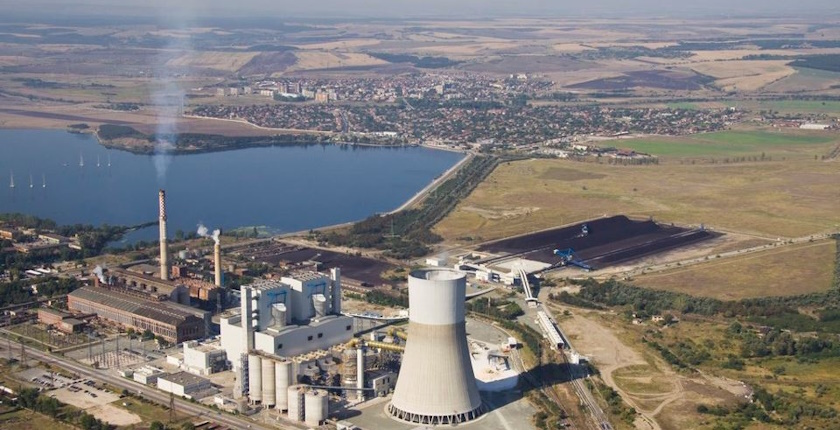
The operator of the AES Maritsa iztok 1 coal plant in Bulgaria is interested in replacing one of its boilers with a molten salt reactor. It would accumulate excess renewable energy from the power grid as heat and produce steam to drive the existing turbine.

With the surge in solar and wind power capacity throughout the world, the grid needs to match it with balancing and flexibility to handle the intermittency of the two sources. Their output varies with weather conditions, so the amount of electricity is often much higher or lower than demand.

Batteries are all the rage now, with investors racing to bridge the gaps between intraday peak production and peak consumption. Southeastern Europe is catching up with the trend, especially in Bulgaria, Romania and Turkey.

A molten salt battery could turn out to be a lifeline for AES Maritsa East 1

It opens up space for some other solutions in the emerging energy storage market which are nearing maturity. United States-based AES Corp.’s subsidiary in Bulgaria is examining one such overlooked opportunity. The molten salt reactor technology could revive the prospects of its coal power plant in Galabovo in Stara Zagora province.

The operator of the AES Maritsa iztok 1 (AES Maritsa East 1) facility is planning to transform one of the units into a so-called Carnot battery, Capital.bg reported. Such systems turn electricity into thermal energy and store it, to convert it back to electricity.

AES plans to maintain generator’s capacity

The company’s solution of choice is a molten salt reactor, which would replace the boiler. AES plans to power it with surplus renewable energy and produce steam for the existing 345 MW turbine. Importantly, among its other assets is the Saint Nikola wind power plant of 156 MW, the largest in Bulgaria.

The battery would hold enough heat to drive the unit at maximum power for five hours, translating to 1.73 GWh.

Coal plants can technically work nonstop, but the market has all but overrun most such facilities in Europe. Now they increasingly operate only when prices are high, covering peaks. It could make the business case for molten salt reactors and preserve jobs.

Molten salt is used in concentrated solar power (CSP) plants. They mostly use electrolytes such as alkali metal chlorides – sodium chloride, potassium chloride or lithium chloride – or nitrates: for instance, sodium nitrate or potassium nitrate.

Need for energy storage strengthening with rise in intraday price spreads

Market prices were negative on 2.8% of the days of last year, while they were lower than EUR 5 per MWh for 8.8% of the time. It compares to 1.9% and 5.5% in 2025, respectively, the article adds. The spread between the maximum and minimum prices is increasing. On 53% of days in the first half of this year, the difference was between EUR 100 per MWh and EUR 200 per MWh. The share of spreads above EUR 200 per MWh was 30%.

Such high amplitudes indicate both oversupply and shortages within the same day, amid the strong growth in variable renewables capacity.