by in News

Critics of Serbia’s draft mining strategy barred from public hearing

A public hearing on the draft Strategy for the Management of Mineral and Other Geological Resources in Serbia for the period 2025 to 2040, with projections until 2050, was held at the Serbian Chamber of Commerce. The document outlines a long-term approach to resource exploitation. A group of citizens, environmental activists, and experts critical of the draft held a protest after being denied entry to the event.

The draft Strategy for the Management of Mineral and Other Geological Resources in Serbia for the period 2025 to 2040, with projections until 2050 is a basis for the government’s decisions regarding geological exploration and mining.

Serbia is following European guidelines, including the Critical Raw Materials Act (CRMA), thereby building a system that supports investment predictability, responsible exploitation, and sustainable development, according to the Ministry of Mining and Energy.

The strategy was modeled after those of European countries

“We want our mining industry to be as developed as in Scandinavian countries. We also used Poland as an example, as it is most similar to us in terms of coal and copper production,” said Assistant Minister for Geology and Mining Ivan Janković.

Besides copper and coal, the strategy emphasizes non-metallic and geological resources like stone, sand, clay, and groundwater.

Public consultations on the draft strategy and the environmental report were held from June 13 to July 2. The public hearing was initially scheduled for July 1 but was postponed “in the interest of full transparency,” according to the ministry, to give all stakeholders sufficient time to submit comments and suggestions.

Environmental activists protest outside of venue

The draft strategy would serve the interest of mining companies while disregarding the needs of the country and its citizens, according to Nebojša Petković, an activist from a local group Ne damo Jadar in western Serbia, who spoke to FoNet news agency ahead of the public hearing. Conversely, Ivan Janković from the ministry denied the claim, arguing that the strategy was created solely in Serbia’s interest.

Environmental activists, citizens, and experts gathered in protest outside the venue after being denied entry, despite registering for attendance. Among them were Dragana Đorđević from the Institute of Chemistry, Technology and Metallurgy, and Zoran Stevanović, retired hydrogeology professor from the Faculty of Mining and Geology. He said the ministry scheduled the hearing only one day in advance, adding that the critics were told there is no room for more people even though they applied as soon as they saw the notice.

The strategy prioritizes mining over nature

Professor Stevanović told N1 that the strategy proposes three levels of investment, with the most intensive scenario involving USD 6.8 billion in foreign investments in mining. In his view, it would lead to an enormous expansion of such activity.

The strategy mustn’t prioritize mining in spatial planning over protected natural zones, even ones with vital water resources, Stevanović underscored.

He also criticized linking exploration with future exploitation, pointing out that the government wouldn’t be able to compete in tenders through public bidding. Stevanović added that Serbia has experts capable of conducting in-depth studies on ores for the benefit of citizens, instead of exporting raw materials.

by in News

Three cities reviving protests against Rio Tinto’s lithium project in Serbia

Opponents of Rio Tinto’s plan to mine and process a lithium and boron ore called jadarite in western Serbia held a protest in Loznica. Representatives of local activist group Ne damo Jadar announced that such gatherings would be organized in the nearby cities of Valjevo and Šabac as well.

Several thousand people demonstrated in the western Serbian city of Loznica against Rio Tinto’s project Jadar, marking what could be the start of another in a string of protests, which began in 2021. Activists from the area said rallies would be held in neighboring cities, too, with a possibility of expansion throughout the country.

Marijana Petković from the Ne damo Jadar group accused the authorities of breaking the law by approving new infrastructure to be built for the planned lithium and boron mining operation and a processing facility. Rio Tinto filed in February for connecting a future 110 kV transformer station to the grid. The activists are also upset because of indications that the company expects to get approval for an exploitation field. It would imply priority in mining the unique lithium and boron ore, called jadarite.

The Lotel television station in Loznica never came to the Gornje Nedeljice village nor has it given the opportunity to the opponents of the Jadar project to speak, said Nebojša Petković from local group Ne damo Jadar

At the protest, the building of local media outlet Lotel was spray-painted and a poster saying “disturbing content” was glued onto it.

“They don’t have any big influence, but they do on a part of the population in Loznica. And they never came to Nedeljice to film what we have, those houses of ours that are whole, nor to film the demolished houses. They never produced a single report. They never gave the opportunity to us or to experts, not a single opponent of the Jadar project, to come to their television studio,” Nebojša Petković from Ne damo Jadar told N1 TV.

The village of Gornje Nedeljice, where the activist group is based, is the site of the proposed mine and processing plant.

Nebojša Petković pointed out that national TV stations of France, Italy and Sweden and other countries and even one from Japan have reported about the Jadar project.

Next protest scheduled for July 24 in Valjevo

The next protest is scheduled for July 24 in Valjevo, and one will probably be held in Šabac, according to Nebojša Petković. He stressed that further activities in the three cities would be coordinated. Exploratory drilling has been conducted around Valjevo and Šabac, too, prompting numerous protests.

Petković jokingly called the three cities the Serbian Bermuda triangle and expressed hope that other areas in Serbia would join the resistance.

The planned investment has been countered by some of the biggest and most widespread protests ever held in the country, in several waves. The European Commission approved a strategic status in early June to the Jadar project.

Balkan Green Energy News has a chronological overview of the key events since 2001.

Nearby lithium project across the river Drina, in BiH, also faces resistance

Notably, in a repeated vote held recently in the National Assembly of the Republic of Srpska, a civic initiative to declare Majevica a natural park failed to receive sufficient support from lawmakers. The mountain is near Jadar, on the other side of the Drina river, in Bosnia and Herzegovina. The Republic of Srpska is one of the two political entities making up Serbia’s neigboring country, and the other one is called the Federation of BiH.

Activists are also demanding an urgent moratorium on the approval of concessions for exploration and exploitation of ores and other resources.

Citizens in the area have held multiple rallies against the local lithium mining project, supported by local authorities.

by in News

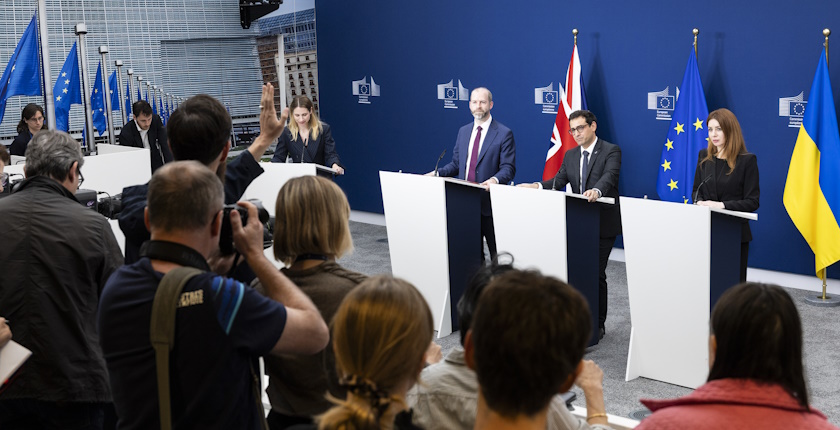
European Commission declares Jadar project in Serbia one of its strategic projects for critical raw materials

The European Commission published the list of the first 13 strategic projects for raw materials outside of the European Union. One of them is project Jadar in Serbia. It is the only one for lithium and boron. Notably, it got the strategic status only for extraction, even though Rio Tinto said it would also build a processing plant.

After adopting 47 strategic projects in line with the Critical Raw Materials Act (CRMA) in March, today the European Commission added another 13, for locations outside of the EU’s borders. They include Rio Tinto’s controversial project Jadar in Serbia, for lithium and boron. The aim is to diversify the sources of supply and increase economic security, but alongside strengthening value creation in third countries, according to the update.

“Europe needs raw materials to succeed in our industrial and climate ambitions. The EU requires stable, secure and diversified supply chains,” said the European Commission’s Executive Vice-President for Prosperity and Industrial Strategy Stéphane Séjourné.

Photo: European Commission

Strategic projects across globe

The first 13 strategic projects outside of the EU are in Canada, Greenland, Kazakhstan, Norway, Serbia, Ukraine, Zambia, New Caledonia, Brazil, Madagascar, Malawi, South Africa and the United Kingdom. They require EUR 5.5 billion in total capital investment to start operations, the European Commission said.

Séjourné revealed that investors filed 49 applications.

Project Jadar in western Serbia, near the city of Loznica, is the only one for lithium and boron. Interestingly, the European Commission only endorsed the extraction segment, even though Rio Tinto has said it would build a processing facility as well. According to today’s announcement, the investment aims to contribute to the supply of lithium – battery grade, and boron for metallurgy.

Several waves of mass rallies against project Jadar have been held throughout Serbia

The local population in the Jadar valley, environmentalist organizations and a number of experts have been opposing Rio Tinto for several years now, citing the lack of transparency and the risks for health, nature and agriculture, and especially the potential pollution of water sources. They held several waves of large countrywide protests.

Balkan Green Energy News has published a chronological overview of the key events since 2001, when Rio Tinto arrived in Serbia.

The mining giant is conducting project Jadar through its Serbian subsidiary Rio Sava Exploration.

Most projects are for graphite, cobalt, nickel

Most of the other endeavors entail the extraction and processing of graphite, cobalt and nickel. The remaining ones are for mining tungsten, rare earth elements, manganese and copper. A project conducted both in Greenland and Norway is for the extraction and processing of graphite.

Rare earth elements have a key role in producing high-performance magnets used in wind turbines or electric motors for renewable energy technologies and electromobility. Boron is used in the automotive, renewable energy, aerospace and defence sectors.

Lithium ion batteries are currently the dominant technology in the electricity storage segment, excluding pumped storage hydropower plants. The alkali metal has a range of applications: from consumer electronics and electric vehicles to stationary facilities within renewable power plants or for grid balancing.

The selected projects meet the environmental, social and governance standards stipulated in CRMA, together with technical feasibility, the EU executive said. They are eligible for support by the European Commission, member states and financial institutions, including “contacts with relevant offtakers,” it added.

Kokanović: We continue resistance

Local activist from the Ne damo Jadar group Zlatko Kokanović said the academic community and the Serbian Academy of Sciences and Arts (SANU) have clearly rejected Rio Tinto’s lithium project. He also claimed that 63.5% of citizens also oppose it, apparently citing results of a recent survey.

The European Commission’s decision doesn’t guarantee environmental standards, Kokanović told Beta news agency. “It is quite hypocritical from a Europe promoting the rule of law, democracy, freedom of speech, a healthy environment and clean air, water and soil. To the detriment of our health and the health of our children, they want to take our lithium and turn us into a waste dump so that they live healthy,” he stated.

There isn’t any such mining project in a densely populated area and on fertile land anywhere in the world, the activist argued. “It is essentially an experimental facility. They don’t have answers to all questions and their main slogan is: ‘We will try to reduce risks’. We now live without risks, we don’t need to reduce them. If an incident happens, they will say that they are acknowledging the mistake, that they will try not to repeat it, and they will apologize. We don’t have anything from it,” Kokanović underscored.

Separately today, he vowed to continue the resistance with all allowed and forbidden and available means. Kokanović resides in the village of Gornje Nedeljice, the site of the proposed mine.