by in News

Athens International Airport builds biggest photovoltaic-BESS plant

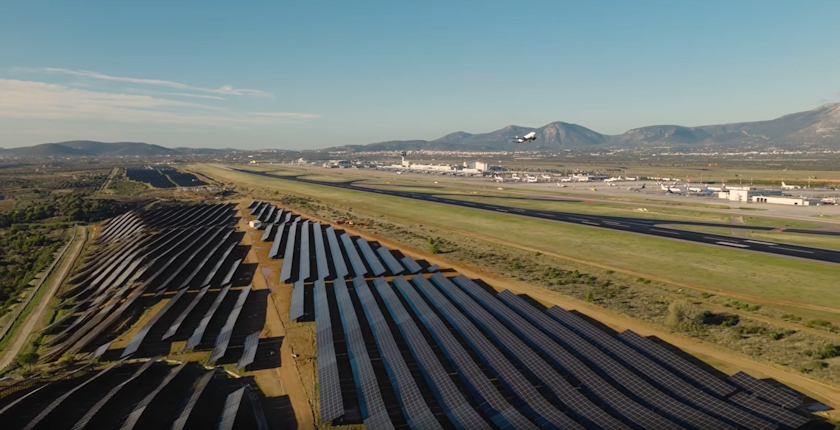
Athens International Airport (AIA) Eleftherios Venizelos completed its comprehensive energy makeover program. It is now operating a photovoltaic facility of 51.5 MW and a battery energy storage system of 82 MWh. It is the largest hybrid power plant of its kind within the premises of any airport in Europe and, reportedly, even the entire world.

At the same time, the Bucharest Henri Coandă International Airport is about to build 12.6 MW in peak PV capacity and a BESS of 17.9 MWh, in the first phase of a larger project.

Following European and global trends, airports in Southeastern Europe are introducing resource, waste and wastewater management systems. Energy is the largest segment of the decarbonization push. With the completion of its Route 2025 program, Athens International Airport Eleftherios Venizelos covered all its electricity needs with photovoltaics, becoming the only such airport in Europe.

In the groundbreaking project, the operator extended the existing solar power plant by 35.5 MW in peak capacity, reaching 51.5 MW, and added a battery energy storage system. The facility has 124 MWh in nominal capacity, of which 82 MWh is usable.

The hybrid system is the largest of its kind inside the fence of any airport in Europe, while the Greek press has even called it the largest in the world. Some of the world’s largest airports are set to follow soon. For instance, IGA Istanbul Airport is investing EUR 212 million in an external solar power plant of 199.3 MW, in Eskişehir.
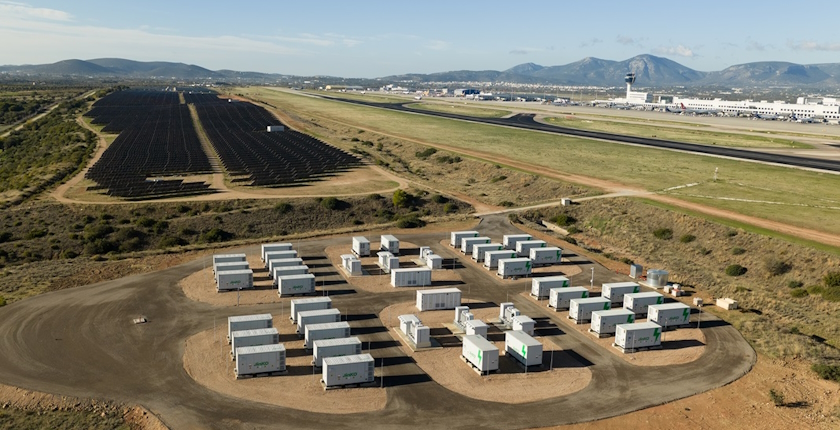
Athens International Airport builds biggest photovoltaic BESS plant
Photo: Athens International Airport

Hybrid power plant to keep Athens International Airport at net zero through 2046

AIA’s PV-BESS plant will generate an estimated 88 GWh per year, which is equivalent to the consumption of 22,000 households. The storage system is only for self-consumption. Importantly, the hybrid system can cover the entire planned expansion up to 2046, when the concession period ends.

AviAlliance, which controls 50.2% of the public-private partnership, is a wholly-owned subsidiary of Public Sector Pension Investment Board (PSP Investments) from Canada. The government holds 25.6% through Superfund, officially Growthfund – The National Fund of Greece.

AIA launched Route 2025 six years ago, with the aim to cut net greenhouse gas emissions to zero by the end of this year. It compares to the 2050 net zero goal of the European airports sector.

The Route 2025 program was worth EUR 70 million

The investments totaled EUR 70 million. A significant portion was financed through loans from the European Union’s Recovery and Resilience Facility (RRF), the update adds.

Heat pumps have eliminated the need for natural gas in buildings at AIA in normal winter conditions. The electric vehicle fleet consists of 19 buses, 13 follow-me vehicles and 29 vans. A network of chargers also serves passenger cars.

“In the airport company, we operate on the basis of the principle that sustainability, and environmental responsibility in particular, are and will increasingly be prerequisites for what we call the social license to operate and grow,” said outgoing Managing Director of AIA Yiannis Paraschis.

Two airports in Romania receive EU funds for solar-BESS projects

As for other recent developments in the Balkans, operators of two airports in Romania received grants via the European Union’s Modernisation Fund for solar power plants with battery storage.

National Company Bucharest Airports (CNAB) signed a contract for RON 132.04 million (EUR 25.9 million) excluding value-added tax. It is for 12.6 MW in peak PV capacity and a BESS of 17.9 MWh at the Bucharest Henri Coandă International Airport in Otopeni.

The entire investment amounts to RON 176.9 million (EUR 34.7 million) excluding VAT. The Romanian state-owned company said it is the first phase of a project for 31.5 MW and 30 MWh overall, valued at EUR 55.7 million.

Bacău International Airport George Enescu will build a solar power plant of 1.25 MW and a BESS of 2.06 MWh. Bacău County Council will also provide support for the on-site project on 2.2 hectares, worth more than EUR 4.9 million.


by in News

Athens International Airport builds biggest photovoltaic-BESS plant

Athens International Airport (AIA) Eleftherios Venizelos completed its comprehensive energy makeover program. It is now operating a photovoltaic facility of 51.5 MW and a battery energy storage system of 82 MWh. It is the largest hybrid power plant of its kind within the premises of any airport in Europe and, reportedly, even the entire world.

At the same time, the Bucharest Henri Coandă International Airport is about to build 12.6 MW in peak PV capacity and a BESS of 17.9 MWh, in the first phase of a larger project.

Following European and global trends, airports in Southeastern Europe are introducing resource, waste and wastewater management systems. Energy is the largest segment of the decarbonization push. With the completion of its Route 2025 program, Athens International Airport Eleftherios Venizelos covered all its electricity needs with photovoltaics, becoming the only such airport in Europe.

In the groundbreaking project, the operator extended the existing solar power plant by 35.5 MW in peak capacity, reaching 51.5 MW, and added a battery energy storage system. The facility has 124 MWh in nominal capacity, of which 82 MWh is usable.

The hybrid system is the largest of its kind inside the fence of any airport in Europe, while the Greek press has even called it the largest in the world. Some of the world’s largest airports are set to follow soon. For instance, IGA Istanbul Airport is investing EUR 212 million in an external solar power plant of 199.3 MW, in Eskişehir.

Athens International Airport builds biggest photovoltaic BESS plant
Photo: Athens International Airport

Hybrid power plant to keep Athens International Airport at net zero through 2046

AIA’s PV-BESS plant will generate an estimated 88 GWh per year, which is equivalent to the consumption of 22,000 households. The storage system is only for self-consumption. Importantly, the hybrid system can cover the entire planned expansion up to 2046, when the concession period ends.

AviAlliance, which controls 50.2% of the public-private partnership, is a wholly-owned subsidiary of Public Sector Pension Investment Board (PSP Investments) from Canada. The government holds 25.6% through Superfund, officially Growthfund – The National Fund of Greece.

AIA launched Route 2025 six years ago, with the aim to cut net greenhouse gas emissions to zero by the end of this year. It compares to the 2050 net zero goal of the European airports sector.

The Route 2025 program was worth EUR 70 million

The investments totaled EUR 70 million. A significant portion was financed through loans from the European Union’s Recovery and Resilience Facility (RRF), the update adds.

Heat pumps have eliminated the need for natural gas in buildings at AIA in normal winter conditions. The electric vehicle fleet consists of 19 buses, 13 follow-me vehicles and 29 vans. A network of chargers also serves passenger cars.

“In the airport company, we operate on the basis of the principle that sustainability, and environmental responsibility in particular, are and will increasingly be prerequisites for what we call the social license to operate and grow,” said outgoing Managing Director of AIA Yiannis Paraschis.

Two airports in Romania receive EU funds for solar-BESS projects

As for other recent developments in the Balkans, operators of two airports in Romania received grants via the European Union’s Modernisation Fund for solar power plants with battery storage.

National Company Bucharest Airports (CNAB) signed a contract for RON 132.04 million (EUR 25.9 million) excluding value-added tax. It is for 12.6 MW in peak PV capacity and a BESS of 17.9 MWh at the Bucharest Henri Coandă International Airport in Otopeni.

The entire investment amounts to RON 176.9 million (EUR 34.7 million) excluding VAT. The Romanian state-owned company said it is the first phase of a project for 31.5 MW and 30 MWh overall, valued at EUR 55.7 million.

Bacău International Airport George Enescu will build a solar power plant of 1.25 MW and a BESS of 2.06 MWh. Bacău County Council will also provide support for the on-site project on 2.2 hectares, worth more than EUR 4.9 million.
by in News

European Commission proposes easing 2035 car emissions rules

The European Commission has proposed a new Automotive Package that aims to give carmakers greater flexibility in meeting emissions reduction requirements. The new rules would lower the emissions cut target from 100% to 90%, allowing the sale of hybrid and internal combustion vehicles after 2035.

From 2035 onwards, carmakers will need to comply with a 90% emissions reduction target, while the remaining 10% emissions will need to be compensated through the use of low-carbon steel produced in the European Union, or from e-fuels and biofuels, according to a press release from the commission.

“This will allow for plug-in hybrids (PHEV), range extenders, mild hybrids, and internal combustion engine vehicles to still play a role beyond 2035, in addition to full electric (EVs) and hydrogen vehicles,” reads the announcement.

Carmakers will be incentivized to produce affordable EVs

The commission is also proposing “super credits” to incentivize carmakers to produce small, affordable electric cars made in the European Union. This measure would be in place until 2035.

Hoekstra: The EU is staying the course towards zero-emissions mobility

European Climate Action Commissioner Wopke Hoekstra has said the EU is staying the course towards zero-emissions mobility, but introducing some flexibilities for manufacturers to meet their CO2 targets in the most cost-efficient way.

The move comes amid pressure from car manufacturers, who claim their business is threatened by competition from China and the United States, according to reports.

The move comes amid pressure from European carmakers

Several EU member states – Germany, Italy, Bulgaria, the Czech Republic, Hungary, Poland, and Slovakia – say their automakers are struggling with high energy prices, a shortage of components, including batteries, and weak demand for electric vehicles.

The proposal includes a EUR 1.8 billion package to help develop a fully EU-made battery value chain and tackle competition from outside the bloc. As part of the accompanying Battery Booster package, EUR 1.5 billion will be disbursed in interest-free loans to European battery manufacturers, according to the press release.

by in News

Slovenia allocates EUR 375 million for sustainable mobility

Slovenia has allocated EUR 835 million from the Climate Fund for climate change mitigation and adaptation. The funds should be used over the period 2025-2028.

The Government of Slovenia has adopted a decree on the allocation plan for the Climate Fund for 2025-2028. The plan follows the key measures from the previous plan for the period 2023-2026 and adds funds for 2027 and 2028. The amount is determined based on expected revenues from emission allowance auctions.

Emission allowances are part of the European Union Emissions Trading System (EU ETS).

The funds will be directed to sectors addressing the main climate challenges, both in mitigation and adaptation to climate change. Measures supporting the green transition and increasing the country’s resilience to climate change will also be supported, according to the Government of Slovenia.

EUR 121 million was allocated for decarbonizing the economy

The largest chunk will go to sustainable mobility – EUR 375 million. The funds will be used for investments in public transport – purchase of new trains and buses, renovation of ticketing and information systems, co-financing of zero-emission vehicles and charging infrastructure, promotion of cycling and walking, and shifting freight transport from roads to rail.

EUR 121 million is designated for decarbonizing the economy. The government will co-finance successful European Union projects, support the introduction of a circular economy and sustainable reporting for small and medium-sized enterprises, as well as investments in industrial decarbonization.

Energy renovation of public and residential buildings, measures to reduce energy poverty, and the construction of nearly zero-energy buildings are also part of the allocation plan. There is EUR 111 million for such activities.

EUR 26 million is set for awareness raising and education

EUR 95 million is designated for renewable energy sources. The funds will be used to replace outdated household heating devices with modern ones and heat pumps, as well as for energy storage, geothermal energy, and measures to increase the energy self-sufficiency of buildings.

The Climate Fund will support additional climate change adaptation measures. The activities include reducing flood risks, preserving biodiversity, adaptation in forestry and agriculture, and strengthening the resilience of local communities. The allocated funds amount to EUR 49 million.

Slovenia has envisaged EUR 12 million for international climate change financing and EUR 26 million for awareness raising and education.

by in News

EU opens energy, environment cluster in accession talks with Albania

Albania officially started negotiations with the European Union on the so-called cluster 4, encompassing the green agenda and sustainable connectivity. It is joining Montenegro and Serbia, which haven’t yet closed any of the four chapters in the group: transport policy, energy, trans-European networks, and environment and climate change.

The Council of the EU held an accession conference with Albania and declared the opening of formal talks on cluster 4.

“Enlargement is at the top of our priorities as a geopolitical necessity for the EU. I am happy that we took a next step today with Albania. This is another clear proof of the country’s path towards European integration. I look forward to holding more meetings in the coming months with Albania and with other candidate countries to move forward the EU’s enlargement,” said Minister for European affairs of Denmark Marie Bjerre, who led the European Union’s delegation. Her country is currently holding the six-month presidency of the Council of the EU.

Rama: Our challenge is to reinvent ourselves

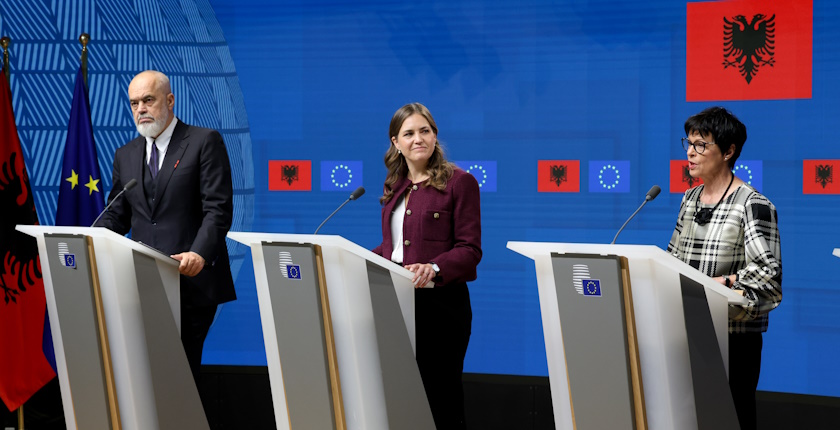
Prime Minister Edi Rama and his team represented Albania at the event, in which European Commissioner for Enlargement Marta Kos participated as well.

“Today we opened another cluster, it’s, as a matter of fact, five clusters in 11 months. In my understanding, it’s a record. And we are looking forward to opening the last cluster before this year ends… Environment is today a really pressing issue, and demands are challenging even for member states to keep the standards and to protect the standards. So, our challenge is to reinvent ourselves,” Rama said at a press conference with the two EU officials.

No chapters from cluster 4 closed yet in Western Balkans

The chapters in cluster 4, on the green agenda and sustainable connectivity, are transport policy (14), energy (15), trans-European networks (21) and environment and climate change (27). The trans-European networks comprise Trans-European Networks for Energy (TEN-E), Trans-European Networks for Transport (TEN-T) and Trans-European Networks for Telecommunications (eTEN).

As for the rest of the Western Balkans, Montenegro opened the first three in 2015 and the remaining one in 2018. It started its accession talks in 2012. The EU grouped 33 chapters into six clusters in 2020, while 34 and 35 are separate.

Albania is third in the region to open cluster 4

Serbia, which started negotiations in 2014, launched cluster 4 in late 2021. Notably, neither closed any chapters in the group. Montenegro closed seven in total, compared to just two on Serbia’s list.

Albania opened accession negotiations in 2022, as did North Macedonia. The former didn’t close any chapters yet and the latter didn’t even open a single one. Bosnia and Herzegovina is a candidate but it still didn’t start negotiations. Kosovo* is only a potential candidate.

EU urging tangible progress against environmental crimes

Among other points in its common position regarding the talks being launched, the EU urged Albania to accelerate renewable energy deployment by completing the necessary rules and regulations on permitting. The negotiators from the administration in Brussels said the Electricity Integration Package (EIP) needs to be fully implemented as well.

Albania has to align with EU acquis on environmental crimes and make tangible progress, especially against wildlife crimes, deterioration of habitats, illegal shipment or dumping of waste, pollution crimes and illegal trading in hazardous substances, the document reads.

* This designation is without prejudice to positions onstatus and is in line with UNSCR 1244/99 and the ICJ Opinion on the Kosovo declaration of independence.
by in News

Hitachi Energy: Game-changing solutions for a sustainable energy future

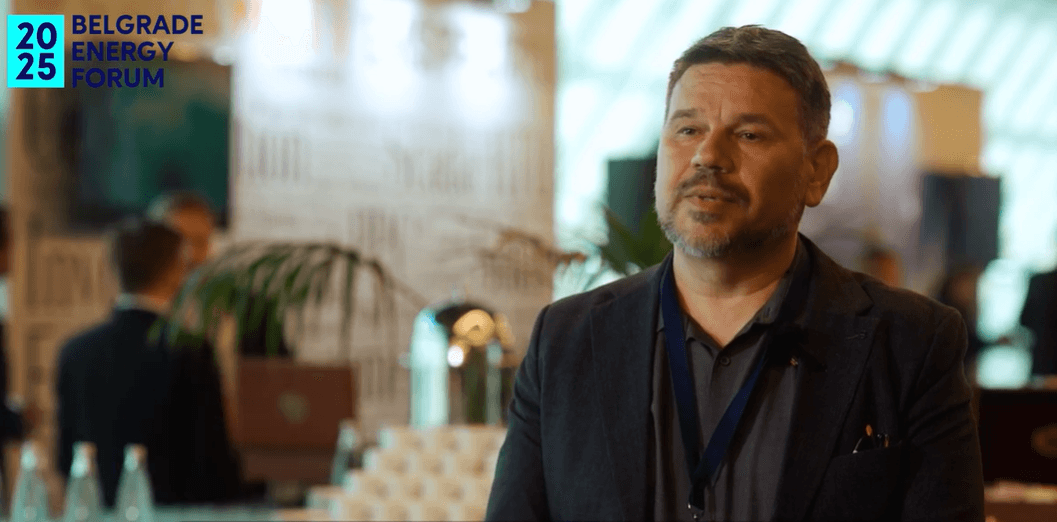
Hitachi Energy, a global leader in energy technology, develops system solutions and offers products and services that actively contribute to sustainable energy and a better future, Igor Anđelković, the company’s Country Marketing and Sales Leader in Serbia, said at Belgrade Energy Forum 2025. Game-changing technologies for high-voltage grids and transportation, along with solutions for renewables integration, support decarbonization efforts and deliver added value to both clients and local communities.

Multinational company Hitachi Energy, a silver sponsor of the BEF 2025 conference, is present in the Southeast Europe region through its Balkan Cluster, which covers seven markets – Albania, Bosnia and Herzegovina, Montenegro, Croatia, Kosovo*, North Macedonia, and Serbia.

[wpcc-iframe title=”Igor Andjelkovic, Country Lead Serbia, Hitachi Energy at the Belgrade Energy Forum 2025″ width=”500″ height=”281″ src=”https://www.youtube.com/embed/KVbO8HI5oLk?feature=oembed” frameborder=”0″ allow=”accelerometer; autoplay; clipboard-write; encrypted-media; gyroscope; picture-in-picture; web-share” referrerpolicy=”strict-origin-when-cross-origin” allowfullscreen=””]

Inspiring the next era of sustainable energy

Since 2010, Hitachi Energy has implemented eco-efficient solutions for high-voltage grids of up to 550kV. The company’s innovative and eco-efficient EconiQ® high-voltage portfolio applies revolutionary technology free of sulfur hexafluoride (SF6) and proven to significantly reduce carbon footprint throughout the life cycle.

The high-voltage EconiQ® roadmap demonstrates the scalability of this technology, which allows customers and industry to quickly transition to eco-efficient solutions.

Photo (Hitachi Energy): Hitachi Energy has implemented eco-efficient solutions for high-voltage grids of up to 550kV

Now more than ever, pioneering technologies like EconiQ are needed to advance a sustainable energy future, says Anđelkovic.

Efficient renewables integration

In the renewable energy segment, Hitachi Energy offers a range of substation solutions that help to efficiently integrate renewable energy into the transmission grid and distribution network. This includes grid connection solutions for all types of renewables power plants.

Hitachi solutions are used in a large number of wind projects in Southeast Europe

The major projects in Southeast Europe, completed or in the implementation phase, which use Hitachi Energy’s technology are wind farms Pupin and Crni Vrh in Serbia, Gvozd in Montenegro, Komanje Brdo and Ivan Sedlo in Bosnia and Herzegovina, and Pometeno Brdo and Korlat in Croatia.

Photo (Hitachi Energy): Hitachi Energy offers a range of substation solutions that help to efficiently integrate renewable energy into the transmission grid and distribution network

Driving transportation and energy towards carbon neutrality

Hitachi Energy is also committed to decarbonizing the transportation sector. Its revolutionary ‘grid-to-plug’ electric vehicle charging system, called Grid-eMotion® Fleet, is a smart mobility solution that enables operators to efficiently scale up their operations and is expected to contribute to sustainable society for millions living in urban areas.

Grid-eMotion® Fleet marks a game-changing shift from a charger-product based approach to a charging-system based approach, which helps to accelerate the future of smart mobility.

Hitachi Energy has been pioneering EV charging solutions since 2013, when it first introduced innovative flash-charging eBus solutions in Geneva and Nantes.

Advanced technologies for smart airports

With its innovative solutions, Hitachi Energy has made significant advancements in air traffic as well, with the development of smart airports being one of its key innovations. This includes advanced technologies such as artificial intelligence (AI), video analytics, and 3D LiDAR to improve the passenger experience and improve airport operational efficiency.

Hitachi Energy also helps airport to decarbonize and become more sustainable with its electrification and digitization solutions.

* This designation is without prejudice to positions onstatus and is in line with UNSCR 1244/99 and the ICJ Opinion on the Kosovo declaration of independence.
by in News

Horius becomes exclusive distributor of PupinEnergy chargers for Serbia

The company Horius d.o.o. has officially signed an exclusive distribution agreement, making Horius the sole authorized distributor of PupinEnergy AC electric vehicle chargers in the Republic of Serbia. This partnership marks a significant step forward for e-mobility development in the country, providing high-quality and reliable EV charging solutions inspired by the legacy of one of Serbia’s greatest scientists – Mihajlo Pupin.

PupinEnergy draws its inspiration from the work of Professor Mihajlo Idvorski Pupin, a Serbian-American scientist and inventor whose 34 patents – including the famous Pupin coil – still play a crucial role in telecommunications and electrical engineering. Honoring his legacy, PupinEnergy designs advanced chargers that combine technological sophistication, ease of use, and reliability in everyday conditions.

Product line available in Serbia

Through the partnership with Horius, customers in Serbia will have access to three key PupinEnergy charger models:

  • PowerGo MultiPlug 2000 – A portable 11 kW charger, perfect for travel and international use. Equipped with automatic fault detection, overheating protection, and an ergonomic handle for easy handling.
  • SkyCharge 500 (Lite, Ultra, Pro) – A premium ground-mounted charger available in 7 kW to 22kW variants. Designed for both residential and commercial users who demand high performance and easy installation, with weather-resistant construction.
  • WallMax 1000 (Lite, Ultra, Pro) – A wall-mounted home charger offering up to 22 kW charging power. Built for fast and reliable charging, it features a modern design, excellent weather resistance, and a three-year warranty.

Horius – a partner in sustainable energy

Horius has long been a leader in the transition to sustainable energy solutions, offering comprehensive services in the design, construction, and management of solar power plants, as well as energy trading. As PupinEnergy’s exclusive partner in Serbia, Horius further strengthens its mission toward a greener and more energy-efficient future.

With this collaboration, PupinEnergy and Horius send a clear message: the future of mobility in Serbia is electric, sustainable, and powered by cutting-edge technology rooted in local spirit and global quality.