by in News

Serbia plans new mining law to align legislation with EU rules on critical raw materials

Serbia’s Ministry of Mining and Energy has launched a public consultation on a preliminary framework for a new law on mining and geological exploration. One of the goals of the new law is to align national legislation with European Union regulations on critical raw materials, sustainable development, and the circular economy.

The law will be harmonized with the EU’s Critical Raw Materials Act and the European Green Deal, to gradually align Serbia’s regulatory framework with the EU’s goals for sustainable mining, climate neutrality, and secure minerals supply, according to a document outlining the basis for the draft law.

Earlier this year, the European Commission included a lithium mining project in Serbia among the EU’s strategic projects for critical raw materials. Rio Tinto’s Jadar project is the only one on the list that involves the extraction of lithium and boron.

Lithium mining in Serbia is among the EU’s strategic projects for critical raw materials

Regarding harmonization with EU regulations, Serbia intends to introduce standardized reporting systems in line with the Pan-European Reserves and Resources Reporting Committee (PERC) standards, the UN Framework Classification for Resources (UNFC), and the Petroleum Resources Management System (PRMS), as well as implement ESG principles, which integrate environmental, social, and governance requirements into all phases of geological exploration and mining.

The main objective of the new law is to establish a modern, transparent, and efficient system for managing mineral and other geological resources in line with sustainable development standards, while strengthening the role of the state as the owner and steward of the country’s natural resources, according to the document.

It further highlights the need for more clearly defined mechanisms to ensure the application of sustainable mining principles and compliance with environmental standards, in line with advanced global practices. Investors’ obligations regarding environmental protection, land reclamation, and site remediation should be more precisely regulated during exploration and mining.

Investors’ obligations concerning environmental protection need to be more clearly defined

Improving the legal framework for granting exploration and mining rights is of particular importance, the document states. This would be done through models that ensure greater legal certainty, more efficient oversight, and consistent application of environmental and social standards, in line with sustainable mining principles.

The new law will also set clear criteria for identifying and protecting strategic mineral deposits, and ensure they are included in spatial and development plans. This would enable long-term protection of national interests in the field of mineral resources.

The law will digitalize permitting procedures for exploration and mining

The law will envisage digitalization and electronic processing in all administrative phases through a unified information system that enables electronic application and permitting, while allowing public access to data on exploration and mining fields.

The new law is also intended to ensure gradual alignment with European policies in the fields of green and digital transition.

The public consultation will be open until November 11, during which time citizens and organizations can submit proposals, comments, and suggestions.
by in News

First desulfurization system test completed at coal plant in Serbia

All construction work on the desulfurization system at coal-fired thermal power plant Nikola Tesla B (TENT B) near Obrenovac, Serbia, has been completed, and individual components of the system are now undergoing testing, the Ministry of Mining and Energy said.

The first test, in which flue gases and limestone slurry were injected through the absorber at unit B1, was completed. The same procedure is planned for absorber B2 in mid-August.

The units utilize the wet desulfurization method. The lime milk solvent is sprayed in absorbers-scrubbers to take in sulfur dioxide (SO2) from flue gas, resulting in the creation of gypsum.

Over EUR 400 million has been invested in desulfurization systems at TENT A and TENT B

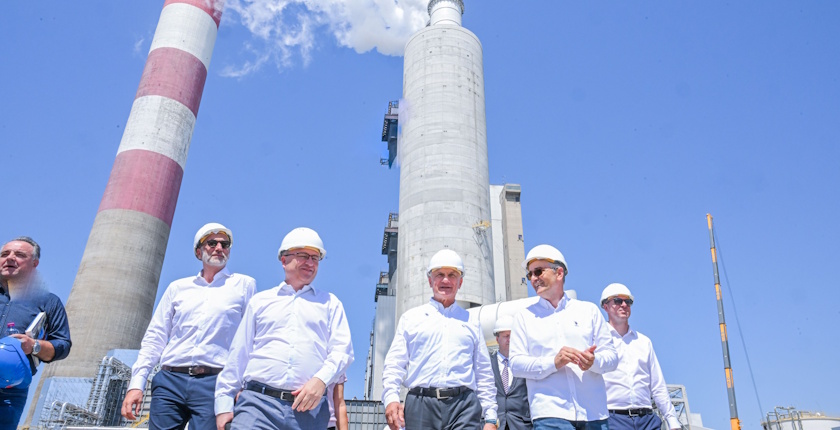
Milan Aleksić, advisor to the Minister of Mining and Energy of Serbia, said during his visit to the site that more than EUR 400 million has been invested in the construction of desulfurization systems at TENT A and TENT B. He emphasized that the facility at TENT B is one of the largest environmental investments by state-owned power utility Elektroprivreda Srbije – EPS. “Last year, a similar system was built in TENT A. It is important that both facilities will contribute to better environmental protection and the health of the residents of Obrenovac and surrounding areas,” said Aleksić.

Thanks to the two systems, both thermal power plants, which still represent the backbone of Serbia’s electricity generation, will be able to operate longer, he asserted.

Aleksić pointed out that the ministry would continue to support EPS in planning and securing funds for environmental projects, with a particular focus on implementing environmental protection measures at thermal energy facilities.

TENT A is in the town of Obrenovac, while TENT B is further west in the same municipality, which is part of the territory of Serbia’s capital, Belgrade.

Cement to be produced using ash from TENT B

EPS’s General Manager Dušan Živković said that with desulfurization systems at three units at the Kostolac B thermal power plant, four units at TENT A, and both units at TENT B, all large EPS thermal power plants would be fully environmentally compliant with both the European Union’s and national standards.

“The hot test, injecting flue gases and limestone slurry through absorber B1, was successfully carried out. This is a key milestone in the technological process. The white plume from the stack is proof that the process is functioning, and we are now entering the phase of fine-tuning all parameters. We expect the desulfurization system at TENT B to begin trial operations in mid-December,” said Živković.

Lafarge plans cement plant and quarry

Another major project is being prepared in Obrenovac. Lafarge BFC Serbia plans to build a cement factory that would use ash from TENT B’s ash landfill as raw material for the production of construction materials. In the first phase, an investment of EUR 110 million is planned. The Government of Serbia has initiated the development of a special purpose spatial plan for the industrial complex.

The project includes a future factory in Ratari, a settlement in the municipality of Obrenovac, and a quarry in the Jazovnik–Svileuva area, spanning the municipalities of Vladimirci and Koceljeva. They would be logistically connected with TENT B. The project addresses the issue of electrostatic precipitator ash disposal and creates opportunities for its reuse in industry, contributing to the sustainability of Serbia’s energy sector.

by in News

Belgrade Energy Forum 2025 – top delegations coming from EU, Southeast European countries

Final preparations are underway for the third Belgrade Energy Forum, BEF 2025. Energy Community Secretariat Director Artur Lorkowski and Serbian Minister of Mining and Energy Dubravka Đedović Handanović will open the event. One of the key speakers is Director Christian Zinglersen of the EU Agency for the Cooperation of Energy Regulators (ACER). The ministerial panel consists of ministers and representatives of the governments of Montenegro, Croatia, Hungary, Serbia and the Republic of Srpska, which is one of the two entities making up Bosnia and Herzegovina.

Senior delegations from the European Union and five countries in the region, eight panel discussions and more than 50 distinguished speakers – energy experts and representatives of energy companies – all prove that the third Belgrade Energy Forum (BEF 2025) will host key stakeholders in Southeast Europe’s energy transition on May 14 and 15.

The conference, organized by the region’s leading energy portal Balkan Green Energy News, will be the meeting point of the representatives of regional and international institutions and organizations as well as the representatives of the business community from the region, Europe and the world. Register in time via this link.

The participants in the first panel at BEF 2025, called ‘High-ministerial panel on SEE regional cooperation and energy transition strategies’, are:

  • Petar Đokić, Minister of Energy and Mining, Government of Republic of Srpska
  • Admir Šahmanović, Minister of Energy and Mining, Government of Montenegro
  • Dr. Illés Boglárka, State Secretary for Bilateral Relations, Ministry of Foreign Affairs and Trade, Government of Hungary
  • Jovana Joksimović, Assistant Minister, Ministry of Mining and Energy, Republic of Serbia
  • Marija Pujo Tadić, Special Envoy for Climate Action, Government of the Republic of Croatia
  • Dario Liguti, Director, Sustainable Energy, UNECE

Director of EU Agency for the Cooperation of Energy Regulators (ACER) Christian Zinglersen will deliver one of the keynote speeches. It is one of the European Union’s most important institutions in the energy sector. He is coming to BEF 2025 at a very important moment for the Energy Community contracting parties and the transposition of the EU’s energy regulations into national law.

Đedović Handanović: The energy transition knows no borders

Ahead of her participation at BEF 2025, Minister Dubravka Đedović Handanović stressed that the energy transition knows no borders and that it is why regional cooperation is of key importance.

“I am glad that energy experts from the entire region will convene in Belgrade, as only through a coordinated approach we can secure a more stable energy market, faster decarbonization and greater investments in renewable energy sources,” Đedović Handanović stated.

In addition to participating in the high-ministerial panel, Montenegrin Minister of Energy and Mining Admir Šahmanović will hold several bilateral meetings in Belgrade.

Šahmanović: The goal is not only clean energy, but just transition as well

“The energy transition is not just a technical challenge – it is a development opportunity and a civilizational leap. For the Western Balkans it is a chance for us to build an economy based on sustainability, connectivity and responsibility toward future generations. Montenegro believes that a successful transition depends on our capability to act together – through the planning of joint capacities, exchanging green energy surpluses and a coordinated approach toward partners and investors”, he said.

Šahmanović underscored that the goal is not only clean energy, but also a just transition – one that creates jobs, lowers poverty and brings growth to every part of the region. “We are ready to be a reliable partner in that joint future,” he added.

Đokić: Through joint efforts to an energy future that is economically stable, environmentally acceptable and socially responsible

The Ministry of Energy and Mining of the Republic of Srpska is again an institutional partner of BEF 2025, which, in the words of Minister Petar Đokić, represents proof of the ministry’s dedication to promoting energy sustainability, improvement of regional cooperation and attracting investments in the energy sector.

“The ministry and I have been actively contributing from the start to the work and discussions of this significant event, which gathers the most important players in the energy sector – institutions, investors, experts and other stakeholders. The forum stands out as a platform bolstering the exchange of ideas and experiences, and the results of these discussions contribute to identifying concrete solutions for challenges in energy,” Đokić pointed out.

He expressed confidence that joint efforts can result in the creation of an energy future that is economically stable, environmentally acceptable and socially responsible.

by in News

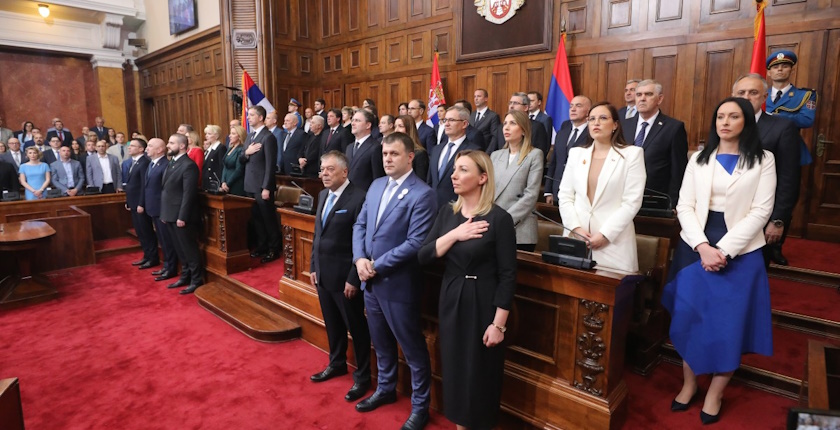
Serbian Minister of Mining and Energy Dubravka Đedović Handanović gets third mandate; Sara Pavkov takes over environment

The National Assembly of Serbia reelected Minister of Mining and Energy Dubravka Đedović Handanović for her third term. The youngest member of the new cabinet, led by Prime Minister Đuro Macut, is the new Minister of Environmental Protection – Sara Pavkov.

Members of parliament voted in the new Government of Serbia today with 153 in favor and 46 against the proposal, while 51 lawmakers were absent from the session. The lineup under Prime Minister Đuro Macut, who has just entered the political arena now, includes Sara Pavkov, responsible for environmental protection. At 33, she is the youngest member of the cabinet.

Minister of Mining and Energy Dubravka Đedović Handanović was elected for her third mandate.

At 33 years old, Sara Pavkov is the youngest minister in the team of new Prime Minister Đuro Macut

Pavkov holds a graduate and master’s degree from the biology and ecology department of the University of Novi Sad Faculty of Sciences (FTN). She is a doctoral candidate and research intern at the faculty, according to her official biography.

Since 2022, she has served as a state secretary at the Ministry of Environmental Protection. Before that, she was the chief of staff since June 2021, after holding the position of special advisor for environmental protection from November 2020.

As one of the vice-presidents of the Bureau of the United Nations Framework Convention on Climate Change (UNFCCC), Sara Pavkov participated in the UN Climate Change Conference COP26 in Glasgow in 2021.

From 2013 to 2020, she coordinated more than 20 civil society projects for environmental protection. The new minister has authored or coauthored 11 scientific and professional papers in the same field.

She joined the ruling Serbian Progressive Party (SNS) since 2012. Since November 2021, Sara Pavkov has been a member of its presidency.

Third run for Dubravka Đedović Handanović as minister of mining and energy

Dubravka Đedović Handanović was first elected minister of environment and energy in October 2022 in the cabinet of Prime Minister Ana Brnabić. She was reappointed last May, when Miloš Vučević became the prime minister of Serbia.

Before becoming minister, she was a member of the Executive Board of NLB Komercijalna banka, responsible for corporate and investment banking. She has an international experience in banking of more than 16 years.

Minister Đedović Handanović, who remained in position in the new government, has worked in the EIB

Đedović Handanović has graduated in banking and finance from the Faculty of Economics in Belgrade and obtained her master’s degree in finance and management from SDA Bocconi University in Milan and the Anderson School of Management at the University of California in Los Angeles (UCLA).

She headed the Regional Office of the European Investment Bank (EIB) for the Western Balkans from 2016 to 2021, before moving to NLB Komercijalna banka.

Until the start of her tenure in Belgrade, Dubravka Đedović Handanović was the manager for Albania, North Macedonia and Serbia at the headquarters of the EIB in Luxembourg. It is the European Union’s main lending institution. She was also in charge of public-private partnership projects and project financing in countries including Ireland, France, the United Kingdom and the Benelux.

Before starting her career in banking, the reelected minister of mining and energy worked in the media and communications sector.