
by in News

Romanian bourse BRM joins power auctions within European Single Intraday Coupling

The Romanian Commodities Exchange – Bursa Română de Mărfuri (BRM), the country’s second nominated electricity market operator (NEMO), has joined intraday auctions (IDAs) under the European Single Intraday Coupling (SIDC) framework. With this move, BRM becomes part of the operational IDA system, launched across Europe in June 2024, according to a press release from European power exchange EPEX Spot.

Other partners involved in the Regional Integration Project (RIP) are the Hungarian Power Exchange (HUPX), the Independent Bulgarian Energy Exchange (IBEX), the Romanian Electricity and Gas Market Operator (OPCOM), Bulgaria’s Electricity System Operator (ESO), Hungary’s Independent Transmission Operator Company (MAVIR), and Romanian transmission system operator Transelectrica, said EPEX Spot.

BRM’s integration marks the second wave of the European IDA rollout, which began on June 13, 2024, when NEMOs and transmission system operators (TSOs) introduced the pricing of intraday cross-zonal capacity through three pan-European auctions, it added.

It is another key milestone in enhancing Europe’s single power market

By integrating BRM, the SIDC framework has reached another important milestone, increasing the efficiency of the single European electricity market, EPEX Spot said. The market has become more liquid and increasingly competitive, in line with its core objectives of ensuring efficient, fair, and non-discriminatory functioning.

Future waves of the IDA rollout will expand its geographic scope

The European power exchange added that future waves of the IDA rollout would continue to expand its geographic coverage and product scope, further enhancing the EU’s internal electricity market.

The SIDC is a market mechanism within the intraday timeframe based on continuous trading and complemented by three intraday auctions, or IDAs. It enables market participants to trade electricity continuously across Europe on the day it is needed. Additionally, IDAs enable pricing cross-border capacity within the intraday timeframe, according to the press release.
by in News

Hungary’s MAVIR commissions 60 MWh battery energy storage system

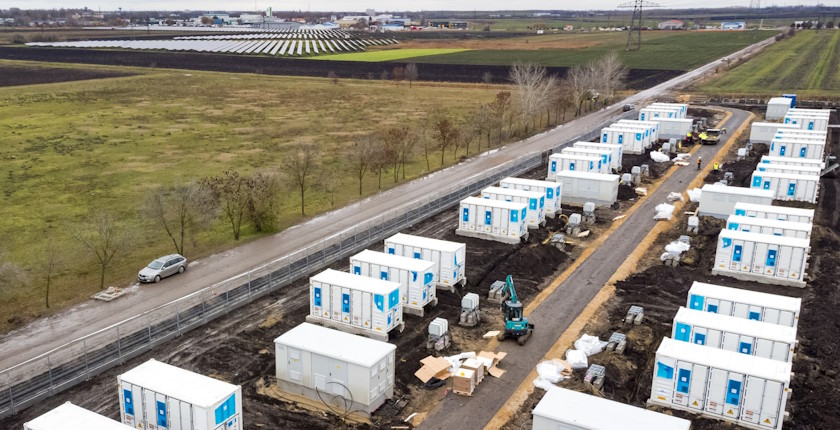
MAVIR, the Hungarian electricity transmission system operator (TSO), put into operation a battery energy storage system, BESS, of 20 MW in capability and a three-hour cycle. It will help grid security and the integration of renewable energy sources.

After entering the world’s top ten in photovoltaic capacity per capita, Hungary is picking up pace in terms of batteries as well. Energy storage units are coming online to maintain grid stability and bridge the hours between the peaks of daily solar power production and electricity consumption. Transmission system operator MAVIR commissioned a BESS of 20 MW in operating power and a three-hour cycle, translating to 60 MWh in capacity.

The EUR 20.3 million project received support in the form of a grant via the European Union. MET Group also put into operation a similarly-sized BESS last month in Hungary, while MOL Group launched construction of another one.

MAVIR’s battery energy storage system is in Szolnok, southeast from the capital Budapest. The company picked Forest-Vill as the contractor in late 2023. They signed the contract in February 2024. The same firm built MET Group’s BESS and also used equipment from Huawei Technologies.

Investors in BESS in Hungary are benefiting from EU grants

MAVIR’s new facility will contribute to grid security and a more efficient integration of renewable energy sources and support a sustainable, green future, said Deputy Minister of Energy and Parliamentary State Secretary of the Ministry of Energy Gábor Czepek.

The government’s EUR 45.1 million subsidy program for residential and corporate investments resulted in the installation of 12,000 batteries in households of 109 MWh in total, the official pointed out. Hungary now hosts 114 MW in battery capability.

Czepek estimated that the grants would bring 1 GW online by 2030, as targeted. Another call, of EUR 12.5 million, will soon be launched for energy storage for the industrial sector, he stressed.

Notably, the Ministry of Energy said solar power production reached 6.25 GW around noon on June 25. It was more than the country’s entire electricity demand at the time, it added.