by in News

North Macedonia launches decarbonization guide for small businesses

The Economic Chamber of North Macedonia has developed the country’s first decarbonization guide for small businesses. The digital tool is intended to help North Macedonia’s economy adapt to international climate rules, including the European Union’s carbon border tax (CBAM).

The decarbonization guide provides detailed instructions on the most effective ways for local companies to reduce their carbon footprint as part of the global fight against climate change, according to the Economic Chamber of North Macedonia.

The key feature is a carbon footprint calculator that covers nearly 60 different energy sources and refrigerants. Information is also available on EU and domestic climate regulations, as well as funding opportunities, such as subsidies.

The platform offers practical case studies and success stories of leading companies to highlight the benefits of clean energy, according to the chamber.

Božinovska: The decarbonization guide marks a turning point in the country’s green transition

The guide was developed in cooperation with the advisory team of the European Investment Bank (EIB) and the Delegation of the EU to North Macedonia.

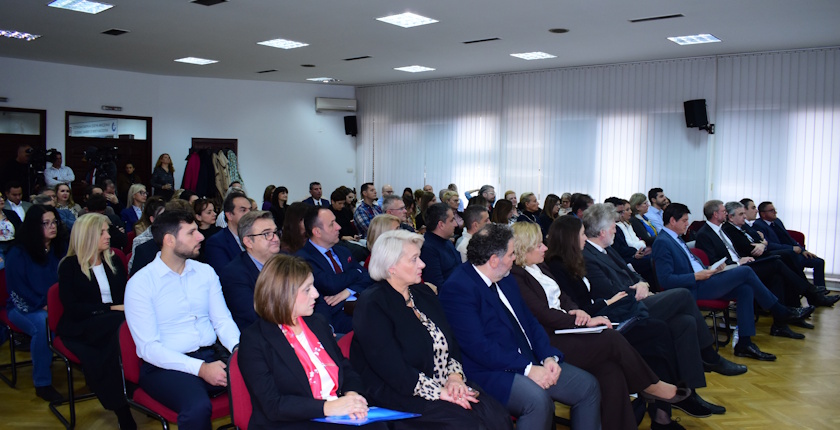
The guide was presented in the country’s capital, Skopje, at a gathering attended by more than a hundred entrepreneurs from all sectors of the North Macedonian economy.

Sanja Božinovska (photo: Economic Chamber of North Macedonia)

“The decarbonization guide is a turning point in our country’s green transition, equipping businesses with the tools they need to act now,” said Sanja Božinovska, North Macedonia’s Minister of Energy, Mining and Mineral Resources.

The guide is designed to help companies reduce greenhouse gas emissions and adapt to international climate rules, while, as the chamber says, preserving competitiveness.

One of these rules is the EU’s tax on the import of carbon-intensive goods, the Carbon Border Adjustment Mechanism (CBAM), which is set to take effect on January 1, 2026.

The guide is available on the website of the Economic Chamber of North Macedonia

This digital tool will help North Macedonia move towards a low-carbon economy, the chamber added.

The guide is available on the chamber’s website in the form of an interactive platform. Its development was financed by EIB Global.

Björn Gabriel, Head of EIB Representation in North Macedonia, has said that the guide comes at a crucial time as North Macedonia advances its green transition and prepares for upcoming carbon regulations.

According to Head of the Delegation of the EU to North Macedonia Michalis Rokas, decarbonization, energy efficiency, and renewable energy sources are powerful tools for building a more innovative, resilient, and competitive economy.

If every small and medium-sized enterprise (SME) takes at least a few significant steps toward greener business practices, the combined impact on more than 68,000 firms will be truly transformative, claims Rokas.

Michalis Rokas (photo: Economic Chamber of North Macedonia)
by in News

Energy Traders Europe calls for clear rules before CBAM implementation

Energy Traders Europe has sent proposals to the European Commission on how to ensure that the Carbon Border Adjustment Mechanism puts a fair price on carbon-intensive electricity imports and facilitates low-carbon flows.

On July 1, the European Commission’s Directorate-General for Taxation and Customs Union launched a public consultation on the potential downstream extension of the Carbon Border Adjustment Mechanism (CBAM), as well as additional anti-circumvention measures and rules for electricity as a CBAM good.

Energy Traders Europe participated in the call for evidence, which was open until August 26. The organization pointed out that the CBAM application to electricity imports shouldn’t start without a thorough impact assessment and a clear legislative framework.

Clarity is urgently needed for contracts for the delivery year 2026

Contracts for the delivery year 2026 are already traded on electricity markets, so clarity about how these will be treated from a customs perspective is urgently needed, the trade association stressed.

In its reaction, Energy Traders Europe argued that the inclusion of electricity imports within the scope of CBAM should respect the principle of proportionality, ensuring that European businesses face no excessive costs or administrative burdens and that a proportionate carbon price is applied.

For the calculation of the carbon price, default emission factors should reflect the actual carbon intensity of the electricity mix imported from a third country, as accurately and as close to real-time as possible.

Therefore, Energy Traders Europe insists that:

  • All generation technologies are taken into account to calculate the emission factor of third countries from which electricity is imported
  • The carbon intensity of electricity imports should be measured with an hourly granularity.

The association also proposes improvements for the utilization of the actual embedded emissions of imported electricity, to reflect the reality of electricity trading:

  • Power purchase agreement (PPA) – The definition should recognise PPAs concluded via intermediaries, such as when a CBAM declarant is reporting via an indirect representative, as well as both physical and virtual PPAs
  • Physical network congestion – Once an importer can prove the hourly matching between electricity production and capacity nomination, and that guarantees of origin (GOs) eventually issued are immediately cancelled, this criterion becomes redundant and hence should be removed
  • Capacity nomination and electricity production – Imports should be reported (and accounted for) based on the hourly confirmed scheduled quantities provided by the TSOs to each market participant, to be linked back to the hourly data of the generation plant underpinning the PPA.

According to Energy Traders Europe, the listed improvements are crucial to ensure that CBAM is fit for purpose for electricity imports, leading to more efficient use of cross-border interconnections between the EU and third countries, preventing renewable curtailments, and promoting the uptake of low-carbon electricity production in third countries.