by in News

European Commission declares Jadar project in Serbia one of its strategic projects for critical raw materials

The European Commission published the list of the first 13 strategic projects for raw materials outside of the European Union. One of them is project Jadar in Serbia. It is the only one for lithium and boron. Notably, it got the strategic status only for extraction, even though Rio Tinto said it would also build a processing plant.

After adopting 47 strategic projects in line with the Critical Raw Materials Act (CRMA) in March, today the European Commission added another 13, for locations outside of the EU’s borders. They include Rio Tinto’s controversial project Jadar in Serbia, for lithium and boron. The aim is to diversify the sources of supply and increase economic security, but alongside strengthening value creation in third countries, according to the update.

“Europe needs raw materials to succeed in our industrial and climate ambitions. The EU requires stable, secure and diversified supply chains,” said the European Commission’s Executive Vice-President for Prosperity and Industrial Strategy Stéphane Séjourné.

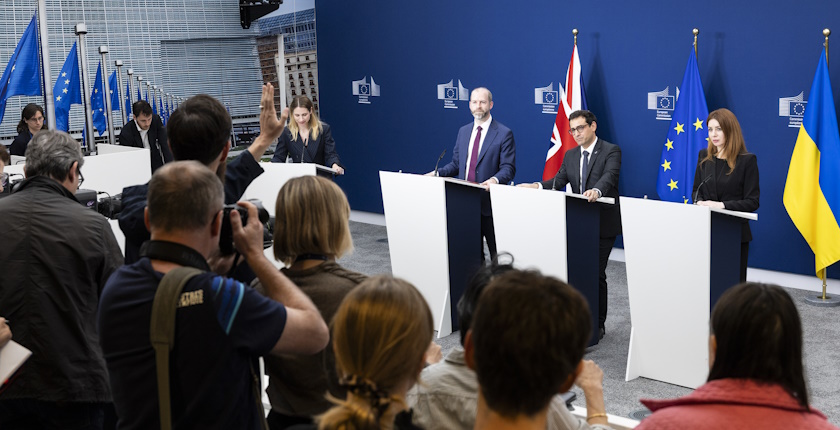
Photo: European Commission

Strategic projects across globe

The first 13 strategic projects outside of the EU are in Canada, Greenland, Kazakhstan, Norway, Serbia, Ukraine, Zambia, New Caledonia, Brazil, Madagascar, Malawi, South Africa and the United Kingdom. They require EUR 5.5 billion in total capital investment to start operations, the European Commission said.

Séjourné revealed that investors filed 49 applications.

Project Jadar in western Serbia, near the city of Loznica, is the only one for lithium and boron. Interestingly, the European Commission only endorsed the extraction segment, even though Rio Tinto has said it would build a processing facility as well. According to today’s announcement, the investment aims to contribute to the supply of lithium – battery grade, and boron for metallurgy.

Several waves of mass rallies against project Jadar have been held throughout Serbia

The local population in the Jadar valley, environmentalist organizations and a number of experts have been opposing Rio Tinto for several years now, citing the lack of transparency and the risks for health, nature and agriculture, and especially the potential pollution of water sources. They held several waves of large countrywide protests.

Balkan Green Energy News has published a chronological overview of the key events since 2001, when Rio Tinto arrived in Serbia.

The mining giant is conducting project Jadar through its Serbian subsidiary Rio Sava Exploration.

Most projects are for graphite, cobalt, nickel

Most of the other endeavors entail the extraction and processing of graphite, cobalt and nickel. The remaining ones are for mining tungsten, rare earth elements, manganese and copper. A project conducted both in Greenland and Norway is for the extraction and processing of graphite.

Rare earth elements have a key role in producing high-performance magnets used in wind turbines or electric motors for renewable energy technologies and electromobility. Boron is used in the automotive, renewable energy, aerospace and defence sectors.

Lithium ion batteries are currently the dominant technology in the electricity storage segment, excluding pumped storage hydropower plants. The alkali metal has a range of applications: from consumer electronics and electric vehicles to stationary facilities within renewable power plants or for grid balancing.

The selected projects meet the environmental, social and governance standards stipulated in CRMA, together with technical feasibility, the EU executive said. They are eligible for support by the European Commission, member states and financial institutions, including “contacts with relevant offtakers,” it added.

Kokanović: We continue resistance

Local activist from the Ne damo Jadar group Zlatko Kokanović said the academic community and the Serbian Academy of Sciences and Arts (SANU) have clearly rejected Rio Tinto’s lithium project. He also claimed that 63.5% of citizens also oppose it, apparently citing results of a recent survey.

The European Commission’s decision doesn’t guarantee environmental standards, Kokanović told Beta news agency. “It is quite hypocritical from a Europe promoting the rule of law, democracy, freedom of speech, a healthy environment and clean air, water and soil. To the detriment of our health and the health of our children, they want to take our lithium and turn us into a waste dump so that they live healthy,” he stated.

There isn’t any such mining project in a densely populated area and on fertile land anywhere in the world, the activist argued. “It is essentially an experimental facility. They don’t have answers to all questions and their main slogan is: ‘We will try to reduce risks’. We now live without risks, we don’t need to reduce them. If an incident happens, they will say that they are acknowledging the mistake, that they will try not to repeat it, and they will apologize. We don’t have anything from it,” Kokanović underscored.

Separately today, he vowed to continue the resistance with all allowed and forbidden and available means. Kokanović resides in the village of Gornje Nedeljice, the site of the proposed mine.
by in News

EU lawmakers urge for rule of law in Jadar lithium project in Serbia

A group of members of the European Parliament is asking the European Commission to demand from the Government of Serbia to comply with domestic and European law as regards Rio Tinto’s disputed Jadar lithium mining project. They pointed out that arresting and intimidating opponents who criticize the proposed investment is unacceptable. The European lawmakers invited Serbian activists to the European Parliament. Without strict rules, transparency and respect for local communities, things can end badly in mining, the Left’s Jonas Sjöstedt warned.

Rio Tinto is expecting to have its controversial lithium mining project Jadar in Serbia declared strategic by the European Union. Serbia and the European Commission have signed a memorandum of understanding for a strategic partnership in sustainable raw materials, battery value chains and electric vehicles. The Anglo-Australian mining giant’s proposed investment was met with years of fierce resistance from the local population and environmentalists.

Now a group of members of the European Parliament is also raising the issue of the persecution of activists, corruption and the risks to water, nature and public health.

Of note, Balkan Green Energy News has published a chronological overview of the key events in the development of the Jadar project since 2001, when the company arrived in Serbia.

The movement includes people from other areas in the country and neighboring Bosnia and Herzegovina with sites for the exploration of lithium and various minerals, as well as various mining operations.

Some mining companies leaving their waste behind for others to tackle

Completing their visit to Serbia, three EU lawmakers from the Left claimed that the Government of Serbia has many questions to answer about the Jadar project.

“My experience is that if you don’t put up strict demands on mining companies, if you don’t have transparency, if you don’t have respect for local communities, things can end really badly when it comes to mining,” MEP Jonas Sjöstedt stressed at a press conference.

He added that in northern Sweden, where he is from, some mining companies have extracted minerals for a short while before leaving without cleaning up first.

Sjöstedt: Multinationals take advantage of countries if they can

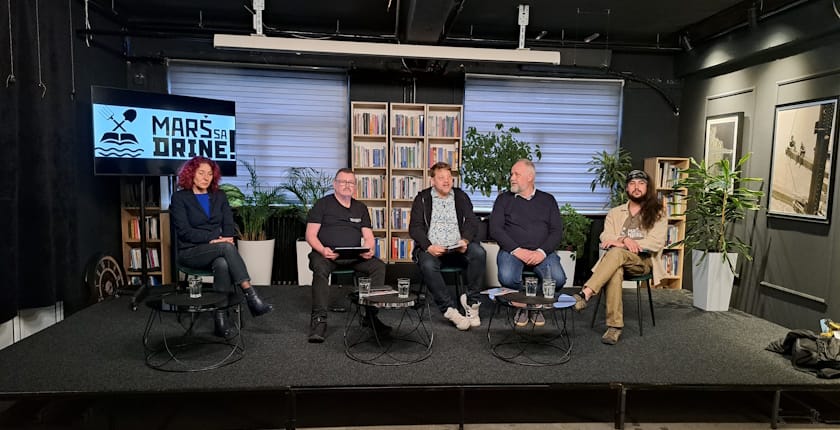
“That’s why it’s so important, so vital to listen to local communities. To have full respect for those who raise environmental concerns. And to not accept corruption or adapt legislation to the wishes of the multinational companies. Because they take advantage of countries if they have the chance,” Sjöstedt said at the event, organized by the Marš sa Drine activist group.

The environmental concerns in the Jadar area are real, especially about the quality of water for millions of people, in his view. If all the questions are not answered how toxic underground water and waste will be treated, it could be a very risky project, Sjöstedt pointed out.

“I’m also deeply worried about all the things we have heard about corruption. That it is possible for big multinational businesses to get their way with Serbian authorities by giving them economical benefits or making a contract that is not fully publicly available. I think that’s a really bad start of big industrial projects,” he asserted.

The level of intimidation against protesters including arbitrary arrests is unacceptable, according to Sjöstedt. “To be able to organize, to freely express your political will, it’s really the essence of democracy and that is what is at stake. Serbia is at a crossroads for the democratic development of the country,” he underscored.

Jadar is unique in natural harmony

The MEPs from the Left vowed to bring activists from Serbia to the European Parliament. Professor Ljiljana Tomović from the Faculty of Biology in Belgrade said at the event that the Jadar area and the adjacent Rađevina in western Serbia are one of the best examples of harmony between natural and human habitats.

They are unique, not only in Serbia, but in most parts of the Balkans, in her view. Tomović noted that more than 3,100 scientists and professors sent a letter to the European Commission to give up on the project.

All deals must be published

Rio Tinto has a long track record of environmental disasters and human rights violations, said EU lawmaker Per Clausen.

“There are legitimate reasons to meet this project with skepticism. Unfortunately, this is not an isolated case in Serbia. Other mining projects, including those financed and operated by Chinese interests, have already led to serious environmental damage and the destruction of nature. Widespread corruption and attacks on democratic rights are part of everyday reality. This is why there is no trust that Serbian authorities will prioritize the needs of local people, the environment or the preservation of nature,” he added.

Voices that should be heard are being silenced, the MEP from Denmark said.

Without democratic control over shared resources, the door opens to corruption and corporate exploitation, MEP Per Clausen warned

“This is not just about biodiversity. It’s about basic survival,” he stressed.

Without democratic control over shared resources, the door opens to corruption and corporate exploitation, Clausen warned.

“We ask the EU Commission to demand that the Serbian government complies with the law in both Serbia and the EU, and give total transparency about all elements of the deal between the EU and Serbia and the deal between the state and the mining company,” he stated.

True democracy means that natural resources belong to the people and are managed correctly for the common good, according to Clausen.

Let’s not replace fossil fuels with another form of environmental destruction

The group met with scientists, locals and representatives of the civil society. “We visited some test drillings and nothing lives around them due to the toxic substances. We cannot achieve the green transition by appeasing our industry and destroying nature and wildlife. In this process, we must not exchange environmental destruction caused by oil and gas for another form of environmental destruction,” said Sebastian Everding.

The German MEP said research should be supported to replace lithium in battery technology “with something that has less impact on the environment and the climate.”

by in News

EU mission in Serbia handed 100,000 signatures against declaring Rio Tinto’s Jadar a strategic project

Informal environmentalist organization Eko Straža has submitted a letter to the Delegation of the European Union to Serbia urging the EU not to grant strategic status to Rio Tinto’s Jadar project in the country. The letter opposing the lithium mining and processing project is backed by the signatures of 100,000 citizens.

Bojan Simišić of Eko Straža said the signatures had been submitted because of the European Commission’s upcoming decision on strategic projects to produce critical raw materials in third countries. The decision is expected to be adopted this week, Fonet reported.

The letter, supported by 100,000 signatures, is the first concrete step by environmental associations and citizens after the announcement that the EU could grant Jadar the status of a strategic project. The site of Rio Tinto’s underground mine and processing unit is near the Western Serbian city of Loznica.

The EU has adopted the first list of strategic projects

On Tuesday, the European Commission approved the first 47 strategic projects, within EU territory, for the production of critically important raw materials. According to the announcement, the decision on the potential selection of proposals for facilities in third countries will be adopted at a later stage.

Under the EU’s Critical Raw Materials Act (CRMA), such strategic projects are eligible for administrative and financial support.

Shortly after the decision was announced, Serbian President Aleksandar Vučić said that within seven or eight days, the EU would also declare the Jadar lithium project as strategic. He made the claim the same evening in Brussels, where he met with the bloc’s top officials.

Eko Straža: If the EU designates Jadar as strategic, protests will follow

Eko straža stressed that the EU does not have jurisdiction to designate Jadar as a strategic project. The organization also pointed out that Jadar was canceled by the Serbian government’s decision in 2022.

“If the EU puts the Jadar project on its list of strategic projects, we will press ahead with protests. However, we will no longer address the Serbian government, which has resigned, but will instead turn to international institutions,” said Eko Straža.

Balkan Green Energy News has compiled a chronological overview of the most important events concerning Jadar since 2001, when Rio Tinto established a subsidiary in Serbia.