by in News

IRENA: Global daily flexibility needs are quadrupling by 2050

In IRENA’s Planned Energy Scenario at the global level, electricity system flexibility needs on a daily timescale are four times higher in 2050 than in 2019. In the weekly and monthly timescales, the energy required for the purpose grows by three and 2.5 times, respectively. As for the 1.5°C Scenario, implying a much higher share of renewables, the daily flexibility needs jump ten times by mid-century, versus six times for both remaining segments.

Electrification of end-use energy, large-scale deployment of distributed energy resources and the emergence of large new electricity loads from data centres are increasing demand and adding new layers of complexity. It means power systems will need stronger grids and more flexibility to ensure that electricity is available when and where needed and at the lowest possible cost, the International Renewable Energy Agency (IRENA) pointed out in a brief called Flexibility for a secure and affordable power sector transformation.

Aside from buildings and transportation, new demand is coming from the growing adoption of artificial intelligence (AI), driving the expansion of data center capacity. In 2024, data centers consumed 1.5% of electricity. The International Energy Agency expects the share to double by 2030.

The share of variable renewable energy is increasing – wind and solar power in particular. Demand patterns become more complex, so the potential for mismatches between supply and demand is likely to grow, becoming more frequent and significant. It highlights the increasing importance of system flexibility. It is the capacity to respond to expected and unexpected fluctuations in the demand for and supply of electricity in a cost-effective manner.

Some forms of flexibility act automatically to keep the system stable, while others can be scheduled and operate over hours, days or even seasons

Insufficient system flexibility can result in excessive curtailment or, in market-based systems, negative electricity prices. It can also result in shortages, jeopardising the reliable supply of electricity.

System flexibility is needed by the power system to adjust to the variability of generation and demand patterns across different timescales. Some forms of flexibility act automatically within seconds to keep the system stable, while others can be scheduled in anticipation and operate over hours, days or even seasons, through market adjustments and operational and resource planning.

Network flexibility, which isn’t covered in IRENA’s brief, is different. It is the capacity to adjust for grid availability by means of preventing or solving congestion or voltage issues.

Required flexibility depends on numerous factors

In the timescale of seconds to minutes, flexibility is needed to maintain the balance during sudden changes in demand or supply, such as the
disconnection of an interconnector or a major load or generator. The hours and days timescale has daily ups and downs of solar and wind generation alongside the peaks and troughs in demand throughout the day.

In the weeks and seasons segment, flexibility enables covering longer weather patterns caused by changes in the season or low-wind periods. In power systems mainly supplied by renewables, flexibility is also needed at inter-annual timescales. The main factors are climate-driven variations in resource availability. It especially concerns hydrology, but also wind and solar, as well as year-to-year differences in seasonal heating and cooling demand.

In power systems mainly supplied by renewables, flexibility is also needed at inter-annual timescales

Flexibility is not a single asset or function; instead it corresponds to a capability provided by a portfolio of different technologies, operational practices and market mechanisms. The required level of flexibility in a power system depends on, among other factors, the prevailing generation mix, geography, power sector structure and affected timescales.

Storage, demand-side management (DSM), interconnections and dispatchable resources each contribute differently.

Advances in forecasting and the introduction of shorter dispatch intervals, scheduled closer to real-time operation, allow more frequent and precise adjustments of generation and demand before electricity is delivered. One example are intraday markets complementing day-ahead markets.

Electricity must become main energy carrier by mid-century to keep global warming in check

In IRENA’s 1.5°C Scenario, the energy transition will be driven by the deployment of renewable energy, improvements in energy efficiency and the electrification of end-use sectors. The aim is to limit global warming to 1.5 degrees Celsius by 2100.

Electricity would need to become the main energy carrier by 2050. It would account for over half of total final energy consumption. The 2022 level was 23%.

Global electricity generation is projected to be 36% higher in 2030 and three times higher in 2050 than in 2023. Renewable resources would supply 68% of electricity in 2030 and 91% in 2050. Renewables would account for 77% of total installed power capacity in 2030 and 94% in 2050.

In the same setting, 70% of electricity generated in 2050 comes from wind and photovoltaics, taken together. In IRENA’s Planned Energy Scenario, not projecting full decarbonization, the level is 53%.

In IRENA’s 1.5°C Scenario, the share of electricity in total final energy consumption more than doubles by 2050, surpassing 50%

Flexibility needs are calculated as total cumulated annual energy deviation from the average net load (which excludes variable renewable energy generation).

In the 1.5°C Scenario, the power sector requires ten times more flexibility in 2050 than in 2019 to manage the daily variability of net load. In terms of share of annual electricity demand, the authors observed a surge to 30% from 7%. Flexibility needs for managing the variability in weekly and monthly timescales are both six times higher.

In IRENA’s Planned Energy Scenario, daily flexibility needs in 2050 are four times higher. In the weekly timescale, the level triples from 2019, and the monthly item is 2.5 times higher.
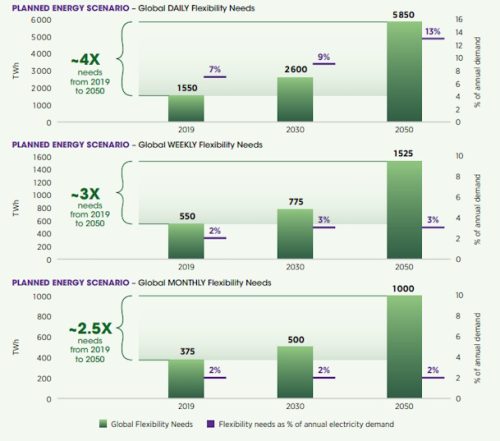
IRENA Global daily flexibility needs quadrupling by 2050
Photo: The height of bars indicates flexibility requirements in terawatt-hours per year. Purple horizontal markers show flexibility needs as a percentage of annual electricity demand. (IRENA)

Batteries perform best in daily segment

Battery energy storage is the most effective in addressing daily flexibility needs, the report finds. It is only 24% as effective at meeting weekly needs and 12% as effective for monthly needs.

Interconnections and LDES are effective on the weekly and monthly scales

Interconnections are the most effective in addressing weekly flexibility needs, but also 98% as effective for monthly needs. As for the daily segment, the coverage is just 28%.

The numbers for long-duration energy storage (LDES) solutions are similar. Compared with addressing weekly flexibility needs, LDES is 90% as effective for monthly needs and 34% as effective in the daily item.

by in News

IRENA: Global daily flexibility needs are quadrupling by 2050

In IRENA’s Planned Energy Scenario at the global level, electricity system flexibility needs on a daily timescale are four times higher in 2050 than in 2019. In the weekly and monthly timescales, the energy required for the purpose grows by three and 2.5 times, respectively. As for the 1.5°C Scenario, implying a much higher share of renewables, the daily flexibility needs jump ten times by mid-century, versus six times for both remaining segments.

Electrification of end-use energy, large-scale deployment of distributed energy resources and the emergence of large new electricity loads from data centres are increasing demand and adding new layers of complexity. It means power systems will need stronger grids and more flexibility to ensure that electricity is available when and where needed and at the lowest possible cost, the International Renewable Energy Agency (IRENA) pointed out in a brief called Flexibility for a secure and affordable power sector transformation.

Aside from buildings and transportation, new demand is coming from the growing adoption of artificial intelligence (AI), driving the expansion of data center capacity. In 2024, data centers consumed 1.5% of electricity. The International Energy Agency expects the share to double by 2030.

The share of variable renewable energy is increasing – wind and solar power in particular. Demand patterns become more complex, so the potential for mismatches between supply and demand is likely to grow, becoming more frequent and significant. It highlights the increasing importance of system flexibility. It is the capacity to respond to expected and unexpected fluctuations in the demand for and supply of electricity in a cost-effective manner.

Some forms of flexibility act automatically to keep the system stable, while others can be scheduled and operate over hours, days or even seasons

Insufficient system flexibility can result in excessive curtailment or, in market-based systems, negative electricity prices. It can also result in shortages, jeopardising the reliable supply of electricity.

System flexibility is needed by the power system to adjust to the variability of generation and demand patterns across different timescales. Some forms of flexibility act automatically within seconds to keep the system stable, while others can be scheduled in anticipation and operate over hours, days or even seasons, through market adjustments and operational and resource planning.

Network flexibility, which isn’t covered in IRENA’s brief, is different. It is the capacity to adjust for grid availability by means of preventing or solving congestion or voltage issues.

Required flexibility depends on numerous factors

In the timescale of seconds to minutes, flexibility is needed to maintain the balance during sudden changes in demand or supply, such as the
disconnection of an interconnector or a major load or generator. The hours and days timescale has daily ups and downs of solar and wind generation alongside the peaks and troughs in demand throughout the day.

In the weeks and seasons segment, flexibility enables covering longer weather patterns caused by changes in the season or low-wind periods. In power systems mainly supplied by renewables, flexibility is also needed at inter-annual timescales. The main factors are climate-driven variations in resource availability. It especially concerns hydrology, but also wind and solar, as well as year-to-year differences in seasonal heating and cooling demand.

In power systems mainly supplied by renewables, flexibility is also needed at inter-annual timescales

Flexibility is not a single asset or function; instead it corresponds to a capability provided by a portfolio of different technologies, operational practices and market mechanisms. The required level of flexibility in a power system depends on, among other factors, the prevailing generation mix, geography, power sector structure and affected timescales.

Storage, demand-side management (DSM), interconnections and dispatchable resources each contribute differently.

Advances in forecasting and the introduction of shorter dispatch intervals, scheduled closer to real-time operation, allow more frequent and precise adjustments of generation and demand before electricity is delivered. One example are intraday markets complementing day-ahead markets.

Electricity must become main energy carrier by mid-century to keep global warming in check

In IRENA’s 1.5°C Scenario, the energy transition will be driven by the deployment of renewable energy, improvements in energy efficiency and the electrification of end-use sectors. The aim is to limit global warming to 1.5 degrees Celsius by 2100.

Electricity would need to become the main energy carrier by 2050. It would account for over half of total final energy consumption. The 2022 level was 23%.

Global electricity generation is projected to be 36% higher in 2030 and three times higher in 2050 than in 2023. Renewable resources would supply 68% of electricity in 2030 and 91% in 2050. Renewables would account for 77% of total installed power capacity in 2030 and 94% in 2050.

In the same setting, 70% of electricity generated in 2050 comes from wind and photovoltaics, taken together. In IRENA’s Planned Energy Scenario, not projecting full decarbonization, the level is 53%.

In IRENA’s 1.5°C Scenario, the share of electricity in total final energy consumption more than doubles by 2050, surpassing 50%

Flexibility needs are calculated as total cumulated annual energy deviation from the average net load (which excludes variable renewable energy generation).

In the 1.5°C Scenario, the power sector requires ten times more flexibility in 2050 than in 2019 to manage the daily variability of net load. In terms of share of annual electricity demand, the authors observed a surge to 30% from 7%. Flexibility needs for managing the variability in weekly and monthly timescales are both six times higher.

In IRENA’s Planned Energy Scenario, daily flexibility needs in 2050 are four times higher. In the weekly timescale, the level triples from 2019, and the monthly item is 2.5 times higher.

IRENA Global daily flexibility needs quadrupling by 2050
Photo: The height of bars indicates flexibility requirements in terawatt-hours per year. Purple horizontal markers show flexibility needs as a percentage of annual electricity demand. (IRENA)

Batteries perform best in daily segment

Battery energy storage is the most effective in addressing daily flexibility needs, the report finds. It is only 24% as effective at meeting weekly needs and 12% as effective for monthly needs.

Interconnections and LDES are effective on the weekly and monthly scales

Interconnections are the most effective in addressing weekly flexibility needs, but also 98% as effective for monthly needs. As for the daily segment, the coverage is just 28%.

The numbers for long-duration energy storage (LDES) solutions are similar. Compared with addressing weekly flexibility needs, LDES is 90% as effective for monthly needs and 34% as effective in the daily item.
by in News

IRENA: 91% of new renewables units are more cost-effective than fossil fuel alternatives

The fossil fuel age is crumbling, according to UN Secretary-General António Guterres. Renewables maintained their cost leadership in global power markets, the International Renewable Energy Agency said in an annual report. In 2024, onshore wind farms were the cheapest of all versus the lowest-cost fossil fuel alternatives, by 53% on average, while photovoltaic systems were 41% cheaper.

Onshore wind power was also the cheapest in levelized cost of electricity (LCOE) terms, followed by solar power. At the same time, 91% of newly commissioned utility-scale capacity was delivering power at a cost lower than for the cheapest electricity from new fossil fuel–fired units.

The Renewable Power Generation Costs in 2024 report confirmed the price advantage of renewables over fossil fuels, with cost declines driven by technological innovation, competitive supply chains and economies of scale, the International Renewable Energy Agency said. IRENA expects cost reductions to continue, but highlighted the short-term challenges.

Geopolitical shifts including trade tariffs, raw material bottlenecks, and evolving manufacturing dynamics, particularly in China, could temporarily raise costs.

Asia, Africa and South America, with stronger learning rates and high renewable potential, could see pronounced cost declines.

Higher costs are likely to persist in Europe and North America, driven by structural challenges such as permitting delays, limited grid capacity, and higher balance-of-system expenses, according to the update. In contrast, regions like Asia, Africa and South America, with stronger learning rates and high renewable potential, could see pronounced cost declines.

The organization pointed to the need for stable and predictable revenue frameworks to lower investment risk and attract capital.

“Clean energy is smart economics – and the world is following the money,” United Nations Secretary-General António Guterres stressed. In his view, the fossil fuel age is crumbling.

Capital costs inflating LCOE in developing countries

Mitigating financing risk is central to scaling renewables in both mature and emerging markets. Instruments such as power purchase agreements (PPAs) play a pivotal role in accessing affordable finance, while inconsistent policy environments and opaque procurement processes undermine investor confidence, IRENA added.

In many developing countries of the Global South, high capital costs, influenced by macroeconomic conditions and perceived investment risks, significantly inflate the levelized cost of electricity (LCOE) of renewables.

Onshore wind power production cheapest by far of all kinds of electricity

In 2024, onshore wind farms were the cheapest of all versus the lowest-cost fossil fuel alternatives, by 53% on average, while photovoltaic facilities were 41% cheaper. Of note, the cost of battery energy storage systems (BESS) declined by 93% from 2010 to 2024, to USD 192 per kWh.

Onshore wind remained the most affordable source of new renewable electricity, with a global weighted average LCOE at USD 0.034 per kWh (USD 34 per MWh), followed by new solar, at USD 0.043 per kWh, and new hydropower plants, USD 0.057 per kWh.

Again per the levelized cost of electricity, 91% of newly commissioned utility-scale renewables capacity was delivering power at a lower cost than the most affordable new fossil fuel–based units.

That said, LCOE increased slightly for solar power, by 0.6%. Onshore wind power was 3% more expensive than in 2023, compared to 4% for offshore wind and 13% for the bioenergy segment. Meanwhile, costs declined for concentrated solar power (CSP), by 46%, followed by electricity from geothermal units, 16%, and hydropower, which slipped 2%.

Solar and wind energy prices have begun to stabilize, which is a natural sign of market maturity, the authors underscored.

Photo: Renewable energy LCOE 2010-2024, in United States dollars per kilowatt-hour (IRENA)

Clear path to affordable, secure, sustainable energy

The addition of 582 GW of renewables capacity in 2024 led to significant cost savings, avoiding fossil fuel use valued at about USD 57 billion, new data shows. Looking at all renewables in operation, the avoided fossil fuel costs in 2024 reached up to USD 467 billion, IRENA’s Director-General Francesco La Camera stated.

New renewable power outcompetes fossil fuels on cost, offering a clear path to affordable, secure and sustainable energy, he pointed out.

by in News

GWEC: Record wind power capacity was installed globally in 2024

New wind turbine installations reached an all-time high 117 GW last year, slightly above the 2023 level, Global Wind Energy Council (GWEC) revealed in its annual report. According to its calculations, China’s share in the additions was 68.2%. At the end of December, the country hosted 45.8% of all wind power capacity, which climbed to 1.14 TW.

The Global Wind Energy Council’s flagship Global Wind Report showed that new capacity hit a record in 2024 for the second time in a row, following two years of declines. The additions came in at 117 GW, compared to 116.6 GW in 2023. Global wind power capacity grew to 1.14 TW, GWEC found.

On the other hand, new offshore wind, 8 GW, was down from the previous 10.8 GW. The segment amounted to 8.8 GW in 2022 and the record 21.1 GW was achieved one year earlier.

In the new outlook, this year’s total new capacities are seen at 138.2 GW, climbing each year to hit a whopping 194.1 GW in 2030.

The new capacities in the update for 2024 are slightly different than in the statistics that the International Renewable Energy Agency (IRENA) published a month ago. Namely, it deducts decommissioned facilities from the additions, while GWEC doesn’t. Still, IRENA’s total offshore wind capacity is 3.8 GW lower than GWEC’s 83.2 GW. The onshore figure is negligibly higher, by 1.1 GW – GWEC measured 1.05 TW.

Photo: GWEC

GWEC warns of from tariffs risk, ideologically driven attacks on wind and renewables

GWEC warned of increasing policy instability in some markets, and pointed to the need to improve permitting, grid transmission and auctioning mechanisms to keep pace with the global trend for electrification, meet countries’ energy and climate targets and lessen reliance on volatile fossil fuels, while fulfilling globally agreed ambitions to triple renewable energy capacity by 2030.

The council pointed out that the headline numbers mask big disparities, with the lion’s share of installations taking place in a small number of key mature markets, including China and Europe.

Blackwell: Halting projects that are under construction threatens investment certainty

“While wind energy continues to drive investment and jobs, improve energy security and lower consumer costs, we are seeing a more volatile policy environment in some parts of the world, including ideologically driven attacks on wind and renewables and the halting of under construction projects, threatening investment certainty,” said GWEC’s Chief Executive Officer Ben Backwell.

He stressed that the impact of the tariff wars has yet to be calculated, and urged decision makers to ensure a stable market and free and fair trade.

China’s share of global capacity nearing 50%

New installations were registered in 55 countries. China maintained its absolute dominance: it added 79.8 GW, translating to 68.2% of the total. Moreover, at the end of December it hosted 521 GW of wind power or a stunning 45.8% of global capacity. IRENA’s data shows the shares at 70.5% and 46.1%, respectively.

On the global scale, the United States is a distant second in wind power additions, at 4.1 GW, as well as the overall capacity: 154.3 GW. The following three are Germany (4 GW), India (3.4 GW) and Brazil (3.3 GW), which surpassed Spain.

The United States is a distant second in both wind power additions and overall capacity

Europe’s new installations in 2024 were 13.8 GW, after 14.5 GW in the previous year. The overall capacity advanced to 251 GW. The region includes Turkey, which surged by 1.31 GW to 13.7 GW. The country accounted for 1.1% of all new capacity last year, earning it a spot in the top ten in the category.

Excluding China, onshore wind volume awarded in auctions and other procurement mechanisms doubled in 2024 to a record 53.5 GW, GWEC said. In Europe, it jumped 24% to 17 GW. Germany accounted for 11 GW. The offshore segment also hit an all-time high, 56.3 GW. Europe led the way with 23.2 GW, against 17.4 GW in China.

Photo: GWEC

Last year’s auctions may boost dormant floating wind power market

The rise of the floating wind turbine technology is stalling, as only 41.8 MW was installed. The level is similar to the previous year.

However, floaters accounted for 1.9 GW of the awarded capacity, of which 750 MW for three projects in France, 750 MW in South Korea and 400 MW in the United Kingdom, for Green Volt. It is the world’s largest proposed floating wind power investment, at up to 560 MW.

The 25.2 MW Provence Grand Large facility of three SGRE turbines was commissioned offshore France. Mingyang installed its 16.6 MW V-shaped floating turbine OceanX near Guangdong. After that, early this year, China Railway Rolling Stock Corp. (CRRC) installed a 20 MW floating turbine at a testing site offshore Shandong.

One technological breakthrough after another in China

GWEC highlighted other technological breakthroughs in China as well. Some new offshore turbines of 18 MW to 20 MW were first deployed while a batch of 16 MW machines also came online.

Dongfang Electric presented the largest (offshore) wind turbine, of 26 MW, while Goldwind manufactured the first 22 MW unit in December. Onshore, 10 MW models are scaling up, and SANY installed a 15 MW prototype. Of note, the Chinese company is participating at the upcoming Belgrade Energy Forum (BEF) in Serbia, on May 14 and 15, where it will have a stand.

The world’s highest wind farm, at an altitude of 5,200 meters, was commissioned in Tibet.

CRRC started testing a 20 MW floating wind turbine early this year

Mingyang (also known as Ming Yang) introduced wind blades of 143 meters in February 2024. Next, Goldwind and Sinoma Blades passed the static load test with 147-meter pieces.

SANY commissioned the world’s largest wind turbine test bench, for 35 MW. A 40 MW platform is under construction in Shantou, Guangdong.

by in Events, News

Bioenergy integrated in the bio-based economy crucial to meet climate targets

Eubce 2016Amsterdam, 9 June – The 24th European Biomass Conference and Exhibition in Amsterdam has provided a unique overview of the state of play of the sector and a much clearer view than before of the role biomass can play in achieving the transition to a low carbon economy.

After the historical Climate agreement at COP 21, international institutions and scientific organizations agree that biomass and the bio-based economy are crucial to meet the 2 degrees target of climate change.

Scientific evidence indicates that 730 Gt (billion tonnes) out of the 1,000 Gt of carbon budget available to keep global temperatures below this threshold were already consumed, therefore the time we have to put in place effective measures is limited. We need low carbon solutions that deliver now and the sustainable use of biomass is undoubtedly included. Bioenergy itself can provide 10%-30% of all total CO2 emission reductions needed and this should be achieved by putting bioenergy in the integrated context of the bio-based economy, in order to maximize the efficiency of how we use this resource, to produce renewable energy, food and materials.

A careful review of the available scientific literature indicates that mobilizing one billion dry tons of ligno-cellulosic biomass by 2030 in Europe is possible and this can be done sustainably. This would mean doubling the current use of biomass and would be sufficient to meet the expected demand both for carbon neutral fuels and materials, without competing with food production.

Unsustainable displacement of food and loss of forest cover can be readily avoided by means of higher resource efficiency in agriculture, livestock management and by restoration of degraded lands. This can also provide major synergies between sustainable Bio-based economy and sustainable, resource efficient food production. State-of-the-art analysis shows that when agriculture and livestock are modernized over time, exploiting yield gaps and efficiency improvements in management, there is both enough food production capacity to feed the world with less land and to produce bioenergy on the surplus land. This can also lead to considerable improvements in carbon stocks on that same land, reduced water use per unit of output, lower GHG emissions and more efficient use of nutrients. Such necessary improvements are also highly desirable from a food security perspective, alleviating poverty, enhancing rural development and making agriculture more resilient to climate change. Similar reasoning holds for forest management, where integrated strategies can enhance forest productivity, maintain or improve carbon stocks, protect biodiversity and maintain the vitality of forest.One of the biggest opportunities lies in the revitalization of marginal and degraded lands by (re-)planting them with trees and grasses. Permanent vegetation cover can over time restore soil structure, water retention functions, minimise soild erosion and improve overall productivity. This changes the perspective on bioenergy from hedging problems to achieving synergies with better agriculture.

After decades of continuous research and technological development, a number of large scale demonstration plants is proving that biomass can be effectively converted into energy, advanced biofuels and bio-based products. Recognizing the value of those good examples is fundamental to build the consensus needed for finally setting a clear, stable European policy framework, which is still lacking, but is essential to enable the widespread development of the bio-based economy. The attention of policy makers and media has been focussed too much on possible negative effects of bioenergy. Attention needs to shift to the positive results that the bio-based economy can deliver in achieving the low carbon economy.

This conference demonstrated that there are high level talents working on these issues, said Prof. André Faaij, conference general chairman in his concluding remarks. It is now about how do we link all this good work to the right arena. Now we need to ensure close interplay and engagement of the research community, the industry and the governance arena. I would like to call upon all the key players in the field, especially international bodies such as UN, FAO, IRENA, IEA, EC, to organize the debate and to give it the focus it needs to solve the problems to progress, he said. He also launched the idea to form a coalition among the GBEP, the Global Environment Facility, the European Commission and the Energy Coalition of the world billionaires, to discuss how to support a series of large scale demonstrations of sustainable biomass production in different settings, integrating biorefineries, BECCS (bioenergy with carbon capture and storage), and bio-chemicals.

More information on www.eubce.com