by in News

Greece outlines long-term investment plan to solve water crisis

The Greek government presented a plan to maintain water supply as drought has reduced reserves to worrying levels in certain areas.

The Ministry of Environment and Energy outlined short-term and long-term measures, with a focus on Attica, the peninsula where Athens is located. The area consumes by far the most water in Greece. This year, the level in the nearby Mornos lake in Fokida has dropped to just 152.9 million cubic meters, with its area reduced to 8.3 square kilometers. It marks a 15-year low for the major reservoir and a steep 45% drop in reserves from 2024.

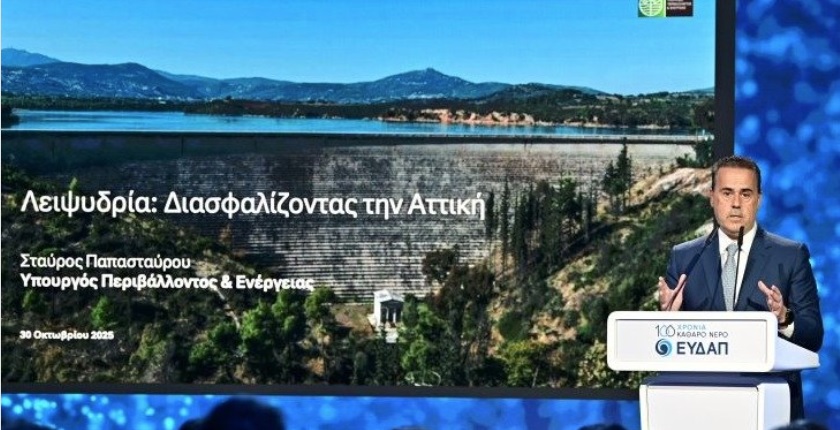
For the long term, the government has launched the Evrytos project for using water from the Evinos river in Aetolia-Acarnania. It will provide Attica with 220 million cubic meters annually, for a cost of EUR 500 million. Necessary infrastructure will become operational by 2029, according to Minister Stavros Papastavrou.

Desalination plants to increase power demand

In the meantime, the government and the Athens Water Supply and Sewerage Company (EYDAP) are examining the installation of three desalination plants: in Thisvi, Nea Peramos and Lavrion. Papastavrou said they can together provide 87.5 million cubic meters annually.

However, such units are both expensive and energy hungry. An average desalination plant consumes about 3.5 kWh of electricity for every cubic meter of water it produces. Therefore, the total for all three is about 600 GWh per year.

The new energy demand has not been anticipated in the ten year development plan of Independent Power Transmission Operator (IPTO or ADMIE) nor the National Energy and Climate Plan (NECP). The 600 GWh is not much compared to a national consumption of 52 TWh, but it would be concentrated in Attica and needs to be taken into account.

Demand is already expected to rise in the region, as a result of electrification and new large-scale construction works in places like Ellinikon.

by in News

Greece’s IPTO mulls capital increase with existing shareholders

Greece’s Ministry of Environment and Energy is reportedly nearing a final decision regarding a capital increase for Independent Power Transmission Operator. The state-controlled transmission system operator (TSO) needs EUR 1.1 billion to continue its investment projects. The government is said to be in favor of existing shareholders providing the funds. There were rumors earlier that the government was going to sell a stake, where it would become a minority co-owner but remain in the driver’s seat, like it did before with Public Power Corp.

Independent Power Transmission Operator (IPTO) needs a capital injection of some EUR 1.1 billion to keep the ten-year core growth plan worth EUR 7.8 billion on track, according to Greek media reports. The government holds a 51% stake through two entities, and the only other major shareholder is State Grid Corp. of China. It acquired 24% in 2017.

The company, also known for its Greek acronym Admie, is said to require an urgent capital increase as it can’t get loans anymore. The last one amounted to EUR 300 million, from the National Bank of Greece.

Greece aiming to keep 51% stake amid geopolitical uncertainty

Energypress learned, citing unnamed sources in the Ministry of Environment and Energy, that the government is about to make a decision. The latest unofficial information was that, due to unprecedented geopolitical uncertainty, Greece wants to keep its majority stake and raise the capital in tandem with other existing shareholders.

China’s State Grid holds 24% of IPTO since 2017

Earlier reports have indicated that the government was considering a sale of a stake and a stock market listing. It would keep some 34%, allowing it to continue running the Independent Power Transmission Operator, like it did in 2021 with Public Power Corp. – PPC Group.

Major tender already underway for Dodecanese Interconnection

Most of the capital expenditure through 2034 is scheduled for before the end of the decade, EUR 6.5 billion. The biggest projects on the current ten-year list, updated in September, are the Dodecanese Interconnection, North Aegean Interconnection and the one for the second line to Italy. They amount to EUR 5.2 billion in total. All three are for submarine cables.

Last month the TSO published a tender for a bidirectional undersea link between the mainland grid, in Corinth, and the Dodecanese island of Kos. The cable system would be 1,290 kilometers long and have 1 GW in total transmission capacity. The budget is EUR 1.35 billion.

Notably, the company froze another major tender last year after receiving the bids in April.

Interconnections with Egypt and Saudi Arabia are planned in the longer term. The Crete-Cyprus link, part of the Great Sea Interconnector endeavor, is also separate.

BlackRock, Meridiam, Fortress, Fidelity, KKR and Abu Dhabi National Energy Co. (TAQA) were rumored to have expressed interest in entering ownership, among others.

by in News

Greece’s IPTO mulls capital increase with existing shareholders

Greece’s Ministry of Environment and Energy is reportedly nearing a final decision regarding a capital increase for Independent Power Transmission Operator. The state-controlled transmission system operator (TSO) needs EUR 1.1 billion to continue its investment projects. The government is said to be in favor of existing shareholders providing the funds. There were rumors earlier that the government was going to sell a stake, where it would become a minority co-owner but remain in the driver’s seat, like it did before with Public Power Corp.

Independent Power Transmission Operator (IPTO) needs a capital injection of some EUR 1.1 billion to keep the ten-year core growth plan worth EUR 7.8 billion on track, according to Greek media reports. The government holds a 51% stake through two entities, and the only other major shareholder is State Grid Corp. of China. It acquired 24% in 2017.

The company, also known for its Greek acronym Admie, is said to require an urgent capital increase as it can’t get loans anymore. The last one amounted to EUR 300 million, from the National Bank of Greece.

Greece aiming to keep 51% stake amid geopolitical uncertainty

Energypress learned, citing unnamed sources in the Ministry of Environment and Energy, that the government is about to make a decision. The latest unofficial information was that, due to unprecedented geopolitical uncertainty, Greece wants to keep its majority stake and raise the capital in tandem with other existing shareholders.

China’s State Grid holds 24% of IPTO since 2017

Earlier reports have indicated that the government was considering a sale of a stake and a stock market listing. It would keep some 34%, allowing it to continue running the Independent Power Transmission Operator, like it did in 2021 with Public Power Corp. – PPC Group.

Major tender already underway for Dodecanese Interconnection

Most of the capital expenditure through 2034 is scheduled for before the end of the decade, EUR 6.5 billion. The biggest projects on the current ten-year list, updated in September, are the Dodecanese Interconnection, North Aegean Interconnection and the one for the second line to Italy. They amount to EUR 5.2 billion in total. All three are for submarine cables.

Last month the TSO published a tender for a bidirectional undersea link between the mainland grid, in Corinth, and the Dodecanese island of Kos. The cable system would be 1,290 kilometers long and have 1 GW in total transmission capacity. The budget is EUR 1.35 billion.

Notably, the company froze another major tender last year after receiving the bids in April.

Interconnections with Egypt and Saudi Arabia are planned in the longer term. The Crete-Cyprus link, part of the Great Sea Interconnector endeavor, is also separate.

BlackRock, Meridiam, Fortress, Fidelity, KKR and Abu Dhabi National Energy Co. (TAQA) were rumored to have expressed interest in entering ownership, among others.

by in News

Greece outlines long-term investment plan to solve water crisis

The Greek government presented a plan to maintain water supply as drought has reduced reserves to worrying levels in certain areas.

The Ministry of Environment and Energy outlined short-term and long-term measures, with a focus on Attica, the peninsula where Athens is located. The area consumes by far the most water in Greece. This year, the level in the nearby Mornos lake in Fokida has dropped to just 152.9 million cubic meters, with its area reduced to 8.3 square kilometers. It marks a 15-year low for the major reservoir and a steep 45% drop in reserves from 2024.

For the long term, the government has launched the Evrytos project for using water from the Evinos river in Aetolia-Acarnania. It will provide Attica with 220 million cubic meters annually, for a cost of EUR 500 million. Necessary infrastructure will become operational by 2029, according to Minister Stavros Papastavrou.

Desalination plants to increase power demand

In the meantime, the government and the Athens Water Supply and Sewerage Company (EYDAP) are examining the installation of three desalination plants: in Thisvi, Nea Peramos and Lavrion. Papastavrou said they can together provide 87.5 million cubic meters annually.

However, such units are both expensive and energy hungry. An average desalination plant consumes about 3.5 kWh of electricity for every cubic meter of water it produces. Therefore, the total for all three is about 600 GWh per year.

The new energy demand has not been anticipated in the ten year development plan of Independent Power Transmission Operator (IPTO or ADMIE) nor the National Energy and Climate Plan (NECP). The 600 GWh is not much compared to a national consumption of 52 TWh, but it would be concentrated in Attica and needs to be taken into account.

Demand is already expected to rise in the region, as a result of electrification and new large-scale construction works in places like Ellinikon.

by in News

Uncertain future of Greece-Cyprus Great Sea Interconnector project

Greece and Cyprus find themselves at odds when it comes to Great Sea Interconnector (GSI), their big project for a subsea electricity cable. A new investigation by the European Public Prosecutor’s Office (EPPO) further complicates things.

Great Sea Interconnector is an envisaged 1,208-kilometer power line that would connect Crete, Cyprus and Israel. Planned for 1,000 MW in capacity and doubled later, the link would provide energy security and lower energy costs for Cypriot consumers, who currently pay the highest wholesale prices in Europe. Cyprus has also been plagued by very high curtailments and rolling blackouts, meaning that a solution is needed urgently.

The EUR 1.9 billion project benefits from a EUR 657 million funding from the Connecting Europe Facility (CEF), for the Greece-Cyprus section. It is also included in the Projects of Common Interest (PCI) list.

Currently, GSI is at the stage of bathymetric surveys in the offshore region between Greece and Cyprus. Italian ships were hired, but they were stopped last year by Turkish naval forces near the island of Kasos, east of Crete. This year, the Greek government appeared ready to reinitiate the surveys, this time with military escort, but in recent days, the government in Nicosia raised new concerns.

Cyprus raises cost issues

Statements by the two governments revealed diverging views about GSI. Cyprus has raised the issue of economic viability, with Minister of Finance Makis Keravnos maintaining a hard line and saying that it is not evident whether the interconnection would benefit his country.

“No one knows how much it will cost consumers and when the project will be completed,” said Keravnos.

Greece responded by reminding the decision makers in Nicosia that an agreement was signed last year, specifying that Cyprus needs to pay EUR 25 million annually to the project promoter, the Greek Independent Power Transmission Operator (IPTO or ADMIE). The first payment is expected this year, if the project is to continue.

IPTO has said that without the remaining decrees from Cyprus Energy Regulatory Authority (CERA or RAEK), it would stop paying Nexans, the French company in charge of building the cable. At that point, the interconnector project freezes.

Essentially, Greece wants Cyprus to pay before it moves ahead with new surveys around Kasos, which could trigger a military showdown with Turkey. On the other hand, the government in Nicosia wants Greece to complete the surveys before providing the money, thus removing any geopolitical risk.

Mitsotakis: Cyprus must show it wants the project

“Cyprus is the primary beneficiary of this project, therefore it must show its commitment,” said Greek Prime Minister Kyriakos Mitsotakis.

Things have been further complicated by EPPO’s new investigation. According to leaks in the Cypriot press, the administration in Brussels is looking into potential mismanagement when EuroAsia Interconnector was the project promoter, before IPTO took over.

Geopolitics at the epicenter

However, the elephant in the room is the geopolitical issue. Greece and Cyprus have delimited their exclusive economic zones (EEZs) in the waters between them, in line with international law. However, they haven’t signed a bilateral demarcation agreement.

Turkey, on the other hand, laid a claim over the marine region. It is one of the few countries that have not signed the United Nations Convention on the Law of the Sea (UNCLOS). In 2022 it signed an EEZ agreement with Libya to solidify its claims, which Greece, Cyprus and the European Union have called illegal.

by in News

Investors in standalone batteries in Greece request extension as deadline looms

September 30 marks a crucial deadline for standalone battery projects selected through Greece’s first two auctions.

Investors in battery projects of about 700 MW in total are rushing to submit their so-called declarations of readiness to the Independent Power Transmission Operator (IPTO or ADMIE) by the end of September. After that point, the projects must become operational by the end of the year.

Investors claim that a lengthy licensing process, combined with a one year equipment procurement span, means many will be unable to reach the finish line in time. Licensing delays also caused problems with financing.

If a project breaches the deadlines, it will be subject to the loss of the letter of guarantee, resulting in losses that can even reach several million euros, depending on the capacity of the battery.

The deadline for commissioning for projects selected through the third auction, which amount to 200 MW, is April 30.

Market warns of insufficient time for batteries

The Hellenic Association of Energy Storage Systems (HAESS) has asked for more time and a new final declarations deadline, end-July 2026, for the projects selected through all three auctions. It added that the investors of the first two rounds only managed to acquire connection terms by mid-year.

The deadlines are binding to secure funding from the European Union’s Recovery and Resilience Facility (RRF), the organization explained. It means that if the timeframe is breached, selected projects will not receive support.

So far there has been no official statement about the possibility of extending the deadlines. Therefore, it remains to be seen whether the Ministry of Environment and Energy will maintain a strict stance, as Greece urgently needs storage to address ever higher curtailments.

by in News

Greece launches Attica-Crete subsea power interconnector

The Attica-Crete subsea power interconnector has been put into trial operation, marking a milestone for Greece’s transmission system. The country now has a high-voltage direct current (HVDC) interconnection, and its largest island is fully integrated into the national electricity system, according to an announcement by the Independent Power Transmission Operator (IPTO or Admie).

The Ariadne subsea power interconnector entered into operation on May 24 with the successful transfer of direct current electricity, said IPTO, whose subsidiary Ariadne implemented the project. The trial operation phase is expected to last throughout the summer, IPTO added.

The two submarine power links have ended Crete’s electrical isolation

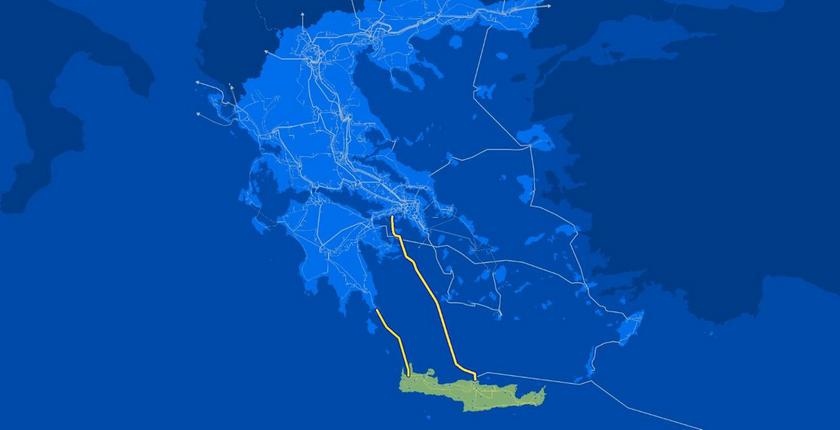
Combined with the existing interconnection via the Peloponnese peninsula, the new cable has completely ended Crete’s electrical isolation, making it an energy hub with significant environmental and economic benefits for the country and the local community, according to IPTO.

The first power link between Crete and the mainland is the 174-kilometer alternating current (AC) cable linking the island with the Peloponnese. It was completed in 2021, following an investment of EUR 380 million.

The EUR 1.1 billion Ariadne interconnector is among the deepest in the world

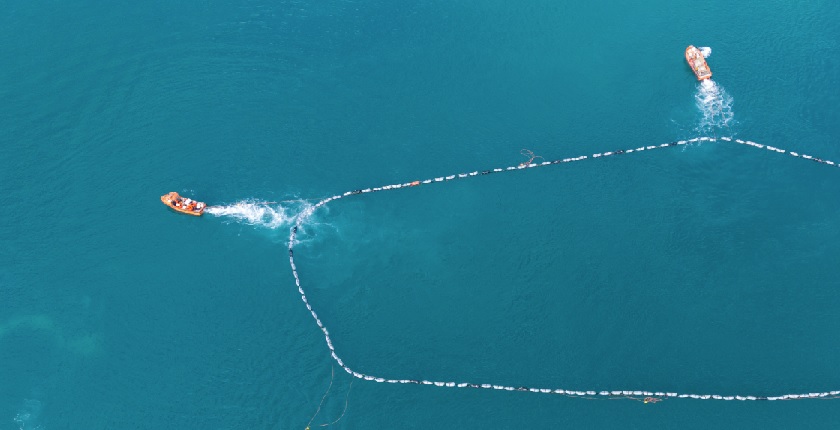
The Ariadne interconnector, which cost over EUR 1.1 billion to build, is one of the deepest subsea power cables in the world. It consists of two 500 kV cables of 500 MW each, laid at depths of up to 1,200 meters. The construction lasted 4.5 years.

Greek Minister of Environment and Energy Stavros Papastavrou stated that the new power link has made Crete a “central pillar in the country’s energy transition,” and IPTO CEO Manos Manousakis claimed it is opening “a new chapter for the island’s energy security.”

The project was co-financed through the National Strategic Reference Framework (NSRF 2014-2020 and NSRF 2021-2027), via the European Union, with up to EUR 535.5 million.

IPTO recalled that the project consisted of many large subprojects, with contractors including Siemens, Terna, Nexans, Prysmian, NKT, and Hellenic Cables.

by in News

Negative prices threaten future payments to Greek renewable energy producers

Greece’s special account for renewables, which covers support payments to renewable energy producers, turned positive again in 2024 after years of instability.

The account is currently manageable, according to data from the Renewable Energy Sources Operator & Guarantees of Origin (DAPEEP). The update is bringing certainty to the market and reassures investors that their power plants won’t come up short.

For the end of 2025, initial projections show a deficit of EUR 173 million, which would be covered by a EUR 70 million reserve and proceeds from the taxation of diesel sales.

Lower wholesale prices reduce income

However, DAPEEP’s leadership is concerned about the future balance. The reason is the effect of zero or negative wholesale power prices as they are becoming more common than before.

In the trading session for May 1 on the day-ahead market of the Hellenic Energy Exchange (HEnEx), a record low hourly price was registered, EUR 50 per MWh below zero. The event occurred amid high solar production in combination with low demand on a holiday, and similar conditions in neighboring markets. The authorities are expected to allow the formation of negative prices in the balancing market, starting in June. It is expected to lead to more common zero and negative prices.

Low market prices harm the special renewables account, according to DAPEEP’s new CEO Dimosthenis Voivontas. Consumers benefit in such situations but they reduce income for the operator.

So far, the exact effect of negative prices remains to be seen, as there is limited data to analyze. Nevertheless, energy storage must be brought online quickly, together with demand response capabilities, says Viovontas.

Producers switch off to avoid negative prices

Negative hourly prices have led producers to switch off their renewable energy plants lately in order to avoid a financial loss. It is making it more difficult for the Independent Power Transmission Operator (IPTO or ADMIE) to conduct daily scheduling. The authorities are worried that a sudden disconnection of large capacities could result in instability, in light of the recent blackout in Spain and Portugal.

The focus is on aggregators, which represent groups of renewable electricity facilities in the market. Currently they lack the means to completely control their production in real time. Discussions are underway about a mutually acceptable solution.

by in News

Second HVDC link from mainland Greece to Crete coming online

Greece’s Independent Power Transmission Operator (IPTO) is completing the last elements of the Ariadne Interconnection project, one of the deepest subsea links in the world. The company plans to switch on the double high-voltage direct current (HVDC) cable between Attica and Crete by the end of the month. In addition, IPTO and its Italian counterpart Terna are developing a project for a second interconnector between them.

Final tests and equipment checks are being completed at the Damasta Converter Station in Heraklion ahead of the start of the trial operation of the Crete-Attica electricity link. The management of IPTO, also known by its Greek acronym Admie, and the HDVC Ariadne Interconnection project firm inspected the site.

The transmission system operator said it plans to energize it this week by injecting reactive power into the electricity system in the country’s biggest island.

The transmission of active power from Attica to Crete is set to begin in late May, the update adds. Ariadne consists of two 500 kV cables of  500 MW each. One end is in Pachi in the city of Megara, between Athens and Corinth, and the other one in Korakia in Crete. The submarine and underground cables were tested earlier.

Line on mainland is under trial electrification

At the same time, on the Attica side, a trial electrification of a 400 kV cable system is taking place between the Koumoundouros Converter Station and the adjacent Extra High Voltage Center. Ariadne Interconnection is the largest and most complex electricity transmission project in Greece so far, IPTO underscored.

Furthermore, a 150 kV transmission line between Chania and Damasta recently received the decision on the approval of environmental conditions (AEPO), the company added. It is considered necessary for an optimal combined use of Crete’s two interconnections with the mainland, the announcement reads. The first one, from Peloponnese, was established in 2021.

Ariadne, worth more than EUR 1.1 billion, is one of the three deepest interconnections in the world. The HVDC line’s capacity matches the interconnector to Sardinia, the strongest power link so far with an island.

The project is co-financed through the National Strategic Reference Framework (NSRF 2014-2020 and NSRF 2021-2027), via the European Union, with up to EUR 535.5 million. The idea for the endeavor dates back to the 1990s.

The contractors are Nexans and Prysmian. Each was responsible for one of the two cables while the latter also laid two submarine telecommunication lines.

Erdoğan again taunts Great Sea Interconnector by promising alternative cable

Ariadne is part of a proposed corridor with the Great Sea Interconnector project, formerly EuroAsia Interconnector, envisaged going to Cyprus and Israel. The Crete-Cyprus investment has been suffering heavy delays amid financing issues, ownership disputes and Turkey’s threats.

In early May, President Recep Tayyip Erdoğan visited the Cypriot Turkish breakaway republic, recognized only by Turkey, and promised an interconnection with his country. He compared it to an existing water pipeline.

“Did we bring water from under the sea to Northern Cyprus from Turkey? Now we are in the second stage. God willing, we will bring electricity and with that we will cover the needs of Northern Cyprus in water and electricity,” Erdoğan stated.

Notably, IPTO denied yesterday a press report that it is considering the possibility, together with Nexans, the contractor, to alter the route and connect Crete with the Dodecanese Islands instead of with Cyprus. The archipelago includes Rhodes, Astypalaia (Astypalea), Kos and Tilos.

EBRD is providing a grant for the first studies for an interconnection between Greece and Egypt

In other news, the European Bank for Reconstruction and Development (EBRD) and Elica Interconnector, a member of the Copelouzos Group, signed a grant agreement for the first studies for the planned Egypt-Greece (GREGY) electricity interconnection.

IPTO and its Italian counterpart Terna signed today a memorandum of understanding to install a second undersea HDVC power line. The GR.ITA 2 project is for a double cable, two times 500 MW, scheduled for completion in 2031. The two sides earmarked a total of EUR 1.9 billion.

The existing 500 MW interconnector, in operation since 2002, is temporarily down due to a malfunction.

by in News

Cypriot minister not optimistic about cable project with Greece amid Turkish intimidation

Cypriot Minister of Finance Makis Keravnos said the Great Sea Interconnector (GSI) project still faces very serious political obstacles. He highlighted the pressure from Turkey, alongside the financing disputes with Greece regarding the EU-backed bilateral investment to lay an undersea electricity cable that would connect the two countries.

Following a second incident this month when Turkish navy intimidated ships researching the seabed, Minister of Finance of Cyprus Makis Keravnos expressed doubt in the feasibility of the Great Sea Interconnector (GSI). It is a project to connect his country’s electricity system with Greece’s through Crete, by laying a cable under the sea.

“I can’t say I’m optimistic, especially when there are still very serious political obstacles, namely those posed by Turkey,” the official said, as quoted by domestic media. Namely, Turkish corvette TCG Bartın has approached Ievoli Relume and NG Worker, Italian vessels conducting research for the interconnection, in international waters just north of Crete.

GSI investment concerns now have to be addressed

Nevertheless, a recent due diligence study by a hired foreign consultancy showed the draft bilateral deal heavily favors Greece’s Independent Power Transmission Operator (IPTO or, in Greek, Admie). The authors warned of an “unnecessary additional layer of risks for any equity investors in GSI.”

Keravnos said the document confirms his concerns and that they must be discussed. While the two sides are working to overcome their financing dispute, the project is suffering delays, increasing the risk of cancellation.

Keravnos said in October that the total cost could well surpass EUR 2 billion. The Crete-Cyprus part is substantially leaning on funding from the European Union. The idea was to later extend the interconnector to Israel.

Turkey has been obstructing both GSI surveys and hydrocarbon exploration around Cyprus. There were several incidents involving gunboats.

Cyprus craves interconnections, flexibility sollutions

Meanwhile, Cyprus is struggling to maintain the stability of its isolated electricity system. Oil-fired power plants are increasingly working near their upper limits in peak hours. Conversely, storage capacities, flexibility systems and digital controls are needed for mitigating the pressure on the grid at times of weather-induced jumps in the production of wind and solar power, but also sharp drops.

It is the only noninterconnected country in the European Union. Moreover, Cyprus has no access to natural gas yet.

GSI was formerly known as EuroAsia Interconnector.

  • 1
  • 2