by in News

Montenegro Achieves Regulatory Milestone: Full Alignment with EU Electricity Integration Package

In a significant leap toward European energy integration, Montenegro has officially completed the transposition of the European Union’s Electricity Integration Package (EIP). According to the Energy Community Secretariat, this regulatory alignment positions Montenegro alongside Moldova and Serbia as frontrunners in the Western Balkans’ effort to merge with the European single electricity market.

The move is designed to catalyze Montenegro’s energy transition by enhancing market competitiveness and ensuring the country can participate in regional power exchanges even before formal EU accession.

The Gateway to Market Coupling: SDAC and SIDC

The primary objective of transposing the EIP is to enable Market Coupling. By harmonizing its domestic laws with EU standards, Montenegro is preparing to join two critical pillars of the European energy infrastructure:

  • Single Day-Ahead Coupling (SDAC): A mechanism that optimizes electricity prices and cross-border flows across Europe for the following day.

  • Single Intraday Coupling (SIDC): A continuous trading environment that allows market participants to adjust their positions as close to real-time as possible.

This integration is expected to lower costs for consumers, provide clearer signals for renewable energy investors, and significantly bolster the security of the national supply.

The Legislative Roadmap

The finalization of this process occurred on February 15, 2026, when the Montenegrin government adopted two pivotal decrees governing:

  1. System Operation: Establishing technical rules for grid stability.

  2. Emergency and Restoration: Outlining protocols for grid recovery during unforeseen outages.

These decrees complement existing legislation, including the Law on Energy and the Law on Cross-Border Exchanges in Electricity and Natural Gas. Together, these legal frameworks form the “four pillars” identified by the Secretariat as essential for a cost-efficient clean energy transition:

  • Clear investment signals.

  • Strengthened regional cooperation.

  • Reinforced fair competition.

  • Enhanced security of supply.

The Path to Verification

While the legislative work is complete, Montenegro now enters the Verification Phase. This process involves a rigorous audit by the Energy Community Secretariat and the European Commission to ensure that the laws on paper translate into functional market practices.

Country Status of EIP Transposition Verification Phase
Serbia Completed In Progress (Started Oct 2025)
Moldova Completed Initiating
Montenegro Completed Pending Request
North Macedonia Partial Pending Legislation

“Montenegro is now stepping up efforts to submit a formal request initiating the verification process,” the Secretariat noted, echoing recent sentiments from Director Artur Lorkowski regarding the rapid progress of the “Vienna Group” of energy reformers.

Expert Analysis: What This Means for the Region

For a small economy like Montenegro, market coupling is a “force multiplier.” By removing the barriers to cross-border electricity trade, the country can better manage the intermittency of new wind and solar projects. This regulatory bridge to the EU not only modernizes the grid but also makes Montenegro a more attractive destination for “green” capital, as energy produced domestically can now be more easily sold into the massive European market.

by in News

MEMO Analysis Links Solar Output to Lower Day-Ahead Power Prices in North Macedonia

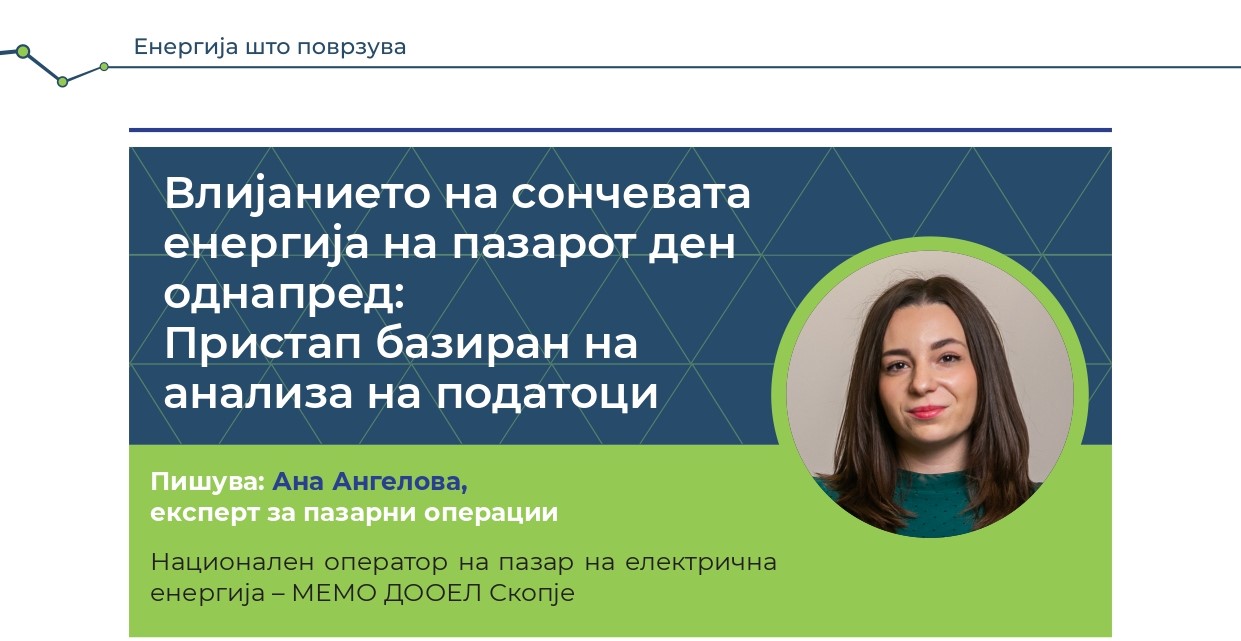
Electricity generation from solar power plants tends to push prices down on the power exchange, while reduced solar output is associated with price increases, according to an analysis by Ana Angelova, a market operations specialist at the National Electricity Market Operator (MEMO).

The analysis aimed to identify seasonal trends and highlight the relationship between photovoltaic (PV) generation, electricity consumption, traded volumes, and day-ahead prices on the North Macedonian power exchange. MEMO noted that the day-ahead market operates in an isolated mode.

Angelova used official power exchange data for 2024, focusing on hours when PV plant efficiency exceeded 30%.

Consumption remains broadly stable across the year

The findings point to a clear seasonal pattern. Electricity consumption stays relatively steady throughout the year, with only minor declines during spring and summer. PV generation, however, shows a pronounced seasonal swing—peaking in summer and reaching its lowest levels in winter.

Angelova also stressed that higher PV output coincides with increased traded volumes on the day-ahead market.

Prices bottom out in April, rise toward winter

According to the analysis, day-ahead prices are lowest in April, a period linked to milder weather, lower demand, and stronger solar production. From summer onward—and particularly during winter—prices trend higher, peaking in November.

The November price peak aligns with a combination of weak PV generation and higher consumption.

“Increased electricity generation from photovoltaic plants is associated with lower prices, while low generation leads to higher market prices, emphasizing the impact of renewable energy availability on price formation. The trend indicates that energy policies should focus on addressing weaknesses during the winter period and harnessing the potential of solar energy in summer,” Angelova wrote.

Proposed measures to strengthen renewables integration

north macedonia solar analysis memo power exchange ana angelova

Photo: MEMO

Angelova outlined several options to improve the integration of renewables—especially solar—into the power system. The proposed mechanisms include:

  • Flexible market mechanisms: introduction of a 15-minute trading interval, creation of an intraday market, dynamic tariffs, and guarantees of origin.

  • Energy storage technologies: battery energy storage systems (BESS) and pumped-storage hydropower plants.

  • Alignment with the European energy framework: adoption of ENTSO-E grid codes, coupling with the single European electricity market, deployment of smart meters, and use of financial instruments such as contracts for difference (CfD) and power purchase agreements (PPA).

by in News

EPS to help SEEPEX strengthen Serbia’s intraday power market

Serbia’s power exchange, SEEPEX, has reached an agreement with state-owned utility Elektroprivreda Srbije to work together on strengthening the intraday electricity market.

SEEPEX is proud to announce the signing of a strategic agreement with Elektroprivreda Srbije (EPS), Serbia’s largest power utility company, aimed specifically at securing its support for the organized intraday continuous (IDC) electricity market, the power exchange said.

SEEPEX is part of ADEX, which was established in 2022 through a corporate merger between Slovenian energy exchange BSP SouthPool and its Serbian counterpart. In December 2024, ADEX Group completed a merger with the Hungarian Power Exchange (HUPX).

The agreement between SEEPEX and EPS marks an important step forward in strengthening SEEPEX’s organized IDC electricity market, which will also help improve the integration of renewable energy sources, according to the update.

EPS will actively support and participate in the SEEPEX IDC market

Through this partnership, EPS will actively support and participate in the SEEPEX IDC market, enhancing its liquidity and encouraging engagement from all 32 IDC members.

“We believe this collaboration will position the SEEPEX IDC market as a trusted and dynamic platform for electricity trading across the region and beyond,” SEEPEX stressed.

SEEPEX launched the intraday market in July 2023

The contract aims to secure daily offers from EPS to encourage other participants to access the market and start trading, Balkan Green Energy News has learned.

In October 2023, SEEPEX signed a market-maker agreement with EPS for the intraday continuous market.

SEEPEX launched the intraday market in July 2023, with 16 out of 20 registered participants active on the first trading day. The participants came from Serbia, neighboring countries, and the European Union. The SEEPEX intraday market now has 32 participants.

With the launch of the IDC market, SEEPEX became the first organized market in the region to fully implement all aspects of an organized market, according to company’s CEO Miloš Mladenović.

by in News

Serbia eyes last quarter of 2027 for power market coupling with EU – SEEPEX CEO

Serbia is targeting the last quarter of 2027 for coupling with the European Union’s single day-ahead market, Serbian power exchange SEEPEX’s Managing Director Miloš Mladenović said.

Miloš Mladenović was one of the speakers at the Energy Connectivity, Resilience and Security in Southeastern Europe panel at the 14th International Forum on Energy for Sustainable Development in Skopje.

He recalled that a few weeks ago, the European Commission finally published the governance for the verification process regarding the transposition of the Electricity Integration Package (EIP) for market coupling by the contracting parties of the Energy Community.

SEEPEX would try to reduce the required time

Also, he added, it would took up to six months starting from the new year to implement the Market Coupling Operator Integration Plan (MCO IP).

“I think that in the middle of next year, we can start with this famous 18 months, which is regular time to implement the single day-ahead coupling (SDAC),” Mladenović stressed.

He underlined that within the extended ADEX family, with EPEX Spot and the transmission system operators (TSOs), which are shareholders, they would try to reduce the required time at the market coupling steering committee.

“Our common goal now is to try to catch this time slot, the last quarter of 2027,” he stated.

Mladenović noted that it is usual to use the first quarter of a year for the single day-ahead coupling (SDAC), and the last quarter for single intraday coupling (SIDC).

SEEPEX plans to proceed with intraday coupling with Hungary

“I hope that we would have understanding within the nominated electricity market operators (NEMOs) and the TSOs community to catch this thing and to have this last quarter of 2027 as a time slot for SDAC coupling,” he explained.

After that, SEEPEX plans, in his words, to proceed with intraday coupling with Hungary.

He pointed out that a few days ago, SEEPEX received positive feedback from the Italian Border Working Table (IBWT) regarding its initiative to couple Serbia with Bulgaria.

Now the request will be provided to national regulators for a confirmation letter, he added.

“I hope that for all other neighboring contracting parties of the Energy Community, the Serbia-Hungary coupling could be a vehicle to speed up the process,” Mladenović asserted.

European Commission to allow acceleration of market coupling

Mladenović also highlighted the experience Serbia had with the legal and regulatory side of the coupling process. “I will put business and technical parts aside, because I’m sure that my colleagues, both the power exchanges and the TSOs, are ready to implement all that is needed for the coupling,” he added.

The legal and regulatory process is, in his words, very demanding, because there are 10 grid codes to be transposed to align all the rules with the country’s market rules, with the transmission codes and with the legal framework.

He expressed doubt that the neighboring countries could achieve such speed.

“It could be some joint request to the European Commission to try to make coupling processes parallel. We insisted on this from the beginning. I hope that our colleagues from the region will get the green light to implement the project even before the legal and regulatory framework are in place,” Mladenović stressed.

He said he believes that the Serbia-Hungary coupling and the future Serbia-Bulgaria coupling could be a shiny start, leading soon to the entire region’s coupling with the EU internal market.

by in News

Romanian bourse BRM joins power auctions within European Single Intraday Coupling

The Romanian Commodities Exchange – Bursa Română de Mărfuri (BRM), the country’s second nominated electricity market operator (NEMO), has joined intraday auctions (IDAs) under the European Single Intraday Coupling (SIDC) framework. With this move, BRM becomes part of the operational IDA system, launched across Europe in June 2024, according to a press release from European power exchange EPEX Spot.

Other partners involved in the Regional Integration Project (RIP) are the Hungarian Power Exchange (HUPX), the Independent Bulgarian Energy Exchange (IBEX), the Romanian Electricity and Gas Market Operator (OPCOM), Bulgaria’s Electricity System Operator (ESO), Hungary’s Independent Transmission Operator Company (MAVIR), and Romanian transmission system operator Transelectrica, said EPEX Spot.

BRM’s integration marks the second wave of the European IDA rollout, which began on June 13, 2024, when NEMOs and transmission system operators (TSOs) introduced the pricing of intraday cross-zonal capacity through three pan-European auctions, it added.

It is another key milestone in enhancing Europe’s single power market

By integrating BRM, the SIDC framework has reached another important milestone, increasing the efficiency of the single European electricity market, EPEX Spot said. The market has become more liquid and increasingly competitive, in line with its core objectives of ensuring efficient, fair, and non-discriminatory functioning.

Future waves of the IDA rollout will expand its geographic scope

The European power exchange added that future waves of the IDA rollout would continue to expand its geographic coverage and product scope, further enhancing the EU’s internal electricity market.

The SIDC is a market mechanism within the intraday timeframe based on continuous trading and complemented by three intraday auctions, or IDAs. It enables market participants to trade electricity continuously across Europe on the day it is needed. Additionally, IDAs enable pricing cross-border capacity within the intraday timeframe, according to the press release.