by in News

U.S. Energy Secretary Warns IEA: Prioritize Energy Security or Face U.S. Exit

Chris Wright urged the International Energy Agency to prioritize energy security over advocacy for the deployment of renewables, and warned that the United States could withdraw from the body if it does not change course. The remarks, delivered at a conference in Paris, accused the agency of acting like a “climate advocacy organization” and dismissed the value of a global net-zero scenario as unrealistic.

The intervention, which Politico reported as signalling growing tension between Washington and the IEA, frames a broader disagreement between the agency’s modelling of low-carbon transitions and the current U.S. administration’s pro-fossil-fuel orientation. Politico covered Wright’s comments and the administration’s stance.

Chris Wright

Chris Wright

Wright argued that when international data and analysis bodies devote resources to what he characterised as “leftist fantasies,” they risk undermining their core mission of delivering objective analysis for energy security and market stability. He warned that continued emphasis on net-zero scenarios could prompt a reevaluation of U.S. membership in the IEA.

Those remarks echo positions voiced by other senior U.S. officials. At the World Economic Forum in Davos, Howard Lutnick criticised European solar and wind deployment and questioned the desirability of pursuing net-zero policies, urging instead greater reliance on oil, gas and even coal. World Economic Forum meetings in Davos gathered these high-profile exchanges.

Observers note that the rhetoric follows a wider shift in U.S. climate and energy policy since the current administration’s decision to withdraw from the Paris climate accord earlier this year, a move that has intensified transatlantic debate over the pace and direction of the energy transition. Donald Trump has publicly criticised Europe’s renewables push and framed the U.S. approach as a deliberate return to fossil-fuel development.

The clash poses a practical challenge for the IEA, whose forward-looking scenarios and data are widely used by governments and markets. How the agency responds — whether by adjusting emphasis, defending its analytical frameworks, or engaging in political dialogue with member states — will shape its role in an era of sharply divergent energy strategies.
by in News

IEA: Employment in energy sector grows two times faster than in global economy

A new report from the International Energy Agency (IEA) shows that the rate of employment growth in the energy sector was two times higher in 2024 than in the overall global economy. On the other hand, the organization is warning of a serious shortage of skilled workers in key sectors. Renewable energy sources, especially solar power, and the broader process of electrification play a key role in the expansion.

The energy sector employed 76 million people last year, according to the IEA’s World Energy Employment 2025 report. Investments in energy infrastructure contributed to employment growth, which came in at 2.2%, nearly double the global 1.3% rate.

The shift toward electrification is significantly transforming the structure of the workforce. It has led to the electricity sector surpassing the fuel supply sector in employment for the first time.

The number of people working in electricity generation, transmission, distribution, and storage has increased by 3.9 million over the previous five years, reaching 22.6 million—representing nearly three-quarters of all new jobs created in the energy sector.

Renewable energy sources, particularly solar power, are the strongest drivers of job creation. Solar alone accounts for 50% of all new power sector jobs since 2019. Last year, solar employment grew by 310,000, almost half of global power generation job growth. The total number of solar jobs is estimated at five million.

Nuclear power, grid expansion, and energy storage collectively accounted for one quarter of new energy sector jobs since 2019, despite challenges such as rising component costs and shortages of skilled labor, the report notes.

Wind sector stagnates

Employment in the wind sector grew by 3% in 2024, reaching 1.7 million jobs, compared to a compound annual growth rate of 5% over the previous five years. Rising procurement costs and declining government subsidies have slowed project development and delayed new investments, according to the latest data.

The slowdown is most visible in manufacturing, where employment fell by 6% due to reduced demand for new turbines and components as projects were delayed or cancelled.

Investors in offshore wind have significantly scaled back investment plans in response to rising project costs. Europe recorded the largest decline in offshore wind employment last year, with a 4% drop.

The automotive sector also recorded solid growth last year, driven by an increase in jobs related to electric vehicles (EVs) and batteries.

Oil and gas employment returns to 2020 levels

Employment in coal supply has fallen by 20% in advanced economies since 2019, but due to expansion in India, China, and Indonesia, global coal employment increased by 8%.

The report also notes that the number of workers in the oil and gas supply has returned to 2020 levels. “However, it now appears that many firms are entering a new period of retrenchment in the face of lower oil prices and revenues, with a number of major oil companies announcing job cuts in 2025,” the report states.

Shortage of skilled labour deepens

Despite job growth, the report highlights an acute shortage of skilled labour. Applied technical occupations—including electricians, pipefitters, lineworkers, plant operators, and nuclear engineers—are in particularly short supply.

In the IEA’s Energy Employment Survey, 60% of companies reported labour shortages. This bottleneck threatens countries’ ability to maintain energy security, expand grids, scale clean energy manufacturing, refurbish nuclear power plants, and attract investments.

The number of graduates with energy-relevant training is not keeping pace with rising demand. According to the report, to prevent further skill misalignment by 2030, the number of graduates entering the energy sector would need to increase globally by around 40%. Expanding training capacity to this level would cost an estimated USD 2.6 billion annually.

Limited impact of artificial intelligence

Companies are increasingly turning to workers from related industries and reskilling programs to fill labour gaps. Although 50% of surveyed fossil fuel workers said they would remain in the energy sector if alternative employment existed, not all workers have equal opportunities for retraining.

The report also examines the role of artificial intelligence. While AI brings benefits, its impact remains limited, as it cannot reduce the demand for manual technical labour—precisely the occupations in shortest supply.

Policy interventions can significantly influence the ability to attract new workers into the energy sector. According to the IEA, the biggest barriers to entering training programs include high costs, income loss during training, and limited awareness of available programs. Effective measures include targeted financial incentives, expanded vocational programs, greater industry involvement in curriculum development, and investments in training centres, while reskilling within the sector remains essential.

Working conditions also play an important role. Pay, job security, and a safe work environment are the most important factors for workers, the report shows, and these issues are increasingly at the centre of social dialogue.

by in News

IEA on deep shifts in auto industry: Electric car sales soar, ICE models drop 30%

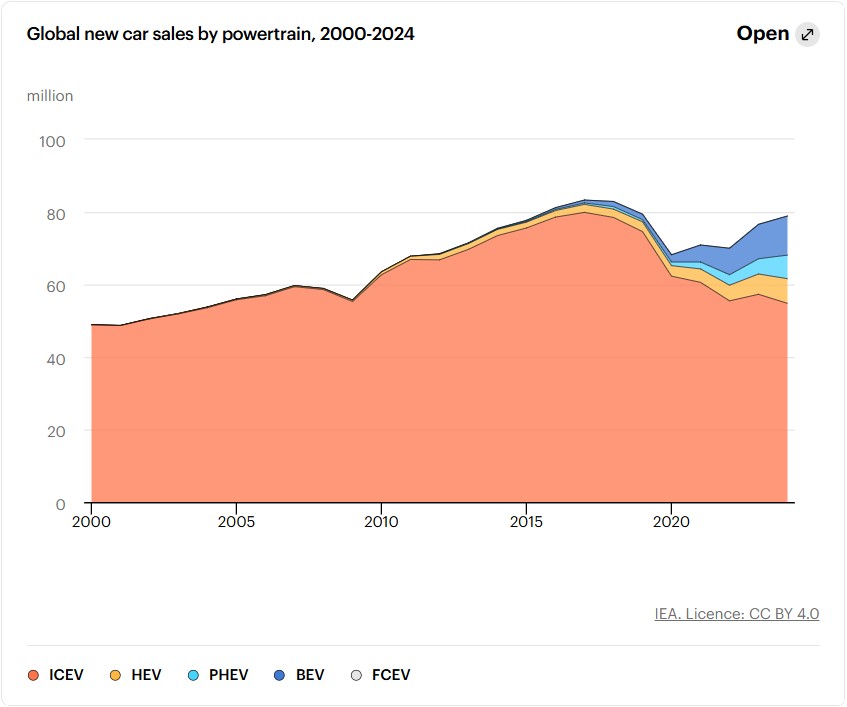
Global car sales growth is predominantly driven by sales of electric and hybrid cars. Sales of pure internal combustion engine cars peaked in 2017 and have since fallen by 30% while the sales of electric cars achieved a 14-fold increase, according to the latest report, called What Next for the Global Car Industry?

The International Energy Agency, which published the data, stressed that the car industry is experiencing deep changes as electric car sales continue to rise and the geography of global car sales shifts.

How the incumbent car industry responds to these shifts will be critical for its future and that of industries across the supply chain – and for the energy sector as a whole, IEA warned.

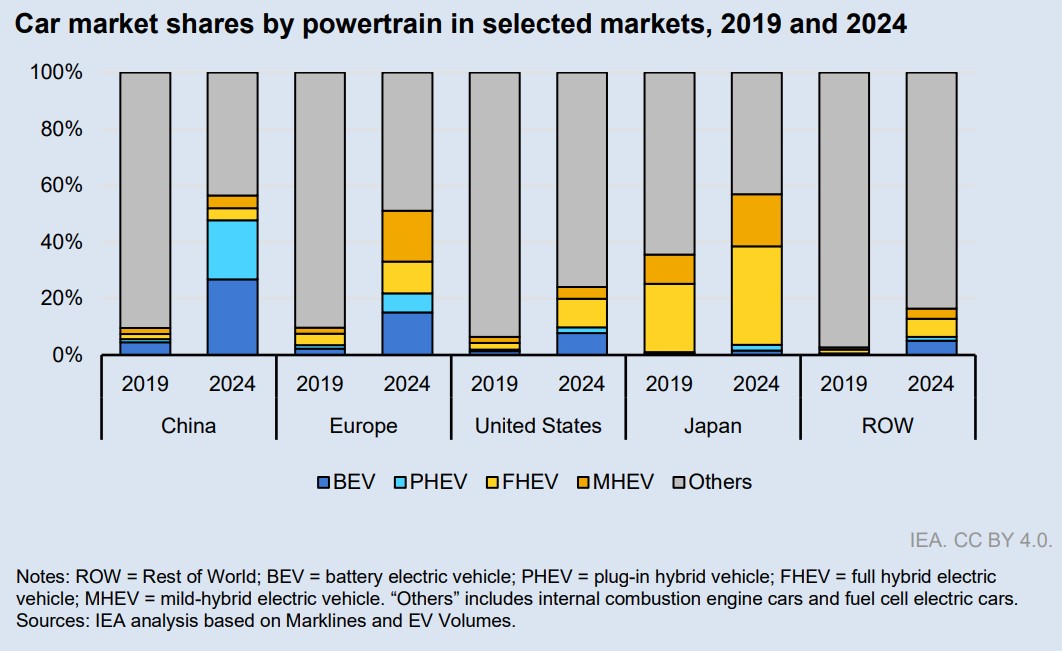
Global car sales reached 80 million in 2024, driven by electric and hybrid cars. They made up around 30% of the total.

world iea report auto industry car sales by fuel

Sales of pure internal combustion engine (ICE) cars peaked in 2017 and have since fallen by 30%. Electric car sales grew more than 14-fold over the same period, reaching over one fifth of cars sold globally in 2024, according to IEA’s data.

The second major shift is the geography of car markets. China and other emerging economies now account for over half of global car sales, up from just 20% in 2000, the report What Next for the Global Car Industry? reads.

world iea report auto industry car sales by fuel regions

China’s car production more than doubled between 2010 and 2024, while India’s output grew 25% from the 2017 level. China overtook the European Union to become the world’s largest exporter. China now accounts for 40% of total manufacturing capacity, and Europe and North America have a 15% share each.

What will he incumbent car industry do?

The response of the incumbent car industry is crucial, IEA underlined.

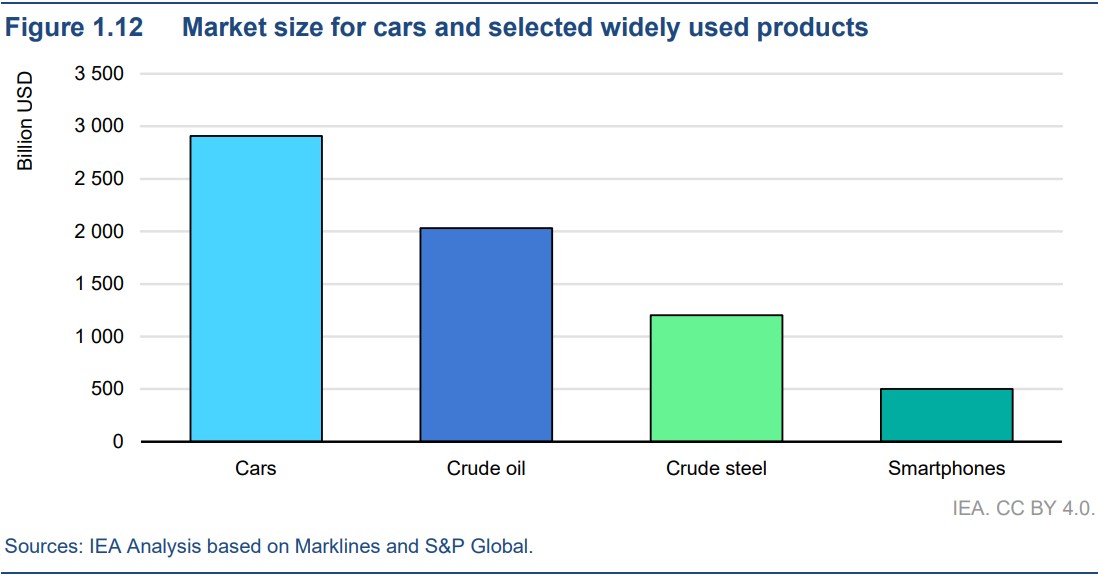
The agency added that passenger cars represent the single largest source of global oil demand today, with 25% of total consumption. The use of alternative fuels, notably biofuels, represents 5% of energy use from cars today.

The extent and pace by which cars electrify, however, is what will affect future car manufacturing as well as the energy sector the most, and it explains the focus of the report, IEA stressed.

world iea report auto industry car sales market

Even as ICE car sales are on a downward trend in China and advanced economies in aggregate, they are likely to rise in some regions, meaning carmakers must navigate multiple trends at once, the report reads.

For example, imports from China make up 90% of electric car sales in emerging markets today. New market entrants are capturing an increasingly large share of the electric car market.

Carmakers from China and US-based Tesla sold 45% of all electric cars in 2024, IEA underlined.

Batteries drive manufacturing costs

The report adds that battery costs remain the main factor for higher direct manufacturing costs of battery electric cars than ICE cars.

Producing cars in China is cheaper than in advanced economies, especially electric ones. Advanced economies include the EU, USA, Japan and South Korea.

Producing a small SUV in China is over 30% cheaper than in advanced economies for both ICE and battery electric powertrains.

Large-scale manufacturing operations and vertical integration are the key reasons behind China’s cost competitiveness; lower energy prices and labour costs also contribute, but to a lesser degree, the IEA concluded.

by in News

US electricity prices soar 40% in H1 2025, outpacing EU’s 30% increase

In the first half of 2025, wholesale electricity prices in the European Union were about 30% higher than in same period of 2024, while a 40% increase was recorded in the United States. The penetration of negative prices in the EU continues, with their share doubling in H1 2025, according to the latest report of the International Energy Agency.

Wholesale electricity prices in the EU averaged around USD 90 per MWh as costs were mostly underpinned by natural gas prices, which were on average about 20% above the levels from 2024, IEA’s Electricity Mid-Year Update 2025 reads.

Prices saw upward pressure from a boost in fossil-fired generation due to a year-on-year drop in electricity generation from wind and hydropower.

While average power prices remained below the 2023 levels, they were higher than in 2019, according to IEA. The latter is a reference year because it was the last one before turbulences started – the COVID-19 pandemic, energy crisis, and the war in Ukraine.

Electricity prices in the Nordics remained the lowest in Europe

Latest futures prices in the EU average USD 80 per MWh for 2026, indicating a decline of around 15% from 2025, the report underlines.

High gas prices also affected the electricity market in the US, combined with colder weather. Power prices averaged around USD 48 per MWh. However, the increase was from a low base, as prices in the first half of 2024 were the lowest for the first half of the year since 2020, the report notes.

Average electricity prices in the Nordics remained the lowest in Europe, falling by more than 20% year-over-year in the first six months of 2025 to about USD 40 per MWh. It was the result of an increase in wind power generation and higher hydropower output, according to the report.

The update brings details on Germany, France, Japan, India, Australia, and the United Kingdom as well.

Occurence of negative prices doubled

IEA notes that the frequency of negative wholesale prices is increasing in various markets, underscoring the need for greater flexibility in supply and demand. The authors of the report propose appropriate regulatory frameworks and market designs to boost greater demand response and energy storage.

The share of hours with negative prices on the wholesale market reached 8% to 9% in the first half of the year in countries such as Germany, the Netherlands, and Spain – up from between 4% and 5% in 2024, the report reads.

The average price this year in the EU is expected to be twice as high as in the US and about 50% higher than in China

Electricity prices for energy-intensive industries continued to vary significantly across regions. After declining since their 2022 peak, they are expected to rise year-on-year in 2025 in the EU, driven by higher wholesale price levels.

The average price this year in the EU is expected to be twice as high as in the US and about 50% higher than in China, according to IEA projections. By comparison, in 2019, prices in the EU were approximately 50% higher than in the United States and 20% higher than in China.

The cost differences continue to pose challenges for the competitiveness of energy-intensive industries in the EU, IEA stressed.

by in News

International Energy Agency – Official scenarios

International Energy Agency

Reference or baseline scenarios are not presented as business-as-usual or fixed outcomes, but typically are used for comparison, and present the theoretical case where no action is taken, which is not considered a politically realistic viewpoint. The IEA Reference scenario “takes into account all government policies and initiatives that had been adopted by mid-2004. It does not include policy initiatives that might be adopted in the future. Energy markets will probably evolve in different ways from those depicted in this scenario, because the policy landscape will change.”

Similarly the 2003 EU Energy scenario “takes into account existing policies and those in the process of being implemented at the end of 2001” and does not include the Renewables Directive and “additional policies to reduce greenhouse gas emissions”

The International Energy Agency (IEA) estimations in it’s Reference Scenario, presented in 2002 for wind energy was for 33 GW in 2010, 57 GW in 2020 and 71 GW in 2030.

In 2004, the IEA Reference Scenario projections were updated to 66GW in 2010, 131 GW in 2020 and 170 GW in 2030.

Within two years the IEA forecast for wind power installed in the EU for 2010 were doubled.

Advanced scenarios on wind energy

The IEA Advanced Scenario “considers those policies and measures that countries are currently considering or might reasonably be expected to adopt taking account of technical and cost factors, the political context and market barriers. The aim is to present a consistent picture of how global energy markets might evolve if governments decide to strengthen their environmental and energy-security policies.”

The IEA Advanced scenario projected a wind energy market of 75 GW in 2010, 145 GW in 2020 and 202 GW in 2030.